What to Know About Chemical Peels Recovery Before You Begin
Chemical peels recovery looks more dramatic than it feels — but knowing exactly what to expect makes the whole process far less intimidating.
Here is a quick overview of what recovery looks like by peel depth:
| Peel Type | Healing Time | Peeling Duration | Redness Duration |
|---|---|---|---|
| Light (superficial) | ~1 week | 2-4 days | 1-3 days |
| Medium | 7-14 days | 5-7 days | Up to 7-10 days |
| Deep | 14-21 days | 2-4 weeks | Months |
The general pattern for most patients:
- Days 1-2: Redness, tightness, and warmth — similar to a mild sunburn
- Days 3-5: Visible peeling and flaking, often starting around the mouth and chin
- Days 6-7: Fresh, pink skin begins to emerge
- Week 2+: Continued improvement, collagen rebuilding, and fading redness
Peeling is not a side effect. It is the process working exactly as intended.
My name is Ryan Pittillo, and as a Franchise Owner at ProMD Health Bel Air, I work alongside our clinical team to help patients feel fully informed about treatments like chemical peels recovery — from what to expect on day one through long-term results. This guide walks you through every stage so you can plan confidently and heal well.
Chemical peels recovery: what to expect right after treatment
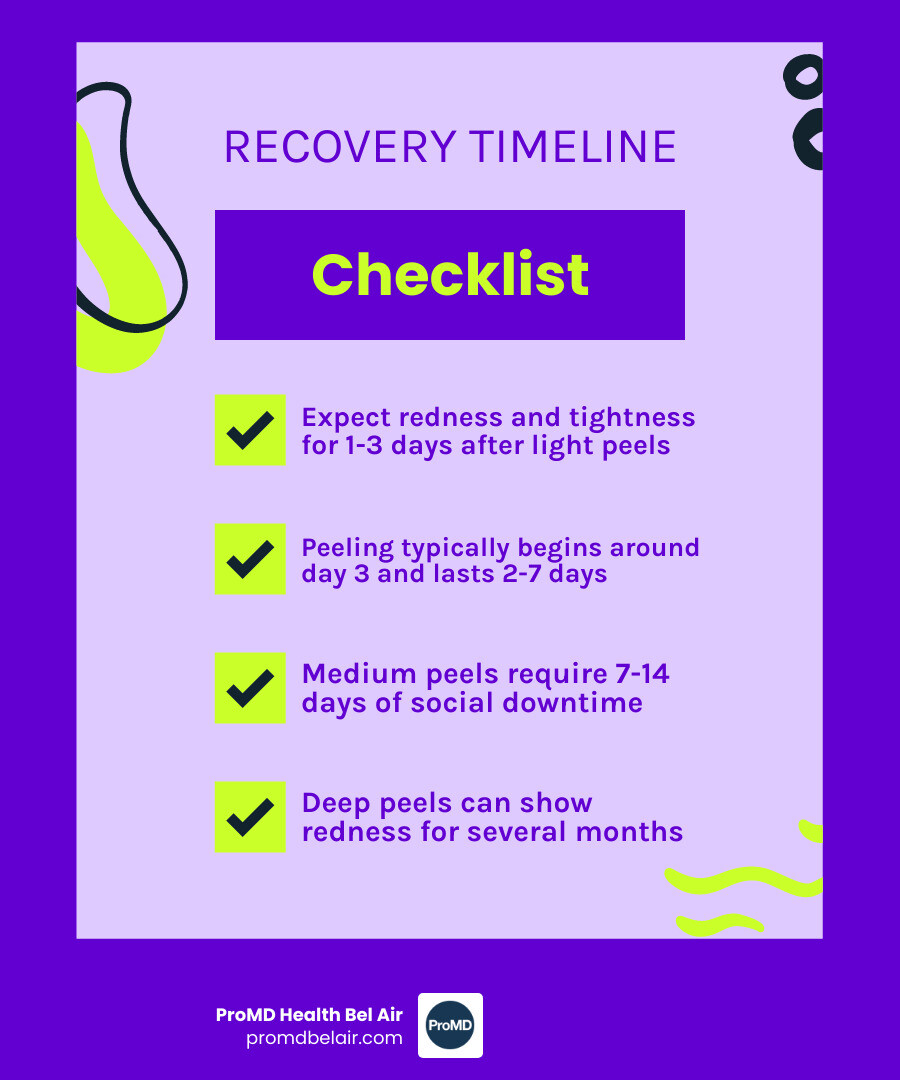
Right after a peel, most patients notice redness, warmth, tightness, and sensitivity. For lighter peels, this may feel like a mild sunburn. For medium or deeper peels, swelling and stronger redness are more common.
During the first 24 hours, normal reactions can include:
- Pink or red skin
- A tight, dry feeling
- Mild stinging or tingling
- Slight swelling
- Increased sensitivity to heat, sunlight, and skincare products
This is expected. A peel works by creating a controlled injury in the skin so fresh skin can replace damaged surface layers. In other words, your skin is renovating itself, and renovation is rarely glamorous on day one.
Chemical peels recovery timeline: days 1 to 3
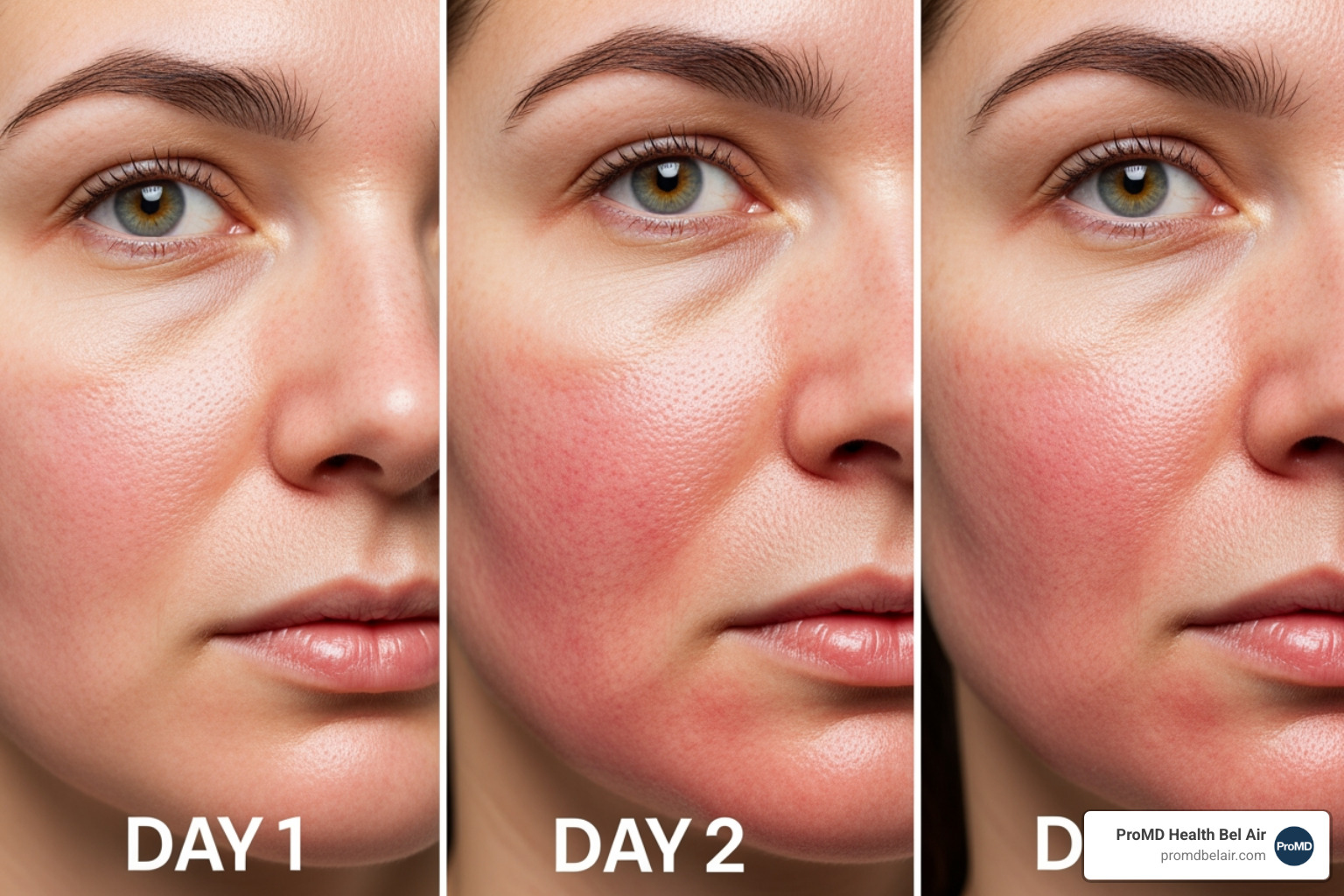
Days 1 to 3 are usually the “tight and shiny” phase.
You may notice:
- Pinkness or redness
- Dryness
- Mild swelling
- Light stinging
- Skin that feels firmer than usual
At this stage, less is more. Wash with cool or lukewarm water and a mild cleanser if your provider says to cleanse. Pat dry, never rub. Apply the recommended moisturizer or ointment to support the skin barrier.
Important rules for these early days:
- Do not pick or scratch
- Do not use scrubs, retinoids, acids, or vitamin C
- Do not take hot showers or use steam rooms
- Do not assume “more product” means faster healing
Chemical peels recovery timeline: days 3 to 7
This is when visible peeling usually begins. Research consistently shows that peeling often starts around day 3 and may continue for up to a week depending on peel depth.
Common patterns include:
- Flaking around the mouth first
- Peeling around the chin and nose
- Itching as dead skin separates
- Sheet-like peeling with stronger peels
- Fresh pink skin underneath
This phase tends to look worse than it feels. That is why many patients panic on day 3 and then realize later that everything was completely normal.
Keep doing the basics well:
- Use only approved gentle products
- Moisturize often
- Wear broad-spectrum SPF 30+ every day
- Avoid makeup if skin is actively peeling unless your provider says otherwise
- Never pull hanging skin

Week 2 and beyond: when skin looks normal again
By week 2, many light peels are essentially healed and many medium peels are close to social recovery. Skin often looks brighter, smoother, and more even. Texture continues to improve as the barrier normalizes.
A few important notes:
- Mild lingering pinkness is common after medium peels
- Deep peels may stop actively peeling after about two weeks, but redness can last for months
- Collagen remodeling continues after visible peeling ends
- Tone blending and full settling take longer than social downtime
So yes, you may look “better” at one week, but final improvement keeps building after that.
Light vs medium vs deep peels: how recovery changes by depth
Not all peels recover the same way. Depth matters more than almost anything else.
According to scientific information on chemical peel types and recovery and this medical overview of chemical peels, healing time, redness, peeling, and aftercare become more involved as peel depth increases.
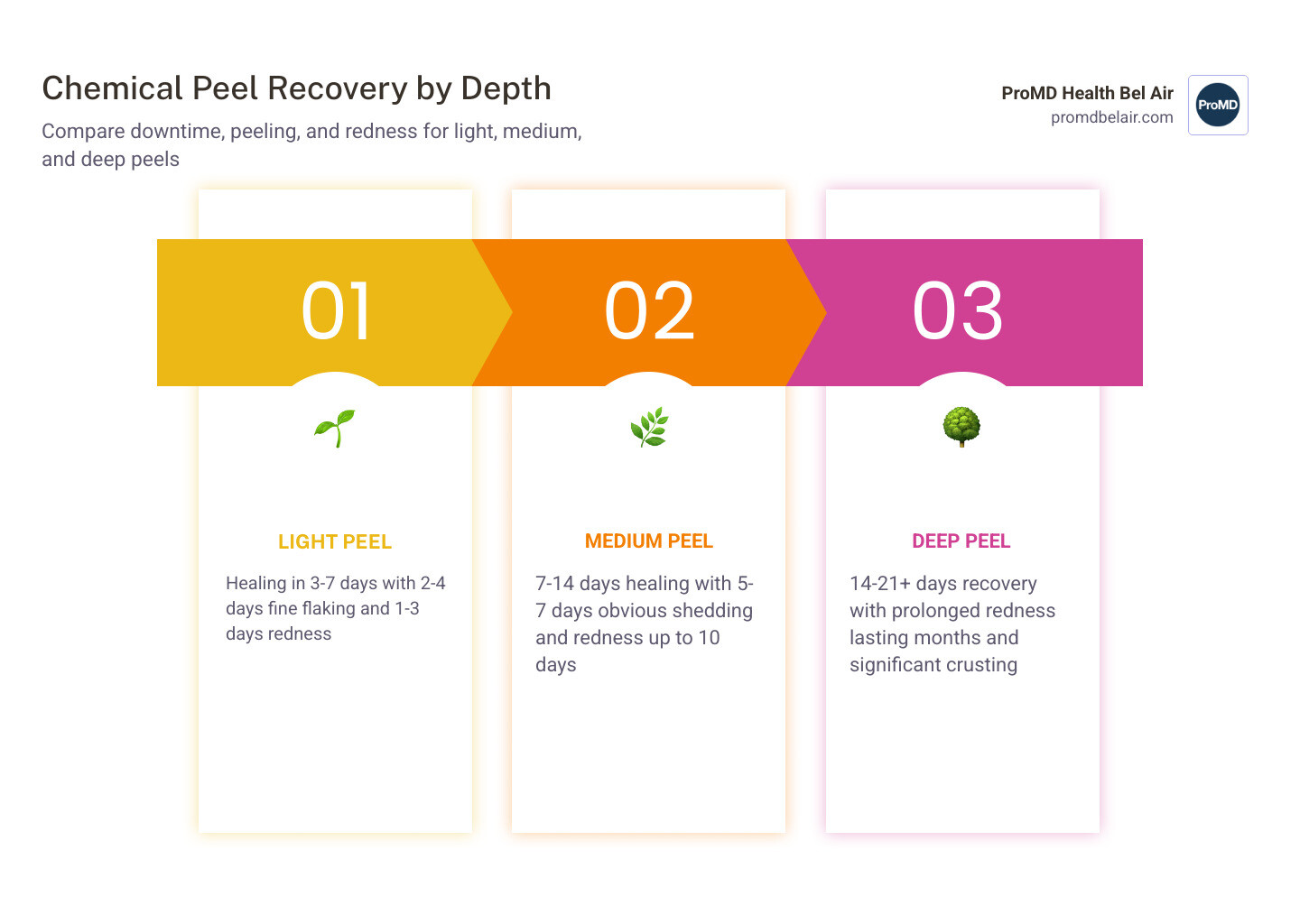
| Peel Depth | Typical Healing Time | Visible Peeling | Social Downtime | Exercise Limits | Redness Duration |
|---|---|---|---|---|---|
| Light | 3-7 days to about 1 week | 2-4 days, often fine flaking | Minimal | Usually brief | 1-3 days |
| Medium | 7-14 days | 5-7 days, more obvious shedding | Moderate | Avoid strenuous activity longer | Up to 7-10 days or more |
| Deep | 14-21 days or longer | 2-4 weeks with crusting or intense peeling | Significant | Strict restrictions | Can last for months |
Light peels: minimal downtime and quick flaking
Light or superficial peels usually involve mild acids and the shortest recovery. Many patients return to work quickly, especially if they do not mind a little dryness or flaking.
Typical recovery:
- Healing in about 1 week
- Redness for 1 to 3 days
- Peeling for 2 to 4 days
- Makeup often possible sooner than with deeper peels, depending on the skin’s condition
- Often performed as a series spaced every 4 to 6 weeks
These peels are popular when patients want brightening and texture improvement without a long social hiding period.
Medium peels: more visible peeling and longer sensitivity
Medium peels go deeper and usually produce more noticeable results, but they also require more patience.
Typical recovery:
- Healing in 7 to 14 days
- Visible shedding for 5 to 7 days
- Stronger redness and more sensitivity
- Swelling may occur, especially around delicate areas
- Makeup is usually delayed until peeling has largely stopped
If you have a wedding, reunion, or photo-heavy event, medium peels should be planned carefully. “A few days before” is not careful. “At least two weeks before” is much wiser.
Deep peels: longest recovery and months of redness
Deep peels are the most intensive and are less common. They require the longest recovery and close follow-up.
Typical recovery:
- Initial healing in 14 to 21 days
- Peeling and crusting may continue for 2 to 4 weeks
- Ointment-based wound care is often needed
- Redness may persist for months
- Usually treated as a one-time procedure rather than a frequent maintenance peel
Deep peels can create dramatic improvement, but they are not a casual lunch-break treatment.
The most important aftercare steps for the best results
Aftercare is what helps a good peel turn into a great result. At ProMD Health Bel Air, we want patients in Bel Air, Fallston, and Forest Hill to know that recovery is not the time to freestyle your skincare routine.
For more on our peel options, visit our peels page or explore our skin rejuvenation treatments.
Core aftercare priorities include:
- Gentle cleansing
- Fragrance-free moisturizing
- Barrier protection with provider-recommended ointment or petrolatum when appropriate
- Daily broad-spectrum SPF 30+
- Physical sun protection like hats and shade
- Careful adherence to your personalized instructions
- Good hydration and steady nutrition
How to adjust your skincare routine during recovery
During healing, your skincare routine should get very boring. That is a compliment.
A good temporary routine usually looks like this:
- Mild non-foaming cleanser
- Simple fragrance-free moisturizer
- Mineral sunscreen with zinc oxide or titanium dioxide
- Nothing else unless we tell you otherwise
Temporarily pause:
- Retinoids
- AHAs
- BHAs
- Vitamin C
- Scrubs
- Exfoliating brushes
- Acne spot treatments unless approved
Use lukewarm water, not hot. Pat dry with a clean towel. If skin feels tight, reapply moisturizer as directed.
If you are working on overall skin quality, our guides on improving skin texture and medical grade facials can help you build a smart plan once recovery is complete.
When you can wear makeup, work out, and go back to work
This depends on peel depth and how your skin is healing.
General timing guidelines:
- Light peel: many patients return to work quickly, sometimes within 24 to 48 hours
- Medium peel: work may be possible sooner than social comfort, but visible peeling often lasts about a week
- Deep peel: expect significant downtime
For makeup:
- Light peels may allow makeup after 24 to 48 hours if skin is intact
- Medium peels usually require waiting until peeling is mostly finished
- Deep peels require much more caution and provider clearance
For exercise:
- Light activity is often okay after 24 to 48 hours
- Wait 3 to 5 days or longer for strenuous exercise
- Avoid sweating, saunas, steam rooms, and hot yoga during active healing
For social events, be conservative. If you need to look polished, schedule a peel with buffer time rather than optimism.
Common mistakes that can delay healing
The biggest recovery mistakes are simple and very common:
- Picking or peeling loose skin
- Over-washing the face
- Restarting active products too early
- Taking hot showers
- Exercising too hard too soon
- Skipping sunscreen
- Going out in direct sun without a hat
- Using dirty makeup brushes or sponges
Picking is the classic mistake. It can increase the risk of irritation, pigment changes, and even scarring. Let the skin separate on its own, no matter how tempting that little flap may be.
Warning signs: when chemical peel recovery is not normal
Most side effects are expected and temporary. But some symptoms should prompt a call to your provider. This aftercare and recovery resource also supports the importance of close follow-up when symptoms seem excessive.
Contact your provider if you notice:
- Severe or worsening pain
- Pus or yellow drainage
- Fever
- Red streaking
- Rapidly worsening swelling
- Blistering
- A spreading rash
- Delayed healing that seems off-pattern
- Signs of infection
- A cold sore flare
- Darkening or lightening of the skin that is getting worse
Normal side effects vs possible complications
Usually normal:
- Redness
- Tightness
- Dryness
- Mild itching
- Flaking
- Temporary swelling
- Pink new skin
More concerning:
- Persistent burning that is intensifying
- Thick crusting with drainage
- Severe swelling beyond what your provider described
- Blisters
- Marked tenderness with heat
- Symptoms that worsen instead of gradually improving
Pigment changes and scarring are uncommon but real risks, especially if aftercare is poor or the wrong peel is used for the skin type.
Who may need closer follow-up after a peel
Some patients deserve extra caution and more personalized planning, including those with:
- Darker skin tones or a history of post-inflammatory hyperpigmentation
- Melasma
- Sensitive or reactive skin
- A history of herpes simplex or cold sores
- Recent use of retinoids or aggressive exfoliants
- Combination procedures
- Prior pigment irregularities after treatments
This is one reason professional guidance matters. A peel is never just a peel; it is a peel plus your skin history.
Planning your treatment series and combining peels with other procedures
Chemical peels often produce visible improvement after one treatment, but best results usually come from a series. Research supports spacing many peels about 4 to 6 weeks apart, depending on depth and goals.
If you are exploring alternatives or complementary treatments, you may also like our guides to facial resurfacing options and medical grade facials.
How many chemical peels are usually needed for best results
The answer depends on what we are treating.
Typical patterns:
- Light peels: often done in a series of 3 to 6 treatments
- Medium peels: fewer sessions, spaced further apart
- Deep peels: typically one-time treatments
- Maintenance peels: often every few months or quarterly once results are established
If the goal is acne, hyperpigmentation, or texture refinement, a series usually works better than expecting one peel to do everything.
Can chemical peels be combined with blepharoplasty or other resurfacing treatments?
Sometimes, yes, but timing matters.
Chemical peels may be combined or staged with other procedures such as:
- Blepharoplasty
- Laser resurfacing
- Microneedling
- Facials and other rejuvenation treatments
The key is provider clearance and careful sequencing. The skin around the eyes heals differently and may need a more conservative plan, especially if surgery such as blepharoplasty is involved. In some cases, periocular peeling may be done as part of a broader rejuvenation strategy, but it must be individualized.
If you are comparing resurfacing options, read more about CO2 laser resurfacing and face rejuvenation treatments.
How to schedule a peel before weddings, vacations, or big events
This part is simple: give yourself more time than you think you need.
Smart planning guidelines:
- Light peels: allow at least 1 week if you need to look polished
- Medium peels: allow at least 2 weeks
- Deep peels: plan far in advance
- Avoid scheduling right before beach vacations or heavy sun exposure
- Do not gamble on “maybe I will heal fast”
For weddings, photos, reunions, and vacations, conservative timing wins every time.
Frequently Asked Questions about Chemical peels recovery
- Light peels usually heal in about 1 week
- Medium peels often need 7 to 14 days
- Deep peels may need 14 to 21 days or longer, with redness lasting months
- Peeling often starts around day 3
- Sunscreen is non-negotiable during healing
- Picking peeling skin can trigger scarring and hyperpigmentation
- Most patients need a series of peels for best long-term results
How long do redness, peeling, and sensitivity usually last?
For light peels, redness often lasts 1 to 3 days and peeling about 2 to 4 days. For medium peels, redness can last up to 7 to 10 days or longer, with peeling commonly lasting 5 to 7 days. Deep peels may involve two weeks or more of peeling, and redness can linger for months.
Sensitivity is usually strongest in the first few days and gradually improves as the barrier recovers.
Is it normal if my skin looks worse before it looks better?
Yes. Mid-recovery often looks rougher than day 1. Sheet peeling, patchy flaking, and pink skin underneath are all common. This awkward middle stage is often a sign that the peel is doing what it is supposed to do.
Trust the process, and resist the urge to “help.”
What should I do if I accidentally pick peeling skin or get too much sun?
Do not panic, but do act quickly.
If you pick at skin:
- Stop manipulating the area
- Keep it moisturized
- Protect it from sun exposure
- Watch for increased redness or darkening
- Contact your provider if the area becomes raw or irritated
If you get too much sun:
- Get out of the sun immediately
- Apply your recommended moisturizer
- Use diligent SPF and physical sun protection afterward
- Contact your provider if redness, stinging, or pigment change increases
Conclusion
Chemical peels recovery is usually straightforward when you know what is normal, follow instructions carefully, and give your skin time to heal. Light peels often resolve within a week, medium peels usually take up to two weeks, and deep peels require much more patience and follow-up.
At ProMD Health Bel Air, we believe recovery should feel predictable, not stressful. That means clear expectations, personalized treatment planning, and guidance that fits your skin, your schedule, and your goals. We also offer tools like our AI Simulator to help patients preview personalized treatment outcomes and plan confidently.
If you are considering a peel in Bel Air, Fallston, or Forest Hill, or want to explore other rejuvenation options, visit our services page.