Do Thread Lifts Work? Here’s What You Need to Know Before Booking
Do thread lifts work? Yes — but with important caveats. They provide a real, measurable lift for the right candidate, but the results are subtle, temporary, and highly dependent on provider skill.
Quick answer for those short on time:
| Question | Short Answer |
|---|---|
| Do thread lifts produce visible results? | Yes, mild to moderate lifting is achievable |
| How long do results last? | Typically 1 to 3 years |
| Are they a facelift replacement? | No — results are subtle, not dramatic |
| What’s the biggest risk? | Asymmetry, dimpling, and short-lived results |
| Who is the best candidate? | Ages 35–55 with mild to moderate skin laxity |
| Are side effects serious? | Most are temporary and self-resolving |
Thread lifts have exploded in popularity on social media, where before-and-after videos make the procedure look like an effortless fix for sagging skin. The reality is more nuanced.
The procedure uses medical-grade threads — inserted under the skin with a thin cannula — to physically reposition tissue and trigger your body’s own collagen production. That dual action (mechanical lift plus biological stimulation) is genuinely useful. But it only works well when the right technique is applied to the right face.
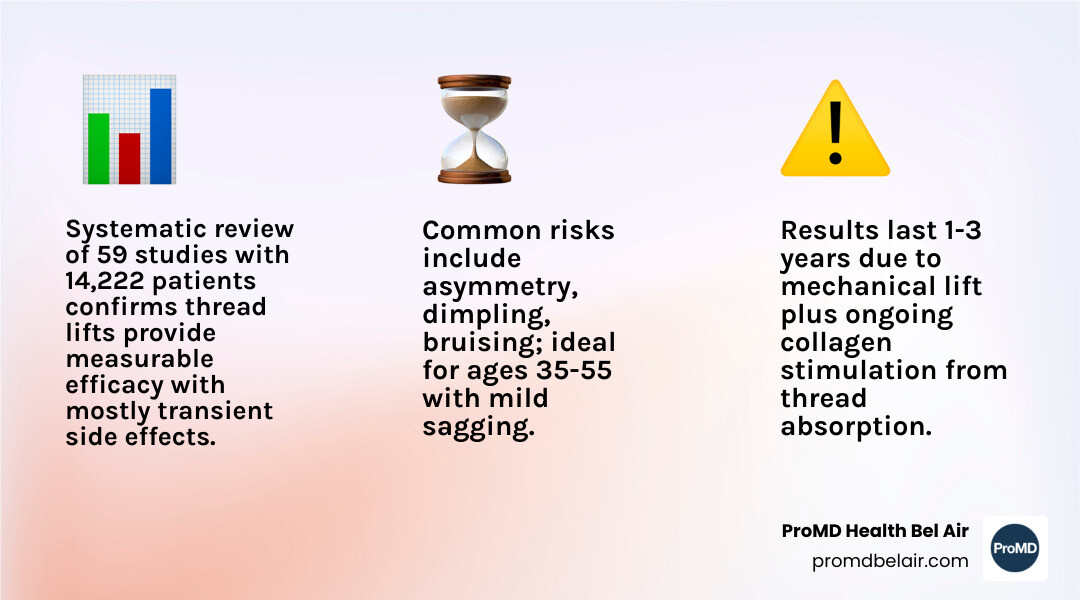
A systematic review of 59 studies covering 14,222 patients found that while most side effects were transient and self-resolving, complications like facial asymmetry, swelling, and bruising were common. And some critics point out that a portion of the “lift” seen in immediate photos is simply post-treatment swelling — not structural change.
This guide cuts through the hype. You’ll get a clear, honest look at what the science actually says, who benefits most, and what to realistically expect from modern bi-directional thread techniques.
My name is Ryan Pittillo, and as a Franchise Owner at ProMD Health Bel Air, I work alongside our clinical team to help patients in the Bel Air area make informed decisions about procedures like thread lifts — including understanding exactly when do thread lifts work and when another approach makes more sense. Our team is here to guide you through every option so your results match your goals.
Do thread lifts work terms to learn:
The Clinical Reality: Do Thread Lifts Work?
When patients ask us, “do thread lifts work?” they are usually comparing the procedure to a surgical facelift. It is vital to understand that while both aim to address sagging, they live in different worlds of clinical efficacy. A surgical facelift is the “gold standard” for dramatic, long-lasting rejuvenation, often costing $20,000 or more but lasting a decade. In contrast, a thread lift is a minimally invasive “middle-ground” option.
To help you visualize the differences, we use our AI Simulator at ProMD Health Bel Air. This technology allows you to preview personalized post-treatment results before we ever start the procedure, which is essential for managing expectations.
Comparison: Thread Lift vs. Surgical Facelift
| Feature | Thread Lift | Surgical Facelift |
|---|---|---|
| Invasiveness | Minimally invasive (Local anesthesia) | Invasive surgery (General anesthesia) |
| Downtime | 2–5 days | 2–4 weeks |
| Primary Action | Repositions skin & stimulates collagen | Repositions muscle & removes excess skin |
| Longevity | 1 to 3 years | 8 to 12 years |
| Ideal For | Mild to moderate sagging | Significant skin laxity |
Scientific data supports the efficacy of threads when used correctly. A Safety Profile of Thread Lifts on the Face and Neck: An Evidence-Based Systematic Review analyzed over 14,000 patients and confirmed that while threads provide a visible “refresh,” the results are most successful in patients who understand the Lifting Your Spirits And Your Skin With Thread Lifts philosophy—subtle, natural-looking enhancement rather than a total overhaul.
Do thread lifts work for jowls and jawlines?
One of the most common requests we see in Bel Air and Fallston is for “snatching” the jawline. The answer to “do thread lifts work for jowls?” is a resounding yes, provided the provider uses the right tools.
Barbed threads are specifically designed for tissue repositioning. These threads feature microscopic “hooks” that anchor into the subcutaneous fat, allowing the provider to physically pull the tissue upward toward the temples. This creates immediate mandibular definition and midface lifting. By using strategic vectoring, we can How To Snatch Your Jawline Back With Thread Lifts by effectively moving the “heavy” skin of the jowls back to where it sat years ago.
Who is the ideal candidate for threading?
Not everyone is a candidate for this procedure. At ProMD Health Bel Air, we find the “sweet spot” for thread lifts is generally:
- Age: 35 to 55 years old.
- Skin Condition: Mild to moderate sagging. If there is significant excess skin (redundancy), threads may cause “pleating” or folds rather than a smooth lift.
- Skin Density: You need enough skin thickness to hide the threads. If the skin is too thin, the threads may be palpable or visible.
- Health: Good overall health and realistic goals are a must.
If you are looking to Reclaim Your Jawline Whats The Best Non Surgical Jowls Lift, a consultation with our team—including experts like Amanda Pittillo, PA-C or Lauren Mason, PA-C—will determine if your anatomy is suited for the mechanical suspension threads provide.
Mechanics of the Lift: PDO and Bi-Directional Threads
The magic of a thread lift happens beneath the surface through a process called neocollagenesis. While there are different materials, the most common are Polydioxanone (PDO), Poly-L-Lactic Acid (PLLA), and Polycaprolactone (PCA).

When we perform a Thread Lift Procedure Complete Guide, we use bi-directional threads. These have barbs that point in two directions, meeting in the middle. This allows the thread to anchor firmly into the tissue at both ends, providing a more stable mechanical suspension than older, unidirectional designs.
According to The Ultimate Guide To Understanding Thread Lifts, the threads act as a “linear filler.” As the body detects the thread as a foreign object, it triggers a controlled healing response. This biostimulation surrounds the thread with new bundles of Type I and Type III collagen. Even after the thread itself dissolves, this new “scaffold” of collagen remains, keeping the skin firmer and more resilient.
Do thread lifts work as a permanent solution?
It is important to be honest: thread lifts are not permanent. Most modern threads are made of absorbable materials that the body naturally breaks down via hydrolysis within six to nine months.
However, the “lift” lasts longer than the thread itself. Because of that collagen scaffold we mentioned, many patients see their results persist for 12 to 24 months. To maintain the look, many of our Forest Hill and Bel Air patients opt for No Scalpel Big Results Non Surgical Ways To Lift And Tighten maintenance treatments every year or two.
Longevity and Results: What to Expect in 2026
As we look at the landscape of medical aesthetics in May 2026, the data on longevity has become much clearer. While the initial lifting effect of some PDO threads can fade slightly after the first 2–3 months as swelling goes down, the long-term biological benefits are significant.
A fascinating retrospective study of 100 patients showed that for those using threads as a “prophylactic” measure, the rejuvenation effect—measured as “youth value” (the difference between real and apparent age)—actually showed an increasing trend after the one-year mark. This suggests that threads can act as “artificial ligaments,” providing a permanent internal support system that slows down the progression of future sagging.
For those wondering The Lifespan Of Youth Pros And Cons Of Non Surgical Facelifts, the consensus is that while you may need repeat procedures, the cumulative rejuvenation is real. Patients who stay consistent often find they Say Goodbye To Sagging 3 Ways To Get A Facelift Without Surgery more effectively than those who wait until sagging is severe.
Safety Profile: Risks, Side Effects, and Recovery
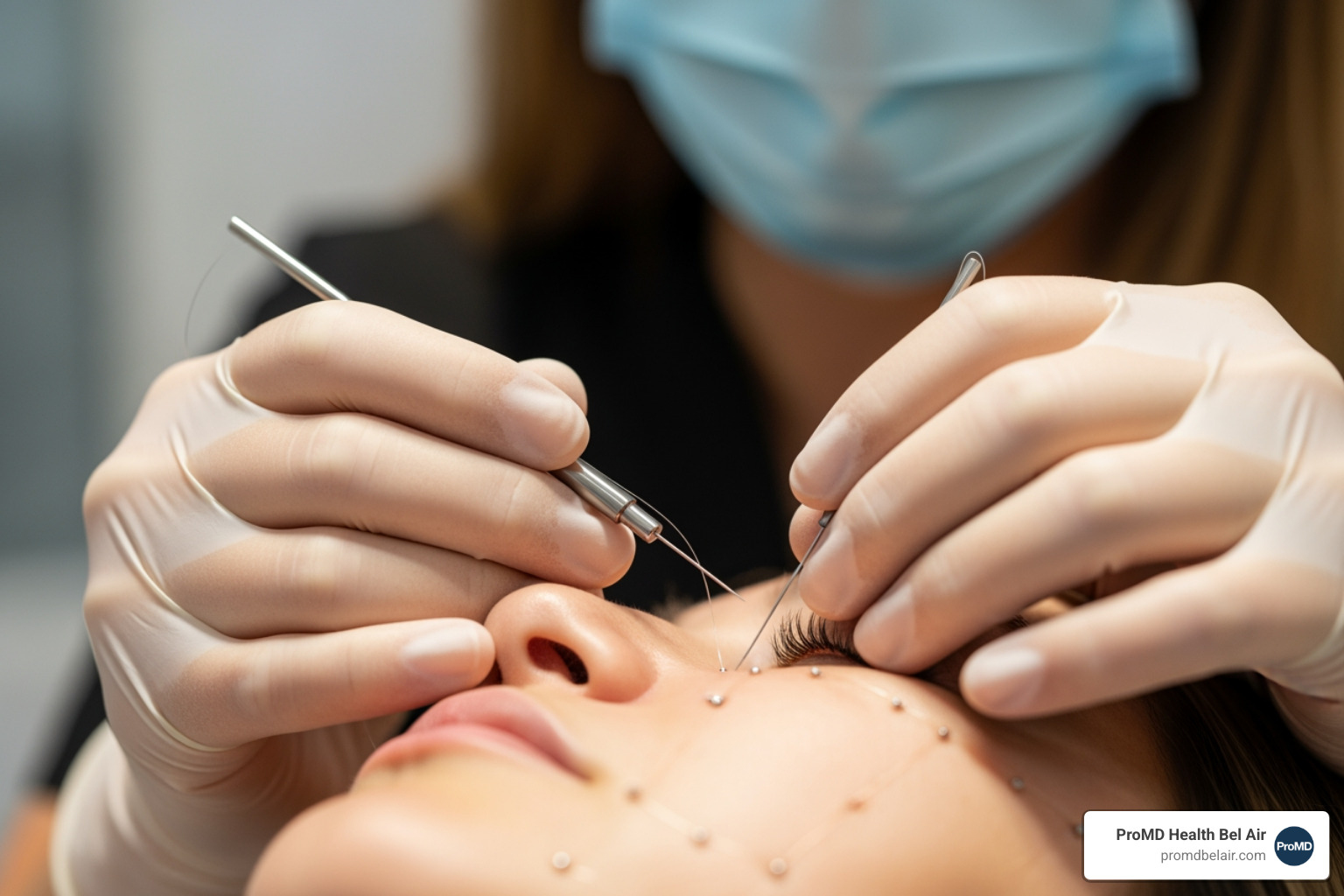
At ProMD Health Bel Air, safety is our absolute priority. The procedure is performed in a sterile, clinical environment using local anesthesia.
Common Side Effects
Most side effects are “transient,” meaning they go away on their own. According to a meta-analysis of 8,190 patients:
- Swelling (Edema): Occurs in about 35% of cases and typically peaks within 48 hours.
- Bruising (Ecchymosis): Common but usually resolves within a week.
- Asymmetry: Reported in about 3% of cases, often due to swelling or the thread settling.
Potential Risks
While rare, serious complications can occur, which is why choosing an experienced injector like Tyra Lindblad, Kate Maguire, or our PA-C team is vital.
- Infection: Rates range from 0.01% to 1.0% in controlled studies.
- Skin Dimpling: Occurs in 10-20% of cases but can often be massaged out by a professional.
- Nerve Injury: Rare (about 3%), usually involving temporary numbness (paresthesia).
Regarding The Honest Truth About Whether Pdo Threads Are Dangerous, the answer is that they are FDA-approved and very safe when administered by medical professionals. However, they are medical procedures, not “beauty treatments,” and require a sterile environment.
Essential Post-Procedure Aftercare
To ensure your threads stay in place and heal correctly, follow these steps:
- Apply Cold Packs: Use intermittently for the first 24–48 hours.
- Sleep Elevated: Use extra pillows to keep your head above your heart for 3–5 days.
- Limit Expression: Avoid wide yawning, hard laughing, or exaggerated facial movements for one week.
- No Exercise: Skip strenuous workouts for at least two weeks.
- Hands Off: Avoid facial massages or sleeping on your side for 14 days.
Thread Lift: What to Expect, Benefits & Complications research shows that following these instructions significantly reduces the risk of thread migration or “poking out.”
Frequently Asked Questions about Thread Lifts
Is the thread lift procedure painful?
We use a local anesthetic (numbing) to ensure the process is comfortable. Most patients describe the sensation as a “tugging” or “pressure” rather than sharp pain. The entire process takes about 60 minutes, and any post-procedure soreness is usually manageable with over-the-counter relievers.
How long is the recovery period?
While often called a “lunchtime lift,” you should expect 48 hours of significant swelling and up to a week of potential bruising. Most people feel comfortable returning to work after 3 to 5 days, though “puckering” of the skin can sometimes last 7 to 10 days as the tissue settles.
Can threads be combined with other treatments?
Absolutely. In fact, we often recommend it. Threads are excellent for lifting, but they don’t address volume loss. Combining threads with dermal fillers can restore the “apple” of the cheeks while the threads snatch the jawline. We also frequently use Botox to relax muscles that might otherwise pull against the threads, extending their lifespan.
Conclusion: Is a Thread Lift Right for You?
So, do thread lifts work? They are a powerful tool for the right person. If you are in your 40s or 50s and noticing that your reflection looks a bit “tired” or that your jawline is losing its crisp edge, a thread lift can provide a beautiful, subtle rejuvenation.
At ProMD Health Bel Air, we don’t believe in one-size-fits-all beauty. We invite you to use our AI Simulator to see exactly what bi-directional threads could do for your specific facial structure. Whether you are coming from Fallston, Forest Hill, or right here in Bel Air, our team is ready to help you decide if a Thread Lift is the right investment for your confidence.
Ready to see your results? Book a consultation with ProMD Health Bel Air today to create your personalized treatment plan.