Is a Thread Lift Right for You? What to Know Before You Book
Thread lift facial lifting is a minimally invasive cosmetic procedure that uses dissolvable sutures to physically lift sagging skin while triggering your body’s own collagen production — no surgery, no scarring, and no lengthy downtime required.
Here’s a quick snapshot of what to expect:
| Factor | Details |
|---|---|
| Procedure time | About 45-60 minutes |
| Anesthesia | Local only |
| Recovery | Swelling/bruising up to 5 days; return to work same day |
| Results last | 1 to 3 years |
| Best candidates | Ages late 30s to early 50s with mild to moderate skin laxity |
| Cost range | $1,200 to $8,500 depending on areas and thread type |
| Also known as | The “lunchtime lift” |
Over time, skin loses collagen and begins to sag — by around age 70, skin thickness can decrease by as much as 80%. Thread lifts address this in two ways: a mechanical lift that repositions tissue immediately, and neocollagenesis — the stimulation of fresh collagen that continues improving your skin long after the threads dissolve.
This guide walks you through everything — how threads work, which areas they treat, what recovery looks like, and how to decide if it’s the right fit for your goals.
I’m Ryan Pittillo, Franchise Owner at ProMD Health Bel Air, and as part of the ProMD team I’ve seen how thread lift facial lifting can restore confidence with natural-looking results for our patients. Let’s dig into the details so you can make a truly informed decision.

Understanding the Mechanics of a Thread Lift Facial Lifting Procedure
When we talk about a thread lift, we are describing a sophisticated medical technique that bridges the gap between topical treatments and major surgery. At its core, the procedure involves the strategic insertion of absorbable sutures under the surface of your skin. These aren’t just any threads; they are typically made of Polydioxanone (PDO), a complex sugar-based polymer that has been used safely in cardiovascular and orthopedic surgeries for decades.
The “lifting” part of thread lift facial lifting happens in two distinct phases. First, there is the immediate mechanical tissue support. The threads often feature tiny barbs or cones that grip the subcutaneous fat and muscle, allowing our providers to physically reposition the skin into a more youthful, elevated state.
Secondly, the presence of these threads triggers your body’s natural healing response. Your immune system recognizes the sutures as a foreign object (a safe one!) and reacts by flooding the area with growth factors and white blood cells. This leads to a process known as neocollagenesis—the creation of new collagen fibers around the threads. According to the American Society of Plastic Surgeons (ASPS), this biological reaction is what provides the long-term structural integrity that keeps you looking refreshed even after the physical threads have begun to dissolve. For more details on how we apply these mechanics at our clinic, you can explore our thread lift services page.
How Threads Stimulate Collagen
Collagen is the structural protein responsible for your skin’s elasticity and firmness. Unfortunately, as we age, our “collagen bank” starts to run low. Research shows that by age 70, most individuals experience an 80% reduction in skin thickness due to collagen loss.
When we perform a thread lift facial lifting procedure, we are essentially placing a “scaffold” that convinces your skin to act younger. As the PDO material slowly breaks down over six months, it leaves behind a sturdy network of fresh collagen. This increase in skin thickness and elasticity helps smooth out fine lines and prevents the “crepey” texture that often accompanies aging. It’s like a biological renovation for your face!
Target Areas and Ideal Candidates for Treatment
One of the reasons we love this treatment at ProMD Health Bel Air is its versatility. We aren’t just limited to the cheeks; we can map out specific vectors to address various “problem spots” that bother our patients in the Bel Air, Fallston, and Forest Hill areas.
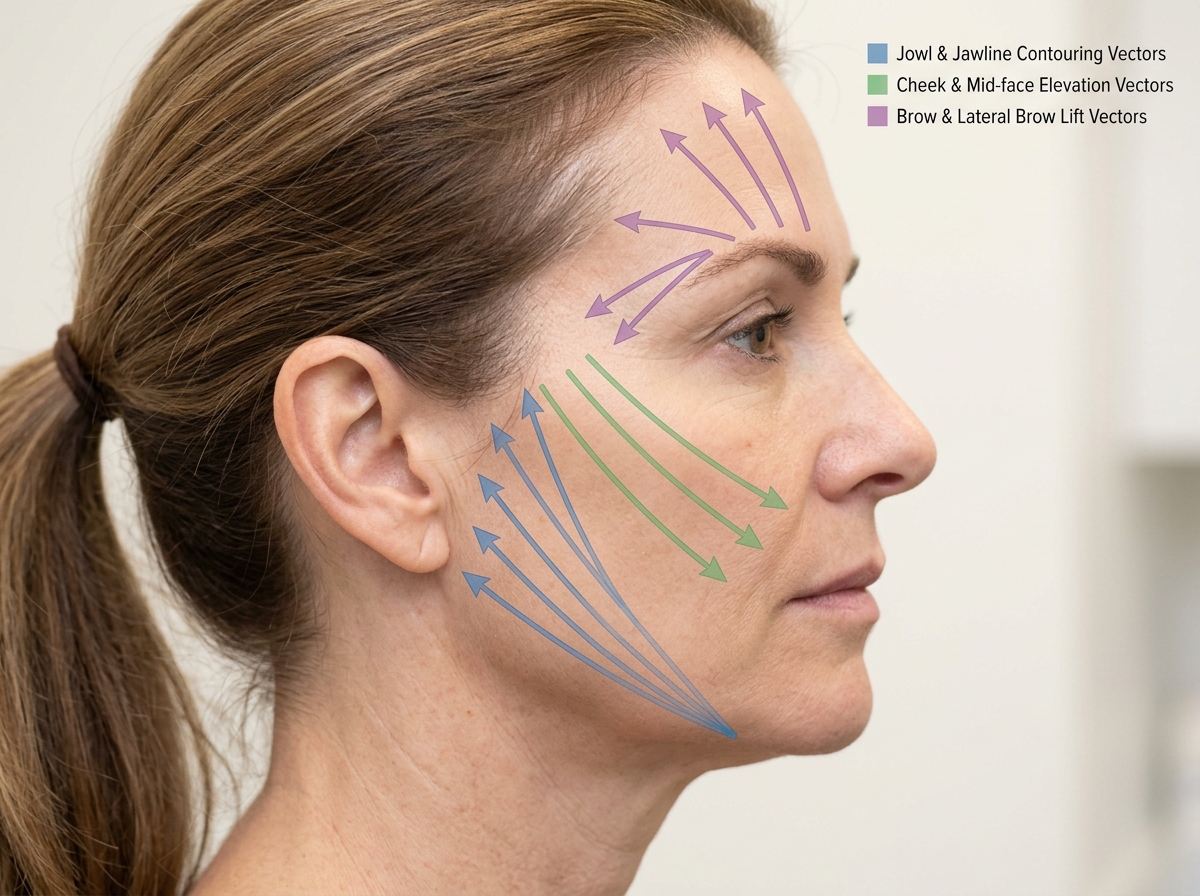
Common treatment areas include:
- Jowls and Jawline: We can tighten the skin along the jaw to restore a sharp, defined profile.
- Nasolabial Folds: By lifting the cheeks, we soften the deep lines that run from the nose to the corners of the mouth.
- Sagging Eyebrows: A “brow lift” with threads can open up the eyes and reduce a heavy, tired appearance.
- Neck Laxity: Often called the “turkey wobble,” loose neck skin can be smoothed out to create a more graceful neckline. Check out our guide on neck and jowl treatments for more non-surgical options.
Who is a Good Candidate for Thread Lift Facial Lifting?
While we wish we could help everyone with threads, they are most effective for a specific group. The ideal candidate is typically between their late 30s and early 50s with mild to moderate skin laxity. If you have very advanced sagging or extremely thin, fragile skin, a surgical facelift might be a better recommendation.
However, thread lift facial lifting is a fantastic option for those who:
- Want to avoid the risks and scarring of general anesthesia.
- Have medical contraindications to surgery, such as high blood pressure or heart disease.
- Prefer a “natural” look rather than the “pulled” look sometimes associated with older surgical techniques.
- Have a busy lifestyle and cannot afford weeks of downtime.
Comparing Thread Types: PDO, Barbed, and Smooth Options
Not all threads are created equal. Depending on your goals—whether you want a dramatic lift or just a boost in skin quality—we choose from different materials and textures.
| Thread Type | Primary Function | Best For |
|---|---|---|
| Smooth (Mono) Threads | Collagen Stimulation | Fine lines, acne scars, skin thickening |
| Barbed (Cog) Threads | Mechanical Lifting | Jowls, cheeks, sagging neck skin |
| Screw (Twist) Threads | Volume Restoration | Sunken areas, deep nasolabial folds |
Beyond the shape, the material matters too. Polydioxanone (PDO) is the most common and is known for its safety and predictable absorption. Other options include Poly-L-lactic acid (PLLA), which can stimulate even more collagen but takes longer to dissolve, and Polycaprolactone (PCL), which is the newest generation of long-lasting threads.
The Role of PDO in Thread Lift Facial Lifting
We primarily utilize PDO threads because of their incredible track record. Because they are biodegradable, your body naturally breaks them down through a process called hydrolysis. They remain in place for about four to six months before dissolving completely, but the collagen “ghost” they leave behind continues to support your skin for 12 to 18 months—sometimes even up to two years. For a deeper dive into the safety profile of these materials, the Cleveland Clinic provides an excellent overview of what to expect regarding complications and benefits.
The Procedure Experience and Recovery Timeline
We know that the idea of “threads under the skin” can sound a bit intimidating, but we promise it’s much simpler than it sounds! At ProMD Health Bel Air, we prioritize your comfort in a modern, clinical setting.
The procedure typically follows these steps:
- Numbing: We apply a local anesthetic to the entry points. You’ll be awake and able to talk to us throughout the process, but you shouldn’t feel pain—just some light pressure.
- Marking: Our providers, like Amanda Pittillo, PA-C or Lauren Mason, PA-C, will precisely mark your face to ensure the most symmetrical and effective lift.
- Insertion: Using a very thin needle called a cannula, we guide the threads into the subcutaneous layer of your skin.
- The Lift: Once the threads are in place, we gently pull them to achieve the desired elevation and then trim the ends so they are invisible.
The entire process usually takes about 60 minutes. You can literally come in during your lunch break and head back to work afterward, though you might have some minor swelling or bruising that lasts up to five days. You can see some of the transformations our patients have experienced in our article on non-surgical facelift results.
Essential Aftercare and Restrictions
To get the best results and ensure the threads “set” correctly, you’ll need to follow a few rules for the first week or two:
- Chill Out: Use a cold compress gently to manage any swelling.
- Sleep High: Prop your head up with extra pillows for the first few nights to prevent rolling onto your face.
- Take it Easy: Avoid vigorous exercise or heavy lifting for at least two weeks. We don’t want the threads to slip before they’ve anchored!
- Clean Carefully: Avoid makeup for 24 hours and be very gentle when washing your face. No scrubbing!
- No “Big Bites”: Try to avoid dental work or eating very crunchy apples for a week, as wide jaw movements can affect the thread placement.
Benefits and Longevity vs. Surgical Alternatives
Why choose a thread lift facial lifting procedure over a traditional facelift? For many of our Bel Air patients, it comes down to the “Three Cs”: Convenience, Cost, and Complications.
A surgical facelift is a major operation. It requires general anesthesia, results in permanent scars behind the ears, and has a recovery period that can last a month or more. While a surgical lift can last 10 years, it also costs significantly more—often upwards of $15,000 to $20,000.
Threads, on the other hand, offer:
- No Scarring: The entry points are tiny and heal completely.
- Immediate Results: You walk out of the office looking lifted.
- Lower Cost: Prices generally range from $1,200 to $8,500 depending on the complexity.
- Safety: The risk of infection or nerve damage is significantly lower than with surgery.
While the results are temporary (lasting 1 to 3 years), many patients enjoy the ability to “tweak” their look over time as their face continues to age naturally. To see how this fits into a broader anti-aging strategy, read our post on face rejuvenation treatments.
Combining Threads with Other Aesthetic Services
Threads work great on their own, but they are even better when they have “friends.” We often combine thread lift facial lifting with other treatments for a “3D” rejuvenation:
- Dermal Fillers: While threads lift, fillers add volume. Using them together addresses both sagging and the “hollow” look that comes with age.
- Botox/Dysport: We can use neuromodulators to relax the muscles that cause forehead wrinkles, while the threads handle the lower face.
- Microneedling: This improves the surface texture of the skin while the threads work on the deeper structure.
Frequently Asked Questions about Thread Lifts
How much does a thread lift cost?
The cost is highly variable. It depends on the number of areas being treated and the type of threads used. A “cat eye” lift or a small brow tweak will be on the lower end ($1,200 – $2,500), while a full face and neck rejuvenation involving multiple barbed threads can range from $4,000 to $8,500. During your consultation, we provide a transparent, personalized quote.
Is a thread lift painful?
Most patients describe the sensation as “odd” rather than “painful.” Because we use local numbing agents, the actual insertion feels like a bit of tugging or pressure. You may feel some tenderness or “tightness” for a few days after the procedure, which is easily managed with over-the-counter pain relief.
How long do thread lift results last?
On average, you can expect your results to last between 12 and 24 months. Factors like your age, skin quality, lifestyle (smoking and sun exposure shorten results!), and how well you follow aftercare will play a role. Because the procedure stimulates a “collagen surge,” some patients feel their skin looks better than it did before the treatment even after the threads are long gone.
Conclusion
At ProMD Health Bel Air, we believe that everyone deserves to feel as vibrant as they are. Thread lift facial lifting is one of the most exciting tools we have to help you achieve that “lifted” spirit and skin without the intensity of surgery.
What sets us apart? We utilize an AI Simulator that allows you to see a personalized preview of your potential results before we even start. This technology, combined with the expert hands of our team—including Tyra Lindblad, Kate Maguire, Amanda Pittillo, PA-C, Lauren Mason, PA-C, Paige Scott, and Natalie Shek—ensures that your journey is safe, predictable, and beautiful.
Whether you are in Bel Air, Fallston, or Forest Hill, we invite you to see if this “lunchtime lift” is the right move for you. Schedule your facial lifting consultation today and let’s create a plan that helps you put your best face forward!