Why the Future of Aesthetics Matters Now
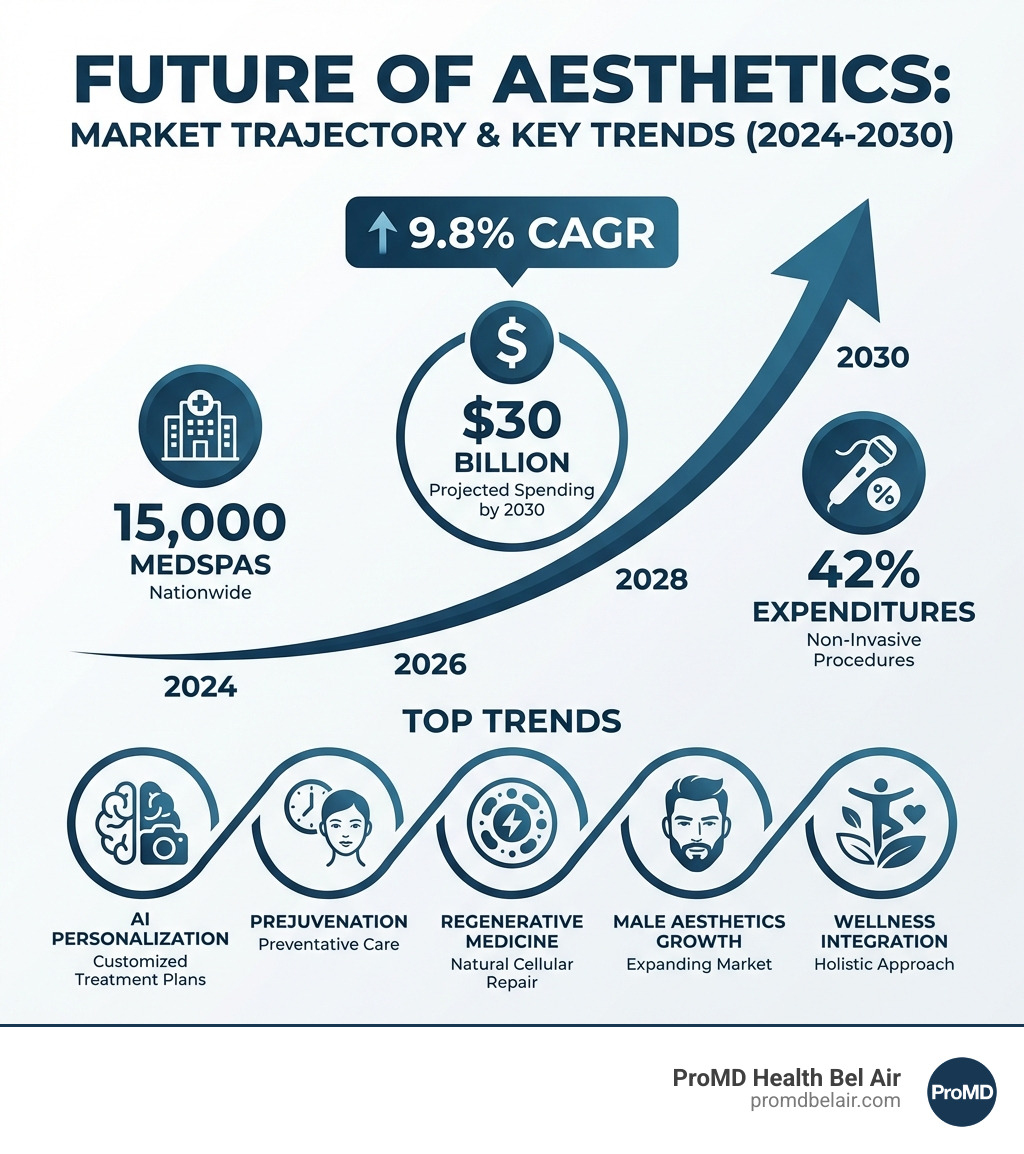
Future of aesthetics is no longer just about Botox and fillers—it’s a rapidly evolving industry combining cutting-edge science, AI-powered personalization, and regenerative medicine to deliver natural, confidence-boosting results. The global aesthetic medicine market is projected to grow at 9.8% annually through 2034, driven by non-invasive treatments, younger demographics seeking preventative care, and holistic wellness integration.
Key trends shaping the future of aesthetics:
- AI-powered personalization – Advanced diagnostics and 3D imaging create customized treatment plans
- Prejuvenation – Gen Z and Millennials using preventative treatments to preserve collagen early
- Regenerative medicine – Biostimulators and exosomes trigger natural cellular repair
- Male aesthetics – Growing acceptance of jawline contouring and minimally invasive procedures
- Holistic integration – Blending beauty with wellness, hormonal balance, and metabolic health
- Sustainable practices – “Aesth-ethics” prioritizing safety, ethical sourcing, and long-term results
The aesthetics industry is entering 2026 with strong momentum. Americans are projected to spend $30 billion annually on cosmetic procedures by 2030, with the number of medspas reaching 15,000 locations nationwide. Non-surgical treatments now represent 42% of total cosmetic expenditures, exceeding $5 billion, as patients increasingly prefer subtle enhancements with minimal downtime.
This shift reflects a fundamental change in how people approach aesthetic care. It’s not about chasing perfection—it’s about personalized, preventative treatments that help you look and feel like the best version of yourself. Technology is making this possible through AI simulators that preview results, advanced diagnostics that tailor treatments to your unique biology, and regenerative therapies that work with your body’s natural healing processes.
I’m Ryan Pittillo, Franchise Owner at ProMD Health Bel Air, and I’ve seen how the future of aesthetics is transforming patient experiences through personalized care and advanced technology. Whether you’re exploring treatments for the first time or looking to stay ahead of emerging trends, understanding these innovations helps you make confident, informed decisions.
Market Snapshot: Growth and the Rise of Non-Invasive Care
The landscape of beauty is shifting beneath our feet, and the numbers tell a fascinating story. We are witnessing a monumental pivot in how the world views medical enhancements. According to recent data, the global aesthetics market continues to expand at an impressive pace, fueled by a consumer base that values convenience just as much as results.
The current projection shows that the global aesthetic medicine market will grow at a compound annual growth rate of 9.8% from 2024 to 2034. While traditional surgery still has its place, the real “stars of the show” are non-invasive and minimally invasive procedures. These treatments represent the largest and fastest-growing segments within aesthetic medicine, largely because patients today are “time-poor.” We want to look refreshed for our 2 PM Zoom call without the two-week recovery time of a traditional facelift.
In the United States alone, spending on cosmetic procedures has already surpassed $16 billion annually. By 2030, that number is expected to hit $30 billion. This isn’t just a “trend”; it’s a fundamental shift in healthcare. We are moving toward a world where non-invasive treatments are a standard part of a self-care routine, much like going to the gym or the dentist.
| Feature | Surgical Procedures | Non-Surgical Procedures |
|---|---|---|
| Growth Rate (Historical) | Steady (~2-5%) | Explosive (>500% since 1997) |
| Downtime | Weeks to Months | Minutes to Days |
| Primary Driver | Structural Correction | Prevention & Maintenance |
| Market Share | Declining relative to total | 42% of total expenditures and rising |
The Shift Toward Prejuvenation
If you’ve noticed more 20-somethings in the waiting room lately, you’re seeing the “Prejuvenation” movement in action. Gen Z and Millennials are not waiting for wrinkles to appear; they are actively working to ensure they never show up in the first place.
The logic is simple: it is much easier to preserve your natural collagen than it is to try and rebuild it once it’s gone. Did you know that our collagen levels decrease by about 1% every year after we turn 20? By starting with Botox & Dysport early, younger patients can train their facial muscles to move less aggressively, preventing deep lines from etching into the skin.
But prejuvenation isn’t just about freezing muscles. It’s about skin barrier health and “banking” collagen. We are seeing a massive surge in treatments that focus on long-term skin quality, ensuring that the canvas remains smooth and resilient for decades to come.
The Future of Aesthetics for Men and Younger Generations
The “Bro-tox” era has officially arrived, and it’s here to stay. Men are now one of the fastest-growing demographics in the future of aesthetics. In fact, male acceptance of minimally invasive procedures has reached an all-time high. Men are increasingly seeking out treatments that offer a “competitive edge” in the workplace or a more defined, masculine profile.
Top of the list for our male patients? Jawline contouring. A sharp, chiseled jawline is often associated with fitness and youth. We use products like Kybella to permanently dissolve submental fat (the “double chin”) and dermal fillers to add structure to the mandible.
Furthermore, the industry is moving toward “gender-inclusive beauty.” Modern aesthetics is ditching the binary. We are seeing a rise in “degendered” treatment options where the goal is simply “better,” regardless of the patient’s gender identity. Whether it’s a Millennial looking for a sharper jaw or a Gen Z individual exploring “ephemeral expression” through temporary lip flips, the future is inclusive.
The Future of Aesthetics: AI and Personalized Diagnostics
At ProMD Health Bel Air, we believe that the “one-size-fits-all” approach belongs in the past. The future of aesthetics is deeply rooted in precision. How do we achieve that? Through the power of Artificial Intelligence.
We use an AI Simulator that allows our patients to see the “after” before they even commit to the “before.” This isn’t just a fun gimmick; it’s a critical diagnostic tool. By using predictive analytics and 3D imaging, we can show you exactly how a specific amount of filler will interact with your unique bone structure. This level of personalization in aesthetic medicine ensures that results are balanced, symmetrical, and—most importantly—exactly what the patient desires.
AI is also transforming how we track progress. Advanced diagnostics can now identify biomarkers and skin health metrics that the human eye might miss. We can track your “skin age” over time, adjusting your treatment plan as your biology changes. This is “precision healthcare” at its finest, where data drives every needle prick and laser pulse.
Sustainable Practices in the Future of Aesthetics
As patients become more conscious of what they put in their bodies, they are also becoming more concerned with the ethics behind their treatments. We call this “aesth-ethics.” The future of aesthetics involves a commitment to clean beauty and ethical sourcing.
This also means a “safety-first” approach. In a market flooded with at-home devices, we emphasize the importance of medical-grade standards. For instance, did you know there is a Health Canada advisory on device risks regarding certain plasma pens? Many of these “miracle” at-home tools can cause permanent scarring or hyperpigmentation, especially on darker skin tones. Part of our role in the future of this industry is protecting patients from “unscrupulous providers” and unregulated technology.
Digital Lens and the Metaverse
We can’t talk about the future without mentioning the “Digital Lens.” The “Zoom Boom” was real—spending hours staring at ourselves on camera during the pandemic led to a massive spike in facial scrutiny. This has evolved into what researchers call aesthetic life in the digital age.
Social media platforms like Instagram have fundamentally changed public interest in procedures. We are even seeing the emergence of “meta-clinics” in the metaverse, where virtual consultations and digital self-perception influence real-world demand. While filters can sometimes set unrealistic expectations, they also allow patients to explore different “looks” in a low-stakes environment. Our job is to bridge that gap, taking your digital inspiration and turning it into a safe, physical reality.
Regenerative Medicine and the Science of Cutaneous Regeneration
If Botox was the breakthrough of the early 2000s, regenerative medicine is the breakthrough of the 2020s. We are moving away from simply “filling” a line and toward “repairing” the skin from within.
Regenerative aesthetics focuses on biostimulators—substances that trigger your body’s own production of collagen and elastin. Products like Sculptra or Radiesse don’t just provide immediate volume; they act as a “seed” that grows new tissue over several months. This leads to an increase in collagen density by up to 25% over half a year when combined with other therapies.
We are also looking closely at dermal fillers that utilize Vycross technology for smoother, more natural integration. Scientific research on hyaluronic acid effectiveness shows that these molecules can actually improve skin hydration and texture on a cellular level, not just a physical one. The goal is cutaneous regeneration—literally giving your skin the tools to fix itself.
Combination Therapies and Treatment Stacking
In 2026 and beyond, you’ll rarely see a patient get just one treatment. The secret to the most “natural” results is “stacking.” By combining different modalities, we can address multiple layers of aging simultaneously.
For example, we might use microneedling to address surface texture, followed by laser treatments to target pigmentation, and finishing with biostimulatory fillers for deep structural support. This “synergy” allows us to use smaller amounts of each product, which reduces downtime and creates a more harmonious look. Research shows that combination therapies can actually extend the duration of your results by up to 30%.
The Quest for Natural Results
The “frozen” look is officially out. The “Invisilift” era is in. Today’s patients want people to ask, “Did you go on vacation?” not “Who is your doctor?”
Achieving these subtle enhancements requires more than just a needle; it requires a master injector with deep anatomical knowledge. We focus on the “artistry” of the face, understanding how facial nerves and blood vessels interact with the products we use.
One of the most exciting tools in our kit is the “injectable moisturizer.” Products like Skinvive are designed not to change your shape, but to provide “hydration that lasts for months.” It’s like having the best skincare routine of your life, injected directly into the dermis where it can actually make a difference.
Holistic Integration: Blurring the Lines Between Beauty and Longevity
The future of aesthetics is no longer a siloed industry. We are seeing a “wellness and beauty fusion” where aesthetic treatments are just one piece of the longevity puzzle.
There is a massive demand for integrated aesthetic and wellness services, particularly among Millennials. Patients are realizing that if they are inflamed, stressed, or nutritionally deficient, their skin treatments won’t work as well. This is why we are seeing the integration of:
- IV Therapy: Delivering vitamins and hydration directly to the bloodstream for a “glow from within.”
- Hormonal Support: Addressing the root causes of skin thinning and hair loss during menopause or andropause.
- Metabolic Health: Using peptide therapies to support weight management and cellular energy.
The Future of Aesthetics in Practice Operations
Behind the scenes, the way we run our practices is also evolving. We are moving toward “integrated EHR systems” and data-heavy operations. By using data analytics, we can predict when a patient is due for a touch-up or which treatments are providing the highest satisfaction rates in the Bel Air area.
We also focus heavily on services that prioritize patient retention and safety. In a saturated market, the clinics that thrive are those that invest in staff education and rigorous regulatory compliance. We aren’t just a “medspa”; we are a medical facility that uses technology to ensure every outcome is safe and predictable.
Economic Shifts: From Transactions to Relationships
The business of beauty is changing from a “one-off” transaction to a long-term relationship. Many practices are adopting membership models and subscription services. Why? Because aesthetics is a marathon, not a sprint.
By offering memberships, we help patients spread the cost of their care over time, making “prejuvenation” more accessible. We also utilize “Buy Now, Pay Later” (BNPL) options to ensure that financial uncertainty doesn’t stand in the way of your confidence. This shift toward “value-based pricing” means we are invested in your long-term results, not just a single syringe sale.
Frequently Asked Questions about the Future of Aesthetics
What is the projected growth of the aesthetics industry?
The industry is expected to grow at a CAGR of 9.8% through 2034. In the U.S., annual spending is projected to reach $30 billion by 2030, supported by an increase in the number of medspas and the rising popularity of non-invasive treatments.
How is AI currently being used in aesthetic practices?
AI is used for 3D imaging and simulations (like our AI Simulator at ProMD Health Bel Air), allowing patients to preview results. It also assists in “precision healthcare” by analyzing skin biomarkers and helping clinicians create highly customized, data-driven treatment plans.
What are regenerative aesthetic treatments?
Regenerative treatments use “biostimulators” and other biotechnology to trigger the body’s natural healing processes. Instead of just adding volume, these treatments encourage your skin to produce its own collagen and elastin, leading to longer-lasting and more natural-looking rejuvenation.
Conclusion
The future of aesthetics is bright, resilient, and incredibly personal. We have moved past the era of “one-size-fits-all” beauty and into a time where science, AI, and holistic wellness converge to help you age on your own terms. Whether it’s through the preventative power of “prejuvenation” or the cutting-edge science of regenerative medicine, the goal remains the same: to help you look in the mirror and love what you see.
At ProMD Health Bel Air, we are proud to be at the forefront of this evolution. From our AI Simulator to our focus on long-term patient relationships, we are here to guide you through the exciting innovations of 2026 and beyond.
Ready to see what the future holds for you? Explore our full range of services and let’s start your journey toward a more confident, refreshed you.