Understanding the Journey to Restore Youthful Skin
Restore youthful skin through a combination of scientifically proven methods that address both surface-level concerns and deeper structural changes. Here’s what actually works:
Quick Answer: How to Restore Youthful Skin
- Daily sun protection (SPF 30+ broad-spectrum sunscreen)
- Medical-grade topicals (Vitamin C 5-15%, retinoids, niacinamide 5%)
- Professional treatments (chemical peels, laser resurfacing, IPL)
- Injectable therapies (hyaluronic acid fillers, botulinum toxin)
- Lifestyle optimization (hydration, nutrition, stress management)
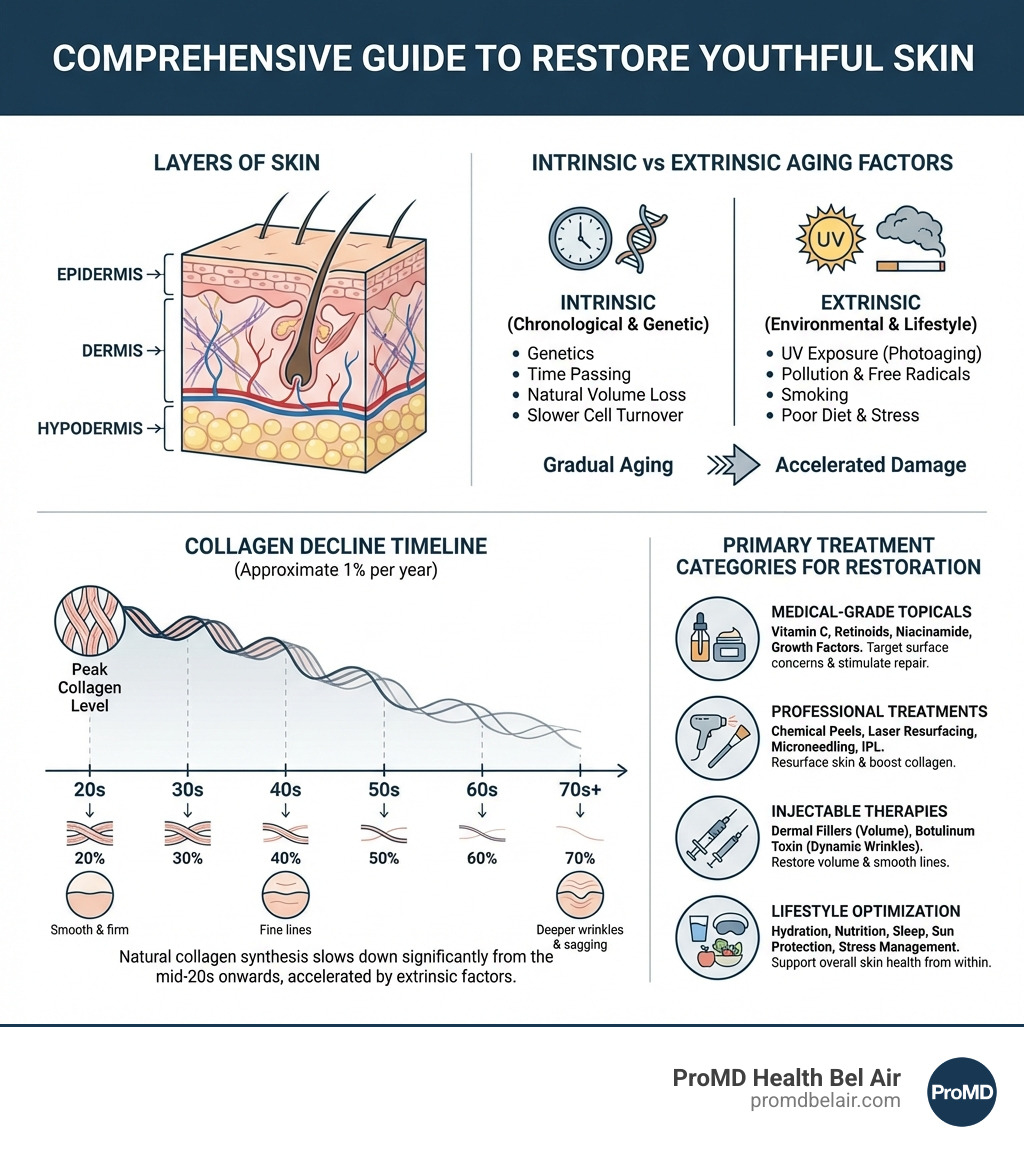
Aging is simply part of being human. Your skin shows the first visible signs—fine lines around the eyes, uneven tone, loss of firmness. But here’s what matters: intrinsic aging (the natural process controlled by genetics) differs dramatically from extrinsic aging (damage from sun, pollution, and lifestyle choices). The good news? You can influence the second category significantly.
Research shows that collagen—the protein giving your skin its structure—declines approximately 1% per year. Sun exposure accelerates this through a process called photoaging, which creates deeper wrinkles and rough texture compared to natural aging alone. The skin around your hands, neck, and face bears the brunt because these areas see the most UV exposure.
Modern dermatology offers proven solutions. Topical antioxidants like vitamin C stimulate new collagen production. Clinical procedures including chemical peels and laser treatments resurface damaged layers. Injectable fillers restore lost volume while botulinum toxin smooths dynamic wrinkles. Each approach targets different aspects of skin aging.
I’m Ryan Pittillo, and while my primary focus has been coaching and healthcare leadership, I’ve learned through our work at ProMD Health that achieving natural, lasting results in skin restoration requires the same personalized, team-based approach I bring to athletic development. Our practice combines evidence-based treatments with advanced visualization technology to help you restore youthful skin with confidence and predictable outcomes.
The Biological Mechanisms of Skin Aging
To truly understand how to restore youthful skin, we have to look under the hood. Skin aging isn’t just one thing; it’s a multi-layered biological process. Scientists generally divide it into two categories: chronological aging and photoaging.
Chronological aging is the “intrinsic” clock. It’s what happens because of time and genetics. Over the years, our skin naturally becomes thinner and more atrophic. The dermal-epidermal junction—the interface where the top layer of skin meets the deeper layer—flattens out. This makes the skin more fragile and prone to shearing.
However, what most people identify as “aging” is actually premature damage. Scientific research on premature aging highlights that up to 80% of visible facial aging is due to extrinsic factors, primarily UV radiation. This is known as photoaging. Unlike natural aging, which leaves skin smooth but thin, photoaging results in thickened, leathery texture, deep furrows, and “solar elastosis”—an accumulation of abnormal elastic tissue.
Inside the dermis, three key components keep things looking bouncy:
- Collagen: This is the “scaffolding.” It provides strength and structure. Unfortunately, the overall collagen content per unit area of the skin surface is known to decline approximately 1% per year throughout adult life.
- Elastin: This allows your skin to “snap back.” When elastin degrades, we see sagging and laxity.
- Glycosaminoglycans (GAGs): These are moisture-binding molecules, like hyaluronic acid. They keep the skin hydrated and plump.
As these components diminish, the skin loses its ability to retain water and maintain its thickness. By the time we reach our 60s, our skin may produce only about a quarter of the collagen it did when we were infants. This is why a proactive approach is so vital for those living in sunny areas like Bel Air and Fallston.
Essential Topicals to Restore Youthful Skin
Before jumping into the clinic for a procedure, your first line of defense is your bathroom cabinet. But forget the “miracle creams” advertised on late-night TV; we’re talking about medical-grade ingredients with proven efficacy.

The Power of Antioxidants
Oxidative stress is like rust for your skin. It’s caused by free radicals—unstable molecules generated by UV rays and pollution. To neutralize them, you need antioxidants.
- Vitamin C (L-ascorbic acid): This is a powerhouse. In concentrations between 5% and 15%, it has been proven to have a significant anti-aging effect. It doesn’t just protect; it actually promotes the synthesis of new collagen.
- Vitamin E: Often used in tandem with Vitamin C, it helps repair oxidized membranes.
- Niacinamide (Vitamin B3): Used in a 5% concentration, niacinamide is a versatile tool. Studies show it improves skin elasticity, reduces redness (erythema), and fades pigmentations after about three months of consistent use.
A landmark study on topical antioxidants found that a solution containing Vitamins C and E stabilized by ferulic acid provides significantly higher protection against UV damage than the vitamins alone.
Cell Regulators: Retinoids and Peptides
While antioxidants protect, cell regulators actually “talk” to your skin cells, telling them to behave like younger versions of themselves.
- Retinoids (Vitamin A): Tretinoin is the gold standard here. In the United States, a 0.05% concentration is commonly approved for anti-aging. Retinoids increase cell turnover, thicken the epidermis, and inhibit the enzymes that break down collagen.
- Peptides: These are short chains of amino acids that act as messengers. They can signal the skin to produce more collagen or elastin, helping to firm up the dermal matrix.
Clinical Procedures for Dermal Resurfacing
Sometimes, topical creams need a little help from professional equipment. Dermal resurfacing involves removing damaged outer layers of skin to reveal the smoother, more vibrant skin beneath.
Chemical Peels
Chemical peels involve applying a solution that causes controlled “injury” to the skin, triggering a healing response that results in new collagen formation. We classify peels by how deep they go:
| Peel Type | Depth reached | Common Ingredients | Primary Benefits |
|---|---|---|---|
| Superficial | Epidermis | Glycolic acid, Salicylic acid, TCA 10–30% | Brightens tone, treats mild acne and fine lines. |
| Medium | Upper reticular dermis | TCA 30% to 50% | Improves pigment issues, deeper wrinkles, and actinic keratosis. |
| Deep | Lower reticular dermis | TCA > 50%, Phenol | Significant remodeling of deep wrinkles and scars. |
Light and Energy-Based Devices
If the idea of a chemical peel sounds a bit too “Old School” for you, modern light-based therapies offer incredible precision.
- Intense Pulsed Light (IPL): This isn’t a laser, but a broad spectrum of light. It’s fantastic for “photorejuvenation,” specifically targeting redness and brown spots. A 45-year-old patient might see a dramatic reduction in sunspots after just one or two sessions.
- Fractional Lasers: These create thousands of microscopic “holes” in the skin, leaving the surrounding tissue intact. This speeds up healing and triggers massive dermal remodeling.
- Radiofrequency (RF): Devices like Sylfirm X use RF energy to heat the deeper layers of the skin without damaging the surface. This is the go-to for skin tightening and addressing laxity.
Maximum results from these non-ablative treatments are typically seen between 3 and 12 months after the procedure, as your body takes time to build that new collagen.
Advanced Injectables for Facial Rejuvenation
When we talk about a “youthful” face, we aren’t just talking about a lack of wrinkles; we’re talking about volume. As we age, we lose the fat pads in our cheeks, and our bone structure even changes slightly. This is where injectables shine.
- Hyaluronic Acid (HA) Fillers: These are soft, gel-like substances. HA is naturally found in your skin, so these fillers are very safe. They provide immediate volume restoration.
- Botulinum Toxin (Botox/Dysport): These are neuromodulators. They don’t fill wrinkles; they relax the muscles that cause them. This is ideal for dynamic lines—the ones that appear when you frown or smile.
- Platelet-Rich Plasma (PRP): Often called the “vampire facial,” this uses your own blood’s growth factors to stimulate healing and collagen production.
Using Injectables to Restore Youthful Skin Volume
To restore youthful skin volume, we often target the mid-face. By injecting HA fillers into the cheeks or nasolabial folds (the lines from your nose to your mouth), we can create a subtle “lift” that makes the whole face look more rested.
The duration of these effects varies. HA fillers typically last 3 to 12 months, though some long-lasting versions can maintain their position for two years or more. Botulinum toxin usually lasts 3 to 6 months. One of the best things about these treatments is the safety profile—the amounts of Botox used for cosmetic treatments are 25–100 times less than the dose that would be considered dangerous, making it incredibly safe when administered by a professional.
Holistic Strategies for Healthy Aging
We believe that what you put into your body is just as important as what you put on it. “Healthy aging” is a systemic approach.
Systemic Anti-Aging and Hormones
As we age, our hormone levels naturally shift, which can lead to drier, thinner skin—especially during menopause.
- Hormone Replacement Therapy (HRT): Some evidence suggests that maintaining estrogen levels can help maintain skin thickness and moisture.
- DHEA: A randomized, placebo-controlled study of 280 older adults showed that 50 mg of DHEA daily for a year led to improved skin health and bone density, particularly in women.
- Oral Supplements: Hydrolyzed collagen peptides and oral hyaluronic acid have shown promise in clinical trials. Some studies indicate that oral collagen can improve skin elasticity by about 7% and reduce wrinkle depth by up to 20% after two months.
Lifestyle Habits to Restore Youthful Skin Naturally
You can’t out-treat a bad lifestyle. To keep your skin glowing in Forest Hill or Bel Air, consider these non-negotiables:
- Photoprotection: This is the #1 rule. Wear broad-spectrum SPF 30+ every single day, even if it’s cloudy. UV rays are responsible for the vast majority of skin aging.
- Smoking Cessation: Smoking restricts blood flow to the skin and actively destroys collagen and elastin. If you want to restore youthful skin, quitting is the most effective thing you can do for free.
- Hydration and Diet: Drink plenty of water and eat a rainbow of fruits and vegetables. The antioxidants in your diet help fight oxidative stress from the inside out.
- Sleep Hygiene: Your skin does most of its repair work while you sleep. Aim for 7-9 hours of quality rest.
Frequently Asked Questions about Skin Restoration
What is the difference between photoaging and chronological aging?
Chronological aging is the natural, genetic process of getting older, resulting in thin, relatively smooth skin. Photoaging is damage caused by UV exposure, resulting in deep wrinkles, leathery texture, and dark spots. Most of what we perceive as “old skin” is actually photoaged skin.
How long do the effects of hyaluronic acid fillers last?
Most standard HA fillers last between 3 and 12 months. However, the longevity depends on the specific product used and how quickly your body metabolizes the gel. High-density fillers used for bone-structure mimicry can sometimes last up to two years.
At what concentration is Vitamin C most effective for anti-aging?
For topical L-ascorbic acid to be effective, it generally needs to be in a concentration between 5% and 15%. Anything lower may not provide significant results, and anything much higher can cause irritation without providing additional benefits.
Conclusion
Restoring your skin’s youthful vitality isn’t about chasing an impossible standard; it’s about helping your skin be its healthiest, most resilient self. Whether you are starting with a simple medical-grade skincare routine or exploring the transformative power of lasers and injectables, the key is a personalized approach.
At ProMD Health Bel Air, we take the guesswork out of the process. Our unique AI Simulator allows you to preview your potential post-treatment results before we even begin. This technology ensures that our goals are aligned with yours, focusing on natural-looking enhancements that make you look like a refreshed version of yourself—not a different person.
From our offices in Bel Air, Fallston, and Forest Hill, we are dedicated to helping our community age gracefully and confidently. Ready to see what’s possible for your skin? More info about aesthetic services is just a click away. Let’s work together to restore youthful skin and reveal the glow you deserve.