Why a Sharper Jawline Starts With Understanding Kybella for Jawline Definition
Kybella for jawline definition is a non-surgical injectable treatment that destroys fat cells beneath the chin to create a cleaner, more sculpted profile — no scalpel required.
Here’s a quick summary of what you need to know:
| Question | Quick Answer |
|---|---|
| What is it? | An FDA-approved injectable using deoxycholic acid to dissolve submental fat |
| How many sessions? | Typically 2–6, spaced at least 4 weeks apart |
| Is it permanent? | Yes — destroyed fat cells do not regenerate |
| Downtime? | 24–48 hours of light activity; swelling peaks around 72 hours |
| Best candidate? | Adults with moderate to severe submental fullness and good skin elasticity |
You eat well. You work out consistently. But that stubborn fullness under your chin just won’t budge — and it shows up every time you glance at yourself on a video call or catch your profile in a mirror.
That frustration is incredibly common. And for many people, it has nothing to do with lifestyle habits. Genetics play a big role in where fat accumulates, and the area beneath the chin is one of the most stubborn spots on the body.
The good news? Kybella targets exactly that problem — at the cellular level — without surgery, without general anesthesia, and without significant downtime.
I’m Ryan Pittillo, Franchise Owner at ProMD Health Bel Air, and I’ve seen how Kybella for jawline definition transforms both profiles and confidence for patients in our community. In this guide, we’ll walk you through everything you need to know — from how it works to what recovery actually looks like.
Glossary for Kybella for jawline definition:
Understanding Kybella for Jawline Definition
Kybella is a prescription injectable made with synthetic deoxycholic acid, a molecule your body naturally uses to help break down dietary fat. The FDA has approved it to improve the appearance and profile of moderate to severe submental fat, which is the pocket of fullness beneath the chin often called a double chin. You can review the official safety details in the FDA Prescribing Information.
For patients bothered by a soft or heavy-looking lower face, this matters because reducing submental fat can create a sharper angle where the chin meets the neck. That cleaner transition is what many people are really after when they search for jawline sculpting.
A key point: Kybella is designed for fat reduction, not for lifting loose skin or reshaping bone structure. If the main issue is fat under the chin, it can be a great fit. If the main issue is laxity, jowling, or significant tissue descent, we may recommend a different approach or combination plan. Our Kybella treatment page explains the basics, but the best plan always starts with a personalized assessment.
How Kybella for jawline definition works on a cellular level
Here is the science in plain English:
- Kybella is injected into the targeted fat beneath the chin.
- The deoxycholic acid disrupts the membranes of fat cells, also called adipocytes.
- Once those fat cells are broken down, the body clears the cellular debris through natural metabolic processes.
- Over the following weeks, the treated area gradually looks slimmer and more contoured.
That last step is why results are not instant. This is not like contour makeup, and it is definitely not a same-day magic wand. The visible change appears gradually as inflammation settles and your body processes the destroyed fat cells.
Because treated fat cells do not regenerate, the reduction is considered long lasting. In other words, once those specific cells are gone, they are gone. That is one reason many patients like Kybella as a non-surgical option for long-term contouring.
How Kybella can improve jawline definition
When submental fullness is reduced, the jawline often looks more defined for a simple reason: there is less fullness blurring the border between the chin and the upper neck.
This can improve:
- The side profile
- The angle between the chin and neck
- The appearance of heaviness under the chin
- Overall facial balance in photos and video calls
Think of it like clearing visual clutter from the lower face. Kybella does not add volume the way a filler would. Instead, it removes the excess fat that is softening the contour. For the right patient, that can make the lower face look slimmer, cleaner, and more structured.
It may also help some patients who feel their jawline disappears in certain lighting or from certain camera angles. If the issue is truly submental fullness, reducing that pocket can make a big difference.
What it does not do is create a dramatically snatched jawline in someone with heavy jowls, pronounced skin laxity, or a recessed chin. In those cases, we talk honestly about realistic outcomes and whether another treatment may better match the anatomy.
The Treatment Journey: Sessions and the “Bullfrog” Recovery
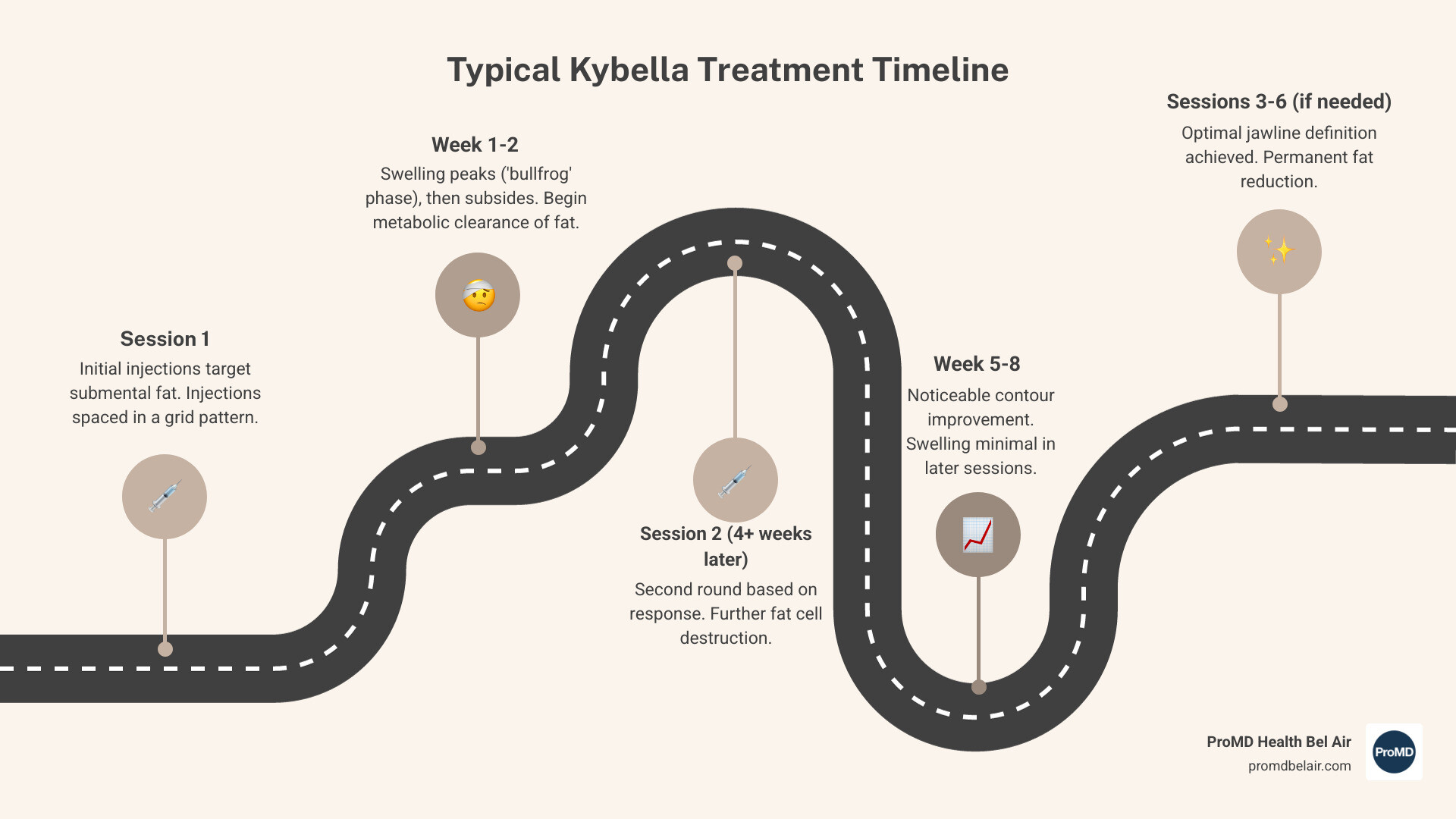
Kybella is not a one-and-done treatment for most people. It is usually performed as a series of sessions, commonly 2 to 6, spaced at least 4 weeks apart. The exact number depends on:
- How much submental fat is present
- Your skin quality and elasticity
- How sharp a contour you want
- How your body responds after each session
Many patients begin to notice improvement after a couple of treatments, with fuller results developing after later sessions. The procedure itself is usually quick, often around 15 to 30 minutes.
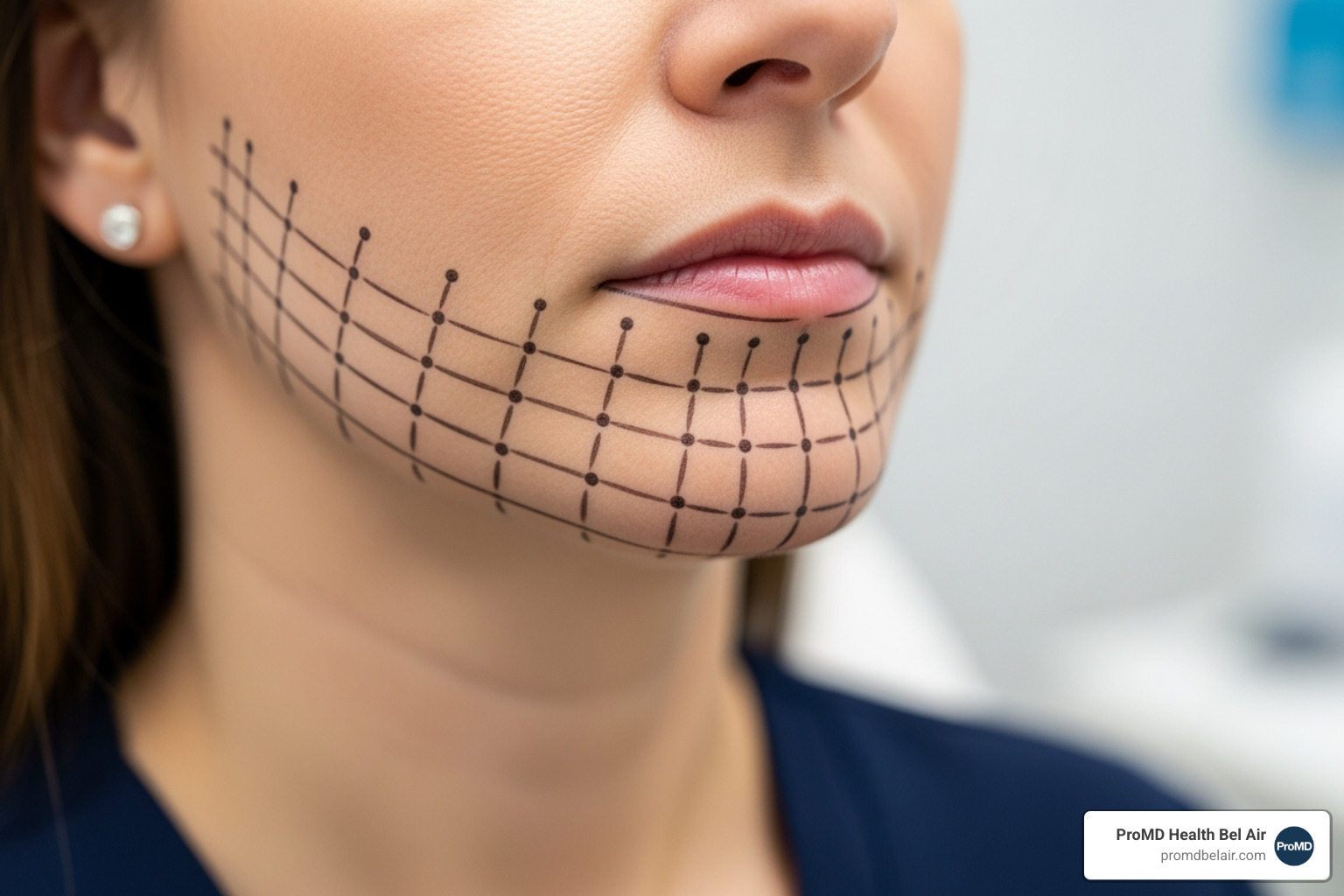
At ProMD Health Bel Air, we evaluate the area carefully before treatment. That includes reviewing your anatomy, discussing expectations, and mapping the treatment area so injections are placed precisely.
The treatment process generally looks like this:
- We assess the area and review your goals.
- We mark the injection grid under the chin.
- We cleanse the skin and may use comfort measures to make the session easier.
- We place a series of small injections into the targeted fat.
- You head home with post-care instructions and a realistic idea of what swelling will look like.
If you are still wondering whether you check the right boxes, our guide on how to see if Kybella is right for you is a helpful next read.
Managing the “Bullfrog” swelling phase
Let us talk about the part everyone asks about: the famous “bullfrog” phase.
Yes, the swelling is real. Yes, it can be dramatic. And yes, it is usually expected.
After Kybella, the treated area often becomes noticeably swollen because the medication is creating an inflammatory response as it destroys fat cells. That temporary fullness under the chin is what many patients jokingly call the “bullfrog” look.
Here is what patients can usually expect:
- Swelling starts soon after treatment
- It often peaks around 72 hours
- Tenderness, firmness, numbness, and bruising can occur
- The area can feel warm, puffy, or tight
- The swelling gradually improves over days to weeks
For some patients, the first treatment causes the most dramatic swelling. For others, later treatments can still puff up the area depending on the dose and treatment plan.
A few practical tips:
- Plan social events and photos accordingly
- Sleep with your head slightly elevated
- Use cold compresses as directed
- Stick with light activity for the first 24 to 48 hours
- Follow all aftercare instructions from our team
The phrase “minimal downtime” is technically true for many patients because you can often return to light daily activities quickly. But socially, you should expect visible swelling. We prefer to be honest about that rather than pretend you will look camera-ready the next morning.
Kybella vs Other Approaches for Double Chin Reduction
Kybella is not the only option for double chin reduction, and it should not be treated like the answer to every lower-face concern. The best treatment depends on whether the main issue is fat, loose skin, muscle banding, or deeper structural anatomy.
Here is a general comparison:
| Approach | Type | Downtime | Sessions | Best for |
|---|---|---|---|---|
| Kybella | Injectable fat reduction | Swelling common; light activity in 24-48 hours | Usually 2-6 | Localized submental fat in patients wanting a non-surgical option |
| Liposuction | Surgical fat removal | More recovery than injectables | Usually 1 | Larger fat volume and patients wanting more immediate removal |
| CoolSculpting | Non-surgical fat freezing | Mild to moderate downtime varies | Often multiple | Select patients preferring a device-based option |
| RF-based contouring | Energy-based treatment | Varies by device | Often multiple | Some fat reduction with possible tightening support |
Kybella may be a great choice if you:
- Want to avoid surgery
- Prefer gradual improvement
- Have a distinct fat pocket under the chin
- Understand that swelling is part of the process
- Are comfortable with multiple sessions
Liposuction may be more efficient for larger-volume fat removal, especially when someone wants a surgical approach with more immediate debulking. On the other hand, non-surgical alternatives may appeal to patients who want no incisions and an in-office treatment.
You can learn more in our comparison article on Kybella vs CoolSculpting for the chin.
What about off-label treatment areas like the jowls or lateral jawline? This is where expert evaluation really matters. Kybella is FDA-approved for submental fat under the chin. Some injectors use deoxycholic acid off-label in other small fat pockets, including parts of the lateral jawline, but those uses require extra caution and are not part of the original FDA-approved indication. Because anatomy around the jawline is more complex, we carefully assess whether the area is actually fat, skin laxity, or jowl descent before considering any treatment.
Safety Considerations and Candidate Selection
Kybella is effective, but it is still a medical treatment with real risks. That is why proper patient selection and injector expertise matter.
According to the FDA-approved prescribing information, serious side effects can include:
- Nerve injury in the jaw
- Trouble swallowing
- Injection-site tissue injury
Common side effects include:
- Swelling
- Pain
- Numbness
- Redness
- Hardness in the treatment area
One of the most discussed risks is injury to the marginal mandibular nerve, which can temporarily affect the smile by causing weakness of the lower lip. This is uncommon, but it is important enough that every patient should understand it before treatment. Precise placement, knowledge of anatomy, and careful mapping are essential to minimizing risk.
You should not receive Kybella if you have an infection in the treatment area. We also review medical history carefully, including:
- Previous surgery or cosmetic treatments in the neck or chin area
- Trouble swallowing
- Bleeding issues
- Medications that affect clotting
- Pregnancy or breastfeeding considerations
Who is usually a good candidate for Kybella for jawline definition?
- Adults with moderate to severe submental fullness
- Patients with decent skin elasticity
- People near a stable weight
- Patients who want a non-surgical option
- Those with realistic expectations about gradual results and swelling
Who may need a different strategy?
- Patients whose main issue is loose skin, not fat
- People with prominent platysmal banding
- Patients with significant jowls rather than under-chin fat
- Those wanting a dramatic change in one visit
- Anyone unable to accept the temporary swelling phase
This is why consultation matters so much. At ProMD Health Bel Air, we do not just ask, “Do you hate your double chin?” We ask why it looks the way it does. Is it fat? Is it laxity? Is it a recessed chin? Is it lower-face heaviness? Different causes need different solutions.
And because we offer an AI Simulator, we can help patients visualize personalized possibilities before moving forward. That can be especially helpful for treatments like Kybella, where the final result develops gradually rather than overnight.
Frequently Asked Questions about Jawline Sculpting
Does Kybella tighten loose skin?
Not in the way a dedicated skin-tightening treatment does.
Some patients notice a mild amount of skin retraction after the fat pocket is reduced, especially if they already have good elasticity. But Kybella should not be considered a primary treatment for significant loose skin. If laxity is substantial, removing fat alone can sometimes make the looseness more noticeable.
That is why we assess skin quality before recommending treatment. If your concern is neck looseness or jowling more than fullness, you may benefit from a different or combined approach. Our articles on non-surgical treatments for your neck and jowls and the best non-surgical jowls lift go deeper into that topic.
How many Kybella sessions are usually needed for jawline definition?
Most patients need 2 to 6 sessions, spaced at least 4 weeks apart. The number depends on:
- The volume of submental fat
- Your facial anatomy
- The amount of contour improvement you want
- How your tissue responds between visits
Some people see visible improvement after 2 to 4 treatments. Others need more sessions for their optimal result. We create the plan based on your anatomy, not a one-size-fits-all package.
What happens if I gain weight after my Kybella sessions?
The fat cells destroyed by Kybella do not come back. That is why results are considered permanent.
However, the remaining fat cells in the area can still enlarge if you gain weight. So while the exact treated cells are gone, significant weight changes can still affect your contour. The best way to maintain your result is to keep your weight relatively stable.
Can Kybella be used for jowls or the side of the jawline?
Possibly, but this enters off-label territory and is not the FDA-approved use. Kybella is officially approved for submental fat beneath the chin. In select cases, deoxycholic acid may be considered in nearby areas when the anatomy is favorable and the concern is truly a localized fat pocket.
The key word there is select. Jowls are often caused more by tissue descent and skin laxity than by isolated fat. If we reduce fat in the wrong patient, we may not create the improvement they are hoping for. Sometimes support-focused treatments, such as thread lifts for jawline support, are more relevant than fat-dissolving injections.
Is Kybella better than surgery?
Better is the wrong word. More appropriate is better.
Kybella is better for patients who want a non-surgical treatment, can tolerate swelling, and have a modest to moderate fat pocket under the chin. Surgery may be better for patients with larger-volume fat, more laxity, or a desire for a more dramatic one-time change.
The real goal is matching the treatment to the anatomy, not forcing every patient into the same lane.
Conclusion
For the right patient, Kybella for jawline definition can be a smart, effective way to slim a double chin and reveal a cleaner profile without surgery. It works by destroying targeted fat cells beneath the chin, and those cells do not regenerate. The tradeoff is patience: results are gradual, multiple sessions are often needed, and the swelling phase is very real.
That is why an expert consultation matters. At ProMD Health Bel Air, we evaluate whether submental fat is truly the cause of your concern, explain what to expect at every step, and build a treatment plan around your anatomy and goals.
If you are ready to explore whether Kybella is the right fit for your jawline, visit our Kybella page to learn more and schedule a personalized consultation with our team in Bel Air, MD.