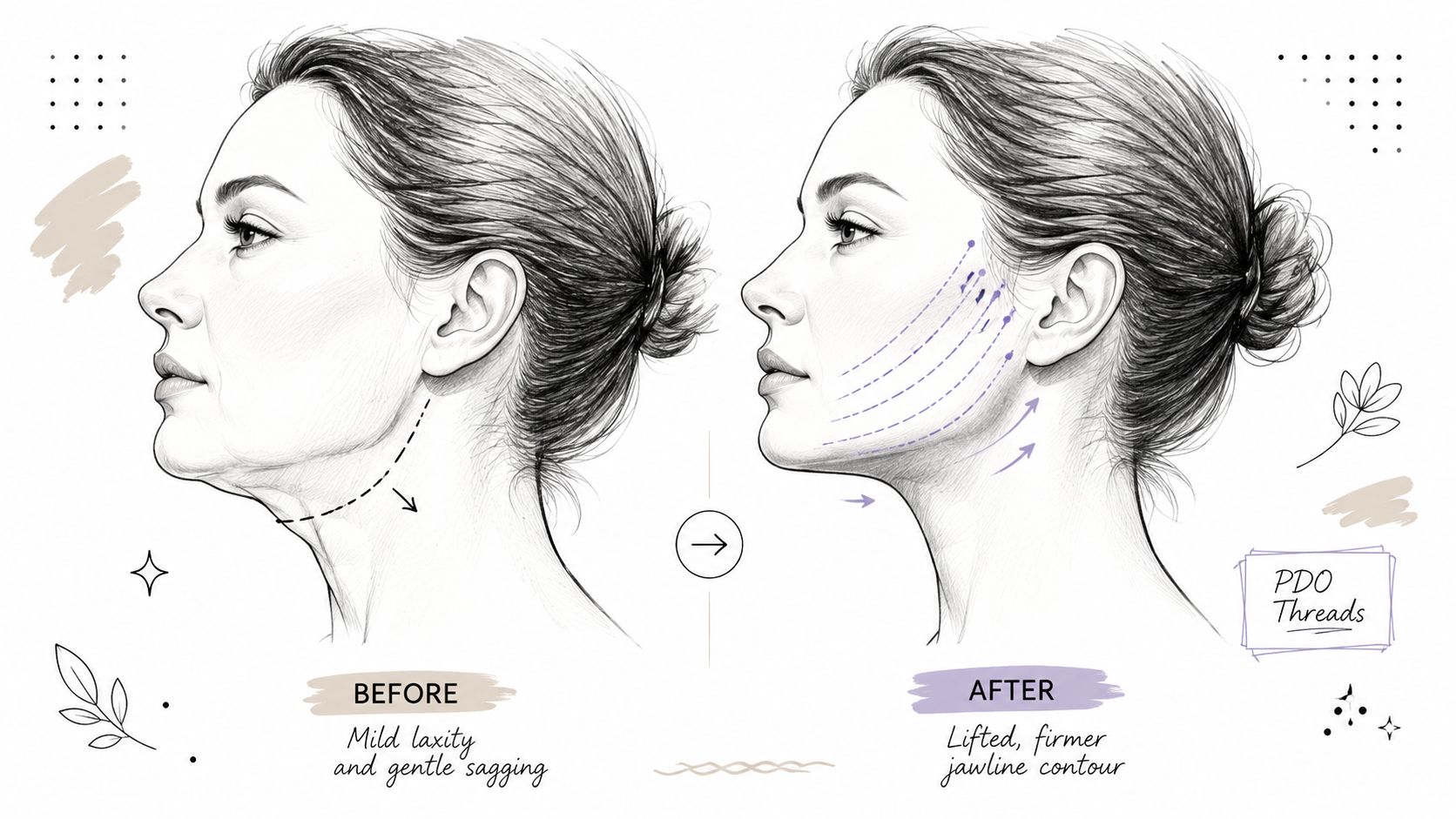
You've probably noticed it in a few different places before you said it out loud. The neckline in photos looks softer. The jawline doesn't separate as cleanly from the neck. Makeup and skincare still help the face look refreshed, but the area under the chin and along the neck seems to age on its own timeline.
That's usually when people start searching for PDO thread lift neck before and after photos, hoping to find something more useful than generic stock images or dramatic, unrealistic transformations. A neck thread lift can create meaningful improvement, but only when the right patient gets the right treatment plan and understands what “after” really means.
Table of Contents
- A Non-Surgical Solution for Neck Laxity
- ProMD Health Bel Air Neck Thread Lift Gallery
- How PDO Threads Lift and Rejuvenate Neck Tissue
- Are You a Good Candidate for a Neck Thread Lift
- The Timeline of Your Neck Thread Lift Results
- What to Expect During Recovery and Aftercare
- Frequently Asked Questions About Neck Thread Lifts
A Non-Surgical Solution for Neck Laxity
A common Bel Air consult starts the same way. A patient turns slightly in the mirror, points under the chin, and says the issue is not dramatic, but their neck no longer matches how youthful the rest of their face looks.
That middle stage is where a PDO thread lift can make sense. It gives support to neck tissue that has started to loosen, without surgery, general anesthesia, or a long stretch of downtime. In practice, I use it for patients who want a cleaner cervicomental angle, better jaw-to-neck definition, and improvement that still looks natural in conversation and profile.
The trade-off matters. Threads can improve mild to moderate laxity, but they do not replace a surgical neck lift in someone with heavier tissue descent, significant platysmal banding, or a large amount of loose skin. Good treatment planning starts with that honesty.
At ProMD Health Bel Air, we also pay close attention to how results are documented. Clear before and after photography should show more than one flattering angle. It should show the actual starting concern, the treatment plan, and the point in the healing timeline when the after photo was taken. For patients reviewing online galleries, basic guidance on optimizing images for web also explains why some photo sets look clearer and more credible than others.
If you are weighing options, it helps to review non-surgical neck and jowl treatment options before deciding that threads are the right fit. Some patients need support and lift. Others do better with skin-quality treatments, jawline contouring, or a combination approach.
What makes pdo thread lift neck before and after images useful is context. The strongest case studies show why the patient came in, why threads were chosen, and what level of change was realistic for that specific neck.
ProMD Health Bel Air Neck Thread Lift Gallery
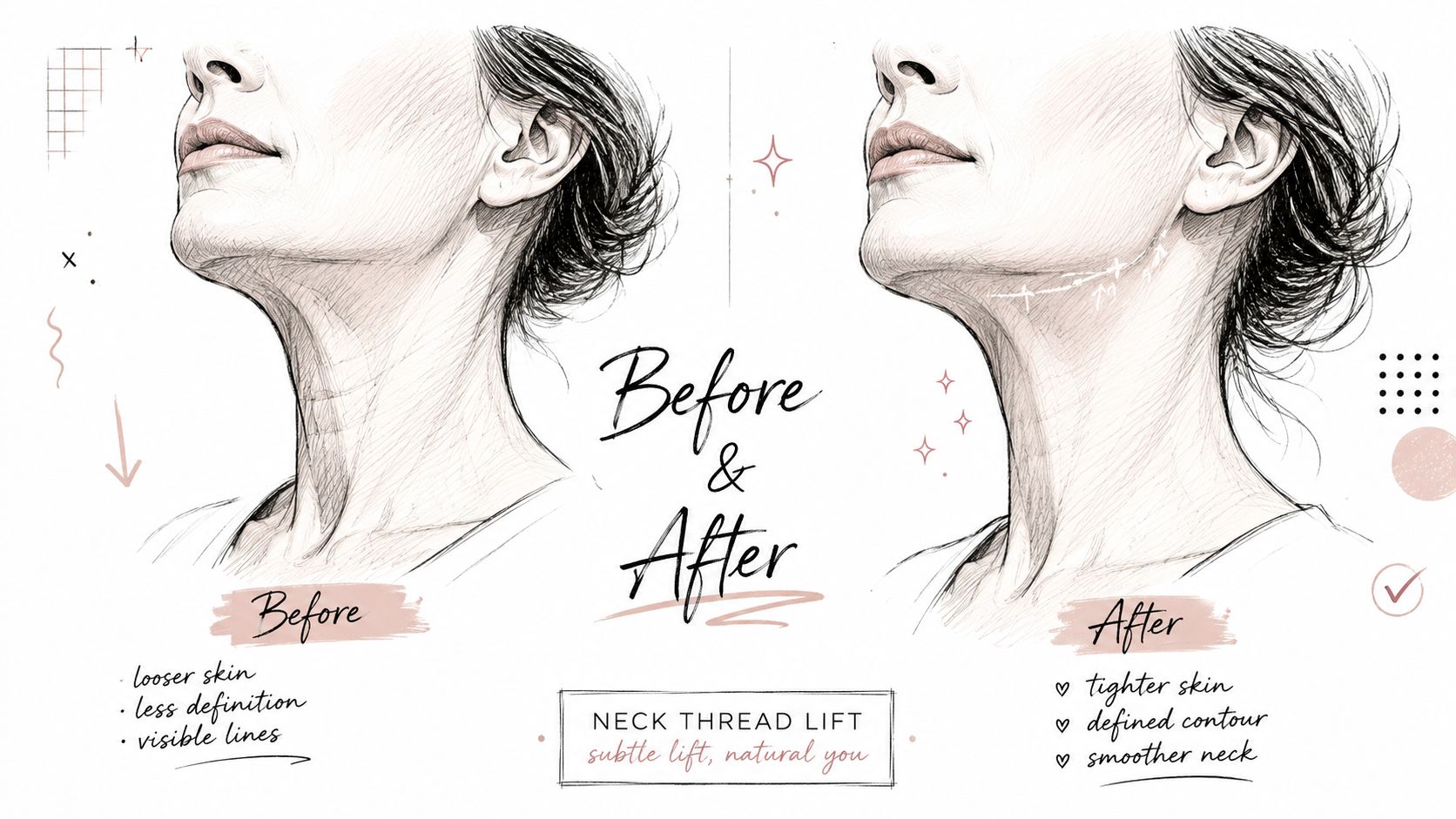
A patient from the Bel Air area comes in saying the same thing I hear often. The face still looks youthful, but the neck gives away fatigue, weight fluctuation, or age sooner than expected. Before-and-after photos only help if they show a patient with a similar starting point and explain why a specific thread plan was chosen.
That is how we build this gallery at ProMD Health Bel Air. The goal is not to show dramatic one-angle transformations. The goal is to show real treatment decisions, realistic improvement, and the point in the healing process when the after photo was taken. Clear presentation matters too. Basic guidance on optimizing images for web helps explain why some online medical galleries look cleaner and more credible than others.
Case Study 1 Restoring Jawline Definition
One of the most common neck-thread consultations starts with early blurring under the jaw. The patient usually does not describe severe sagging. They describe a profile that feels heavier, softer, or less defined in photos than it did a few years ago.
In that case, thread placement is planned around support and direction. The aim is a cleaner jaw-to-neck transition, not a tight or pulled look. Good after photos in this category usually show a sharper neckline in profile and a more distinct jaw border in three-quarter view.
This is also where restraint matters. Adding more threads does not automatically create a better result. In practice, careful vector choice, tissue quality, and patient selection matter more than trying to force a stronger lift. For patients who want more background on thread design and lift patterns, our guide to volume-restoring and bi-directional threads explains how those decisions are made.
Case Study 2 Softening Early Neck Creasing
Some patients are less concerned with fullness and more concerned with texture. Their before photos show early horizontal lines, mild crepiness, or skin that looks thinner and less supported under direct light.
The improvement here is quieter, but it is often very satisfying. The neck can look smoother, firmer, and less crinkled without looking treated. In real practice, these are the cases where expectations need to be set carefully. Threads can improve support and skin quality, but they do not erase etched-in lines the way some patients hope from a single session.
A useful gallery should make that difference obvious. If the concern is surface change more than tissue descent, the value of the procedure is refinement.
Case Study 3 Treating Mild Jowling With Neck Laxity
Another common pattern is a blended lower-face concern. The patient notices early jowls, a softer jawline, and looseness extending into the upper neck. Treating only one area can leave the final result looking incomplete, so the plan has to respect how the jawline and neck read together.
Here is what that usually looks like in a case review:
| Concern in the before photo | Strategy used | What the after photo should show |
|---|---|---|
| Early jowls | Supportive thread placement along lifting vectors | A cleaner jaw contour |
| Mild upper neck laxity | Repositioning with structural support | Better continuity from jaw to neck |
| Soft lower-face outline | Conservative correction | Natural definition without an over-tight look |
Some patients also need adjacent treatment planning, such as neuromodulators or filler, if lower-face balance is part of the problem. Still, the gallery should be honest about what the threads themselves accomplished.
The most useful pdo thread lift neck before and after images do one thing well. They show the right treatment for the right degree of laxity, with enough local context to help a Bel Air patient decide whether their own neck concern looks similar.
How PDO Threads Lift and Rejuvenate Neck Tissue
A patient in Bel Air often comes in saying the same thing. The neck looks heavier or less defined in photos, but it does not feel advanced enough for surgery. That is the space where PDO threads can help, provided the concern is mild to moderate laxity and the treatment plan respects the anatomy of the neck.
What PDO Threads Are Doing Under the Skin
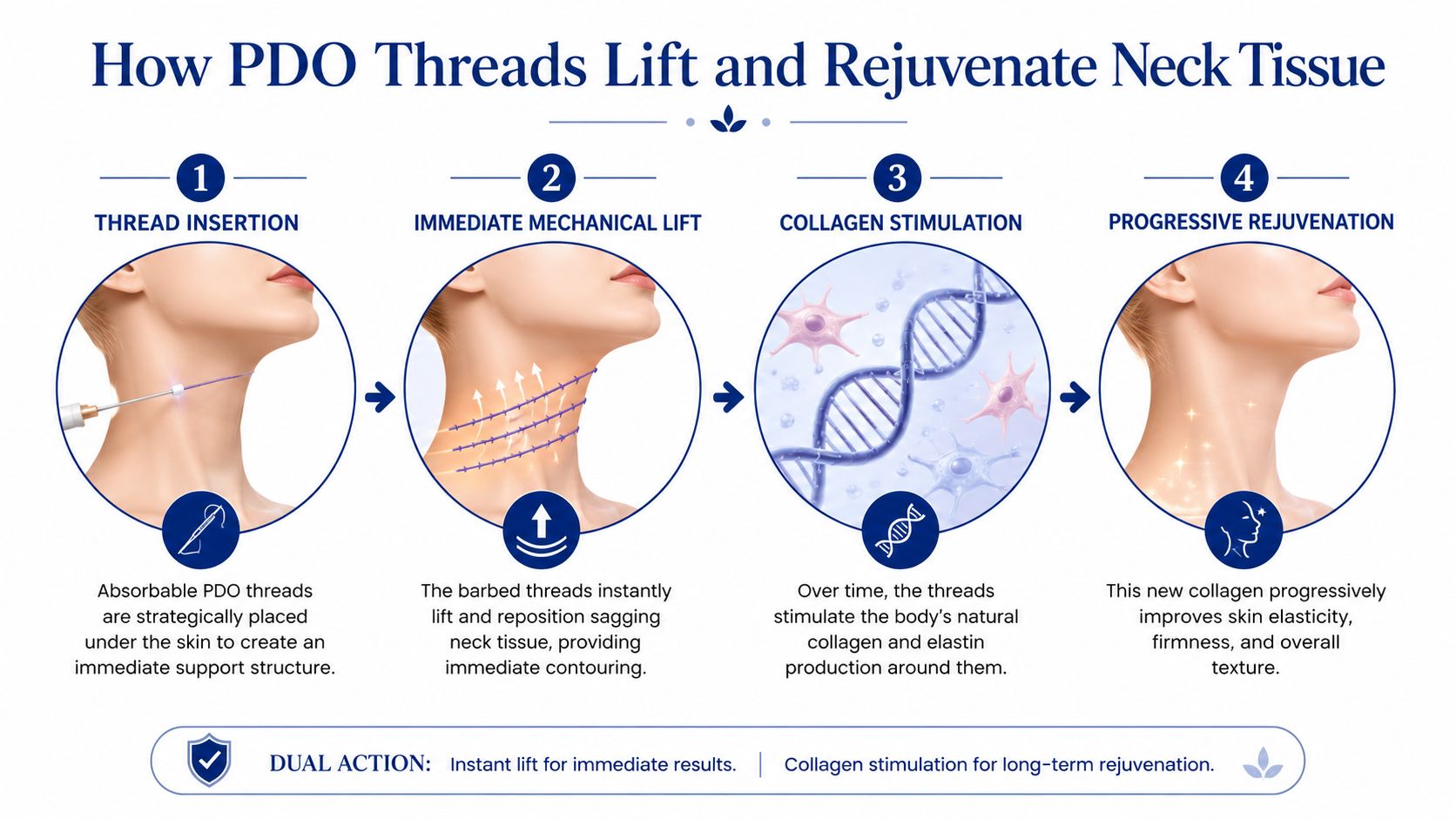
PDO stands for polydioxanone, an absorbable suture material that can be placed beneath the skin to create support. In the neck, that support matters because the skin is thinner, the tissue is mobile, and the area shows laxity early. Proper placement can create an immediate repositioning effect while also encouraging the skin to firm over time.
Patients usually notice two phases of change. The first is structural. The second is biologic, as the tissue responds around the threads and gradually becomes more supported.
At ProMD Health Bel Air, that distinction matters in case planning and in how we review before-and-after photos. A stronger early jaw-neck angle right after placement does not mean the final result is complete that day. The softer, more refined improvement usually develops over the following weeks as swelling settles and collagen response builds.
For patients who want more detail on thread design and lifting behavior, this guide to volume-restoring and bi-directional threads explains how different thread types are selected.
Why the Neck Improves in Stages
The neck is in constant motion. Talking, turning, swallowing, sleeping position, and looking down at a screen all place repeated stress on the area. That is why neck thread results should be judged on a timeline, not on a same-day mirror check.
The process is straightforward:
- Threads are placed along support vectors. The goal is to improve contour without creating an over-pulled look.
- Tissue is gently repositioned. This can sharpen the transition from jawline to neck in the right patient.
- The body forms new support around the threads. That added structure helps the skin look firmer and better organized.
- The threads gradually absorb. The visible benefit depends on the tissue response they helped create, not on permanent implanted tension.
This is also why results vary from one gallery case to another. A patient with early creasing and mild looseness may see a cleaner neckline and smoother texture. A patient with heavier tissue or more skin excess may see partial improvement, but not the degree of change surgery can produce.
A neck thread lift improves support and contour. It does not remove skin, reduce significant heaviness, or replace a surgical neck lift. Patients who understand that usually feel more comfortable with the treatment and more satisfied with the result they get.
Are You a Good Candidate for a Neck Thread Lift

A common Bel Air consult goes like this: a patient pulls up the skin just under the jaw in the mirror and says, “I only want a small improvement, but I want it to look real.” That is often the right starting point for a neck thread lift.
The strongest candidates usually have early to moderate laxity, decent skin quality, and enough natural structure for the threads to support. They want a cleaner neck and jawline transition, not a surgical level change. In our office, those are the cases that tend to photograph well over time because the treatment matches the anatomy.
The Right Candidate Profile
A neck thread lift often suits patients who notice subtle but frustrating changes, such as:
- Early neck looseness: The skin looks less firm, especially in certain lighting or when looking down.
- Loss of jawline definition: The border between the jaw and neck has started to blur.
- Mild jowling with neck involvement: Early descent in the lower face affects the neckline as well.
- A preference for minimal downtime: An in-office treatment fits better than surgery at this stage.
Good candidates also understand the goal. Threads can improve support, soften crepey change, and refine contour. They do not remove extra skin.
When Threads Are Not the Right Answer
Honest consultation matters at this stage. If the neck has significant skin excess, heavier tissue under the chin, or more advanced descent, a thread lift may give only partial improvement. As noted earlier, PDO threads perform best in milder cases.
This is one of the reasons a local case gallery matters more than generic before and after images. At ProMD Health Bel Air, the useful question is not whether threads can create some lift. The key question is whether they can create enough improvement to justify the procedure for that specific patient.
A provider may advise against threads if the concern is mostly fullness, marked laxity, or skin that no longer recoils well. Proper case selection protects patients from spending time and money on a treatment that is unlikely to meet their expectations.
The right plan starts with anatomy, not optimism.
If your tissue can respond to internal support, a neck thread lift can look polished and natural. If your concerns fall outside that range, a different treatment plan is usually the better call.
The Timeline of Your Neck Thread Lift Results
A Bel Air patient often comes back to review her photos and asks the same question. “Is this my final result, or is it still changing?” That question matters, because neck thread lift results develop in stages, and the early appearance can look quite different from the settled outcome.
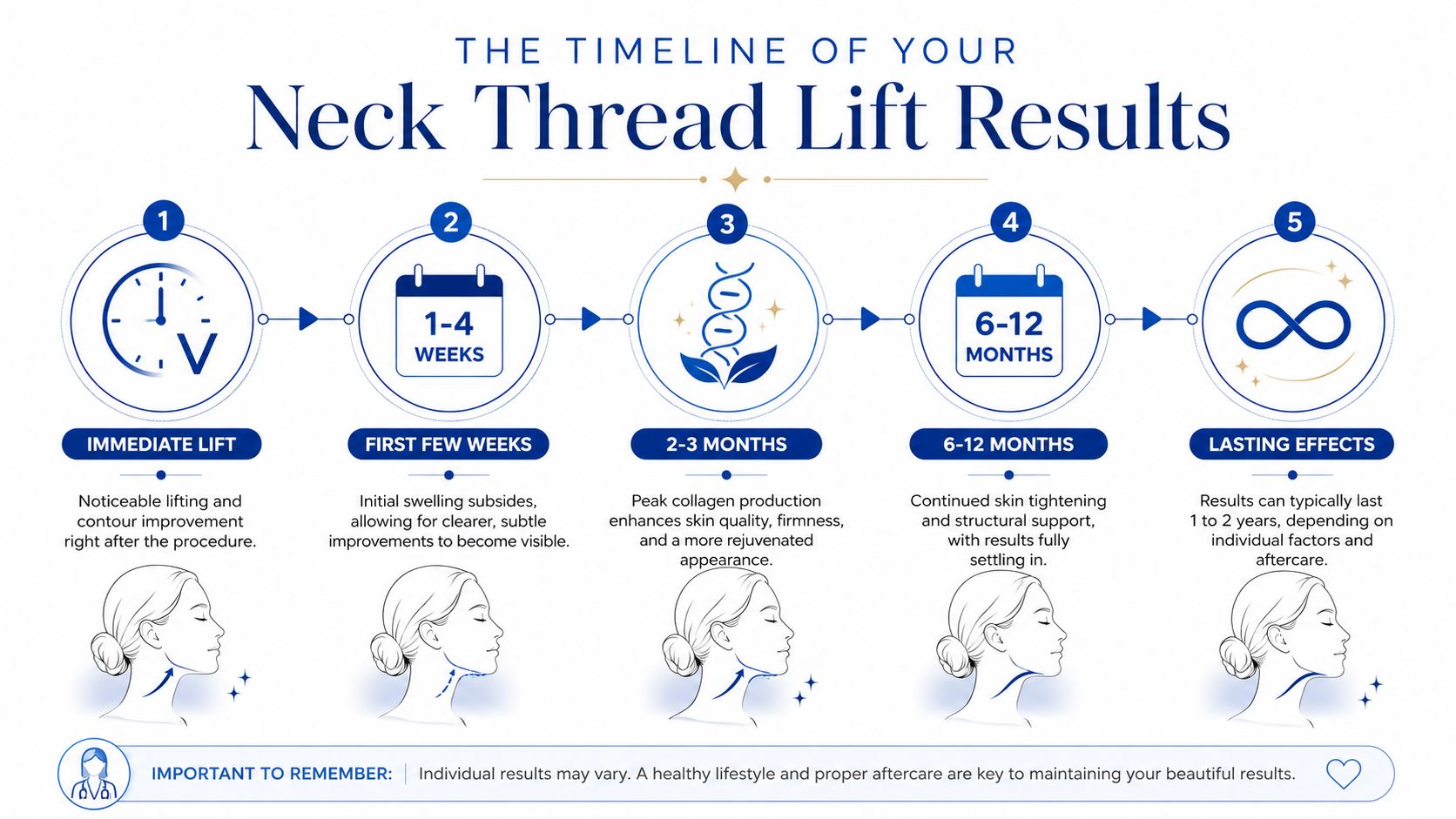
The first change is mechanical support. Threads reposition tissue at the time of placement, so some improvement in neck definition is visible right away. That early look is not the finish line. Swelling, tightness, and small areas of unevenness can temporarily sharpen or blur what you see in the mirror.
This is why immediate before and after images need context. A useful gallery does more than show a day-of angle. At ProMD Health Bel Air, the more honest comparison is the one that matches the biology of healing and shows how the neck looks once the tissue has relaxed into place.
What Usually Happens Over Time
Most patients notice the treatment in phases rather than all at once.
- Right after treatment: There is usually a visible change in contour, especially along the cervicomental angle and under the jaw.
- First 1 to 2 weeks: Swelling settles, tenderness improves, and the neck starts to look less “treated” and more natural.
- Weeks 4 to 8: The result often looks cleaner and more believable as the tissue adapts around the threads.
- Months 2 to 6: Collagen remodeling continues, and many patients notice better firmness and skin quality during this window.
- After that: The neck continues to age normally, but support can remain for many months depending on tissue quality, movement patterns, and how much laxity was present at baseline.
A review in the aesthetic surgery literature describes the same general pattern clinicians see in practice. There is an immediate lifting effect from placement, followed by gradual improvement as fibrosis and collagen form around the threads over the following months. The threads themselves do not create permanent suspension, which is why maintenance planning matters and why realistic case selection matters even more.
Why Timing Changes How “Before and After” Photos Should Be Read
Neck tissue is mobile. Patients talk, turn, swallow, exercise, and sleep on that area every day. Because of that, the day-one photo can look slightly overcorrected in one patient and underwhelming in another, even when both are on track.
The more meaningful after photo is usually taken after early swelling has resolved and the collagen response has had time to show up. In practice, that is when the result starts to match what patients hoped they were buying. It also explains why a local, case-based gallery is more helpful than generic stock before and after images. You can see not only who improved, but how long it took, what the starting anatomy looked like, and whether the strategy matched the concern.
What to Expect During Recovery and Aftercare
A common Bel Air scenario is this. A patient feels fine the next morning, sees only mild swelling, and assumes normal sleep, workouts, and errands are all back on the table. That is usually when we have to slow things down. The neck is in motion all day, and early healing depends as much on what you avoid as on what was done in the treatment room.
The first several days are usually straightforward, but they do require some discipline. Expect tightness, tenderness, and swelling that is often most noticeable early on. Bruising can happen, especially in thinner skin or in patients who are naturally prone to it. Small areas of puckering or unevenness can also show up at first. In practice, these early changes are usually temporary and do not mean the treatment has failed.
The First Several Days
Plan for a quieter schedule. I tell patients at ProMD Health Bel Air to treat the first few days like a protection phase, not a social showcase. You may be able to work, drive, and handle normal daily tasks, but the goal is to limit extra movement, pressure, and friction while the threads settle.
That means being selective about routine habits. Looking down at a phone for long periods, turning the neck sharply during exercise, or sleeping with the face pressed into a pillow can all make the area more irritated.
How to Protect Your Result
Aftercare instructions are simple, but following them closely makes a real difference.
- Sleep with care: Use the position your provider recommends, and avoid putting direct pressure on the treated side of the neck.
- Hold off on hard exercise: Heavy lifting, intense cardio, and workouts that involve neck strain can increase swelling and stress the treated tissue.
- Keep hands off the area: Do not massage, rub, or test the neck because it feels tight or uneven.
- Stay patient with texture changes: Mild bunching, tenderness, or a pulling sensation often improves as swelling settles and tissue adapts.
- Follow your provider's timeline: If something feels more painful than expected or looks noticeably asymmetric, check in rather than guessing.
Patients usually do better when they plan for a few low-key days instead of expecting to look photo-ready right away. That is one reason our local before and after gallery matters. It shows results at meaningful checkpoints, not just immediately after placement, so patients can see what normal healing is like in reality.
Safety questions are reasonable, especially if you are deciding whether neck threads fit your anatomy and tolerance for downtime. This review of whether PDO threads are dangerous covers the risks, limits, and the kind of aftercare judgment that protects a good result.
Aftercare rule: Protect the threads early so the neck can settle evenly and look more natural as healing progresses.
Frequently Asked Questions About Neck Thread Lifts
A question I hear often in Bel Air consultations is simple: “Will this look better, or will it just look tight for a few weeks?” That is the right question. Neck threads can create a visible improvement in the right patient, but the result depends on skin quality, baseline laxity, and how well the treatment plan matches the concern.
Does a neck thread lift hurt
Most patients describe neck thread placement as uncomfortable but very manageable. Expect numbing first, then pressure, a pulling sensation, and some soreness afterward. The appointment itself is usually fairly short, which helps many patients tolerate it well.
The neck can feel tighter than the face in the first few days. That does not mean something is wrong. It usually reflects swelling and tissue adjustment.
How long do neck thread lift results last
Results are not permanent. In practice, I tell patients to expect improvement that gradually softens over time rather than a fixed expiration date.
Some necks hold a result longer because the skin still has decent elasticity and the laxity is mild. Others fade sooner, especially when the skin is thinner, the weight of the tissue is heavier, or the patient wanted more lift than threads can realistically provide. That is why our ProMD Health Bel Air gallery focuses on real checkpoints instead of a single polished after photo. The timeline matters.
Can neck threads be combined with other treatments
Yes, often with better planning than with more product. Threads can pair well with neuromodulators, selected filler work in the lower face or jawline, and regenerative options when the goal is not just lift but better skin support and contour.
The key is sequence. A patient with platysmal banding may benefit from relaxing the neck first. A patient with early jowling and neck laxity may need lower-face support so the neck result looks balanced. Good outcomes come from matching the treatment to the anatomy, not stacking services.
If safety is one of your main concerns, review our guide on whether PDO threads are dangerous before your consultation.
What does a neck thread lift cost
Cost varies based on how many threads are needed, the type of threads used, and whether the neck is treated by itself or as part of a lower-face plan.
A lighter case may need a modest amount of support. A more advanced case may require a broader strategy or may not be a strong thread candidate at all. That is why price without an exam is not very useful. The better question is whether threads are likely to give enough improvement to justify the cost, recovery, and maintenance.
If you're considering a neck thread lift and want a realistic opinion on candidacy, timing, and what your own before-and-after potential may look like, schedule a consultation with ProMD Health Bel Air. An in-person assessment can clarify whether a thread lift is the right fit for your anatomy, goals, and recovery preferences.