Generic oral estradiol can cost about $13 to $25 per month, while compounded hormone pellets commonly run $300 to $500 per insertion every 3 to 4 months, which works out to roughly $1,200 to $2,000 per year. If you've been quoted two very different prices for hormone therapy, that gap is usually about more than the hormone itself, it's about how the medication is delivered, how often you're monitored, and what's bundled into the visit.
A Bel Air patient can hear one plan framed as a simple prescription and another framed as a full care program. Both may be legitimate, but they don't cost the same because they don't include the same things. At ProMD Health Bel Air, that difference matters, especially if you're trying to compare medication-only pricing with a more complete treatment path that may include labs, consults, and follow-up care. Hormone Replacement Therapy at ProMD Health Bel Air
Table of Contents
- Introduction to Hormone Therapy Cost
- Understanding Key Cost Factors
- Typical Cost Ranges for HRT Modalities
- Insurance Coverage and Out of Pocket Expenses
- Financing Options at ProMD Bel Air
- Sample Patient Cost Scenarios
- Strategies to Manage and Reduce Costs
- Conclusion and Next Steps
Introduction to Hormone Therapy Cost
A Bel Air resident walks into a clinic expecting a straightforward answer and gets two different quotes instead. One quote sounds low because it only covers the medication, while the other is higher because it includes office time, monitoring, and lab work. That's the part often overlooked when first inquiring about hormone therapy cost.
The price spread is real, and it starts with the basics. A 2026 review places cash-pay hormone replacement therapy at about $15 to $200 per month overall, with many generic regimens staying under $50 per month and telehealth bundles adding roughly $25 to $110 per month Vidabeacon's HRT cost review. That range is wide because hormone therapy isn't one fixed product, it can be a pharmacy script, a pellet program, or a bundled care plan with repeat visits.
Practical rule: Ask for the full year-one estimate, not just the monthly medication price.
That question changes the conversation fast. It forces the clinic to separate the drug cost from the care cost, which is the only way to compare options fairly. It also helps you see whether a quoted price is a maintenance prescription, a monitored program, or something in between.
Understanding Key Cost Factors
What drives the bill
The biggest cost driver is the delivery route. Oral estradiol, transdermal patches or gels, injections, and pellets don't all cost the same to produce, dispense, or manage, and older medication-cost data show that route alone can change annual spend substantially. In one published analysis, oral estrogens ranged from US$47.45 to US$591.30 per year, transdermal estrogens from US$357.76 to US$657.80, and combined therapies from US$474.50 to US$803.00 PMC medication-cost study.
That's why a medication with a similar clinical goal can land in a very different pricing tier. The pharmacy receipt is only one layer. The full bill can also include the consultation, safety labs, dosage adjustments, and any dispensing or membership fees.
Why the same therapy can cost more or less
Whether a product is FDA-approved or compounded matters too. In the U.S. market, generic oral estradiol can cost about $13 to $25 per month, while compounded hormone pellets commonly cost $300 to $500 per insertion every 3 to 4 months, or roughly $1,200 to $2,000 per year Vidabeacon HRT cost review. That's a big jump, but it usually reflects more than the active ingredient. It reflects the delivery system, the visit cadence, and the monitoring model around it.
An independent Bel Air-area estimate puts monthly hormone therapy at about $150 to $600, including medication, office visits, and lab testing needed to monitor hormone levels Bel Air cost estimate. That local number is useful because it captures the all-in reality many pricing pages leave out.
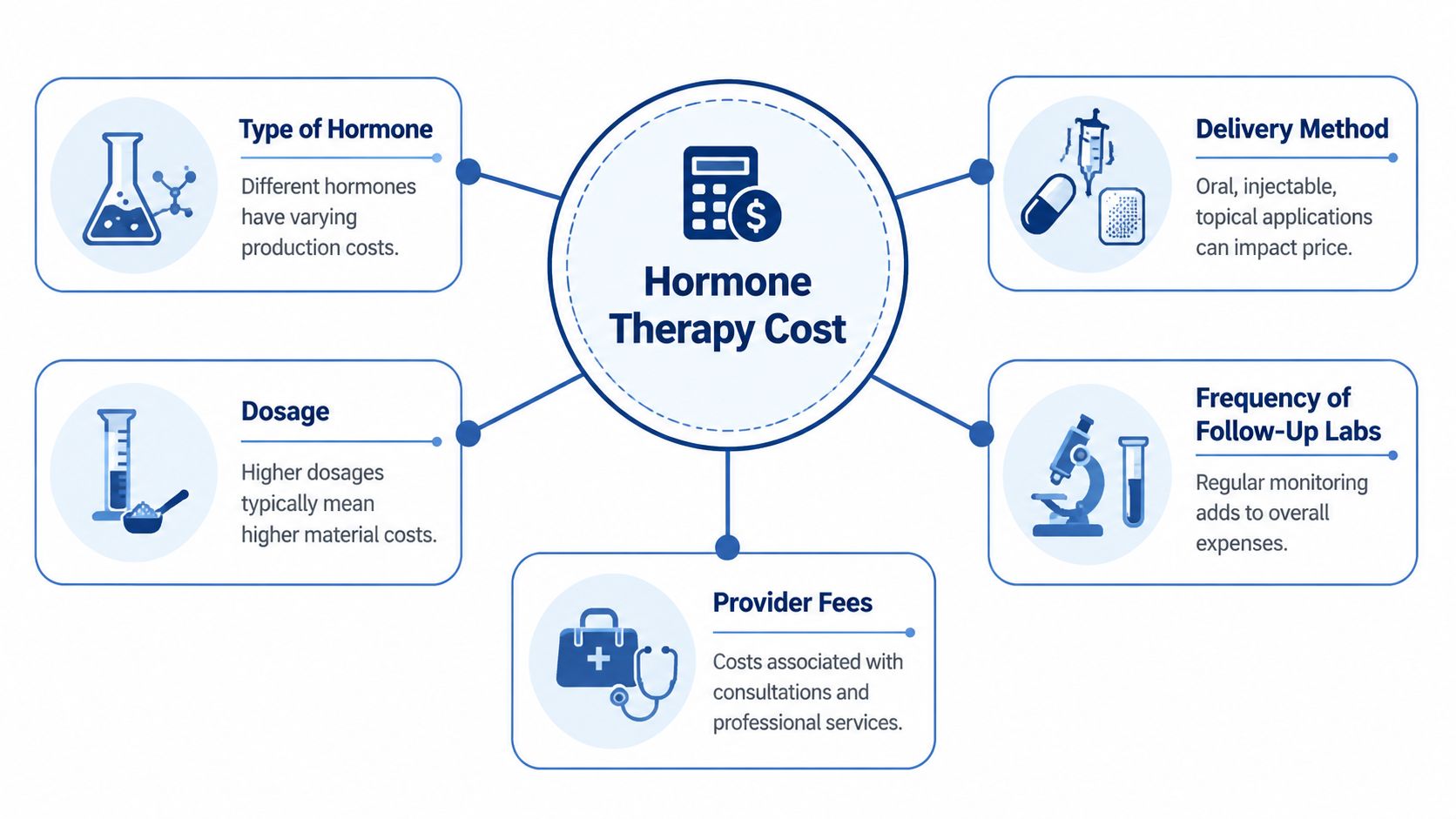
Bottom line: The medication is only one part of hormone therapy cost. Delivery method, dosage, follow-up labs, and provider fees can be just as important as the prescription itself.
Typical Cost Ranges for HRT Modalities
Comparing common delivery methods
A useful way to compare hormone therapy cost is by delivery method, because the same hormone can be priced very differently depending on how it's given. Oral therapy is usually the lightest lift on the pharmacy side, while pellet-based care typically involves a larger upfront charge and fewer insertions over the year. If you're trying to understand where your money goes, this side-by-side view is more helpful than a single headline number.
| Modality | Cost Range | Frequency or Notes |
|---|---|---|
| Oral estradiol | $13 to $25 per month | Usually the lowest-cost medication route in the U.S. market Vidabeacon |
| Generic oral HRT | $10 to $30 per month | Often the simplest medication-only option, before labs and visits Midi cost overview |
| Bundled HRT plans | $100 to $300 per month | Often include medication, visits, and lab coordination Midi cost overview |
| Transdermal estrogen | US$357.76 to US$657.80 per year | Medication layer is usually higher than many oral options PMC study |
| Compounded pellets | $300 to $500 per insertion | Insertions often repeat every 3 to 4 months, or about $1,200 to $2,000 per year Vidabeacon |
For patients comparing pellet care with other approaches, timing matters. ProMD Health's pellet hormone therapy page states that women typically experience relief for 3 to 5 months and men for 4 to 6 months, which means maintenance visits are spaced out rather than monthly ProMD pellet hormone therapy. That cadence can feel simpler, but the upfront price is still higher than an oral prescription.
If you're also reading about metabolic or peptide-based support, optimizing hormones with peptide protocols can be useful background because it helps you distinguish hormone replacement from adjacent wellness approaches. They're not priced or structured the same way.
ProMD Health Bel Air also offers BioTE hormone pellets as one HRT option, which fits into the pellet category above. BioTE hormone pellets at ProMD Health Bel Air
Insurance Coverage and Out of Pocket Expenses
Why coverage changes the picture
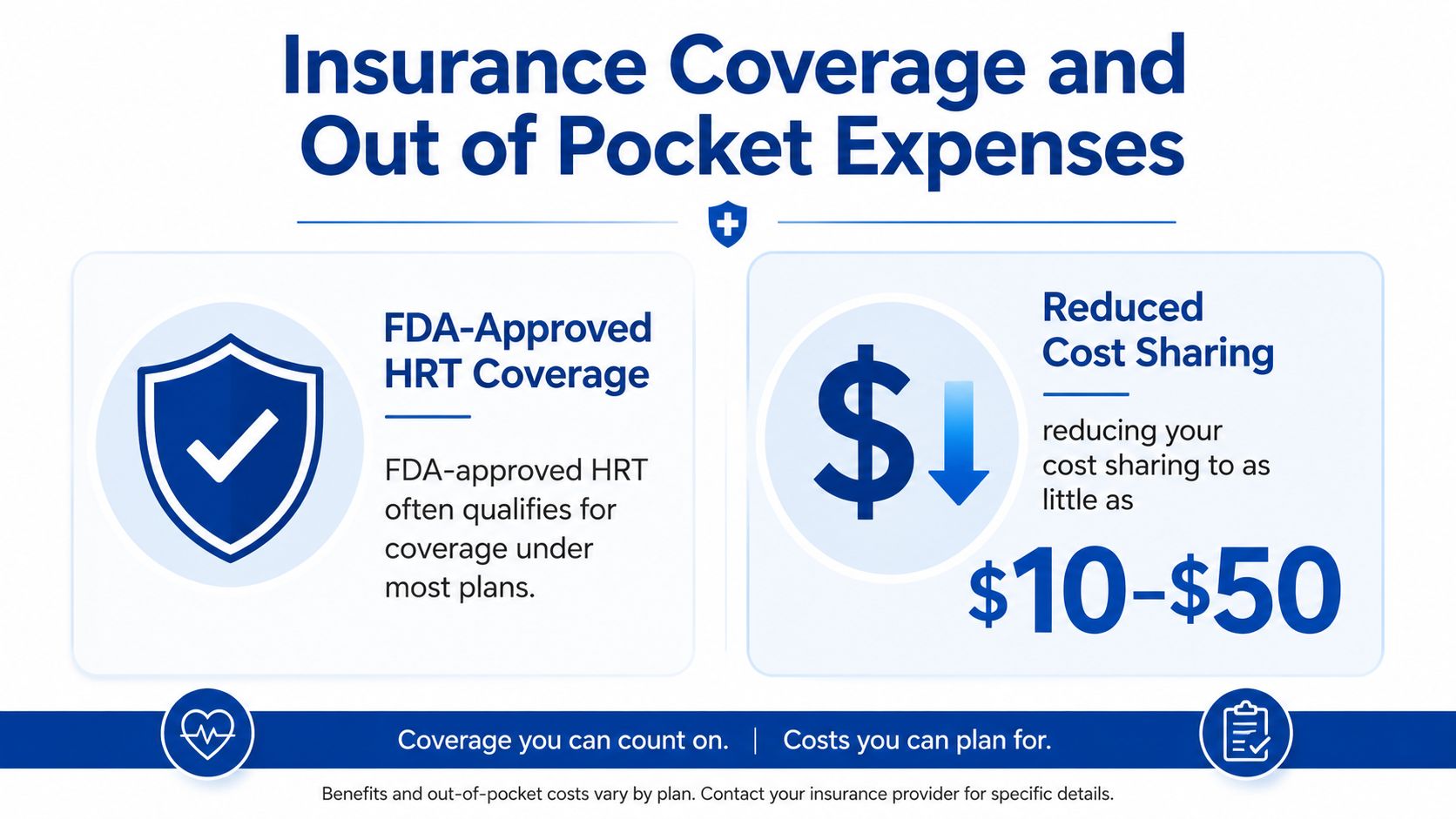
Insurance can shrink out-of-pocket expense fast, but only when the hormone and the benefit design line up. One 2026 guide reports that insurance covers FDA-approved hormones for menopause treatment in approximately 85% of plans, bringing patient cost sharing down to about $10 to $50 per month Formblends HRT cost guide. That's a very different number from cash-pay pellet programs or concierge-style care.
The reason is simple. Insurers tend to favor products that are FDA-approved and on formulary, while compounded or highly customized programs may sit outside standard coverage. When coverage applies, the patient may still owe copays or coinsurance, but the medication line item is often much lower than people expect.
What to verify before you start
Ask these questions before your first fill: Is the hormone FDA-approved, is it covered under my plan, and does prior authorization apply?
That single check can save a lot of confusion later. You'll want to know whether your plan treats the therapy as a standard pharmacy benefit, whether the pharmacy must use a preferred formulation, and whether the clinic needs to submit paperwork before the prescription is filled. If the answer is no coverage, the same therapy may shift into cash-pay territory immediately.
The claims data in gender-affirming hormone care show how coverage can compress patient burden. In one large claims study, median patient out-of-pocket costs were only US$5.00 to US$12.86 for commonly prescribed hormones when coverage was present, even though broader system spending still mattered Springer claims study. The point isn't that every patient pays that little, it's that the insurance design can matter more than the molecule itself.
Financing Options at ProMD Bel Air
How payment structure affects access
Even when a therapy is clinically appropriate, the timing of payment can be the barrier. Some patients can handle a small pharmacy copay but not a larger first-visit bill plus labs. Others prefer to spread costs out so the first month doesn't feel overloaded.
ProMD Health Bel Air says it offers financing offers that can help make care more manageable. Those options are worth discussing early because they can change whether a treatment feels feasible in the first place. ProMD financing offers
How to think about the options
The practical choice usually comes down to three paths. A membership-style arrangement can smooth recurring care. A bundled package can make the care components easier to predict. A payment plan can reduce the sting of paying everything at once.
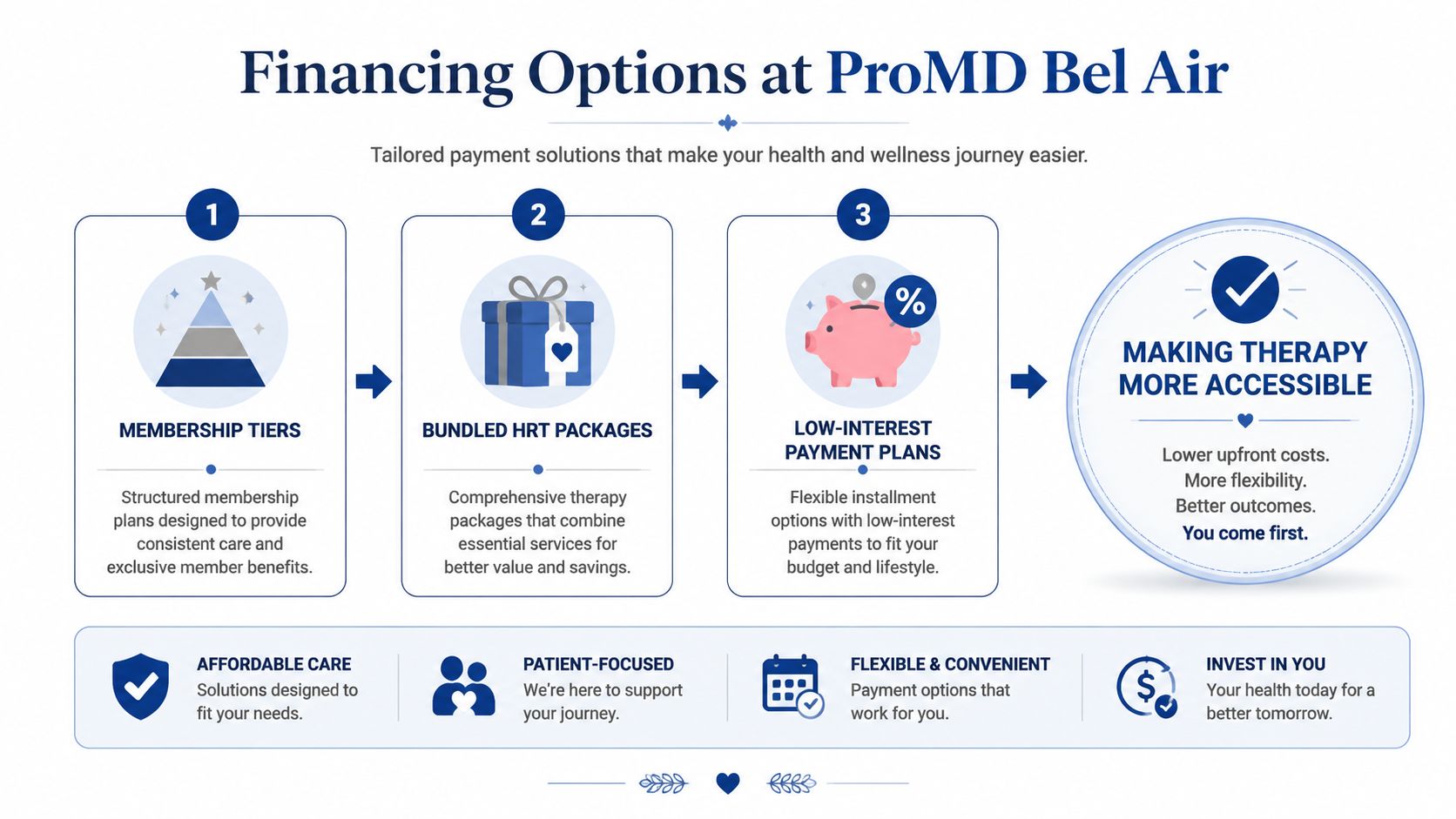
- Membership tiers: Good for people who expect steady follow-up and want a more predictable monthly pattern.
- Bundled HRT packages: Helpful when you want medication, labs, and visits organized into one structure.
- Low-interest payment plans: Useful when the main problem is upfront cash flow, not the total treatment decision.
If you're asking the front desk how this works, start with the billing cadence, the amount due at checkout, and whether labs are billed separately. That's the fastest way to see the actual monthly impact. The clinic can also help you understand whether a financing option pairs well with insurance or whether the therapy is likely to remain cash-pay.
Sample Patient Cost Scenarios
A woman using oral estrogen
A 45-year-old woman starts with generic oral estradiol. Her medication cost could fall near the $13 to $25 per month range, but that only tells part of the story Vidabeacon HRT cost review. If her plan includes monitoring, office visits, and lab work, the total will rise above the pharmacy price.
In a simple year-one budget, the biggest difference is whether she's paying for medication only or paying for a structured care plan. A low monthly drug price can still become a mid-range annual spend once follow-up is added. That's why a “cheap” prescription is not always the cheapest treatment in practice.
A man choosing pellet therapy
A 55-year-old man chooses pellets because he wants fewer maintenance visits. The pellet price typically lands at $300 to $500 per insertion, with repeat placement every 3 to 4 months, or roughly $1,200 to $2,000 per year Vidabeacon HRT cost review. He may appreciate the spacing, but the total annual medication spend is much higher than oral generics.
People often misunderstand this. They hear “fewer visits” and assume “lower cost.” In reality, fewer visits can mean convenience, not savings. If the insertion fee is built into each cycle, the annual total still adds up quickly.
A patient comparing routes
A 50-year-old patient is deciding between an oral route and a pellet route after noticing a big gap in quote style. The oral option feels lighter month to month. The pellet option feels easier to manage because maintenance is less frequent.
The right comparison is not just monthly cost versus monthly cost. It's total year-one spend, then maintenance spend after dosing stabilizes.
That distinction matters because the first year often includes extra visits, lab review, and dose refinement. Once a regimen stabilizes, the ongoing cost can change, but the starting quote should still show the full picture. That's the only way to compare options.
Strategies to Manage and Reduce Costs
Ways to keep spending under control
The easiest way to reduce hormone therapy cost is to ask what can be simplified without changing the clinical goal. Generic products usually cost less than highly customized programs, and pharmacy-only regimens can be cheaper than bundled care when you don't need extra services. A useful comparison shows generic HRT as low as $10 to $30 per month versus bundled plans at $100 to $300 monthly Midi cost overview.
That gap usually comes from what's added on top of the prescription. Consults, labs, and monitoring can all be appropriate, but you should know when they're included and when they're separate. If a provider explains the cost in layers, you can decide which layer you need.
Practical cost-saving moves
- Use the right formulation: If a generic FDA-approved option fits your care plan, it may reduce pharmacy spending.
- Bundle labs when possible: Grouping monitoring visits can keep the billing pattern simpler.
- Ask about insurance first: Coverage can turn a cash-pay idea into a much lower monthly expense.
- Watch the timing of follow-ups: Don't overpay for repeat visits you don't yet need.
- Clarify what's in the quote: A quoted price should say whether labs, consults, and medication are all included.
If you want a local place to start, ProMD Health Bel Air offers hormone replacement therapy in a medically supervised setting, and that makes it easier to ask for a clear cost breakdown before you commit. The value is in transparency, not in guessing.
Conclusion and Next Steps
Hormone therapy pricing makes more sense once you split it into pieces. The medication has one price, the delivery method has another, and the consultation and lab layer can change the total again. Once you see those parts separately, the quotes stop looking random.
The smartest next step is to request a personalized estimate, then verify whether your plan covers FDA-approved therapy or whether you're looking at cash-pay care. From there, you can compare the annual cost of oral therapy, pellet therapy, or a bundled program without mixing up pharmacy price and total treatment price. If you want a local team to help you sort through those choices, ProMD Health Bel Air's medically supervised approach can give you a clearer path forward.
Tyra Lindblad, Kate Maguire, Amanda Pittillo, PA-C, Lauren Mason, PA-C, MSHS, Paige Scott, and Natalie Shek are part of the Bel Air team, and a consultation can help you decide which payment structure fits your budget and your goals.
A CTA for ProMD Health Bel Air.