
You catch it in a bathroom mirror or under a parking lot light after work. The skin under your eyes looks flatter, darker, or just more tired than the rest of you, and no amount of sleep seems to change the shadow. For a lot of people in Bel Air, that's the moment the conversation about filler for under eyes starts, because the concern isn't just fine lines, it's the hollow that makes the whole face look worn down.
At ProMD Health Bel Air, that conversation should stay honest. Under-eye filler can help, but only when the problem is really a tear trough hollow and the anatomy is right for it. This guide takes you through what that means, why hyaluronic acid is usually the starting point, how an in-office consultation works, what recovery looks like, and where filler stops being the right answer.
Table of Contents
- Why Patients in Bel Air Are Asking About Under Eye Filler
- How the Tear Trough Works and Who Is a Good Candidate
- Filler Types and Why Hyaluronic Acid Leads for Under Eyes
- What a Bel Air Under Eye Filler Appointment Actually Looks Like
- Recovery, Aftercare, and a Realistic Day by Day Timeline
- Risks, Complications, and How the Bel Air Team Reduces Them
- Alternatives Worth Considering Before You Book Filler
- Cost, Consultations, and Booking at ProMD Health Bel Air
Why Patients in Bel Air Are Asking About Under Eye Filler
The complaint usually sounds simple. “I look tired.” “Concealer isn't helping.” “My eyes look sunken even when I'm rested.” In real life, those are often different versions of the same issue, a visible tear trough hollow that throws shadow under the eye and changes the balance of the face.
That matters because under-eye concerns aren't always about skin quality. Sometimes the issue is volume loss, sometimes it's pigment, sometimes it's puffiness, and sometimes it's a mix. Filler for under eyes only helps when the main problem is structure, not when the issue is mostly discoloration or swelling.
At ProMD Health Bel Air, the conversation has to start with the right diagnosis, not the product. The under-eye area is thin, unforgiving, and easy to overcorrect, which is why a medically supervised setting matters. If you're trying to decide whether this is something you should book, this is the right guide if you want straight talk about candidacy, product choice, recovery, and safety.
Practical rule: if the shadow changes when you tilt your head or pull the skin gently, volume loss is more likely part of the problem.
How the Tear Trough Works and Who Is a Good Candidate
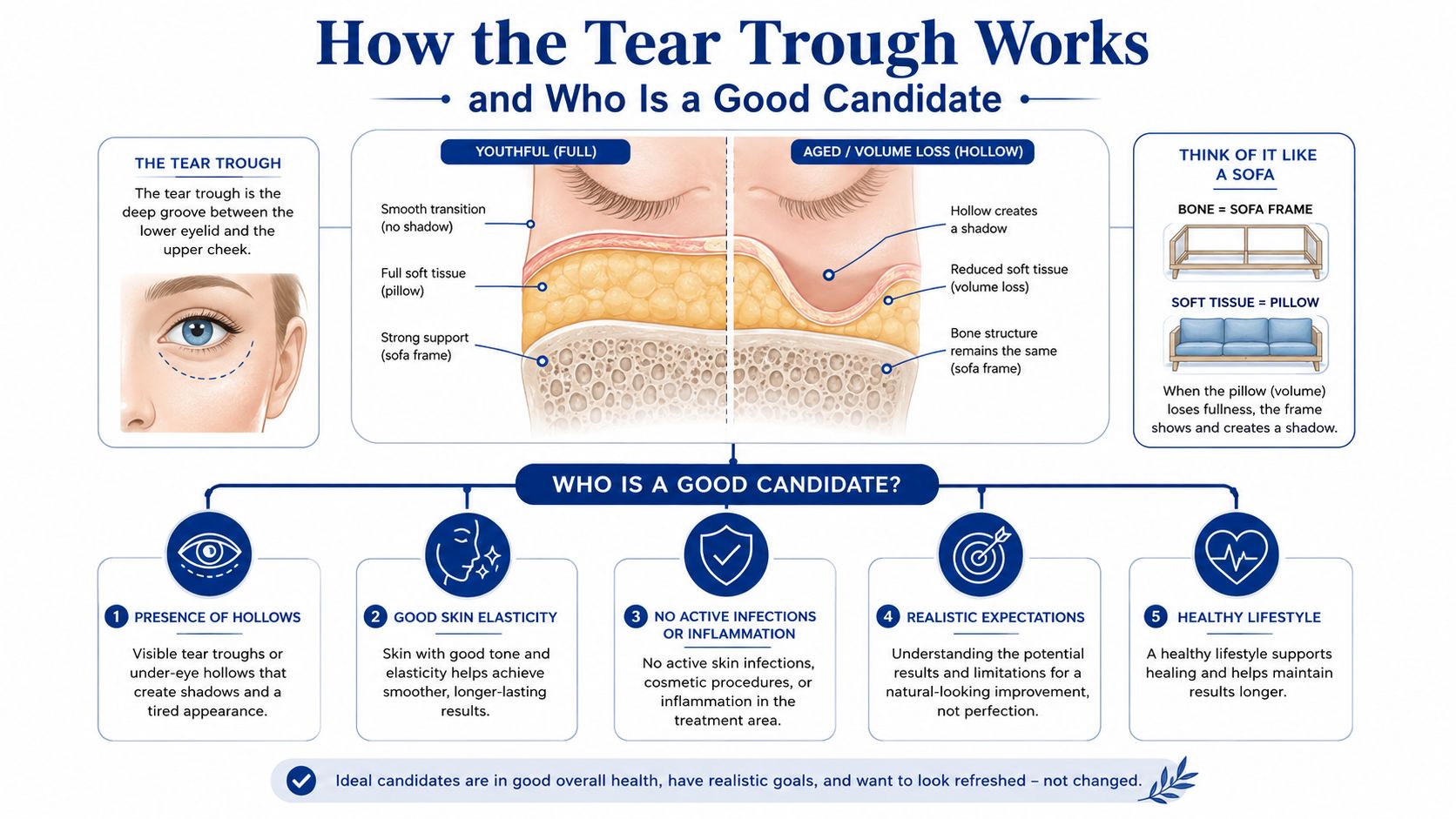
The easiest way to understand the tear trough is to think of the under-eye area like a sofa cushion over a frame. When the cushion loses fullness, the frame starts to show through, and the light creates a shadow where the surface dips. That's the look many people call a tired face, even when they're sleeping fine.
What makes someone a reasonable candidate
A good candidate usually has under-eye hollowing, mild to moderate shadowing, and skin that still has enough thickness to hold filler smoothly. People with age-related volume loss and people who've had the hollow look for years because of genetics are both common candidates. In a clinical review of 1,956 patients treated for tear trough deformity, the mean age was 44.9 years, which fits with the fact that many patients start looking into treatment in midlife, not only later on AAO review of tear trough filler outcomes.
The same review showed 74.4% of those patients were female and 84.4% reported overall satisfaction, with 76.7% still satisfied at 6+ months AAO review of tear trough filler outcomes. That doesn't mean everyone is a candidate, but it does show this is a well-used treatment when the anatomy fits.
Best-fit candidates tend to have hollows more than bags, realistic expectations, and no active swelling issue masking the real problem.
Who should pause before booking
Patients with noticeable puffiness from fluid retention, allergies, or protruding fat pads usually need a different plan first. If the lower lid is already full or swollen, adding filler can make the area look heavier instead of fresher. Significant skin laxity can also limit how clean the result looks, because filler can't tighten loose skin.
Active infection, irritation, or a history that suggests unstable swelling should be discussed carefully in consultation. The under-eye area does not tolerate casual decision-making. It rewards restraint, and it punishes overfilling.
Filler Types and Why Hyaluronic Acid Leads for Under Eyes
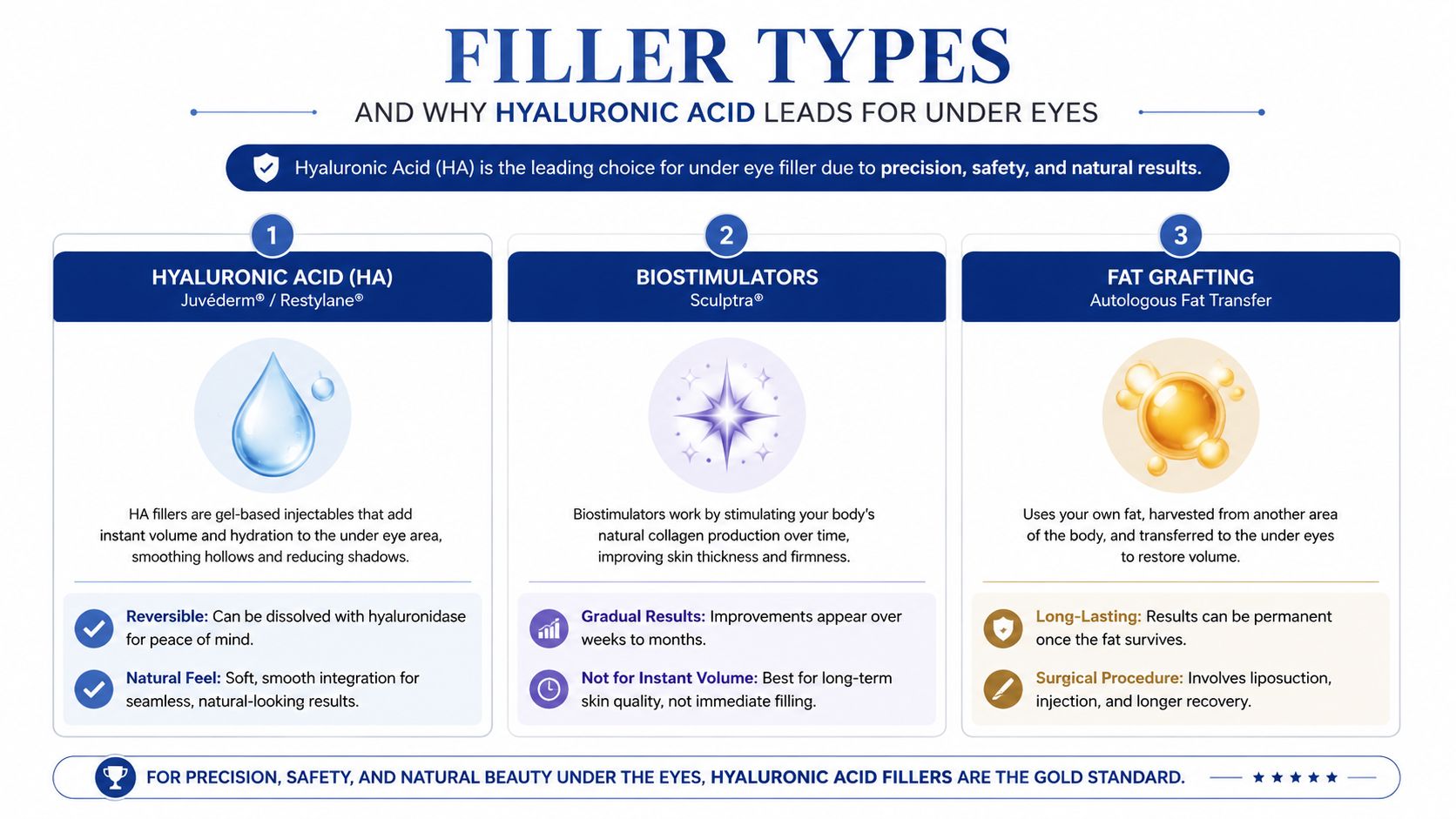
For the tear trough, the product choice isn't about what sounds strongest. It's about what behaves best in thin skin. That's why hyaluronic acid fillers lead here, because they can be selected for softness, adjusted conservatively, and reversed if needed.
A clinical review of infraorbital filler performance emphasizes low elasticity (G′), low cohesivity, and low water uptake for the under-eye region, because the tissue is thin and prone to visible irregularity and puffiness when the wrong material is used clinical review on infraorbital filler properties. A related study also found favorable infraorbital behavior when a small-particle HA filler had low elasticity, low cohesiveness, high tanδ, narrow particle distribution, and small particle size clinical study on small-particle HA filler behavior. In plain English, the material has to spread evenly without building ridges or drawing too much water.
The best-studied under-eye products are still HA-based for that reason. A peer-reviewed review described Juvéderm Ultra XC as containing 24 mg/mL of HA with a 6% cross-linked composition, designed as a soft, viscous, nonbeaded gel to improve smoothness and durability peer-reviewed tear trough review. FDA-facing manufacturer information also states that JUVÉDERM VOLBELLA XC is approved for under-eye hollowing and can last up to 1 year with optimal treatment, using a small needle or cannula for placement peer-reviewed tear trough review.
The newer milestone in this space is Restylane Eyelight, which the FDA approved for undereye hollows in adults over age 21 on June 5, 2023 Galderma FDA approval announcement. Galderma's clinical data reported that more than 70% of treated patients improved at 3 months, and that improvement persisted to 18 months in the optimal-treatment group Restylane Eyelight fact sheet. That kind of durability matters because under-eye filler is often a value conversation as much as an aesthetic one.
For a broader look at longevity, this internal guide on how long dermal fillers really last is a useful companion read.
Why HA stays first-line: it's precise, conservative, and forgiving if the area needs adjustment.
Biostimulators like Sculptra can be excellent in other parts of the face, but the tear trough is not where I'd start with them. They work gradually, which is useful for some treatment plans, but the under-eye area usually needs exact placement and a predictable surface. Fat grafting is another option, but it's surgical in nature and doesn't belong in the same category as a straightforward filler visit.
A practical way to think about it is this. If the issue is a delicate contour problem, HA filler is usually the most controlled first step. If the issue is broader facial volume or a surgical contour correction, that's a different conversation.
One note on skincare-style “blend” marketing, a product like a hyaluronic acid collagen blend may interest people looking at skin support from the inside out, but it isn't a substitute for structural correction under the eye. That distinction matters.
What a Bel Air Under Eye Filler Appointment Actually Looks Like
The visit starts with a medical conversation, not a syringe. A good injector asks what bothers you, checks your history, looks at the skin, and decides whether the problem is hollowing, puffiness, pigment, or a mix of all three. That first minute matters more than you might think, because the wrong diagnosis leads to the wrong result.
At ProMD Health Bel Air, the appointment can also include the Entity Med AI Simulator to preview possible post-treatment outcomes. That doesn't replace judgment, and it's not a promise machine, but it does help set expectations before anyone injects. A visual preview is useful when patients are trying to understand how much lift, not just how much volume, is needed.
What happens on treatment day
The skin is cleaned, the area is assessed again, and numbing is discussed if it's appropriate for the plan. Under-eye filler is usually placed with either a needle or cannula, depending on anatomy, product, and injector preference. The goal is small, layered placement, not a single big deposit.
Small amounts matter here. The under-eye area can look overdone fast, so a careful injector builds support gradually and checks the surface as the product settles. That's also why the mirror check at the end is part of the appointment, not an afterthought.
Good under-eye filler should look like less shadow, not like filler.
If the product or plane isn't right, the result can look puffy, bumpy, or unnatural. That's exactly why a medically supervised clinic is the right setting for this treatment, especially in a delicate zone where a small mistake is visible.
Recovery, Aftercare, and a Realistic Day by Day Timeline
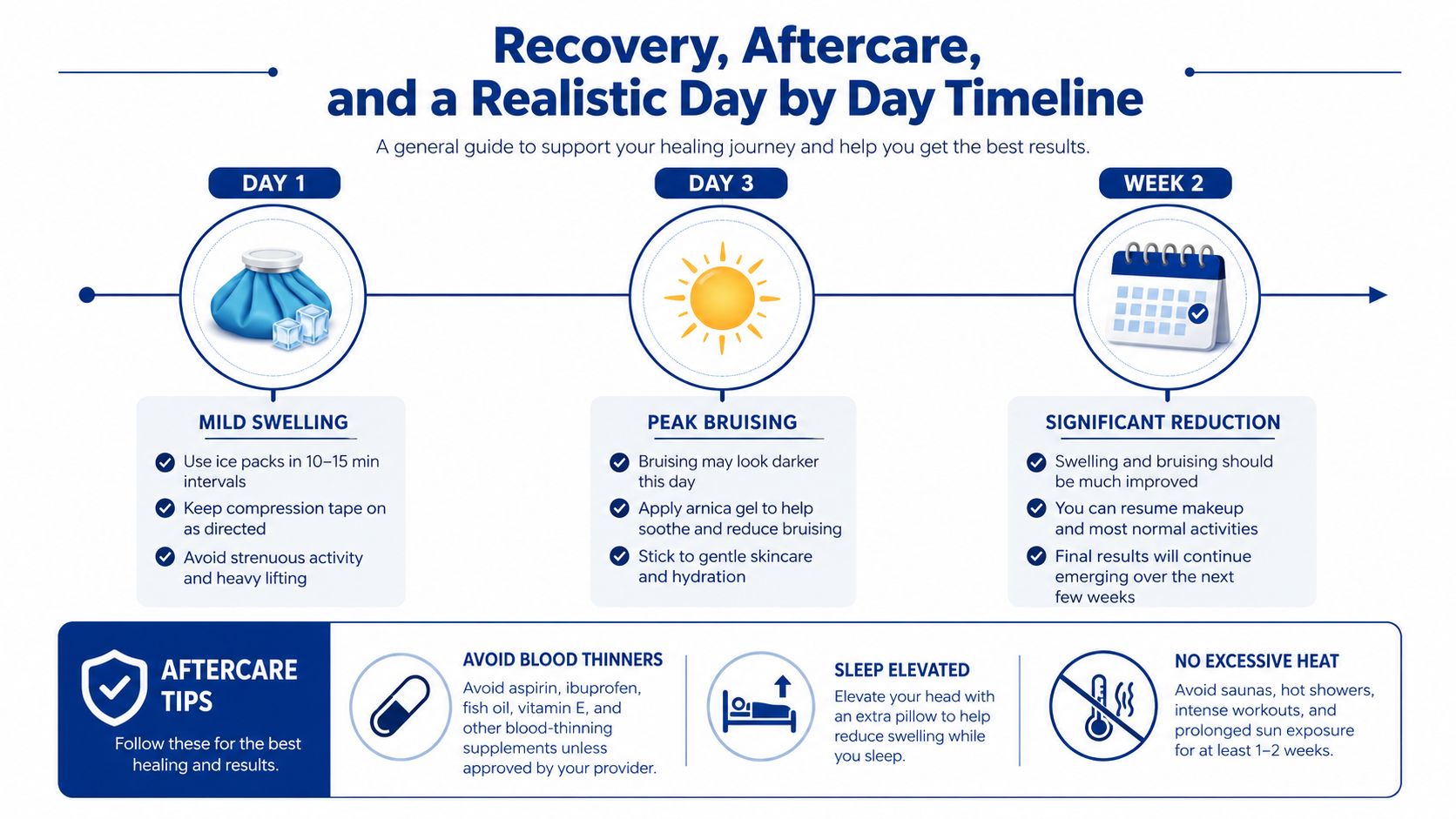
Recovery is usually pretty manageable, but it's not nothing. In a review of 1,956 patients, the most common complications were ecchymosis (12.9%), edema (9.2%), and lumpiness (6.5%) AAO review of tear trough filler outcomes. Those numbers are exactly why patients should expect bruising or swelling to be part of the process rather than a surprise.
Day one usually means mild swelling, tenderness, and maybe a little asymmetry while the product settles. Ice can help, and sleeping with your head raised is smart. I also tell patients to skip strenuous exercise for a short window and to leave the area alone rather than pressing or massaging it.
Day three is often when bruising shows itself most clearly if it's going to show at all. Makeup can usually help once the skin is calm enough, but that should be based on the injector's post-care guidance, not on guesswork. Gentle skincare is fine, harsh rubbing isn't.
By about the second week, the area should look more settled and the final contour starts to show itself. That's when patients usually judge whether the correction was balanced enough or whether they need a follow-up conversation. The patients who do best are usually the ones who expected a gradual polish, not a dramatic transformation overnight.
Call the clinic sooner if swelling is getting worse instead of better, if pain is out of proportion, or if skin color changes look unusual. Under-eye filler recovery should be watchful, not alarmist.
Risks, Complications, and How the Bel Air Team Reduces Them
The internet makes under-eye filler sound either effortless or terrifying. Real practice sits in the middle. The procedure is common and generally effective, but the area is delicate enough that the injector's technique, product choice, and anatomy knowledge really matter.
The serious risks are uncommon, but they're real. The under-eye region has blood vessels that require respect, and poor placement can cause vascular problems. The area also has a reputation for the Tyndall effect, which is that bluish cast you can get when filler sits too superficially under thin skin. That's not a reason to avoid the treatment, it's a reason to do it properly.
What lowers risk in a medical clinic
A trained injector maps the anatomy before placing filler. The product is chosen for the tear trough, not for cheeks or lips. A cannula may be preferred in some cases because it can reduce sharp vessel trauma, though the final choice still depends on the patient's anatomy and the injector's plan.
If the filler is hyaluronic acid, having hyaluronidase available is part of prudent practice because HA filler can be dissolved if correction is needed. That safety net is one of the reasons HA is such a practical choice under the eye. It gives the injector room to be conservative, which is exactly what this area requires.
The safest environment is the one that treats under-eye filler as a medical procedure, not a quick beauty add-on. I'd rather a patient walk out slightly underfilled than overfilled.
For a deeper look at the risk conversation, this internal guide on eye-opening truths about under-eye filler safety and results is worth a read.
Alternatives Worth Considering Before You Book Filler
Not every dark circle needs filler. If the concern is mostly pigment, surface roughness, or skin texture, other treatments may do more of the heavy lifting first. That's why good consultations don't start with a product pitch, they start with figuring out where the shadow is coming from.
Surface concerns usually need surface treatment
Lasers can help when discoloration is part of the problem. Microneedling makes more sense when texture and crepey skin are the issue. Chemical peels can be useful for certain surface discoloration patterns, and a solid skincare plan can support daily maintenance between visits. The point is simple, structural shadow and surface pigment are not the same thing.
If the under-eye problem is mostly hollowing, filler stays central. If it's mostly pigment or texture, surface treatments and skincare may need to come first. Sometimes the best plan is combined treatment, with filler handling structure and skin-focused treatments refining the surface afterward.
If you're also thinking about contour changes in the lower face, this piece on non invasive jowl reduction can help frame how different non-surgical concerns are approached, even though it's a different area entirely.
Decision rule: hollowing points toward filler, pigment points toward skin treatment, and puffiness calls for caution before adding volume.
The important part is not forcing the under-eye area into one category. It responds better to the right tool than to the fastest one.
Cost, Consultations, and Booking at ProMD Health Bel Air
Under-eye filler pricing varies because the plan varies. Product choice, the amount needed, and how technically complex the anatomy is all affect cost. For a general framework on pricing and value, this internal guide on how much fillers cost and whether they're worth it is a helpful place to start.
At ProMD Health Bel Air, the consultation should include a review of your concerns, a look at whether hollowing is really the issue, and a discussion of whether filler, another treatment, or a combination plan makes the most sense. Virtual consultations are available, which is useful if you want an initial conversation before coming in. Saturday appointments are available by arrangement, and that can make the visit easier for patients commuting from Bel Air, Fallston, Forest Hill, Abingdon, or Havre de Grace.
If you're considering under-eye work as part of a larger face plan, ask about financing options and gift cards during the consultation. The best next step is a real medical assessment, because under-eye filler only works well when the plan matches the anatomy.
If you're in Bel Air and you want an honest opinion about whether filler for under eyes fits your face, ProMD Health Bel Air can walk you through the options, the trade-offs, and the recovery before you commit. Visit ProMD Health Bel Air to schedule a consultation and get a clear, medically guided plan for the under-eye area.