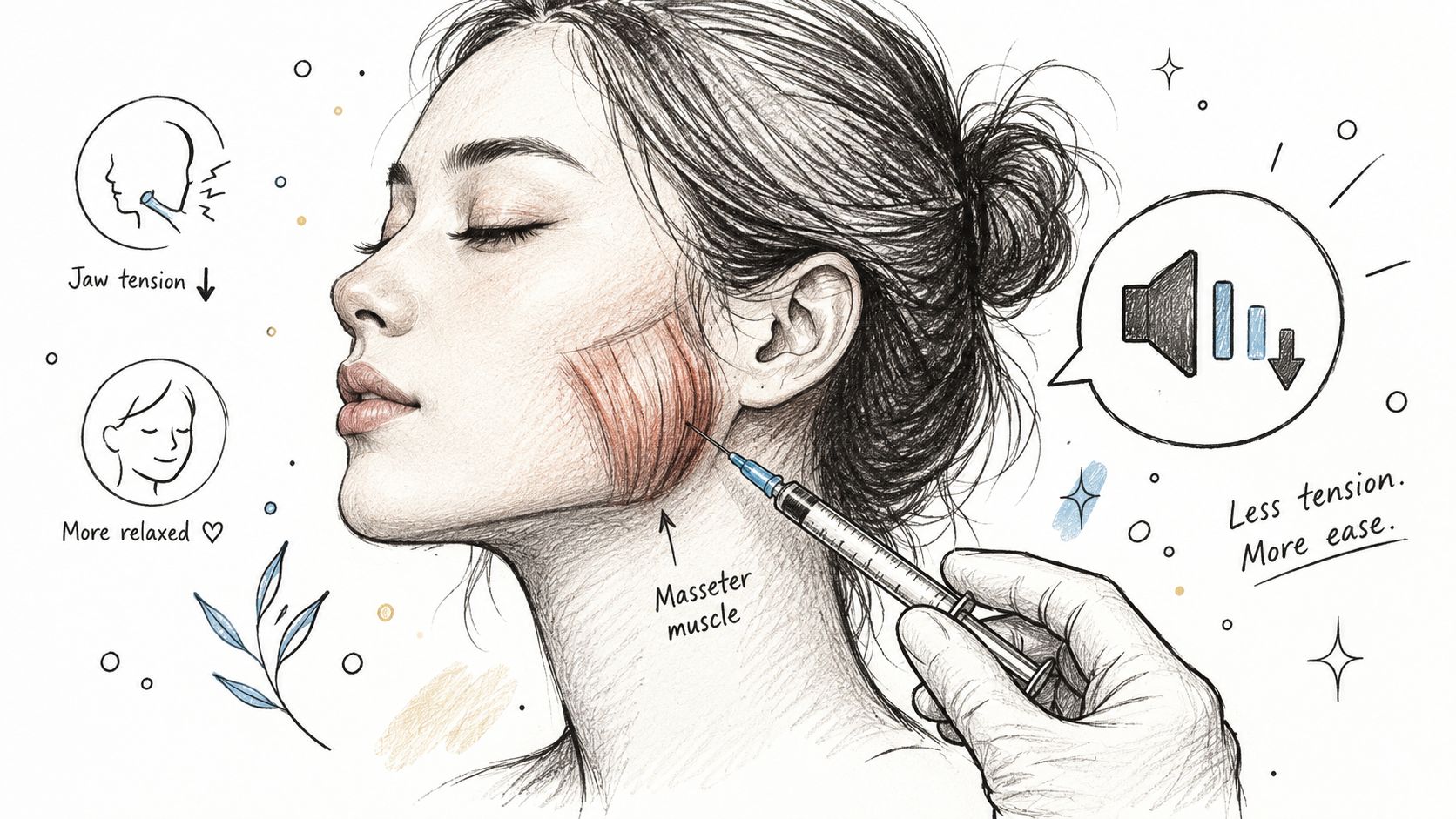
Most advice about Botox for jaw clenching starts with the wrong promise. It treats masseter injections like a cure, when the more accurate story is that they reduce muscle force, ease strain, and sometimes make clenching far less damaging, without necessarily removing the habit or its trigger. That distinction matters if you're waking up with a sore jaw, wearing down a night guard, or trying to decide whether your problem is muscle overactivity, stress, sleep, or something dental.
A 2024 systematic review in PMC found nine randomized clinical trials with 137 participants looking at botulinum toxin for bruxism and jaw-clenching symptoms, and the results were mixed, even though several studies showed clear short-term benefit. One included trial reported pain scores dropping from 7.1 to 0.2 at 6 months and 1 year, while another reported bruxism events falling from 4.97 per hour to 1.70 per hour at 12 weeks after BoNT-A injections into the masseter muscles (PMC review). That's real relief, but it's not the same thing as fixing the reason the clenching started.
If you want pain relief that's grounded in how muscles behave, it can help to think beyond one intervention and look at evidence-based pain management as a broader framework. For some people, that means addressing bite protection, sleep issues, or stress patterns alongside treatment, not instead of it.
Table of Contents
- Why Botox for Jaw Clenching Is Not a Cure-All
- How Botox Works on the Masseter Muscle
- Who Benefits Most from Masseter Botox
- What Happens During Your Botox Appointment
- Realistic Timelines and Expected Results
- Risks, Side Effects, and Long-Term Considerations
- Comparing Botox with Mouthguards and Dental Treatments
- Scheduling Your Consultation at ProMD Health Bel Air
Why Botox for Jaw Clenching Is Not a Cure-All
The biggest misconception is that Botox for jaw clenching stops clenching itself. It lowers the force your masseter can generate, which can reduce muscle overuse, morning pain, and the mechanical wear that comes from chronic squeezing.
That distinction matters because symptom relief and root-cause treatment are different. A patient whose clenching is driven by obvious masseter overactivity, jaw enlargement, or nighttime bruxism may feel a clear change. A patient whose clenching is tied to poor sleep, stress arousal, airway issues, or dental factors may get partial relief and still need the underlying trigger addressed. For more evidence-based pain management, see evidence-based pain management.
Practical rule: if your jaw feels better but your habit never changed, the treatment helped the symptom, not the cause.
The broader literature reflects that nuance. A British Dental Journal systematic review estimated adult prevalence at 24% for awake bruxism and 16% for nocturnal bruxism, and it described trials where botulinum toxin reduced bruxism events and biting force, but the broader evidence base still isn't uniform (BDJ review). That means this is a targeted tool, not a universal fix.
That also explains why one patient can have a strong response while another notices only mild change. If the masseter is the main driver, reducing its output can feel dramatic. If the jaw pain comes from another source, the benefit may be limited. For people who need something broader than an injection alone, a good consult should also consider sleep, dental wear, and bruxism triggers.
How Botox Works on the Masseter Muscle
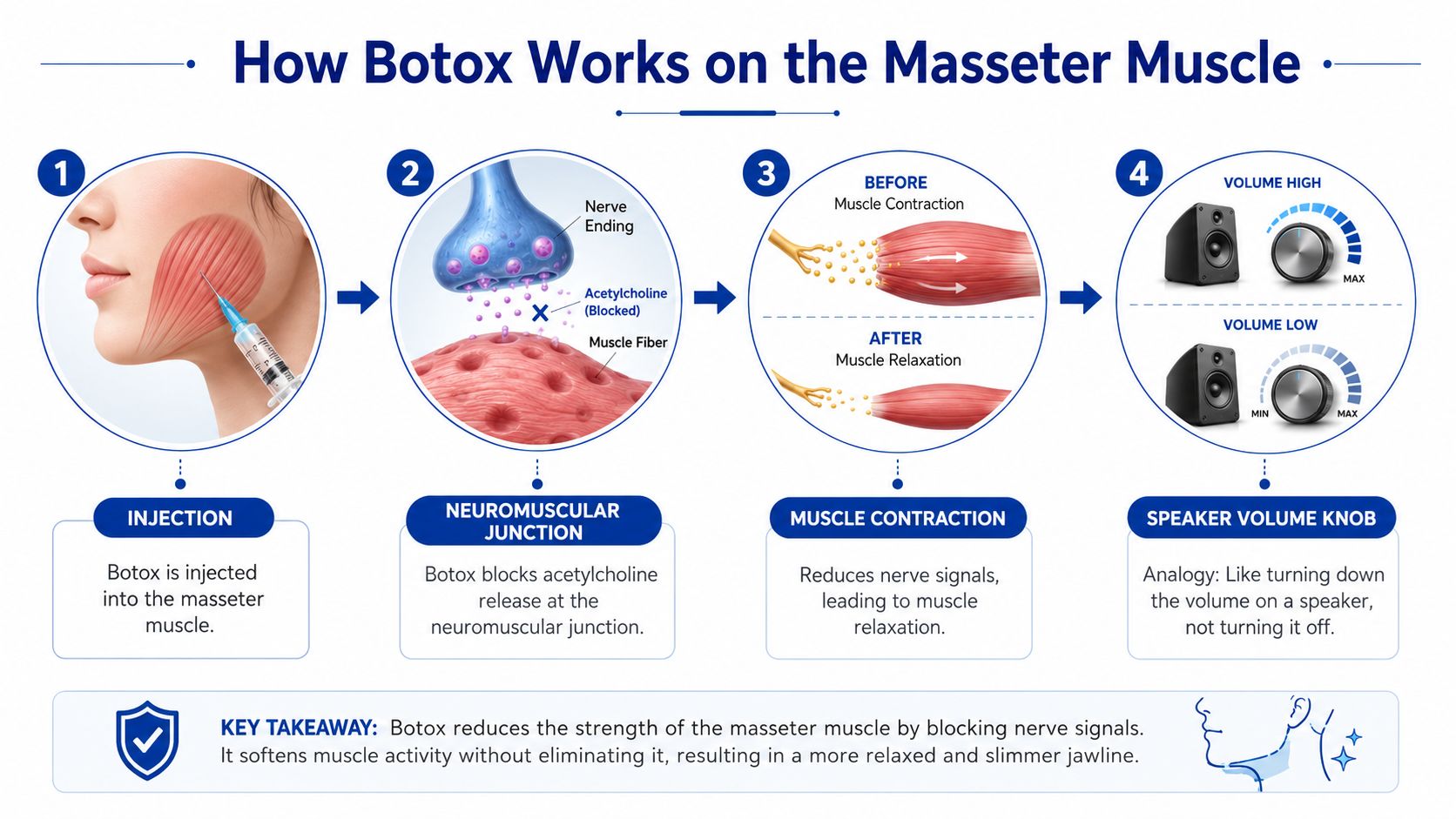
The masseter is the jaw's power speaker. Botox lowers the signal that tells that muscle to contract, so it cannot fire with the same intensity every time you clench.
Botulinum toxin works by blocking acetylcholine release at the neuromuscular junction, which creates temporary chemical denervation and partial paralysis of the injected muscle (mechanism review). In practical terms, the muscle still functions, but it cannot generate the same bite force. That is why people can still chew and speak, while the forceful clenching that causes wear and pain becomes less intense.
Why the effect is temporary
The body adapts over time. New synaptic connections form, and the benefit fades, which is why repeat treatment is usually needed. The temporary nature is part of how the treatment works.
In clinic, the main target is usually the masseter, and sometimes the temporalis when symptoms or anatomy point that way. Dosing is individualized because jaw strength, asymmetry, and clenching patterns are not the same from one person to the next. Published protocols commonly fall around 25 to 50 units per side, with some cases adding temporalis treatment when needed. Learn more about our Botox/Dysport services here (review on dosing and planning).
The goal is not to freeze the jaw. It is to lower the force enough that the muscle stops overworking.
For a patient in the chair, that usually means balancing relief with preserved function. Too little treatment leaves the overactivity unchanged. Too much can make chewing feel weaker than it should. The right dose softens the clenching without taking away normal jaw movement.
Who Benefits Most from Masseter Botox
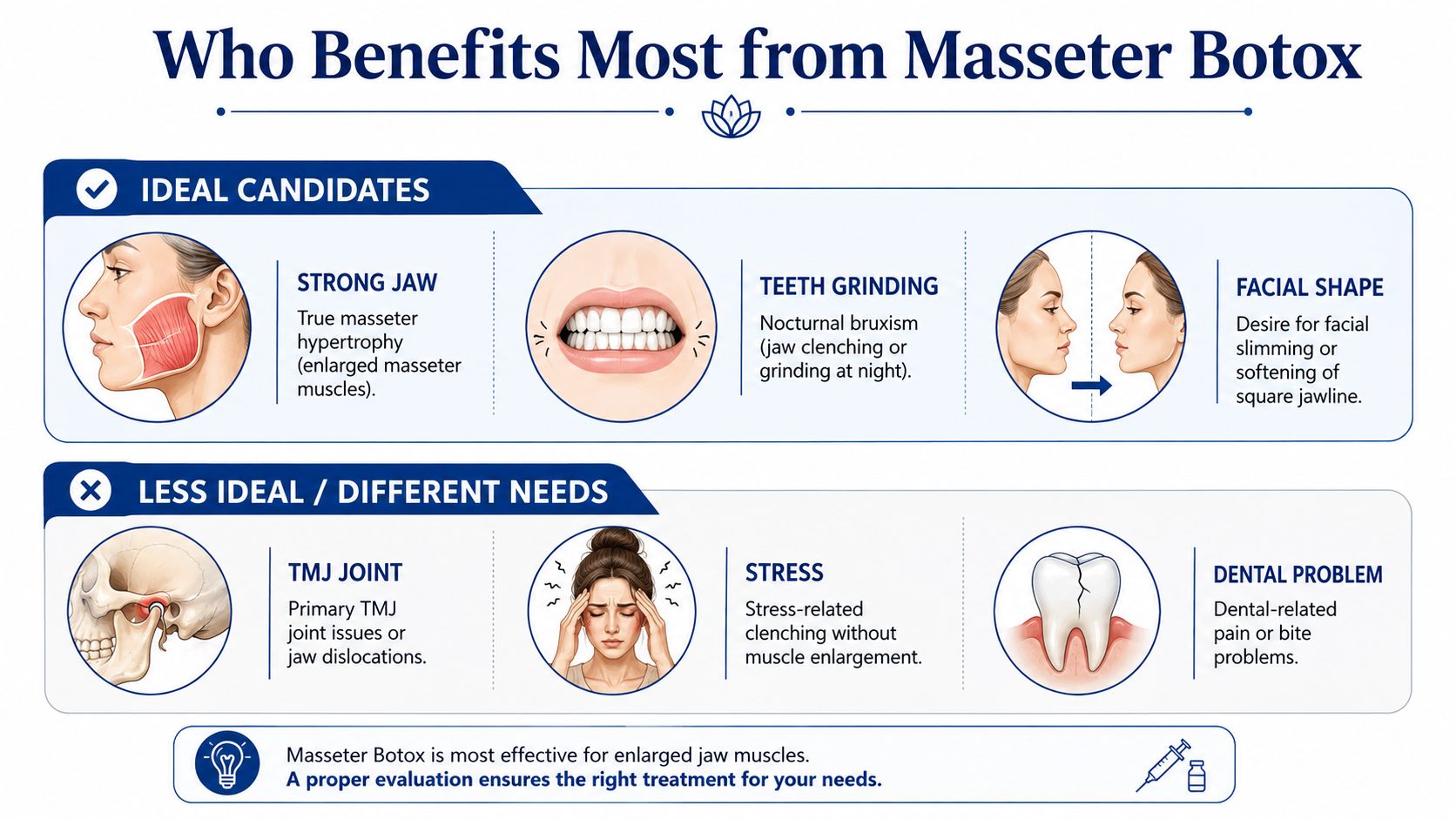
The people who tend to do best usually have muscle-driven clenching. You see that in a visibly strong or enlarged masseter, waking up with jaw soreness, or grinding that a dentist has already identified. Some patients also like the softer lower-face shape that can follow, but that cosmetic change is secondary to the functional benefit.
Who tends to respond well
Patients with true masseter hypertrophy often feel the clearest difference, because the injected muscle is already overworking. Nocturnal bruxism can also respond well when the problem is force generation rather than just stress awareness. In a BDJ review, studies described lower bruxism activity after treatment and reduced maximum biting force at follow-up, which fits what we see in clinic, less clamping power, less muscle fatigue, and less morning soreness.
The response is usually strongest when the jaw problem is local and muscular. If the masseter is the main driver, treatment can calm the force without changing the basic shape of the jaw or the way you speak and chew.
Who may need something else first
If clenching shows up with stress, poor sleep, airway issues, or bite-related discomfort, Botox can still help, but it rarely solves the whole picture. A patient who wakes with pain but has little obvious muscle enlargement, or whose symptoms track closely with sleep quality, often needs a broader evaluation first.
That is also why jaw pain should not be assumed to come from clenching alone. If chewing hurts and you want to understand why, Mouthology on why chewing hurts is useful background before you decide the masseter is the only problem.
One more point matters. Jaw clenching is not always a one-muscle issue. The masseter is common, but the temporalis and other structures can contribute too, so a good assessment looks at the full pattern instead of treating every jaw the same way.
What Happens During Your Botox Appointment
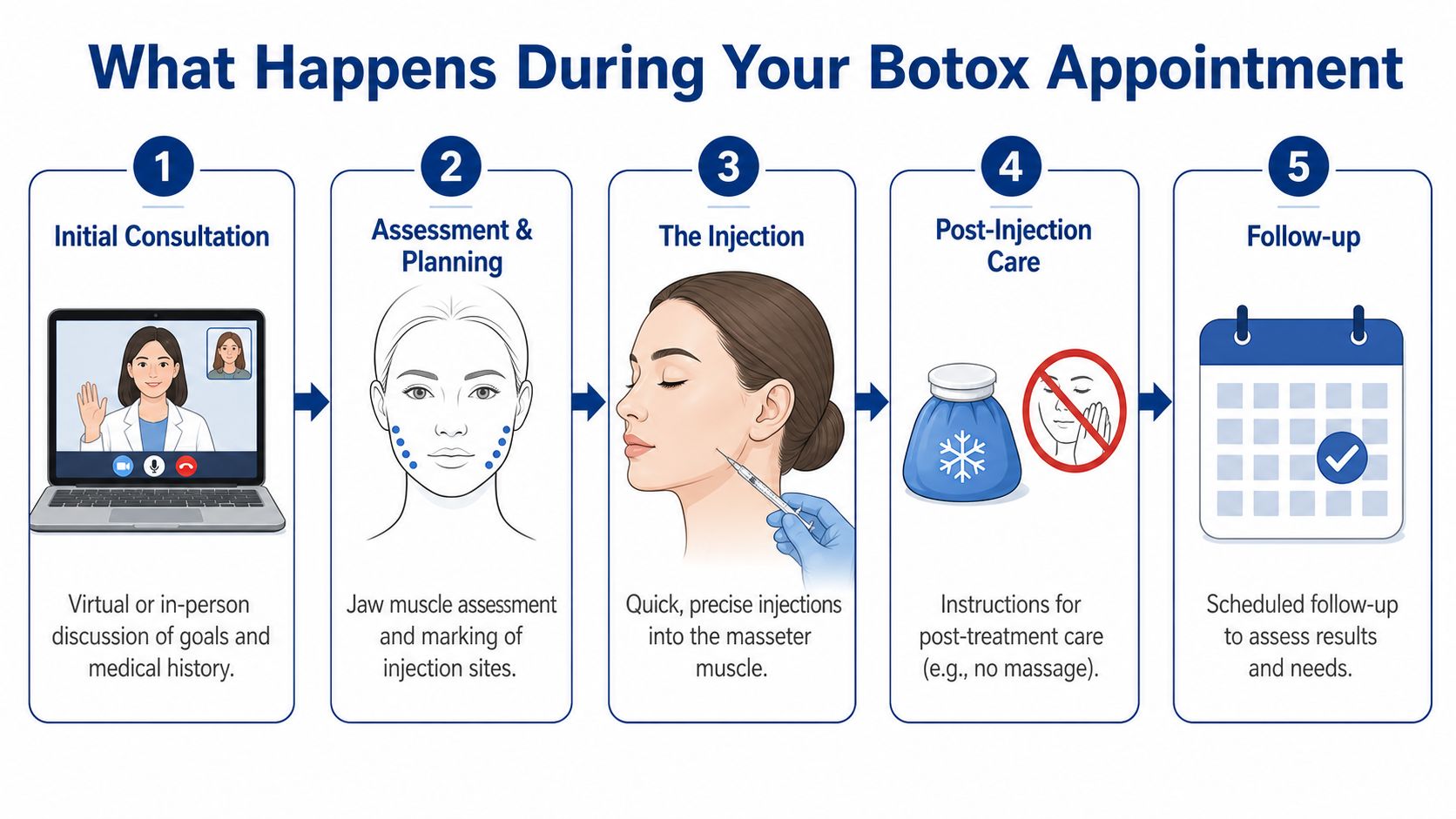
The appointment starts with a conversation, not a syringe. A good injector wants to know when the clenching happens, what the jaw feels like in the morning, whether you wear down a guard, and whether the pain feels muscular or joint-based.
At ProMD Health Bel Air, that evaluation can happen in person or virtually first, depending on what makes sense for the visit. The provider looks at muscle bulk, asymmetry, and clenching patterns, then plans the injection points. ProMD's medically supervised team includes Amanda Pittillo, PA-C and Lauren Mason, PA-C, MSHS, which matters because jaw treatment should be planned with anatomy and function in mind, not just appearance.
What the injection phase feels like
The treatment itself is fast. The usual pattern is a few precise injections into each masseter, with the number of units adjusted to the muscle and the goal. After that, you get aftercare guidance and leave the office the same day.
Practical aftercare: avoid aggressive chewing, gum chewing, and hard jaw workouts right after treatment. The muscle is already being dialed down, so you don't want to stress it more.
A realistic consult should also cover follow-up. If the result feels uneven or too strong in one area, reassessment is part of good dosing, not a sign that the treatment failed. For a patient, that's the benefit of a medically supervised setting, there's a plan for adjustment, not just a one-time injection.
Realistic Timelines and Expected Results
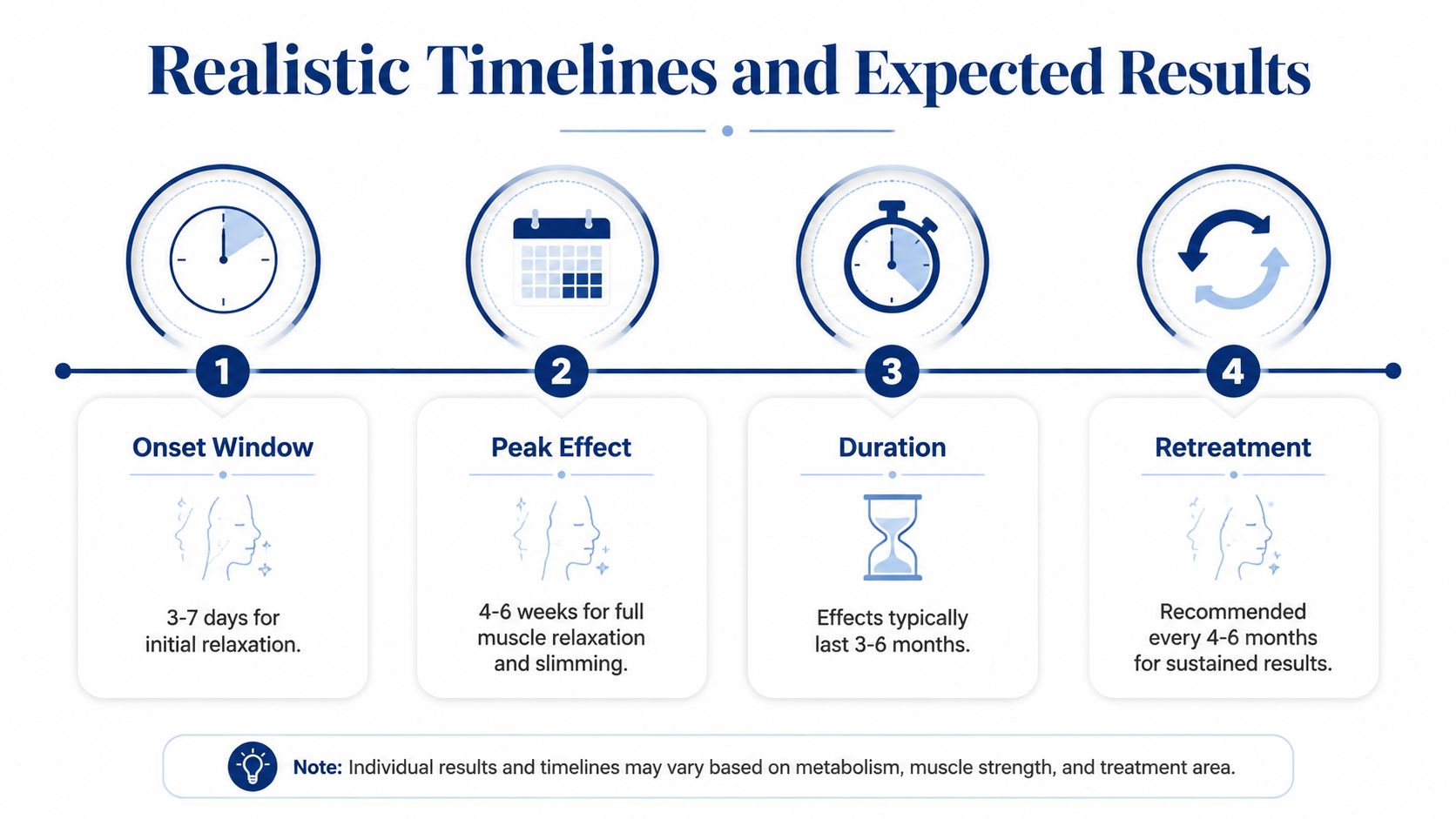
The first question patients usually ask is straightforward, how soon does it work? The effect builds gradually. Some people notice the jaw feeling less tight within the first several days, while the more meaningful change usually develops over the next few weeks.
Clinical results show why the timeline varies. In one review, a trial reported pain scores dropping from 7.1 to 0.2 at 6 months and 1 year, and another reported bruxism events falling from 4.97 per hour to 1.70 per hour at 12 weeks after masseter BoNT-A injections (PMC review). Those findings point to a practical reality. Some patients improve a lot, and different symptoms do not always improve on the same schedule.
A separate review in the journal Toxins found that botulinum toxin can reduce bruxism activity and pain in some patients, but the response depends on the dose, the muscle involved, and whether the clenching is driven mainly by muscle overactivity or by another source (PMC review). That distinction matters in the chair. If the jaw pain is coming from sleep-disordered clenching, airway issues, bite problems, or a true joint problem, masseter Botox may quiet the muscle without solving the cause.
What patients often notice first
Jaw stiffness is often the first thing to change. Sleep may feel less disrupted too, although the order of improvement is different from patient to patient. Pain relief can be clear, mild, or mixed with a sense of less pressure rather than complete symptom removal.
The most useful way to judge the result is over time, not in the first day or two. A follow-up visit matters because the next dose often depends on what changed, what did not, and whether the muscle softened too much or not enough.
For patients who want a realistic plan, the right question is not whether the change looks dramatic on day one. It is whether the jaw is carrying less strain once the treatment has fully settled.
Risks, Side Effects, and Long-Term Considerations
Botox in the masseter is generally used off-label for jaw clenching. The TMJ Association notes that Botox has FDA approvals for certain muscle-related conditions, but jaw-muscle injection itself is still unapproved by the FDA for safety and efficacy, and chronic TMD evidence remains inconclusive (TMJ Association summary). That doesn't make the treatment invalid, but it does mean the conversation should be honest about what's known and what isn't.
The most common trade-off is simple. Less clenching force can mean temporary chewing fatigue or a feeling that hard foods take more effort. With repeated treatment, the masseter can gradually shrink, which may soften the jawline over time. Some patients like that change, some don't, and that preference should be discussed before the first dose.
Mixed evidence, real-world caution
The evidence base isn't one-directional. A 2024 meta-analysis in PMC concluded botulinum toxin was not significantly better than placebo for pain reduction at 1, 3, or 6 months, and it found no clear improvement versus placebo or other treatments in mouth opening, bruxism events, or maximum occlusal force (meta-analysis). That's the reason experienced injectors keep the conversation practical, not promotional.
If the goal is permanent correction, this treatment will disappoint. If the goal is controlled symptom reduction, it can still be useful.
Long-term planning matters too. Repeated use may change facial shape gradually, and if you stop, the muscle activity returns as the toxin wears off. That's why the decision should be based on whether you're comfortable with a maintenance approach, not just whether you want a quick fix.
Comparing Botox with Mouthguards and Dental Treatments
Botox fits into jaw-clenching care as one part of a larger plan, not the only tool on the table. A mouthguard protects teeth from wear, but it doesn't lower muscle force. Botox lowers force, but it doesn't protect enamel in the same way. Those are different jobs.
For patients already using a guard, the best next step is often a conversation about whether the clenching force is still high enough to justify muscle treatment. If you're looking at custom nightguards and splints, the underlying goal is often tooth protection, bite distribution, and symptom relief through mechanical support. Botox can complement that when the muscle remains overactive.
| Treatment | How It Works | Time to Relief | Maintenance | Best For |
|---|---|---|---|---|
| Botox for jaw clenching | Lowers masseter force by blocking nerve signaling | Gradual, over days to weeks | Repeat treatments are usually needed | Muscle-driven clenching, jaw pain, masseter hypertrophy |
| Mouthguard or splint | Protects teeth and can redistribute bite forces | Immediate for protection, variable for symptoms | Nightly use and periodic replacement | Tooth wear, bruxism protection, bite support |
| Dental or sleep evaluation | Looks for bite, airway, or sleep-related drivers | Depends on the finding | Ongoing care if a root issue is found | Clenching tied to sleep or dental causes |
| Physical therapy or habit-focused care | Addresses muscle use patterns, posture, and strain | Gradual | Ongoing practice and follow-up | Habit clenching, neck/jaw tension, postural strain |
If you're comparing options for jawline shape as well as jaw comfort, it can also help to look at how jaw-focused treatment differs from other contouring approaches. A useful place to start is the Bel Air clinic's discussion of Kybella vs. CoolSculpting for chin contour, since that puts jawline concerns in a clearer context.
The cleanest treatment plans usually combine approaches instead of forcing one method to do everything. If the jaw is overworking, the teeth are vulnerable, or sleep is part of the picture, layering care makes more sense than chasing a single fix.
Scheduling Your Consultation at ProMD Health Bel Air
A useful first consult starts with specifics, not assumptions. At ProMD Health Bel Air, you can book a virtual or in-person visit through the clinic's contact page, then talk through whether your symptoms look muscle-driven, dental, or sleep-related. That matters because the right treatment plan depends on what's causing the clenching."
The clinic's model is built for patients who want both aesthetic and functional options in one place. That can include jaw-focused Botox when appropriate, but the point of the visit is to decide whether it belongs in your plan at all. If you're a good candidate, the provider can map the muscles, discuss dosing, and talk through what maintenance might look like over time.
What to expect when you book
Scheduling is available on extended weekdays, with Saturday appointments by arrangement. The team also offers financing options, which can help if you're deciding between a one-time consultation and a longer treatment plan. Named providers at the practice include Amanda Pittillo, PA-C and Lauren Mason, PA-C, MSHS, and the setting is medically supervised rather than purely cosmetic.
If you've been living with jaw soreness, worn teeth, or a night guard that doesn't seem to solve the problem, the best next move is a real evaluation. Not every clencher needs Botox first, but the patients who benefit most usually know one thing quickly, they're tired of guessing.
If jaw clenching is wearing you down, ProMD Health Bel Air can help you sort out whether Botox for jaw clenching makes sense for your pattern of symptoms or whether another approach should come first. Visit ProMD Health Bel Air to schedule a consultation and get a plan that matches your jaw, your habits, and your goals.