
B12 shots get marketed like a shortcut to instant energy, easier weight control, and better mood. That pitch is popular, but it isn't the whole story. For women, the value of B12 injections is much narrower and much more useful; they're best supported when someone has true B12 deficiency or impaired absorption, not when levels are already normal. A major review notes that injections can restore normal metabolism and reverse hematological and some neurological complications of deficiency, with anemia usually resolving within 6 to 8 weeks after treatment begins, which is a very different promise than a casual wellness boost (PMC review on B12 deficiency and treatment).
That distinction matters because women don't all start from the same place. B12 deficiency rates vary widely by population, from under 1% to nearly 50% in the review above, so baseline status changes the likely benefit a lot (PMC review on B12 deficiency and treatment). If you're in Bel Air and you're wondering whether a shot would help, the first question isn't “Do I want more B12?” It's “Do I have low B12, poor absorption, or a stage of life that raises my need?”
For many women, that answer is tied to diet, digestion, pregnancy, or lactation. In those settings, B12 replacement can be a clinically meaningful part of care, not a trend. If you want a pregnancy-focused perspective, Feed Mom & Me on B12 is a helpful read alongside medical guidance, especially if you're trying to separate real need from internet hype.
Table of Contents
- The Truth About B12 Shots and Women's Health
- How Vitamin B12 Works in the Female Body
- Evidence-Based Benefits of B12 Injections for Women
- B12 Injections Versus Oral Supplements
- Who Is a Good Candidate for B12 Shots
- What to Expect at ProMD Health Bel Air
- Common Questions About B12 Shots for Women
The Truth About B12 Shots and Women's Health
A B12 shot is not a default fix for fatigue. In women with normal B12 levels, the evidence does not show reliable energy boosts or weight loss from injections, and that point is easy to miss when wellness marketing makes B12 sound broadly energizing (Cleveland Clinic on B12 shots and energy or weight loss). The value of the treatment is narrower, and that is what separates evidence-based care from hype.
What the evidence actually supports
The clinical picture is straightforward. B12 injections help when the body is short on B12 or cannot absorb it well enough from food or oral supplements. In those cases, treatment can correct the underlying problem, which may improve symptoms tied to low B12 such as fatigue, anemia, or nerve-related concerns. That is a different claim from saying everyone feels better after a shot.
A patient scenario makes the difference easier to see. A woman eating very little animal-based food, or someone with a stomach or intestinal issue that limits absorption, may need an injection plan that bypasses the digestive tract. Another woman with normal levels and no absorption problem may get more from diet changes or an oral supplement than from a shot. The treatment choice depends on the cause, not on the promise of a quick boost.
Practical rule: if tiredness is the only concern, testing should come before assuming B12 is the answer. The response to treatment depends on whether a deficiency is actually present.
Different life stages can change the decision, too. Pregnancy and lactation increase the importance of adequate B12 status, and women with low intake or absorption concerns may need a more targeted plan. For that reason, the benefits of B12 shots for women are most meaningful when the need is real, not when the goal is general wellness enhancement. If you want a patient-friendly overview of that context, the Feed Mom & Me on B12 resource is a useful place to start.
The bottom line is clinical, not promotional. B12 shots are most useful for women with low intake, malabsorption, pregnancy-related needs, or confirmed deficiency symptoms, and a review of B12 deficiency and treatment describes that same pattern (PMC review on B12 deficiency and treatment). If none of those apply, an injection may not add much beyond what a normal diet or oral supplement already provides. Knowing your baseline makes the choice clearer.
Why the hype keeps spreading
Marketing often blurs two very different ideas, treating a deficiency is not the same as boosting an already healthy body. That is where confusion starts. Women hear that B12 is linked with energy, then assume more B12 automatically means more benefit.
It does not work that way. The more accurate view is simple, B12 helps when the body needs it, and it has far less to offer when levels are already adequate. That keeps expectations grounded and helps women choose care for the right reason, especially when they are deciding between an injection and an oral supplement in Bel Air or nearby.
How Vitamin B12 Works in the Female Body
Vitamin B12 is needed for red blood cell formation, nerve function, and DNA synthesis. Those functions show up in everyday health in a very practical way. Blood has to move oxygen efficiently, nerves have to send signals clearly, and cells have to divide in a controlled, healthy pattern.
Why the injection route matters
Food B12 has to pass through digestion before the body can absorb it. That usually works fine when the stomach and intestines are functioning normally, but absorption problems change the picture. In people with impaired absorption, injections are commonly used to correct deficiency, and expert reviews describe lifelong intramuscular therapy as the usual approach when the body cannot absorb B12 well enough through the digestive tract.
An injection bypasses that problem. It delivers B12 directly into the body, so the result does not depend on the stomach doing all of the work. For women who have trouble absorbing B12 from food or oral supplements, that difference can matter a great deal.
The female body's changing needs
B12 needs are not identical across every stage of life. Pregnancy and lactation place more attention on B12 status because maternal B12 affects both mother and infant. In women with confirmed deficiency, clinicians often treat more directly because leaving the deficiency partly corrected can carry more risk than the inconvenience of treatment.
A good way to understand B12 therapy is to separate replacement from enhancement. Replacement means filling a gap that is there. Enhancement means trying to push an already normal system beyond its usual range. B12 shots fit the first category far better than the second.
That distinction matters in practice. If B12 levels are low, treatment helps restore normal physiology. If levels are already adequate, there is much less room for a shot to make a meaningful difference, whether someone is considering care in Bel Air or comparing it with a high-dose vegan B12 supplement.
Evidence-Based Benefits of B12 Injections for Women
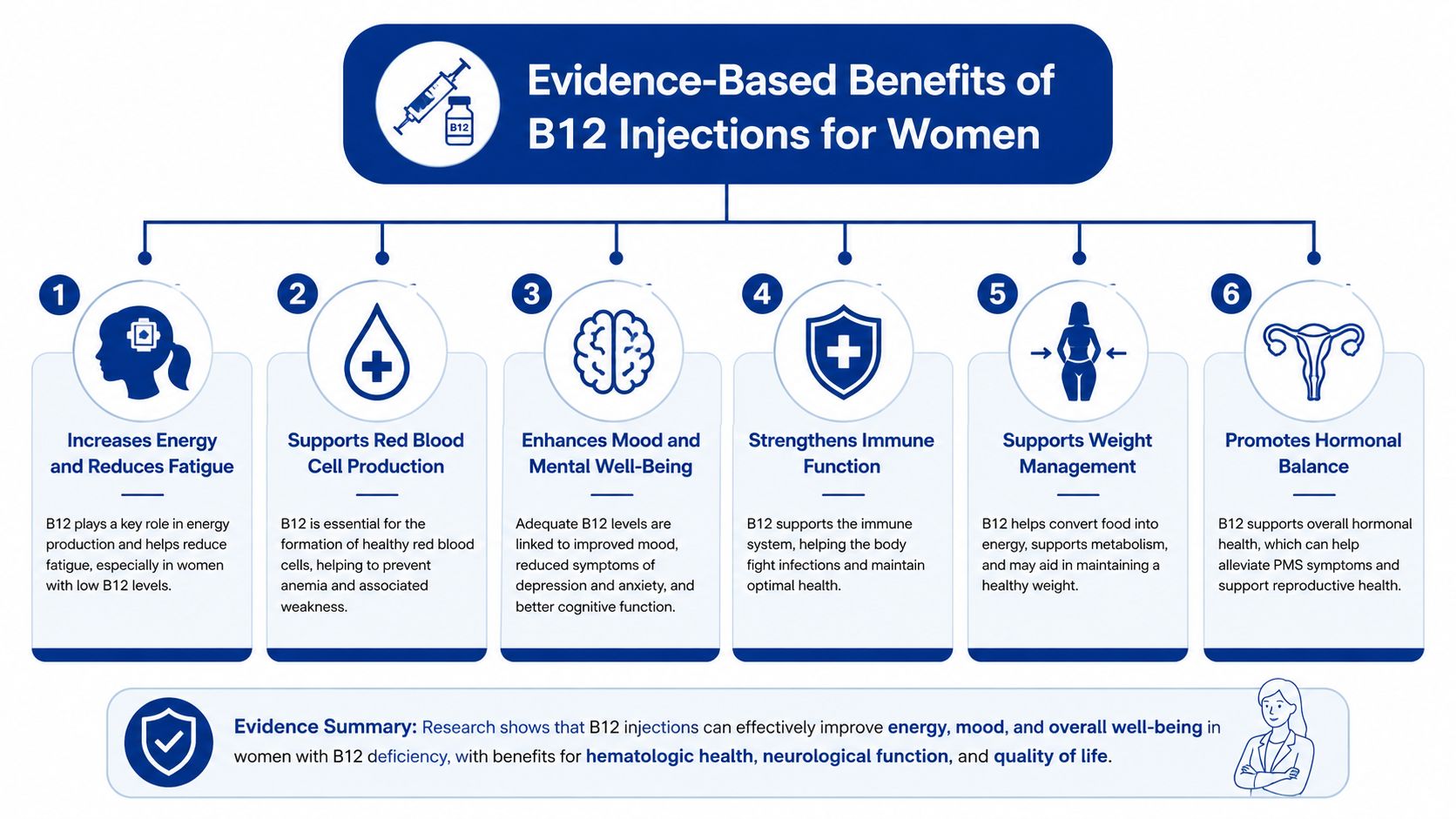
The clearest benefit of B12 shots is correction of deficiency. When B12 is low, replacing it can let the body return to normal metabolism, and symptoms tied to that shortage may improve as the deficiency is corrected. A major review notes that injections can restore normal metabolism and reverse hematological and some neurological complications, with anemia usually improving within 6 to 8 weeks after treatment begins (PMC review on B12 deficiency and treatment).
What clinical data shows
The most practical changes usually appear in a few areas. Fatigue may lessen when low B12 was the cause. Weakness can improve as blood function normalizes. Neurological symptoms linked to deficiency may also get better when treatment starts early enough.
Pregnancy and lactation deserve special attention. An NIH-reviewed summary says B12 deficiency in pregnancy increases the risk of neural tube defects, pre-eclampsia, preterm birth, low birth weight, and early pregnancy loss, and it describes continued B12 therapy in deficient women during pregnancy and lactation as mandatory and safe (NIH review on B12 in pregnancy and lactation). In that setting, B12 replacement is part of routine medical care, not a cosmetic add-on.
Where the benefits are narrower
The picture changes outside confirmed deficiency. Claims about sharper thinking, better mood, or a faster metabolism are often broader than the evidence supports. In a woman with normal B12 status, a shot is unlikely to work like an energy boost or a weight-loss treatment. The best outcomes come from matching the route of treatment to the actual reason B12 is low.
Oral support can still make sense for some women, especially when absorption is not a major problem and the goal is maintenance rather than rapid correction. For diet-related support, a high-dose vegan B12 supplement may fit better than injections. The key question is not which option sounds stronger, but which one matches the reason B12 needs attention.
How to read the evidence
Separate confirmed deficiency treatment from general wellness use. The first is well supported. The second is much less certain. That does not make B12 unimportant, it just keeps expectations realistic.
Women who feel better after a shot usually belong to the group that needed correction in the first place. That is a meaningful response, but it does not mean every woman will notice the same change. If a claim sounds too broad, ask a simpler question, was B12 low? If the answer is no, the benefit is far less certain.
B12 Injections Versus Oral Supplements
B12 shots and oral supplements aren't competing in every case. They solve different problems. Injections are useful when the body can't absorb enough B12 through the digestive tract. Oral supplements can work well when absorption is intact or only mildly challenged.
| Factor | B12 Injections | Oral Supplements |
|---|---|---|
| Main use | Confirmed deficiency or impaired absorption | Maintenance or lower-risk deficiency support |
| How they work | Bypass the digestive tract | Depend on absorption through the gut |
| Best fit | Malabsorption, GI disorders, or reliable replacement needs | People who absorb B12 well enough orally |
| Typical role | Faster repletion, then maintenance | Ongoing daily support for many patients |
| Main limitation | Requires appointments or clinical administration | Less effective when absorption is poor |
When injections make more sense
Medical guidance and patient education sources note that injections may be chosen when someone can't absorb B12 well enough from food or supplements, including conditions that affect absorption (Medical News Today on B12 injections and absorption barriers). MedicineNet also lists malabsorption-related causes such as pancreatic disease, intestinal infections, Crohn's disease, and tropical sprue (Medical News Today on B12 injections and absorption barriers).
That's the clinical reason injections exist. They don't depend on the same pathway oral supplements do. If the gut can't do the job, a shot sidesteps the problem.
When oral supplements may be enough
If a woman has low intake but normal absorption, oral B12 may be enough to maintain status. That's one reason not every woman who is tired needs a shot. In many cases, the issue is not delivery method, it's whether B12 is low in the first place.
Simple decision point: if absorption is the problem, the route matters. If intake is the problem and absorption is fine, oral therapy may be reasonable.
The practical difference also shows up in follow-up. Shots tend to be used when a clinician wants dependable repletion and less guesswork about absorption. Oral supplements can be more convenient for long-term maintenance when the body can use them well. The right choice is individualized, not universal.
Who Is a Good Candidate for B12 Shots
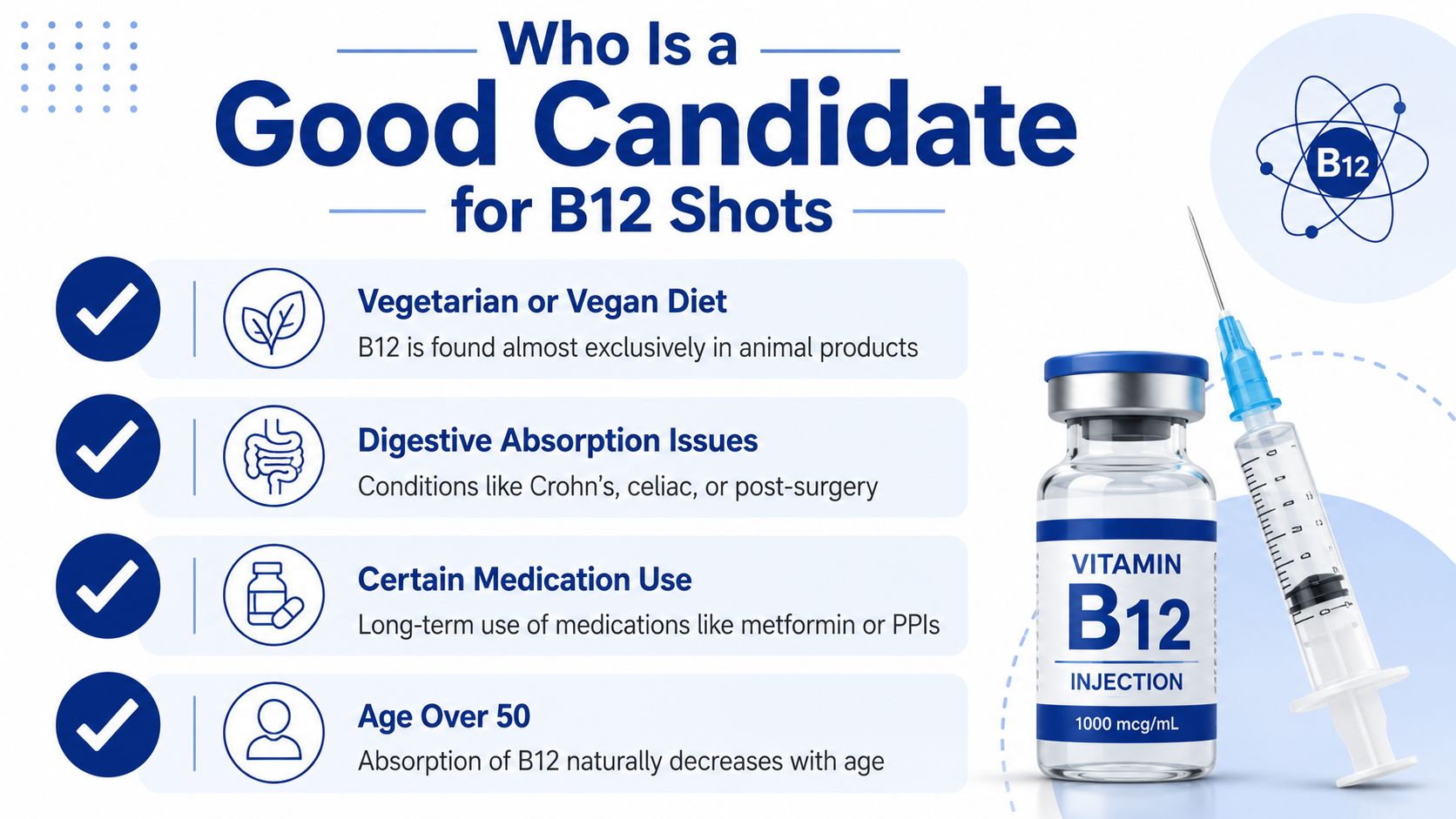
A good candidate is usually a woman with documented low B12 or a clear reason to suspect poor absorption. That can include women who eat little or no animal-source food, women with digestive conditions, women taking certain medications, older adults, and women who are pregnant or breastfeeding. In practice, the decision starts with testing and history, because a shot is meant to treat a specific problem, not vague fatigue.
Clues that testing may be worth it
Fatigue is the symptom many women mention first, but it is not specific. Weakness, numbness, tingling, balance changes, memory concerns, and anemia can all point in the same direction. When those symptoms appear alongside a diet low in B12 or a condition that affects absorption, testing becomes more useful.
Who often benefits most
- Vegetarian or vegan diet: B12 is found almost exclusively in animal products, so intake can fall short.
- Digestive absorption issues: Conditions like Crohn's, celiac, or prior surgery can interfere with uptake.
- Certain medication use: Long-term use of medications like metformin or proton pump inhibitors can lower B12 status.
- Age over 50: Absorption of B12 naturally decreases with age.
For a broader supplement decision framework, a guide to clean energy supplements can help you judge fatigue claims before assuming one nutrient is the answer. That kind of screening matters because tiredness has many causes, and B12 is only one of them.
What to do if levels are normal
Many women feel run down, yet their B12 levels are fine. In that situation, more B12 usually does not translate into more energy. The better next step is to look for other causes of fatigue instead of increasing B12 by default, and the question becomes whether sleep, iron status, thyroid health, stress load, or medication effects need attention.
B12 has a place in care when it matches the problem. If you want a clinical path for evaluation and treatment, the B12 treatments at ProMD Health Bel Air page explains how injections are used in a medical setting.
What to Expect at ProMD Health Bel Air
At ProMD Health Bel Air, B12 treatment is handled as a medically supervised service, not a casual add-on. The clinic is at 2023 Emmorton Rd, Suite A, Bel Air, Maryland, and patients may see team members such as Amanda Pittillo, PA-C or Lauren Mason, PA-C, MSHS during their visit. The process is built to make sure the shot matches the reason you're seeking it.
A typical treatment pattern
For deficiency correction, common regimens use 1000 mcg IM weekly for 4 weeks, then 1000 mcg IM monthly for maintenance, which is designed to restore stores and reduce recurrence when oral absorption is unreliable (NIH ODS Vitamin B12 fact sheet). That schedule is not a one-size-fits-all rule, but it gives you a practical picture of how injections are often used.
Patients from Bel Air, Fallston, Forest Hill, Abingdon, and Havre de Grace can usually expect a straightforward appointment. You come in, discuss symptoms and history, and review whether a shot makes sense for your situation. If it does, the visit is quick and the plan is clear.
Local note: extended weekday availability and Saturday appointments by arrangement make it easier to keep up with follow-up care.
Where B12 fits in the broader clinic menu
If you're already visiting for other supportive services, B12 may be one part of a larger wellness plan. ProMD Health Bel Air also lists wellness services that can be discussed during a consultation, but the B12 decision should still stand on its own medical merits.
The value of the visit is clarity. You don't have to guess whether you need a shot. The goal is to figure out whether your symptoms, diet, or absorption history make B12 therapy a good fit, then choose a plan that matches that answer.
Common Questions About B12 Shots for Women
How fast do women notice a difference? If B12 deficiency is the cause, some symptoms can improve as treatment begins, while anemia usually resolves within 6 to 8 weeks (PMC review on B12 deficiency and treatment). Neurologic symptoms can take longer and may depend on how long the deficiency has been present.
Are B12 shots safe during pregnancy or breastfeeding? In women who are deficient, continued B12 therapy during pregnancy and lactation is described as mandatory and safe in the NIH-reviewed pregnancy paper (NIH review on B12 in pregnancy and lactation). That said, treatment should still be guided by a clinician who knows your full history.
Can I get B12 shots if I'm already on hormone replacement therapy or another wellness treatment? Often, yes, but the question isn't whether they can overlap. It's whether B12 is needed. The shot should be based on deficiency risk, symptoms, or absorption issues, not on the idea that stacking treatments automatically improves results.
What if I get a shot and my B12 was normal? You may not notice much. Higher-quality guidance says B12 injections don't reliably increase energy or cause weight loss when levels are already normal (Cleveland Clinic on B12 shots and energy or weight loss). If that happens, it's a sign to look beyond B12 for the cause of fatigue.
If you're trying to decide whether B12 shots fit your symptoms or your health history, ProMD Health Bel Air can help you sort out deficiency risk, discuss injections versus oral support, and build a plan that matches your needs. Visit ProMD Health Bel Air to explore B-12 treatments with a medically supervised team and take the guesswork out of your next step.