
You're wiped out, sleeping badly, and starting to wonder if your body is trying to tell you something. Maybe a friend in Bel Air mentioned bioidentical hormone therapy, maybe you've seen “BioTE pellets” online, and now you're trying to sort out what's real, what's marketing, and what belongs in a medical conversation.
The right place to start is simple. Bioidentical hormone therapy is a hormone treatment approach that uses hormones with the same chemical structure as the hormones your body makes, and that category includes both FDA-approved products and compounded formulations. If you want a broader clinic overview while you compare options, the Hormone Replacement Therapy page is a helpful place to start.
Table of Contents
- What Bioidentical Hormone Therapy Means for Bel Air Patients
- How Bioidentical Hormones Differ From Synthetic Hormones
- Bioidentical Hormone Therapy vs Conventional HRT
- Delivery Methods Including BioTE Pellets at ProMD Health Bel Air
- Benefits and Side Effects Patients Should Know
- Who Is a Candidate and What Screening Looks Like
- Common Misconceptions About Bioidentical Hormone Therapy
- Frequently Asked Questions and Booking a Bel Air Consultation
What Bioidentical Hormone Therapy Means for Bel Air Patients
A lot of people in Bel Air reach this topic the same way. They're not searching for a theory lesson, they're trying to explain why they feel off, tired, foggy, moody, or unlike themselves. For some, the question starts after months of poor sleep. For others, it begins with hot flashes, vaginal dryness, or a sense that recovery, energy, or focus just isn't where it used to be.
Bioidentical hormone therapy is a category, not a single product. It refers to hormones that are structurally identical to the ones the human body makes, and in practice that can mean an FDA-approved medication or a custom-compounded product prepared for an individual patient. That distinction matters, because the word “bioidentical” alone doesn't tell you how the product is regulated, tested, or monitored.
This guide is written for adults who are trying to understand whether hormone therapy belongs in the conversation at all. That includes perimenopausal women, menopausal women, men with low testosterone symptoms, and adults with documented hormone decline after aging or surgery. If you're reading this from Bel Air, Fallston, or Forest Hill, the goal is to help you walk into a consultation with a clearer sense of what the terms mean and what questions matter.
Practical rule: if a hormone product is being marketed as “natural,” ask what the source is, what the molecular structure is, and whether the product is FDA-approved or compounded.
For a simple outside overview of diet-related support questions people often ask alongside hormone care, the Nutrition Geeks hormone guide is a readable companion piece. It's not a substitute for medical evaluation, but it can help patients think through the day-to-day habits they bring into a hormone conversation.
How Bioidentical Hormones Differ From Synthetic Hormones
A patient sits down for a consultation and asks a simple question, why does one hormone get called bioidentical while another is called synthetic? The answer starts with structure. A bioidentical hormone matches the molecular shape of the hormone the body makes, so it fits the receptor in the same way the body's own hormone does. That tells you what the molecule is. It does not tell you how the product was prepared, how tightly the dose is controlled, or whether the formulation has been studied in the same way as a standard prescription.
The key distinction is between molecular identity and clinical proof. Bioidentical estrogen, progesterone, and testosterone can match human hormones in structure, yet that match does not automatically make them safer or more effective than conventional hormone therapy. Reviews of the evidence describe limits such as small study sizes, uneven dosing, and other design weaknesses, and they do not show clear superiority for bioidentical approaches (PubMed review).
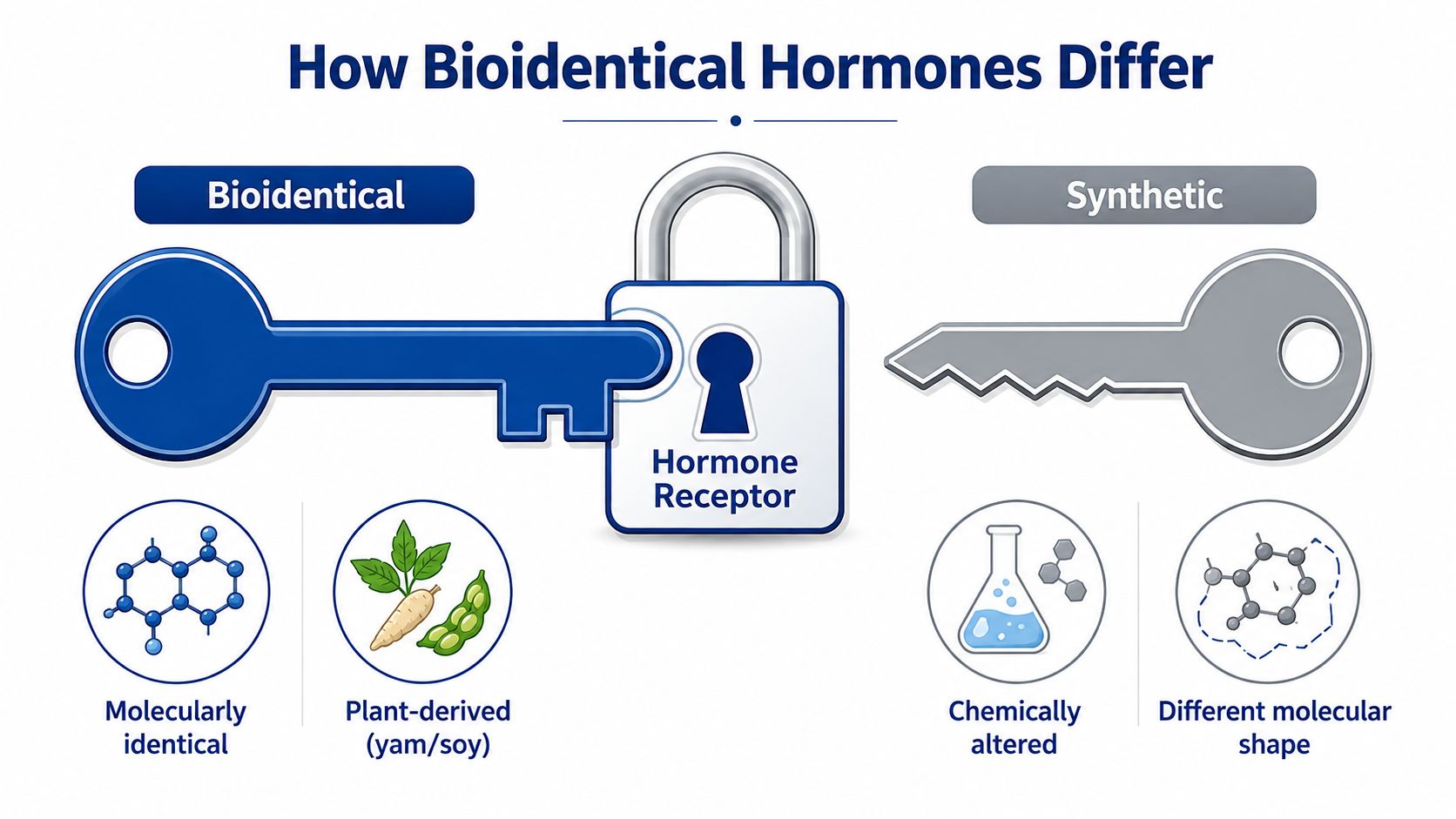
FDA-approved products and compounded products are not the same thing
FDA-approved bioidentical hormones are standardized products with labeled ingredients and testing expectations. Compounded bioidentical hormones are mixed for an individual prescription, which can be useful in select situations, but they are a different category from a mass-produced, FDA-reviewed product. That difference matters because the label bioidentical does not guarantee quality, consistency, or safety.
The Mayo Clinic notes that hormones marketed as bioidentical or natural have not been proven safer than traditional hormone therapy and have not been shown to work better for symptoms such as hot flashes or vaginal dryness. The Endocrine Society also defines bioidentical hormones by structure, not by whether they are compounded or FDA-approved (Endocrine Society statement, Mayo Clinic Proceedings60072-4/fulltext)).
The word “bioidentical” describes a molecule, not a promise.
That framing keeps the discussion honest. Once patients understand it, the better question becomes whether a hormone product is standardized, monitored, and appropriate for their risk profile, not whether it sounds more natural.
Bioidentical Hormone Therapy vs Conventional HRT
A patient in Bel Air may hear both terms in the same appointment and assume the choice is "natural" versus "synthetic." The distinction is more practical than that. Both bioidentical hormone therapy and conventional hormone replacement therapy are used to ease symptoms caused by hormone decline, but they differ in how the products are made, how tightly they are regulated, how much customization they allow, and how much evidence sits behind each approach.
| Factor | Bioidentical HRT | Conventional HRT |
|---|---|---|
| Molecular structure | Matches human hormones | May be structurally different |
| Product type | Can be FDA-approved or compounded | Often standardized prescription products |
| Customization | Can be individualized in compounded forms | Usually follows fixed dosing options |
| Regulation | FDA-approved versions are standardized, compounded versions are not the same class | Standardized and regulated as labeled products |
| Evidence language | Not proven safer or more effective by default | Also used under established clinical guidance |
| Patient experience | May feel more personalized, especially in compounded care | Often simpler to prescribe and monitor |
The practical takeaway is simple. Bioidentical does not automatically mean better, and conventional does not mean the plan is wrong for the patient. The better choice depends on symptoms, medical history, risk factors, and what the treatment is meant to accomplish. A standard FDA-approved option may be the cleanest fit when the dosing needs are straightforward. A compounded option may come up when a person needs a more specific formulation, but that is a clinical decision, not a marketing advantage.
Patients usually want to know whether customization changes outcomes. It can help a clinician tailor a plan to a person's needs, yet it does not remove the need for monitoring, and it does not create evidence where evidence is limited. As noted earlier in this article, hormone structure alone does not prove a therapy is safer or more effective, and the FDA also cautions that compounded bioidentical hormone therapy should not be assumed to carry the same level of oversight as approved products (FDA consumer update).
A careful comparison keeps the decision grounded. You are not choosing a label for your hormones, you are choosing a formulation that fits the symptom pattern, the lab picture, and the trade-offs the patient is willing to accept.
Delivery Methods Including BioTE Pellets at ProMD Health Bel Air
The delivery method matters as much as the hormone itself. A cream, patch, capsule, troche, or pellet each behaves differently once it enters the body. Some people want daily control. Others want a longer-acting approach with fewer steps in the week. There isn't one right route for everyone, only a route that fits a specific body and lifestyle.
Common delivery routes
Topical creams and gels can be easy to use, but absorption can vary from person to person. Transdermal patches offer a more structured way to deliver hormones through the skin, and they're often chosen when steady dosing matters. Oral capsules are familiar and convenient, though they don't suit everyone.
Troches dissolve in the mouth and can feel convenient for some patients. Subcutaneous pellets are placed under the skin during an office procedure, then release hormone over time without daily self-administration. That is one reason some patients ask about pellets when they're tired of remembering a routine every day.
At ProMD Health Bel Air, BioTE pellet therapy is offered as a medically supervised option within hormone replacement therapy. A typical pellet program starts with a consultation, lab review, and symptom discussion, then moves to in-office insertion when the provider decides the route fits the patient's goals and safety profile. The site also describes pellet therapy for women and men as part of its hormone optimization services, with treatment planning based on symptoms, labs, medical history, and goals.

What a pellet visit usually feels like
The insertion itself is done in the office with sterile technique. Patients usually want to know how long the pellet lasts, and in general the effect is discussed over a three to six month window depending on formulation and metabolism. That range is a practical reminder that even long-acting therapy still needs follow-up and dose adjustment, not a one-time guess.
The clinical logic is simple. A longer-acting route can reduce daily hassle, but it also requires a provider who checks the labs, checks the symptoms, and adjusts the plan when the body changes. If you want to see how pellet-based therapy is framed in practice, the BioTE hormone pellets page gives a service-specific overview.
Benefits and Side Effects Patients Should Know
A hormone visit often starts with a simple question, why do I feel off? For many patients, the answer leads to hot flashes, night sweats, vaginal dryness, mood changes, and reduced libido. Those symptoms are often the reason people begin looking for care, because they can affect sleep, comfort, relationships, and day-to-day energy.
Practical rule: if a hormone plan is promising broad anti-aging results, ask which symptoms are actually supported by evidence and which ones are being marketed more aggressively than they're studied.
The evidence is narrower than the marketing around it. FDA-approved bioidentical hormones are well supported for menopausal vasomotor symptoms and vulvovaginal atrophy, but broader claims are less certain. The National Academies note that there are no FDA-approved bioidentical hormone products for female sexual dysfunction and no evidence-based guidance recommending compounded bioidentical therapy for that indication (National Academies).
Side effects deserve the same plain attention. The same source stream names weight gain, acne, additional facial hair, somnolence, and hair thinning. That does not mean treatment should be treated like a warning label only. It means hormone therapy changes biology, and biology usually shifts in more than one direction at a time.
The safety context also matters. After the Women's Health Initiative findings, prescribing patterns changed sharply, and use of FDA-approved oral and transdermal bioidentical products fell substantially from 2002 to 2009 compared with pre-WHI levels (PMC review). That shift happened because hormone therapy safety was reexamined, not because hormone treatment disappeared.
Supervision is what keeps the benefits and the risks in view at the same time. A patient may feel better on the right hormone plan, but the same hormone can cause problems if the dose, route, or timing is off. A medically supervised program gives patients a way to look for symptom relief while still watching for side effects, risk signals, and the kind of follow-up described in the tiny pellets, big impact look at hormone replacement.
Who Is a Candidate and What Screening Looks Like
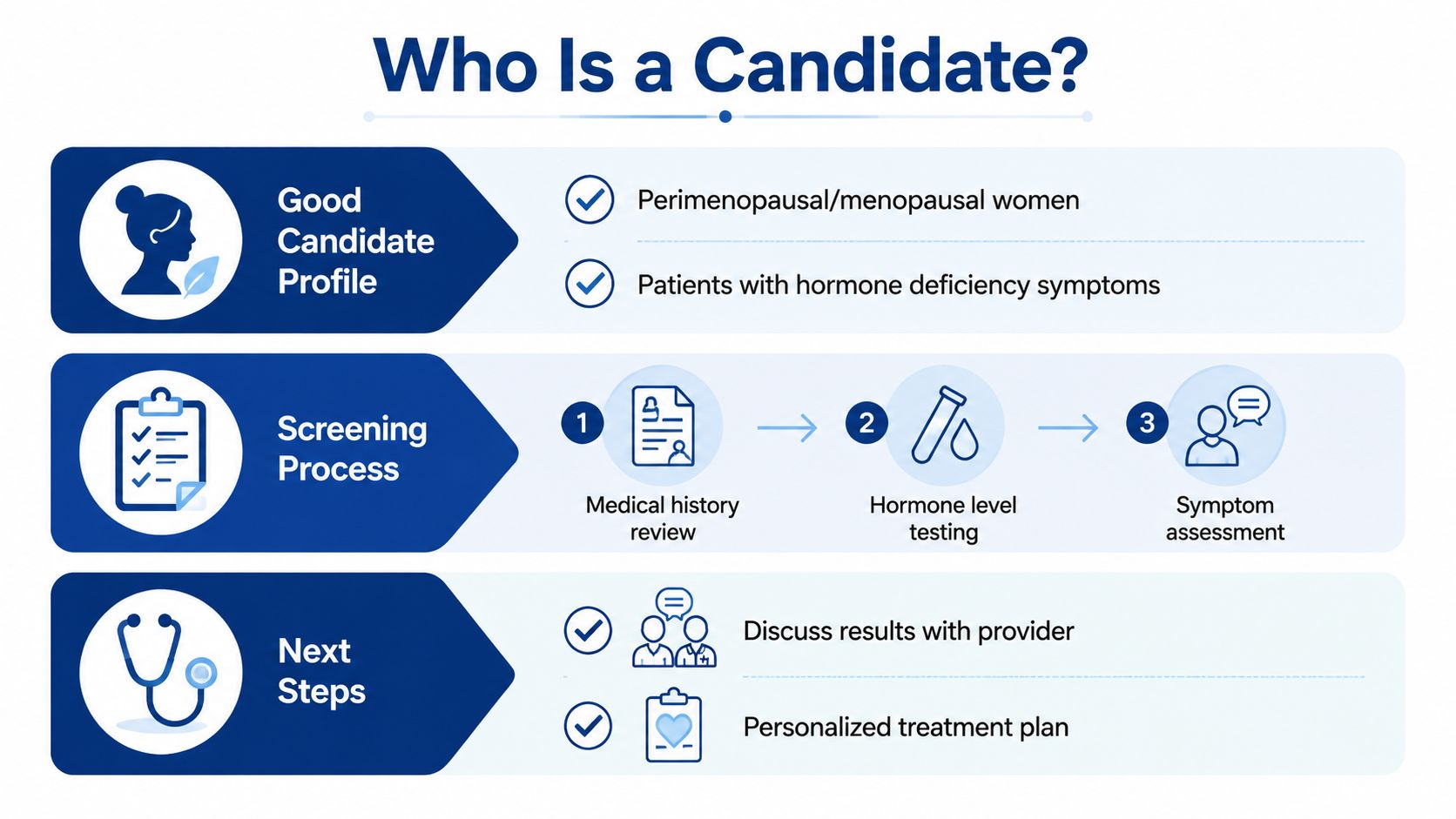
Not everyone who feels tired needs hormone therapy, and not everyone who wants hormone therapy is a candidate. The people who tend to enter this conversation most often are perimenopausal women, menopausal women with moderate to severe symptoms, men with documented low testosterone, and adults with age-related or surgical hormone decline. A careful provider also pays attention to people who need extra caution, including those with a history of hormone-sensitive cancer, blood clots, stroke, or unexplained symptoms.
What Bel Air patients usually go through
The screening process is more than a quick symptom check. It starts with a consultation, then moves into a review of medical history, family risk factors, and current symptoms. Providers commonly order labs such as estradiol, progesterone, testosterone, thyroid markers, and metabolic panels to build a picture of what's going on before treatment is considered.
The best patients for hormone care are usually the ones who can describe their symptoms clearly. If you've ever struggled to explain fatigue, sleep disruption, mood changes, or a shift in libido, it helps to organize those details before the visit. A practical way to do that is by reviewing how to communicate your health story ahead of the appointment, so the provider gets the full picture instead of a rushed summary.
Bring a simple timeline. When did the symptoms start, what changed, and what makes them better or worse?
Follow-up is part of the plan, not an afterthought. In pellet-based care, patients are commonly checked around six weeks after insertion, then monitored with ongoing labs every few months as needed. That cadence gives the provider a chance to see whether the dose matches the body's response, rather than assuming one insertion solves everything.
The point of screening is fit. A good hormone plan is built from symptoms, labs, risk history, and goals, then adjusted with follow-up. That's what medically supervised care is supposed to look like in practice.
Common Misconceptions About Bioidentical Hormone Therapy
One of the biggest misunderstandings is that bioidentical automatically means safer. It doesn't. The International Menopause Society says there is no scientific proof that bioidentical hormones are safer than synthetic ones, and that language matters because “bioidentical” describes structure, not quality.
The second misconception is that saliva or spot testing alone can fine-tune the dose without looking at the person in front of the provider. That idea is too narrow. Lab data matter, but they have to be read alongside symptoms, medical history, and risk factors. Evidence reviews have also found little support for the idea that saliva measurements alone can guide individualized dosing with precision (PubMed review).
A third myth is that hormone therapy reliably fixes every complaint that comes with midlife. It doesn't. It can help certain symptoms when hormone decline is part of the problem, but it isn't a universal fix for weight gain, low energy, mood issues, or hair changes. Those complaints can have multiple causes, and a good clinician should say that plainly.
The cleanest way to think about it is this. Bioidentical is a chemistry term, not a guarantee. If a marketing claim sounds broader than the evidence, that's a sign to slow down and ask for specifics.
Frequently Asked Questions and Booking a Bel Air Consultation
A common question is how quickly people notice a change after pellet insertion. The answer depends on the person and on what symptom is being tracked. Some patients feel a shift earlier, while others need the follow-up visit so the clinician can see how the body is responding instead of trying to judge by the calendar alone.
Insurance coverage comes up just as often. Plans can treat hormone-related visits differently, and coverage may vary by service, so the office should verify benefits directly rather than assume every part of care is covered in the same way. That conversation belongs in the consultation, because the treatment plan should be clear before anything starts.
A virtual visit can help with the first conversation, especially if you live in Fallston, Forest Hill, or another nearby community and want to decide whether hormone therapy is worth pursuing. It can give you time to talk through symptoms, ask basic questions, and understand whether you need lab work or an in-person procedure next.
In-person care is still part of the process. Labs and procedures cannot be done over a screen, but a virtual appointment can make the next step easier to plan without forcing you to rearrange your whole week.
Appointment timing matters for busy patients. Some practices offer weekday flexibility, and Saturday availability may be arranged in some cases, which helps keep the plan realistic instead of letting care slide for months.
If your symptoms feel hormonal, a real consultation is the next step. ProMD Health Bel Air provides medically supervised hormone replacement therapy, including BioTE pellet options and other treatment paths, with decisions based on symptoms, labs, and follow-up care. Visit ProMD Health Bel Air to schedule a conversation and get a personalized plan that fits your health history and goals.
ProMD Health Bel Air offers medically supervised hormone replacement therapy for adults who want a clearer answer about fatigue, hot flashes, sleep disruption, or other hormone-related symptoms. If you're in Bel Air, Fallston, or Forest Hill and want a thoughtful consultation, start with ProMD Health Bel Air and discuss whether a standardized or compounded hormone plan makes sense for you.