What You Should Know About Dermal Fillers for Jowls Before Your First Appointment
Dermal fillers for jowls are a non-surgical way to restore definition along the jawline by adding structural support, camouflaging sagging tissue, and replacing lost volume – all without general anesthesia or significant downtime.
Here is a quick overview of what they involve:
| Question | Quick Answer |
|---|---|
| What do they treat? | Sagging skin and soft tissue along the lower jaw |
| How do they work? | Fillers add volume and support to reshape the jawline contour |
| Who is a good candidate? | Adults with mild to moderate jowling and reasonable skin elasticity |
| How many syringes are needed? | Typically 1 to 4, depending on severity |
| How long do results last? | Around 12 to 18 months on average |
| Is it reversible? | Yes, if a hyaluronic acid filler is used |
| What is the average cost? | Roughly $1,000 to $3,500 depending on product and volume used |
Jowls are one of the most common concerns people bring up when they first start noticing their face has changed. Research from Allergan Aesthetics has highlighted strong patient interest in improving the lower face and jawline – and it is easy to see why. That gradual softening of the jaw can make a person look tired or older, even when they feel great.
The good news is that fillers have become one of the most effective and flexible tools for addressing this. But not all jowl treatments are the same, and understanding how they work – and which approach fits your specific anatomy – makes a real difference in the outcome.
At ProMD Health Bel Air, our experienced injector team specializes in dermal fillers for jowls and lower-face rejuvenation. In this guide, we will walk you through exactly how these treatments work so you can make a confident, informed decision.
What Jowls Are and Why They Happen
Jowls are the soft, sagging areas that develop along the lower cheeks and jawline. They usually show up as a loss of the clean line between the face and neck. In plain English: the jawline starts looking less sharp, and the lower face starts looking a little heavier.
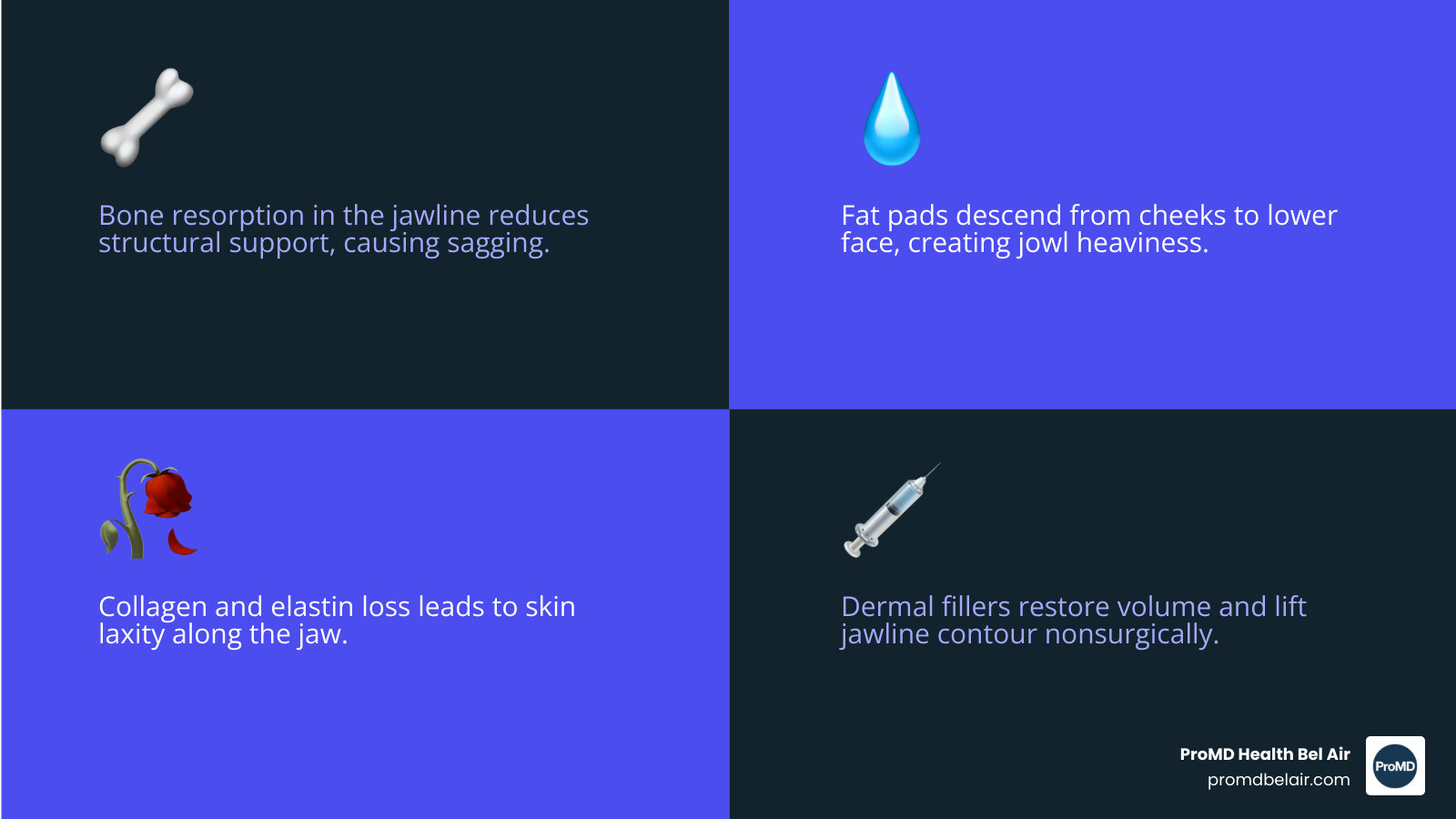
That happens for several reasons at once:
- Facial fat pads shift downward over time
- Bone in the jaw and chin slowly resorbs with age
- Collagen and elastin decline
- Skin becomes thinner and less springy
- Retaining ligaments loosen
- The platysma muscle in the neck can pull downward on the lower face
This is why jowls are not just a “skin problem.” They are a structural aging change.
How Aging Changes the Jawline Over Time
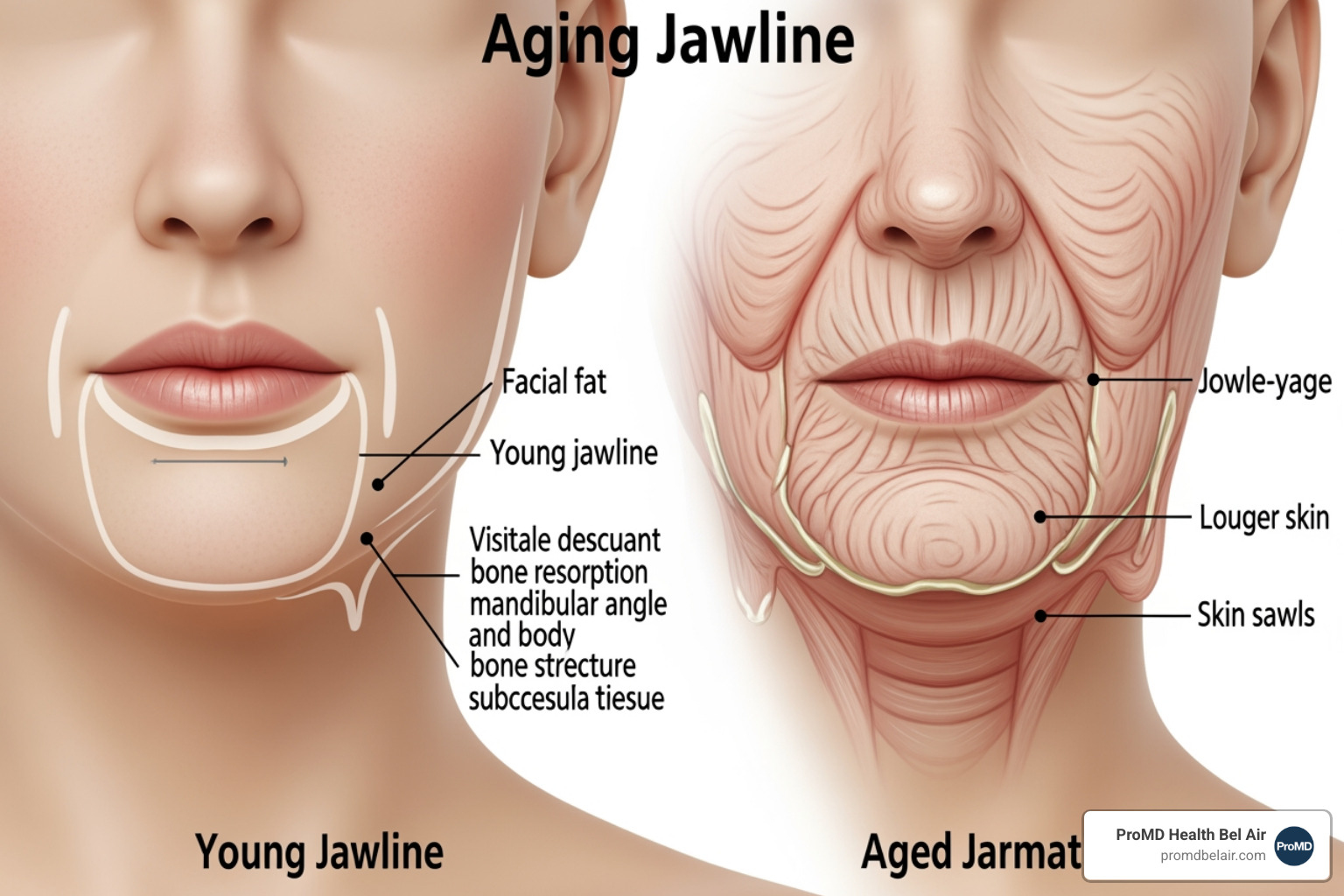
The jawline changes gradually, not all at once. Common age-related shifts include:
- Deflation in the cheeks, which reduces support for the lower face
- A hollow in front of the jowl called the prejowl sulcus
- More noticeable marionette folds
- Loosening around the jaw angle and near the ear
- A blurrier transition between the jaw and neck
This matters because treating the visible jowl alone may not create the best result. Often, we need to support the structures around it so the jawline looks smoother and more balanced.
Who Notices Jowls Earliest and Why
Some people notice jowls earlier because of:
- Genetics
- Thinner skin
- Frequent sun exposure
- Weight fluctuations
- Facial anatomy, including a naturally smaller chin or weaker jawline
Early treatment is often easier than trying to correct advanced laxity later. If there is still decent skin elasticity and only mild to moderate descent, non-surgical treatment can be very effective.
How Dermal Fillers for Jowls Work
Dermal fillers for jowls work by restoring support in strategic areas of the lower face. That may mean filling a hollow, strengthening the chin, defining the jaw angle, or supporting tissue farther back along the jawline.
Rather than “stuffing” filler into loose skin, a good plan uses filler to improve contour and structure.
At ProMD Health Bel Air, our approach is customized. We assess the whole lower face, not just the droopy part that is bothering you in the mirror. You can learn more about our dermal filler services.
Camouflaging vs Supporting With Dermal Fillers for Jowls
This is one of the most important ideas to understand.
Camouflaging means placing filler in front of or around the jowl so the transition looks smoother. A common target is the prejowl sulcus, the dip that makes the jowl stand out more clearly.
Supporting means placing filler in structural areas that help the face look lifted or more anchored, such as:
- Chin
- Jaw angle
- Posterior jawline
- Preauricular area near the ear
- Sometimes the cheeks, if midface deflation is contributing
Think of camouflage as smoothing the pothole, while support is repairing the road underneath.
The best results usually combine both. If we only fill the jowl itself, the outcome can look heavy. If we only lift laterally and ignore the hollow in front, the jowl may still show. Balance matters.
Where Injectors Place Filler for Better Jawline Definition
The exact placement depends on anatomy, but common treatment areas include:
- Chin for projection and lower-face balance
- Jaw angle for sharper definition
- Posterior jawline for continuity
- Prejowl area to reduce the break in the jawline
- Preauricular region to create lateral support
In other words, treating jowls well often means treating the jawline as a whole.
Which Fillers and Treatment Plans Work Best for the Jawline
Not all fillers behave the same way. For the jawline, we usually want products with enough firmness and structure to hold shape under movement.
Broadly, there are two categories often considered for lower-face rejuvenation:
| Filler Type | Best Use | Main Advantage | Reversible? |
|---|---|---|---|
| Hyaluronic acid fillers | Contour, volume, definition | Precise shaping and adjustability | Yes |
| Calcium hydroxylapatite fillers | Skin support and collagen stimulation | Helpful for laxity and firmer tissue support | No, not in the same way as HA |
A recent study noted that calcium hydroxylapatite may be more effective for sagging skin, while a hyaluronic acid filler may be better for patients who need more volume and contour at the jawline. That fits what we see clinically: the right product depends on whether the main issue is skin laxity, structural deficiency, or both.
Why Dermal Fillers for Jowls Often Start With Structural Support
We often begin with the “foundation points” of the lower face rather than chasing the jowl directly.
Why? Because structural support tends to create:
- Better proportions
- More natural-looking contour
- Less heaviness
- A more stable result
This conservative, architectural approach usually looks better than overfilling one small area. It is one reason jawline treatment is as much planning as it is injecting. For patients who want a subtle, balanced result, our guide to natural-looking filler planning is a helpful next read.
What Makes Juvederm Volux a Strong Option for Jawline Definition
Juvederm Volux is a hyaluronic acid filler designed specifically for jawline definition and lower-face contouring. It has a high G-prime, which is a technical way of saying it is firm enough to provide support and maintain shape in areas that need structure.
That is why many injectors consider it a top option for jawline work.
In the pivotal study for Juvederm Volux:
- Nearly 70% of patients showed improved jawline definition and contour at 6 months
- 81.5% were satisfied with their more defined jawline at 6 months
- 70.5% were satisfied with the reduced appearance of wrinkles or jowls in the lower face
Those are strong satisfaction numbers for a non-surgical treatment. If you want to understand how products are selected for different goals, our dermal filler services page goes into more detail.
How Many Syringes Are Usually Needed
This is the question everyone asks, usually right after “Will I look weird?”
Typical ranges are:
- Mild early jowls: 1 to 2 syringes
- Moderate jowls with more contour loss: 2 to 4 syringes
- More advanced lower-face aging: often more than 4 syringes if a full-face balancing plan is attempted, though some patients may be better served by surgery
The total depends on:
- How much support the chin and jawline need
- Whether the cheeks also need treatment
- Skin quality
- Degree of asymmetry
- Desired sharpness of contour
A full-face approach may use filler more efficiently than treating one isolated spot, because restoring support higher up can improve the lower face indirectly.
Who Is a Good Candidate and What to Expect From Treatment
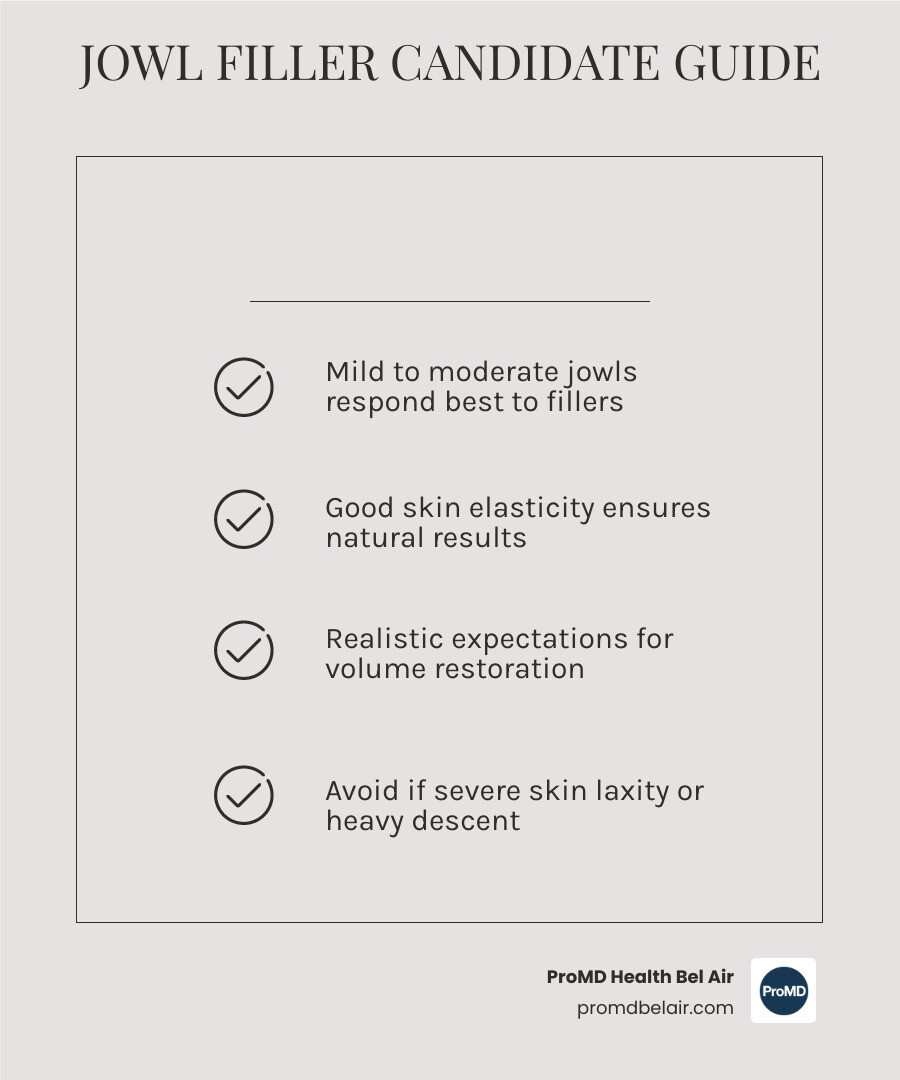
The best candidates for jowl filler usually have:
- Mild to moderate jowling
- Decent skin elasticity
- Volume loss or contour loss along the jawline
- Realistic expectations
- A preference for non-surgical treatment and minimal downtime
People with severe skin laxity, very heavy jowls, or a lot of excess skin may not get enough improvement from filler alone.
At ProMD Health Bel Air, consultation matters. We assess your anatomy, your goals, and whether filler is likely to help, camouflage, or simply not go far enough. We can also use our AI Simulator to preview likely changes, which can make treatment planning much easier to visualize.
What Happens During a Jowl Filler Appointment
A typical appointment includes:
- Assessment of the lower face at rest and in motion
- Facial mapping and discussion of treatment points
- Cleansing and, if needed, topical numbing
- Injection with a needle, cannula, or a combination of both
- Gentle molding and symmetry check
- Review of aftercare instructions
Most appointments take about 30 to 60 minutes, depending on complexity.
Patients usually describe the treatment as tolerable. You may feel pressure, pinching, or a brief sting, but modern fillers often contain lidocaine, which helps. We are not going to pretend it feels like a spa nap, but it is usually very manageable.
Recovery Time, Results, and How Long Fillers Last
Most people can return to normal routine quickly. Common short-term effects include:
- Swelling
- Bruising
- Tenderness
- Temporary firmness
- Mild asymmetry during the early settling phase
Downtime is usually minimal, though social downtime can be a few days if bruising occurs.
Many patients see an immediate improvement, but final refinement often looks better after 1 to 2 weeks, once swelling settles.
For longevity, jawline fillers often last around 12 to 18 months, though this varies by product, placement, metabolism, and movement in the area. You can read more in our guide on how long dermal fillers really last.
How Men and Women Are Treated Differently
Jawline treatment is not one-size-fits-all.
For men, goals often include:
- A broader, squarer jawline
- Stronger jaw angles
- More projection and definition
For women, goals often include:
- A cleaner, smoother jawline
- Softer contour transitions
- Balance without making the face look bulky
The ideal result is not “more filler.” It is a jawline that fits the rest of the face.
Risks, Limits, and When Other Approaches May Be Considered
Like any medical aesthetic treatment, jowl filler has risks. The most common are:
- Swelling
- Bruising
- Redness
- Tenderness
- Small lumps or unevenness
- Temporary asymmetry
Less common but more serious risks include infection, prolonged swelling, and vascular occlusion, where filler compromises blood flow. That is rare, but it is why injector training, anatomy knowledge, and proper technique matter so much.
Can Jowl Fillers Be Dissolved or Reversed?
If hyaluronic acid filler is used, yes. It can be dissolved with hyaluronidase.
That is one reason HA fillers are popular for the jawline: they offer structure but also flexibility if adjustment is needed. This is especially reassuring for first-time patients.
Biostimulatory and calcium hydroxylapatite-based products do not reverse in the same straightforward way, so product selection should match your comfort level as well as your anatomy.
When Fillers Are Not Enough
Fillers are helpful, but they are not magic. If someone has:
- Significant skin redundancy
- Very heavy jowls
- Advanced lower-face descent
- A lot of neck laxity
Then filler may only provide partial improvement. In these cases, a consultation can help determine whether a non-surgical plan is likely to be worthwhile or whether treatment expectations should stay conservative.
If the main issue is excess skin rather than volume loss, filler should not be pushed beyond what it can realistically do.
Best Combination Treatments Offered at ProMD Health Bel Air for Better Lower-Face Results
Many patients get the best outcome from a combination approach. Depending on your anatomy, we may pair filler with:
- Botox or Dysport to relax downward pull from the platysma, sometimes called a Nefertiti-style lift effect
- Kybella if fullness under the chin is blurring the jawline
- Microneedling to support skin quality
- Lasers for texture and collagen support
- Skin care and maintenance planning
For more on combined approaches, see our guide to non-surgical jowl lift options. If you are exploring broader lower-face rejuvenation, you may also like The Magic of Fillers: Your Guide to a Liquid Facelift and Get Your Glow Back With Dermal Fillers in Bel Air.
Frequently Asked Questions About Dermal Fillers for Jowls
What Is the Average Cost of Treating Jowls With Dermal Fillers?
A realistic average range is about $1,000 to $3,500 total, depending on:
- The filler used
- Number of syringes
- Whether the chin or cheeks are also treated
- Complexity of the treatment plan
Jawline treatment often requires more than one syringe, so the total cost is usually higher than treating a small lip area or fine line.
Are Dermal Fillers for Jowls Worth It?
For the right patient, yes.
They can offer:
- Better jawline definition
- A younger, more rested appearance
- Minimal downtime
- No incisions or general anesthesia
- Adjustable and often reversible treatment if HA filler is used
They are worth it when expectations are realistic. Fillers can improve and refine; they do not remove large amounts of loose skin.
How Can I Make My Jowl Filler Results Last Longer?
You cannot freeze time, sadly, but you can help your results last longer by:
- Keeping follow-up appointments on schedule
- Wearing daily sunscreen
- Avoiding smoking
- Maintaining a stable weight
- Following a good skin care routine
- Considering collagen-supporting treatments when appropriate
Maintenance is usually easier than starting over from scratch after everything has fully faded.
Conclusion
Jowl treatment works best when we look beyond the jowl itself and treat the lower face strategically. Dermal fillers for jowls can smooth hollows, restore support, sharpen the jawline, and create a fresher appearance without surgery, especially when jowling is still mild to moderate.
At ProMD Health Bel Air, we build personalized treatment plans based on your anatomy, goals, and comfort level. If you want to explore your options further, you can read more on our dermal fillers page blog content, browse more dermal filler articles, or learn how we lift sagging jawline and neck without surgery.
If you are in Bel Air, Fallston, or Forest Hill, MD and want a clearer idea of what is possible, we invite you to schedule a consultation with our team. We can evaluate whether filler is the right fit, discuss combination options, and use our AI Simulator to help you preview a personalized result before treatment.