Why Surgeons Are Choosing ACell Hair Transplant Over Traditional Methods
ACell hair transplant is a regenerative technique that applies an extracellular matrix (ECM) product — derived from porcine urinary bladder tissue — to hair transplant sites to improve graft survival, accelerate healing, and stimulate follicle regeneration.
Here is a quick snapshot of what you need to know:
| What You Want to Know | The Short Answer |
|---|---|
| What is it? | An ECM-based regenerative treatment used during or after hair transplant surgery |
| How does it work? | Recruits progenitor cells and stem cells to the scalp to rebuild tissue and support follicles |
| Is it surgical? | It is used alongside FUE or FUT surgery, or as a standalone injection therapy |
| When will I see results? | Most patients see new growth within 6 to 8 months |
| How long do results last? | Typically 1 to several years, with optional booster treatments |
| Who is it for? | Men and women with pattern hair loss, thinning hair, or limited donor supply |
| Is it FDA-approved? | ACell MatriStem is FDA-cleared as a regenerative wound management product |
Hair restoration has advanced dramatically over the past decade. Surgeons are no longer limited to simply moving follicles from one place to another. Today, regenerative tools like ACell give the scalp a biological advantage — helping transplanted grafts survive better, healing donor sites with minimal scarring, and even triggering dormant follicles to regrow.
The numbers back this up. Clinical studies have shown a 92% yield for beard hair in donor area scars treated with ACell, compared to 0% without it. And in FUE extraction sites, researchers observed follicle regrowth in 54% of treated sites.
These are not minor improvements. For patients who have struggled with limited donor hair or disappointing transplant results, this technology represents a meaningful shift in what is possible.
I’m Ryan Pittillo, Franchise Owner at ProMD Health Bel Air, and while my background is in building high-performing teams on the football field and in business, my role here puts me alongside a skilled clinical team that evaluates advanced hair restoration options — including the ACell hair transplant — to help our Bel Air patients make confident, informed decisions. Here is what the science and real-world results actually show.
Understanding ACell and the Extracellular Matrix in Hair Restoration
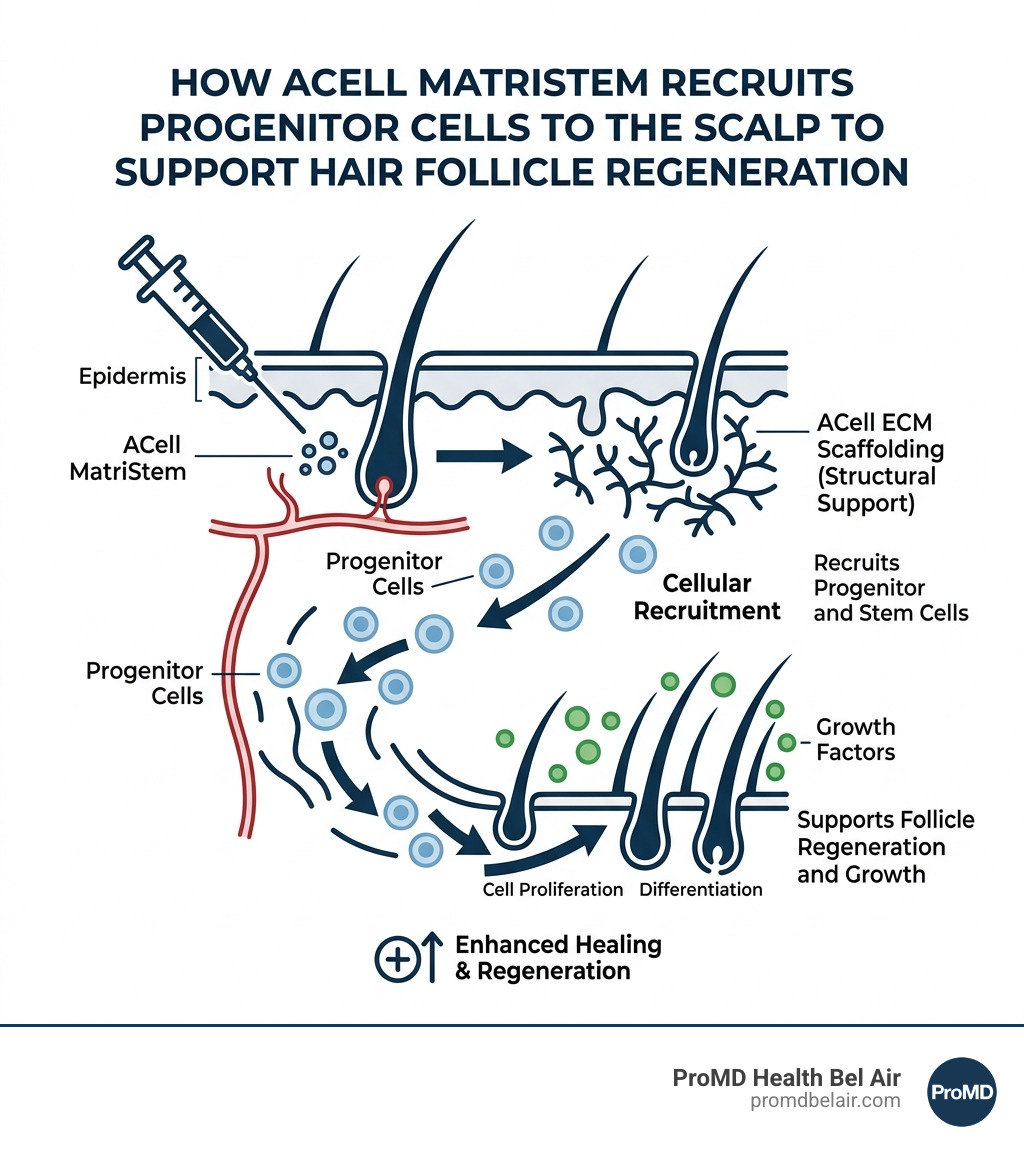
To understand why an acell hair transplant is so effective, we first have to look at what ACell actually is. In regenerative medicine, ACell is known as a “bi-modal extracellular matrix” (ECM). It is derived from porcine urinary bladder matrix (UBM), a material that is structurally and chemically similar to human tissue.
Think of the Extracellular Matrix as the “scaffolding” of your body. It is a complex network of structural proteins (like Collagen types I, II, III, and IV), growth factors, and glycoproteins. When this matrix is introduced to a wound or a thinning scalp, it provides the structural support and biological signals needed for tissue regeneration.
According to scientific research on ACell MatriStem, this technology fundamentally changes how the body heals. Instead of simply forming a scar, the ACell matrix recruits “progenitor cells”—essentially the body’s repair crew. These cells are drawn to the site and instructed to rebuild site-specific tissue. In the context of the scalp, this means supporting the hair follicles and the surrounding blood vessels.
Because it is non-synthetic and fully resorbable, your body eventually replaces the ACell scaffold with its own healthy, new tissue. This process of “constructive remodeling” is what makes it a breakthrough for both surgical and non-surgical Hair Restoration patients.
The Role of ACell in Surgical Hair Transplants
When surgeons perform a hair transplant, they are essentially performing a series of tiny “injuries” to both the donor area (where hair is taken) and the recipient area (where hair is placed). This is where an acell hair transplant protocol shines.

In procedures like Follicular Unit Extraction (FUE) or Follicular Unit Transplantation (FUT), ACell is often used in three distinct ways:
- Graft Holding Solution: Before the follicles are placed back into the scalp, they are often soaked in a solution containing ACell. This increases graft viability, ensuring the delicate follicles stay healthy while they are outside the body.
- Donor Area Healing: One of the biggest concerns with hair transplants is scarring. In FUE, surgeons have found that applying ACell to the tiny “punch” sites can lead to virtually undetectable scarring. For FUT (strip) procedures, it can improve the feel and appearance of the linear scar.
- Recipient Site Growth: By injecting or applying ACell to the areas where new hair is being placed, surgeons can create a more fertile “soil” for the “seeds” (the hair grafts). This promotes more robust growth and can even help regenerate follicles in some cases.
By utilizing this technology, we aim to overcome the traditional limitations of donor supply. If we can improve the yield of every single graft, we can achieve a thicker, more natural look with fewer procedures.
Who is a Candidate for an ACell Hair Transplant?
We often see patients in Bel Air, Fallston, and Forest Hill who are frustrated because they’ve been told they aren’t “ideal” candidates for a standard transplant. The acell hair transplant approach expands the pool of eligible patients.
- Genetic Pattern Hair Loss: Both men and women suffering from androgenetic alopecia can benefit from the regenerative boost.
- Diffuse Thinning: Women, in particular, often experience thinning across the whole scalp rather than a receding hairline. ACell helps thicken existing hair while supporting new grafts.
- Limited Donor Supply: If you have a small “donor bank,” every graft counts. ACell ensures the highest possible survival rate for those precious follicles.
- Early-Stage Hair Loss: For those just beginning to see thinning, ACell can often be used as a standalone injection therapy to “wake up” dormant follicles before surgery is even necessary.
Recovery and Side Effects of an ACell Hair Transplant
One of the best parts about adding ACell to a hair restoration plan is that it doesn’t significantly increase your downtime. The procedure is typically performed under local anesthesia, so the scalp is completely numb and there is no discomfort during the application.
After the treatment, you might experience some mild forehead swelling for two to three days. In rare cases, light bruising may occur under the eyes, but this usually resolves quickly. Most of our patients find they can resume normal activities within 48 hours. Because ACell is a natural product that is eventually absorbed by the body, the risk of an adverse reaction is extremely low.
Synergistic Benefits: Combining ACell with PRP Therapy
While ACell is powerful on its own, it is most frequently used in combination with Platelet-Rich Plasma (PRP). At ProMD Health Bel Air, we view these two as a “dream team” for hair growth.
PRP is harvested from your own blood and is packed with concentrated growth factors. While PRP provides the “fuel” for hair growth, ACell provides the “scaffold” or the structure. When combined, they provide a sustained release of growth factors that nourishes follicles and pushes them into the active growth phase (anagen).
According to scientific research on PRP and ACell, this combination is significantly more effective than PRP alone. While standalone PRP often requires treatments every few months, the ACell + PRP protocol is typically an annual regimen. This makes it a much more convenient and cost-effective option for busy patients.
Realistic Expectations: Results, Timelines, and Success Rates
It is important to remember that hair growth is a slow, biological process. Whether you are doing a full acell hair transplant or a standalone injection therapy, you won’t see results overnight.
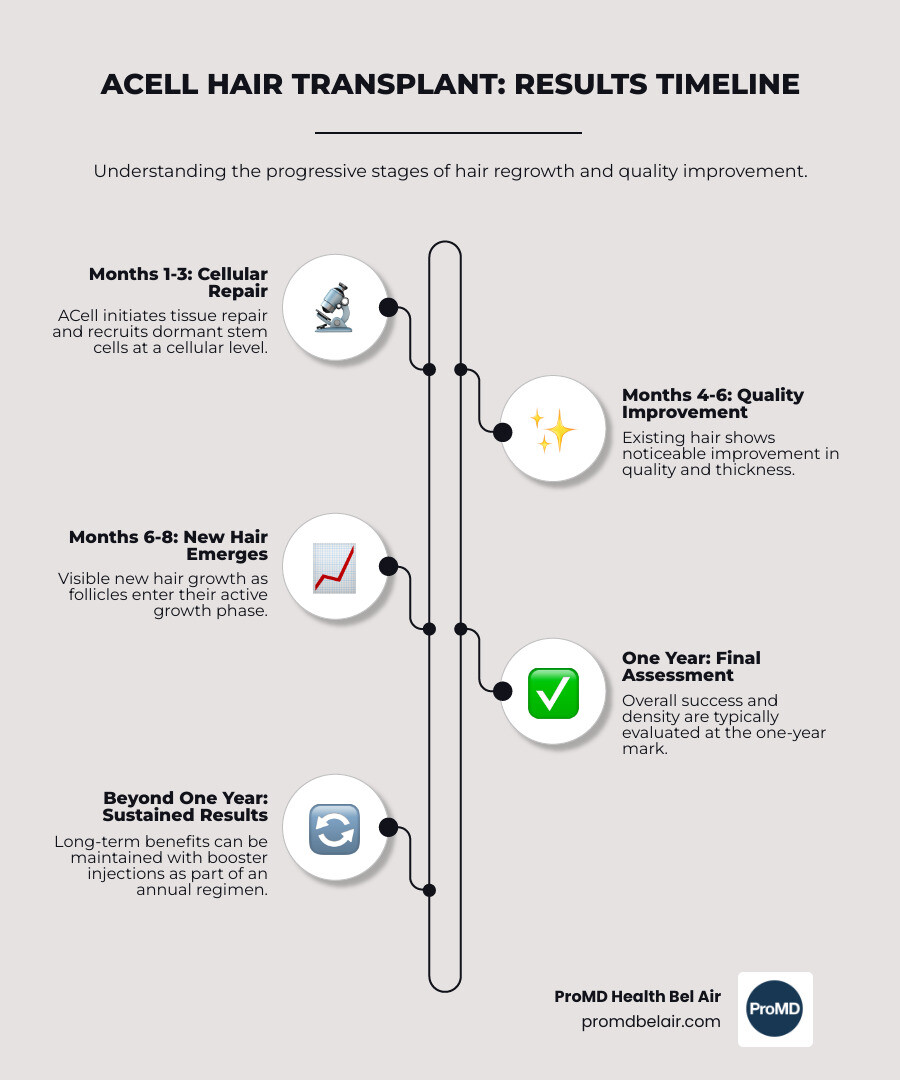
- Months 1-3: This is the “dormant” phase. The ACell is working at a cellular level to repair tissue and recruit stem cells.
- Months 4-6: You will likely notice an improvement in the quality and thickness of your existing hair.
- Months 6-8: This is when new hair growth typically becomes visible.
- One Year+: Final results are usually assessed at the one-year mark.
The success rates are encouraging. Clinical observations have shown that a specific PRP+ACell protocol was beneficial for 99% of men and women with genetic pattern hair loss. Additionally, combination therapy can result in improved coverage for up to 70% of patients who might not have responded as well to traditional methods.
To see how these results might look on you, we invite you to use our AI Simulator during your consultation. It allows us to provide a personalized preview of your post-treatment results, helping you set realistic goals for your Services.
Comparing ACell to Traditional Hair Loss Treatments
When evaluating your options, it helps to see how ACell stacks up against the “old guard” of hair loss treatments like Minoxidil (Rogaine) or Finasteride (Propecia).
| Treatment Type | Frequency | Mechanism | Effectiveness |
|---|---|---|---|
| Minoxidil | Daily (Topical) | Increases blood flow | Moderate; often stops when use stops |
| Finasteride | Daily (Oral) | Blocks DHT | High for maintenance; potential side effects |
| Standalone PRP | Every 2-3 months | Growth factors | Good; requires high frequency |
| ACell + PRP | Once a year | ECM Scaffold + Growth Factors | Very High; long-lasting results |
| LLLT (Laser) | 3x Weekly | Light energy | Low to Moderate; maintenance only |
While medications like Finasteride and Minoxidil are excellent for maintaining the hair you have, they don’t offer the regenerative “reset” that an acell hair transplant provides. Many of our patients choose to use ACell as a way to “supercharge” their results while continuing their standard maintenance medications. For more information on how this fits into a broader health plan, check out our Wellness Services.
Frequently Asked Questions about ACell Hair Restoration
Is ACell FDA-approved for hair restoration?
ACell MatriStem technology is FDA-cleared as a medical device for wound management and tissue reinforcement. While its use in hair restoration is technically “off-label” (as is the case with many regenerative treatments like PRP), it has been used safely and effectively by hair transplant surgeons for over a decade.
How much does an ACell hair treatment cost?
The cost of an ACell treatment can vary depending on whether it is being used as an add-on to a surgical transplant or as a standalone injection therapy. Typically, standalone ACell + PRP sessions range from $1,000 to $3,000. While this is an investment, the fact that it only needs to be done once a year often makes it more affordable than monthly treatments. We offer Financing Offers to help make these treatments accessible.
When will I see the final results of my ACell treatment?
While some improvement in hair texture is seen around 6 months, the final, “mature” results of an acell hair transplant or injection therapy are usually seen between 12 and 18 months. This timeline matches the natural growth cycle of human hair.
Conclusion
The shift toward acell hair transplant technology represents the future of hair restoration. By moving away from simple “plug and play” surgery and toward regenerative medicine, we can offer our patients in Bel Air, MD, more natural results, faster healing, and a higher success rate.
At ProMD Health Bel Air, our team—including Tyra Lindblad, Kate Maguire, and our expert PAs Lauren Mason and Amanda Pittillo—is dedicated to providing the highest level of aesthetic excellence. Whether you are looking to enhance a surgical transplant or seeking a non-surgical way to combat thinning, we have the tools and the expertise to help.
Don’t leave your hair restoration to chance. Use our AI Simulator to preview your results and see the difference that regenerative medicine can make.
Get Started Now with Hair Restoration or Contact us today to schedule your consultation at our Bel Air office.