Your Own Blood Could Be the Key to Regrowing Lost Hair
Plasma hair regrowth is a treatment where your own blood is processed to concentrate platelets and growth factors, then injected into your scalp to reactivate thinning or dormant hair follicles.
Here is a quick overview of how it works:
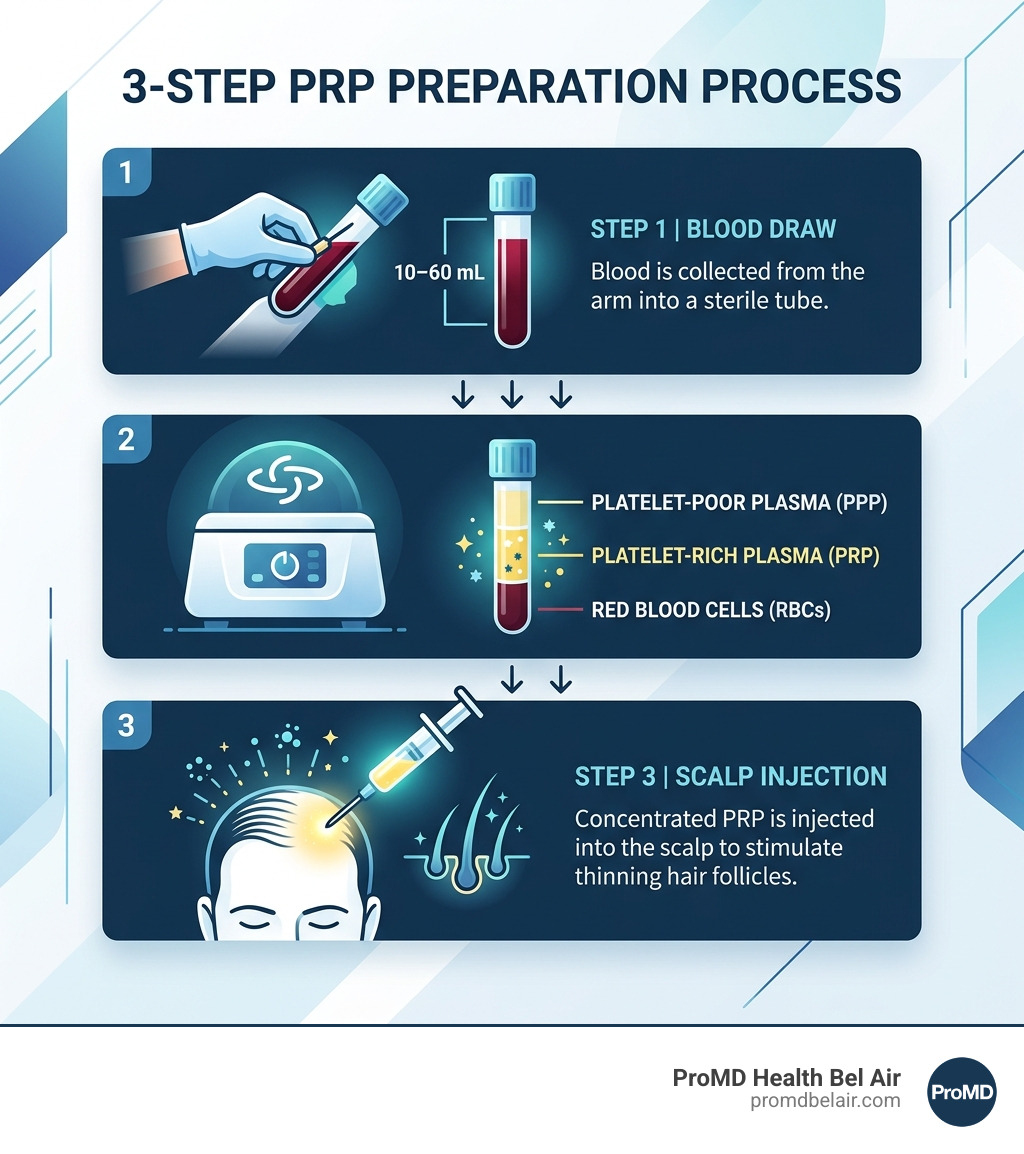
| Step | What Happens |
|---|---|
| 1. Blood draw | 10–60 mL of your blood is collected |
| 2. Centrifugation | Blood is spun to separate platelet-rich plasma (PRP) from red blood cells |
| 3. Injection | PRP is injected into the scalp at follicle level to stimulate regrowth |
Key facts at a glance:
- PRP contains growth factors like PDGF, VEGF, and TGF-β that signal hair follicles to grow
- Clinical meta-analyses show up to 38.75 more hairs per cm² compared to untreated scalp
- A typical plan is 3 monthly sessions, then maintenance every 3–6 months
- Results usually become visible within 3 to 12 months
- It is autologous — meaning it uses your own blood, which lowers the risk of allergic reactions
Hair loss affects roughly half of all men by age 50 and up to half of all women over their lifetime. Yet most people still think their only options are daily pills, foam you rub in every morning, or major surgery. PRP changes that picture. It is a minimally invasive, in-office procedure that works with your body’s own biology — no foreign drugs, no scalpels, no downtime.
I’m Ryan Pittillo, a Franchise Owner at ProMD Health Bel Air with a background in competitive athletics and team-building that has shaped my deep appreciation for evidence-based recovery and performance — principles that directly inform how I think about plasma hair regrowth and the restorative treatments we offer. Read on for a complete breakdown of how PRP works, what the clinical evidence actually shows, and what you can expect from treatment here in Bel Air.
Understanding the Science of Plasma Hair Regrowth
To understand why plasma hair regrowth works, we have to look at what is actually inside your blood. While we often think of blood as just a red liquid that carries oxygen, it is actually a complex cocktail of cells and plasma. The “magic” ingredient for hair restoration is the platelet.
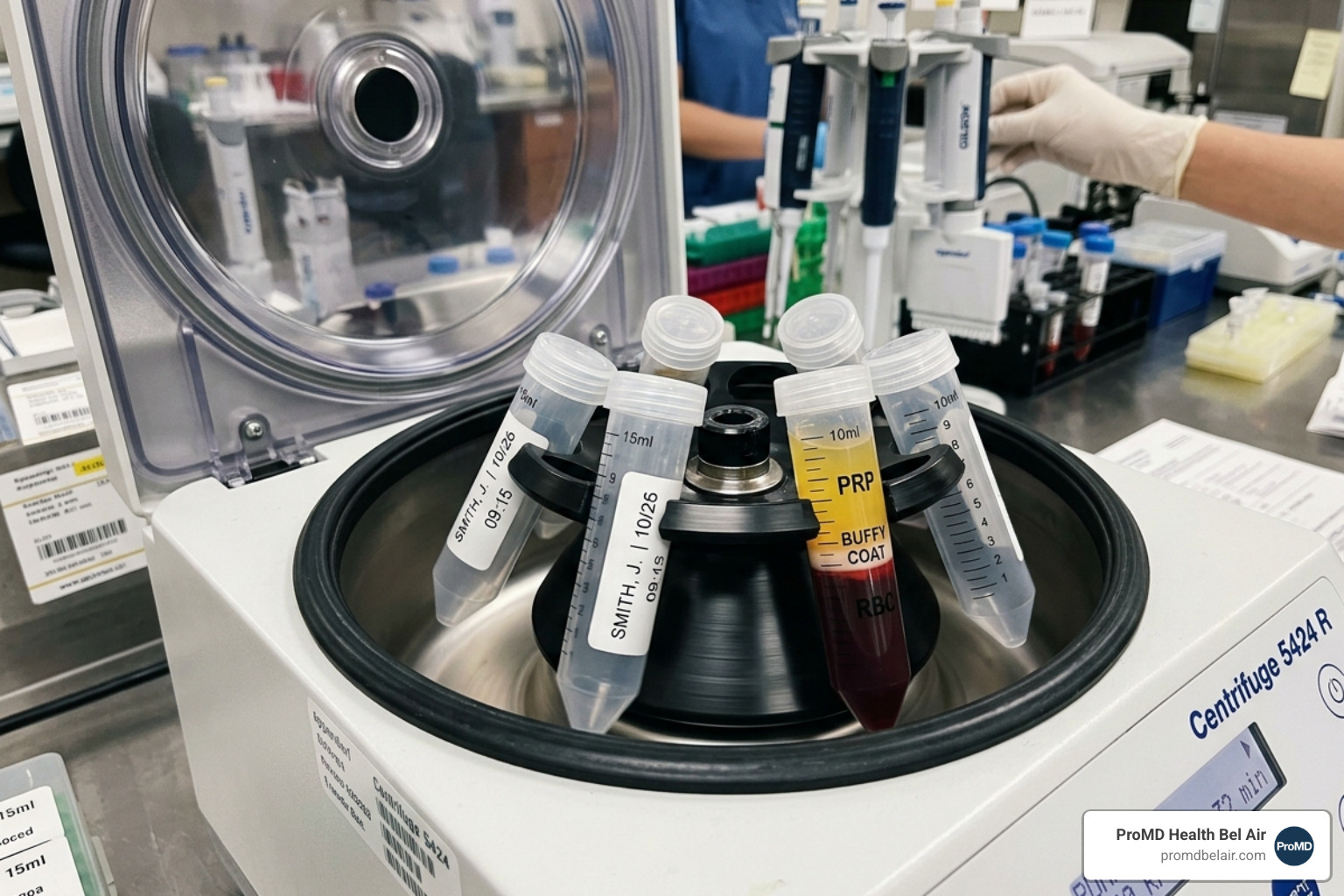
Platelets are famous for clotting blood when you get a cut, but they do much more than that. They are essentially tiny “repair kits” packed with growth factors and cytokines. When we use a centrifuge to spin your blood, we separate the red blood cells from the Platelet-Rich Plasma (PRP). This process concentrates the platelets to levels up to five times higher than what is found in your normal circulating blood.
In the scientific community, we often look at the DEPA classification to measure the quality of PRP. This stands for Dose, Efficiency, Purity, and Activation. For optimal plasma hair regrowth, research suggests we want a high dose (ideally over 5 billion platelets) and high purity.
Inside that concentrated plasma are several key players:
- PDGF (Platelet-Derived Growth Factor): Stimulates cell replication and angiogenesis (the formation of new blood vessels).
- VEGF (Vascular Endothelial Growth Factor): Crucial for increasing the blood supply to the hair follicle.
- TGF-β (Transforming Growth Factor-Beta): Helps regulate the growth and division of cells.
By concentrating these factors and delivering them directly to the scalp, we provide a massive “bio-boost” to follicles that have started to miniaturize or go dormant. You can learn more about the biology of this process in this detailed report on how Platelet-Rich Plasma helps hair growth.
How Platelet-Rich Plasma Restores Thinning Hair
The primary target of plasma hair regrowth is a structure called the dermal papilla. These cells sit at the very base of your hair follicle and act as the “control center” for hair growth. In conditions like androgenetic alopecia (pattern baldness), hormones like DHT cause these follicles to shrink and spend less time in the growing phase.
PRP works by activating specific signaling pathways, most notably the Wnt/β-catenin signaling pathway. Think of this as the “on switch” for hair growth. When these signals are amplified by the growth factors in PRP, several things happen:
- Anagen Phase Extension: The “anagen” phase is the active growth period of a hair. PRP helps keep follicles in this phase longer, leading to longer and thicker hair strands.
- Increased Vascularity: Through angiogenesis, PRP helps build a better “piping system” of blood vessels around the follicle, ensuring it gets the nutrients it needs to thrive.
- Stem Cell Activation: PRP helps recruit and activate stem cells within the hair bulge, which are necessary for regenerating the follicle.
At ProMD Health Bel Air, we see this as a foundational step in comprehensive hair restoration. It isn’t just about covering up a bald spot; it’s about changing the inter-follicular macroenvironment to be more hospitable to healthy hair.
Proven Results for Plasma Hair Regrowth in Clinical Studies
One of the reasons we are so confident in plasma hair regrowth at our Bel Air, Fallston, and Forest Hill locations is the sheer volume of clinical evidence available as of April 2026.
Recent meta-analyses of randomized controlled trials (the gold standard of research) have shown impressive results:
- A meta-analysis of 6 studies involving 177 patients showed a significant increase in hair count per cm² after PRP injections.
- Another comprehensive review confirmed a mean increase of 38.75 hairs per cm².
- 84% of studies on androgenetic alopecia reported positive effects, with 34% showing statistically significant improvements in both hair density and hair thickness.
These results aren’t just for men. In a study of 776 women with Female Pattern Hair Loss (FPHL), PRP showed a significant improvement in hair density compared to control groups. Even for those with Alopecia Areata—an autoimmune condition where the body attacks its own follicles—PRP has shown promise in regrowing hair even in cases that were previously resistant to steroid treatments.
Optimizing Your Plasma Hair Regrowth Treatment Plan
Not all PRP is created equal. The method of preparation matters immensely for your results. In the research, we see a distinction between “single-spin” and “double-spin” methods. While single-spin is faster, the double-spin method often yields a higher concentration of platelets, which clinical data suggests leads to better terminal hair density.
Another interesting finding in recent research is the role of activation. Some providers “activate” the PRP with calcium chloride or thrombin before injection. However, a study comparing the two found that non-activated PRP actually showed a 31% increase in hair count compared to only 19% for activated PRP. This is likely because non-activated PRP allows for a more gradual, sustained release of growth factors once it interacts with the collagen in your scalp.
The Treatment Protocol: What to Expect in Bel Air
When you visit us at ProMD Health Bel Air, we want the process to be as transparent and comfortable as possible. We pride ourselves on a “no-fluff” approach that prioritizes your time and your results.
The standard protocol involves a few simple steps:
- The Blood Draw: We collect between 10–60 mL of your blood (similar to a standard lab test).
- Processing: Your blood is placed in a specialized centrifuge. While you wait, we often apply a topical numbing cream to the treatment area to ensure comfort.
- The Injection: Using a very fine needle, our skilled team—including experts like Amanda Pittillo, PA-C or Lauren Mason, PA-C—injects the PRP into the areas of thinning. The injections are shallow, reaching just to the level of the hair follicles.
The entire procedure takes about 30 to 45 minutes. Because it is your own blood, there is virtually no risk of an allergic reaction. Most patients describe the sensation as a series of small pinpricks or a feeling of pressure.
There is zero downtime. You can drive yourself home, return to work, and even shower later that day. We do recommend avoiding harsh chemical treatments (like hair dye) for about 48 hours. While PRP is our primary focus, we also stay updated on emerging tech, such as research on cold atmospheric plasma, which is a “drug-free” way to stimulate the scalp environment using ionized gas.
Comparing Plasma Therapy to Traditional Hair Loss Solutions
Many of our patients in Bel Air and Forest Hill have already tried over-the-counter foams or pills. While those have their place, plasma hair regrowth offers several distinct advantages.
| Feature | PRP Therapy | Minoxidil (Topical) | Finasteride (Oral) |
|---|---|---|---|
| Application | Injectable (In-office) | Topical (Daily at home) | Pill (Daily) |
| Mechanism | Growth Factor Boost | Vasodilation | DHT Inhibition |
| Side Effects | Minimal (Soreness) | Scalp Irritation | Hormonal/Systemic |
| Effort | Once every few months | Twice daily, forever | Daily, forever |
| Adjunct Use | Excellent with others | Standard | Standard |
One of the biggest “pitfalls” of medications like Minoxidil or Finasteride is that they only work as long as you use them every single day. If you stop, the hair you saved often sheds within a few months. PRP, while requiring maintenance, works by physically revitalizing the follicle itself.
Furthermore, PRP is an incredible adjunct therapy. If you are planning a hair transplant, research shows that soaking the hair grafts in PRP before implantation enhances their uptake, density, and eventual thickness.
Frequently Asked Questions about Plasma Hair Restoration
How long do the results of plasma hair treatment last?
The results of plasma hair regrowth are not permanent because hair loss is often a progressive genetic condition. However, they are long-lasting. Most patients see peak results around the 6-to-12-month mark. To maintain those results, we typically recommend a “maintenance” session once or twice a year. In one study of 20 participants, only 4 reported any recurring hair loss 12 months after their final treatment.
Is the procedure painful or are there side effects?
Most of our patients find the procedure very tolerable. We can use topical numbing or ice to minimize the sensation of the injections. Common side effects are mild and temporary, including some scalp tenderness, slight swelling, or a “tight” feeling in the scalp for a day or two. Because we use your own blood, there is no risk of “rejecting” the treatment.
Who is the ideal candidate for this treatment?
PRP works best for patients with “active” but thinning follicles. If an area of the scalp has been completely bald for more than five years, the follicles may have scarred over, making them less responsive. The ideal candidate is someone noticing early-to-mid-stage thinning or a widening part. It is also important that you don’t have underlying blood disorders, active scalp infections, or certain autoimmune conditions.
Conclusion
At ProMD Health Bel Air, we believe that the best solutions often come from within. By harnessing the regenerative power of your own blood, plasma hair regrowth offers a scientifically backed, low-risk path to thicker, fuller hair.
What sets us apart in the Bel Air, Fallston, and Forest Hill areas is our commitment to personalized care. We don’t believe in a one-size-fits-all approach. That’s why we utilize our AI Simulator, allowing you to preview potential post-treatment results before you even begin. Our expert team—including Tyra Lindblad, Kate Maguire, Amanda Pittillo, PA-C, Lauren Mason, PA-C, MSHS, Paige Scott, and Natalie Shek—is here to guide you through every step of the journey.
Don’t wait until the thinning becomes permanent. Early intervention is the key to maintaining your natural hair for years to come.
Schedule your consultation at ProMD Health Bel Air today and see if your own plasma is the solution you’ve been looking for.