What Is a Mid Face Thread Lift? A Quick, Clear Answer
A mid face thread lift is a minimally invasive, non-surgical procedure that lifts and tightens sagging cheeks, softens nasolabial folds, and restores definition to the midface — all without incisions, general anesthesia, or weeks of downtime.
Here’s what you need to know at a glance:
| Feature | Mid Face Thread Lift |
|---|---|
| Procedure time | 30–60 minutes |
| Anesthesia | Local only |
| Recovery | 2–5 days of mild swelling/bruising |
| Results last | 12 months to 3 years |
| Scarring | None |
| Best for | Mild to moderate midface sagging, ages late 30s–early 50s |
| In-office? | Yes |
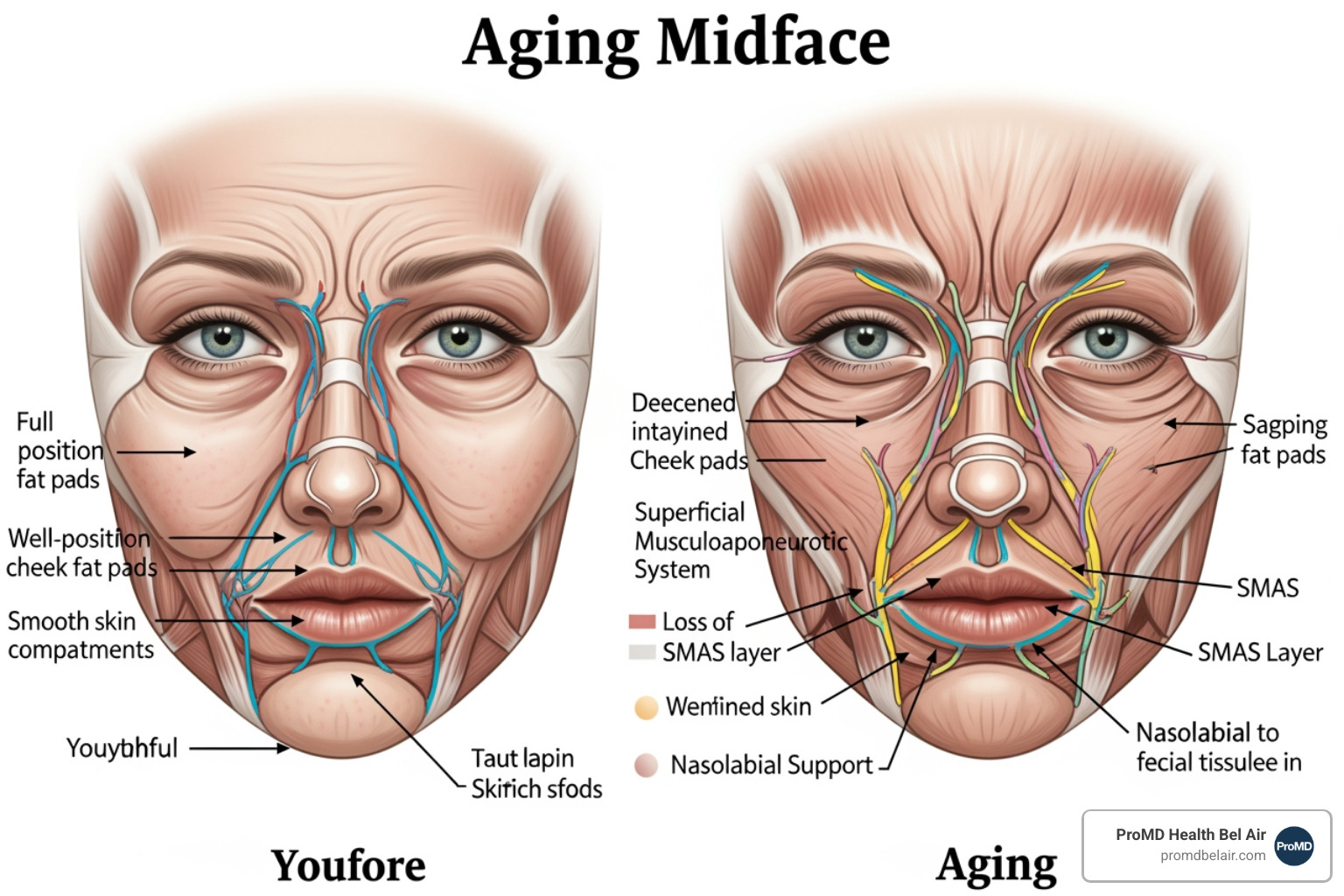
As we age, the structural support layer beneath our skin — known as the SMAS — weakens, fat pads descend, and collagen breaks down. The result: flattened cheeks, deepening folds, and early jowling. A mid face thread lift addresses exactly this, using dissolvable medical-grade threads to physically reposition tissue and stimulate your body’s own collagen production over time.
It’s often called a “lunchtime facelift” — fast, effective, and subtle enough that most people won’t be able to pinpoint what changed, only that you look refreshed.
I’m Ryan Pittillo, Franchise Owner at ProMD Health Bel Air, and my team and I are committed to helping patients in the Bel Air area understand their options for treatments like the mid face thread lift so they can make confident, informed decisions. Read on for everything you need to know — from how it works to what recovery actually looks like.
Mid face thread lift vocabulary:
What is a mid face thread lift and how is it different from surgery?
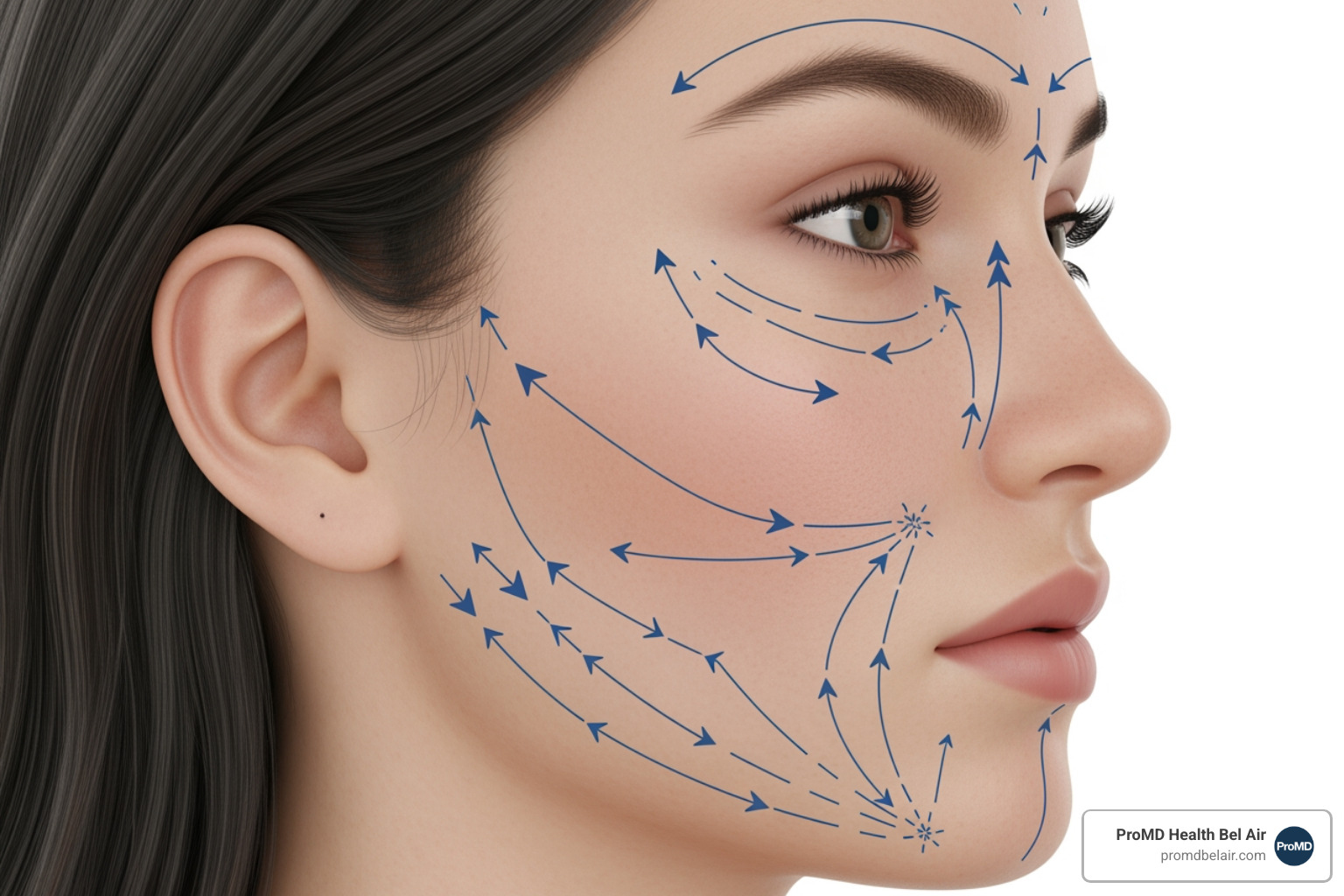
A mid face thread lift targets the area from the cheeks down toward the nasolabial folds and early jowls. Instead of removing skin through incisions, we place dissolvable threads under the skin to lift tissue along carefully planned vectors.
That makes it very different from a surgical mid-face lift.
A surgical lift is designed for more advanced laxity. It typically involves incisions, deeper dissection, more dramatic repositioning, and a longer recovery. A thread lift is more about subtle, natural-looking support for early to moderate sagging. Think refresh, not reinvention.
What a mid face thread lift treats
A mid-face thread lift is commonly used to improve:
- Descending cheek tissue
- Flattened or less defined cheeks
- Deepening nasolabial folds
- Mild marionette lines
- Early jowling
- Loss of soft facial definition
It does not replace surgery for severe sagging, but it can be an excellent choice when the face still has decent skin quality and only moderate tissue descent.
Mid face thread lift vs surgical mid-face lift
Here is the simple version:
| Feature | Mid Face Thread Lift | Surgical Mid-Face Lift |
|---|---|---|
| Incisions | Tiny entry points | Surgical incisions |
| Scars | None visible | Possible, though usually hidden |
| Anesthesia | Local | Often deeper sedation or general anesthesia |
| Downtime | Usually 2-5 days | Often 2-4 weeks |
| Results | Subtle to moderate | More dramatic |
| Longevity | About 1-3 years | Longer-lasting |
| Best for | Early to moderate aging | Advanced laxity |
For many people in their late 30s, 40s, and early 50s, a thread lift hits the sweet spot: enough lift to look fresher, without the commitment of surgery.
Why the mid-face ages first
The mid-face often shows aging early because several things happen at once:
- The SMAS support layer weakens
- Collagen and elastin decline
- Cheek fat pads shift downward
- Bone support changes over time
- Skin becomes less resilient
That is why people often notice “my cheeks look flatter” or “my smile lines suddenly look deeper” before they notice major neck laxity. The issue is not just skin. It is also structural support and tissue descent.
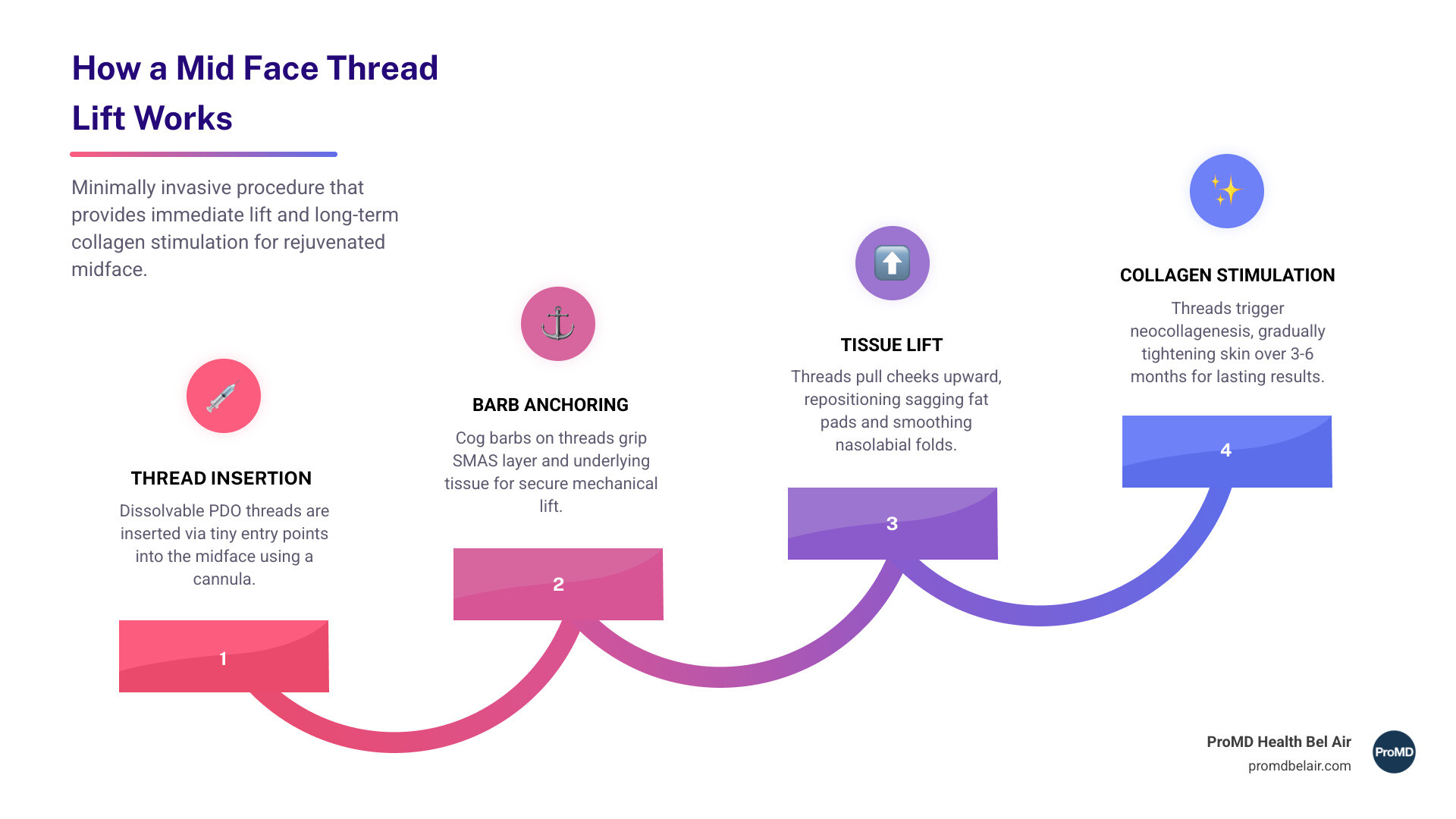
How a mid face thread lift works
A thread lift works through two main mechanisms: immediate mechanical lifting and longer-term collagen stimulation. This dual action is one reason it remains popular as a minimally invasive rejuvenation option.
For a deeper overview of the science and procedural basics, see our Thread Lift Procedure: Complete Guide and this Scientific research on PDO cog threads.
The two effects of a mid face thread lift
First, there is the lift itself. Barbed or cog threads catch and support soft tissue, allowing us to reposition it upward along a planned vector. In plain English: the thread acts like a tiny internal support system.
Second, the threads create a healing response. As absorbable threads gradually dissolve, the body produces collagen around them. Fibroblasts become active, and over time this can improve firmness and skin support. So while the threads do not stay forever, the collagen response can help prolong the cosmetic benefit.
That is why results often have two phases:
- An immediate visible lift
- A gradual tightening and smoothing effect over the following weeks and months
Thread types used in the mid-face
Not all threads are the same. In the mid-face, common categories include:
- PDO threads: Polydioxanone threads are widely used, absorbable, and known for both lift and collagen stimulation.
- PLLA threads: Poly-L-lactic acid threads also dissolve over time and are used for biostimulation.
- Cog or barbed threads: These have tiny grips that help anchor tissue and create lift.
- Smooth or mono threads: These are used more for collagen support than strong lifting.
In the mid-face, barbed threads are usually the main workhorses when we want actual repositioning of descended cheek tissue. Smooth threads may be added in select cases for extra support or texture benefits, but they are not the star of the lifting show.
Why customized thread design matters
This part matters more than many people realize.
A good outcome is not just about placing threads. It is about placing the right threads in the right direction for the right face. We plan around:
- Bone structure
- Skin thickness
- Degree of tissue descent
- Fat distribution
- Facial symmetry
- Natural facial movement
The vector, or direction of lift, is critical. If the lift direction is wrong, the face can look pulled, bunchy, or simply “off.” If it is well designed, the result looks refreshed and believable. People notice you look less tired, not less human.
Who is a good candidate and what benefits can you expect?
The ideal candidate is usually someone with early to moderate signs of aging who wants lift without surgery. You can learn more about our approach on our Thread Lift service page.
Ideal candidates for a mid face thread lift
In general, good candidates are:
- In their late 30s to early 50s
- Starting to notice cheek descent or deepening folds
- Experiencing mild to moderate sagging rather than severe laxity
- Looking for subtle, natural-looking improvement
- Comfortable with temporary rather than permanent results
- Interested in minimal downtime
Some patients outside that age range may still be good candidates, but age is less important than tissue quality and goals. A healthy 58-year-old with mild sagging may be a better candidate than a 42-year-old with heavy skin and significant laxity.
Realistic expectations are important. A thread lift can refresh and support the mid-face. It will not recreate the result of a full surgical lift.
Benefits of choosing a thread lift
The biggest advantages are practical:
- It is an in-office procedure
- Local anesthesia is usually enough
- There are no traditional surgical scars
- Treatment is fast, often 30 to 45 minutes, though some visits run closer to an hour
- Recovery is usually measured in days, not weeks
- Collagen stimulation adds an extra benefit beyond the lift itself
Research cited in the material above also showed strong short-term satisfaction. In one study of 64 patients treated under local anesthesia, mean procedural time was 15 minutes, patient satisfaction was highest at 1 month at 4.7 out of 5, and no major complications were observed. Physician assessment scores gradually declined over time, which is a reminder that thread lifts can work well, but they are not permanent.
When another treatment may be better
Sometimes a thread lift is not the best answer, and honesty matters here.
Another treatment may be better if you have:
- Severe skin laxity
- Heavy or very thick tissue
- Significant volume loss that needs filler support
- Advanced aging changes
- Expectations closer to surgery-level correction
In these cases, we may recommend a different non-surgical plan, combination treatment, or a surgical consultation if that best matches your goals.
What happens during the procedure, recovery, and aftercare?
Most people feel better when they know exactly what the day looks like. Spoiler: it is much less dramatic than many expect. For a fuller walkthrough, visit our complete procedure guide.
Before your appointment
Before treatment, we review:
- Medical history
- Medications and supplements
- Allergies
- Prior cosmetic treatments
- Your anatomy and lifting goals
We may advise you to avoid alcohol and certain blood-thinning medications or supplements before treatment if medically appropriate. We also map the treatment area and discuss what kind of lift is realistic for your face.
This is also where planning matters most. We assess cheek position, fold depth, facial balance, and whether you might benefit from additional support in nearby areas.
During the mid face thread lift procedure
A typical mid-face thread lift usually starts with cleansing, marking, and local numbing. Once the area is anesthetized, threads are inserted through small entry points using a needle or cannula.
Then we:
- Place the threads along the planned vectors
- Reposition the tissue
- Anchor and adjust for symmetry
- Trim the thread ends
Most patients feel pressure, tugging, or odd movement more than sharp pain. It is one of those treatments that sounds scarier than it usually feels.
Treatment time is often around 30 to 45 minutes, though some appointments take up to an hour depending on complexity.
Recovery timeline and aftercare tips
Recovery is usually straightforward, but following instructions matters.
What is common:
- Mild swelling
- Bruising
- Tenderness
- Tightness when smiling or chewing
- Temporary unevenness early on
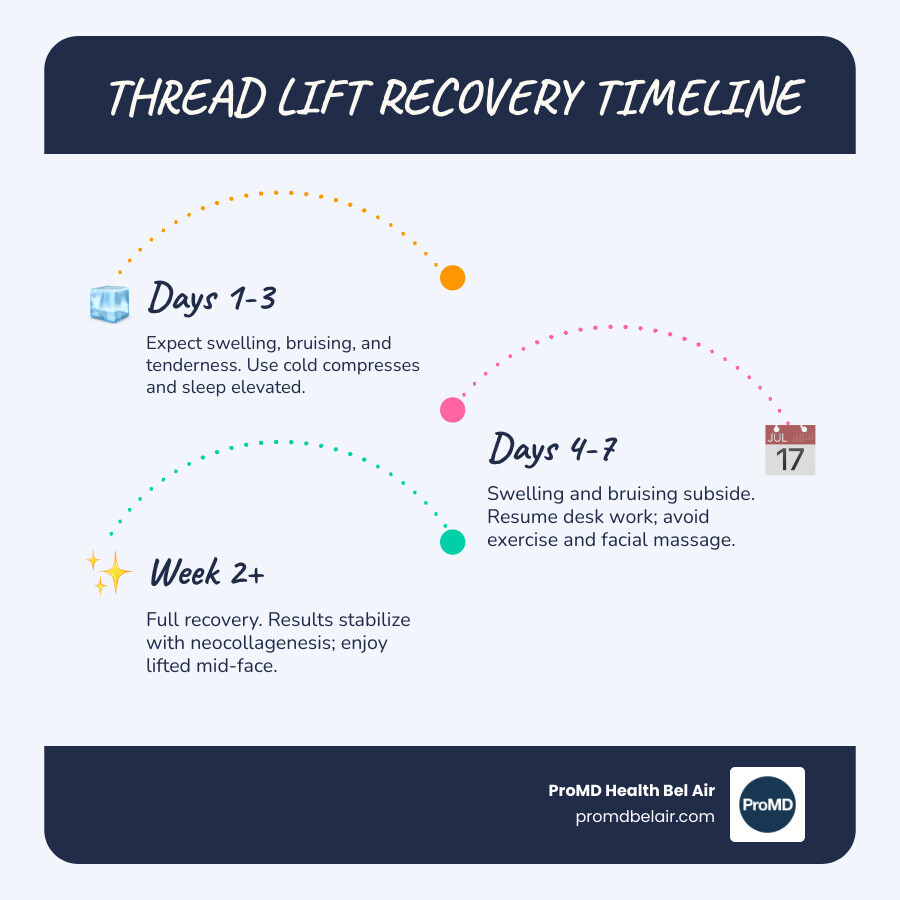
A typical timeline looks like this:
- Day 1-2: Swelling, tenderness, and some tightness are most noticeable
- Day 3-5: Bruising and swelling usually begin settling
- By 1 week: Many patients feel comfortable being fully social again
- By 2 weeks: Most early healing effects are significantly improved
Helpful aftercare tips include:
- Sleep with your head elevated
- Use cold compresses as directed
- Avoid vigorous exercise for about 2 weeks
- Avoid facial massage or aggressive skin treatments
- Limit exaggerated facial movements at first
- Follow makeup and skincare instructions from your provider
Many people return to desk work quickly, often within a day or two, depending on bruising. Social downtime can be a little longer if you bruise easily.
How long results last and what affects longevity
This is one of the biggest questions, and the honest answer is: it varies.
Most mid-face thread lift results last:
- About 12 to 18 months on average in the mid-face
- Up to 2 years for some patients
- Sometimes 1 to 3 years depending on the material, technique, and patient factors
Research and clinical guidance in the material above support that range. Some reports note visible lift lasts 9 to 12 months in very mobile areas and 12 to 18 months in the mid-face and jawline.
Factors that affect longevity include:
- Your metabolism
- Skin thickness and quality
- Degree of aging
- Facial movement
- Thread type used
- Sun exposure and smoking
- Weight fluctuations
- Whether you do maintenance treatments
Maintenance thread lifts can help preserve results over time.
Risks, complications, and how mid-face thread lifts compare to other non-surgical options
A thread lift is minimally invasive, but it is still a medical procedure. That means benefits and risks both deserve attention. For more on safety, see The Honest Truth About Whether PDO Threads Are Dangerous and the Scientific research on real-world midface outcomes.
Common side effects and rare complications
Common short-term effects include:
- Swelling
- Bruising
- Tenderness
- Soreness when chewing
- Tightness
- Temporary dimpling or puckering
Less common but possible complications include:
- Asymmetry
- Contour irregularity
- Thread visibility or palpability
- Infection
- Migration
- Prolonged discomfort
- Irritation of nearby nerves
These risks are minimized by careful patient selection, sterile technique, proper depth of placement, realistic vector design, and clear aftercare instructions.
Mid face thread lift vs fillers, energy devices, and neuromodulators
These treatments do different jobs.
Thread lift:
- Best for lifting mild to moderate sagging tissue
Fillers:
- Best for replacing lost volume or contour
- Helpful if the cheeks look hollow, not just descended
Energy devices such as ultrasound-based tightening:
- Best for stimulating collagen and mild tightening
- Usually less effective for immediate physical lift
Neuromodulators such as Botox or Dysport:
- Best for dynamic wrinkles caused by muscle movement
- Not a lifting treatment for descended cheek tissue
So if your main issue is tissue descent, a thread lift usually beats wrinkle relaxers and often gives more visible lift than energy devices. If your main issue is volume loss, filler may be more helpful. Often, the best answer is not either-or. It is the right combination.
Combining treatments for better results
Combination treatment can be very effective when done thoughtfully. Depending on the face, we may pair a thread lift with:
- Dermal filler for volume support
- Skin resurfacing for texture
- Collagen-building treatments
- Jawline support treatments
- Wrinkle relaxers for expression lines
This layered approach often creates a more balanced result because aging rarely happens in just one dimension. A face can sag, flatten, lose glow, and wrinkle all at once. Aging is annoyingly efficient like that.
Evidence, satisfaction, and cost
The evidence base for thread lifts is not as extensive as it is for surgery, but available data is encouraging for the right patient.
One study referenced in the research found:
- Patient satisfaction was highest at 1 month: 4.7 out of 5
- It declined by 1 year: 2.8 out of 5
- Physician assessment was 4.5 out of 5 at 1 month, 3.8 at 6 months, and 3.1 at 1 year
- Mean procedural time was 15 minutes
- All 64 patients were treated under local anesthesia
- No major complications were observed
That pattern fits what we tell patients every day: results are usually best early on, then gradually soften as the threads dissolve and aging continues.
As for cost, pricing varies by number and type of threads, provider experience, and whether combination treatments are included. In general, a mid-face thread lift costs less than surgery upfront, but because it is temporary, maintenance may be needed over time. Whether it is “worth it” depends on your goals, budget, and tolerance for downtime.
Frequently Asked Questions about mid face thread lift
Is a mid face thread lift worth it compared with surgery?
If you want subtle to moderate lifting, lower downtime, no surgical incisions, and an in-office treatment, yes, it can absolutely be worth it.
If you want a dramatic, long-lasting correction for advanced laxity, surgery may offer better value in the long run. Thread lifts are ideal for people who want a meaningful refresh without the commitment of surgery.
How painful is a mid face thread lift?
Most patients tolerate it well. Local anesthesia is used, so sharp pain is minimized during the procedure. You may feel pressure, pulling, or movement. Afterward, soreness and tightness are normal for several days.
How soon can I go back to normal activities after a mid face thread lift?
Many patients return to desk work within 1 to 2 days. Social plans may depend on bruising. We usually recommend pausing strenuous exercise for around 2 weeks and avoiding facial massage during early healing.
Conclusion
A mid face thread lift can be a great option for patients who want to lift sagging cheeks, soften folds, and restore definition without surgery. The key is personalized planning, careful vector design, realistic expectations, and a maintenance strategy that fits your face and lifestyle.
At ProMD Health Bel Air, we believe natural-looking results start with good assessment and honest guidance. We also offer an AI Simulator that can help patients preview personalized post-treatment possibilities, which can make treatment planning feel much more concrete and less like guesswork.
If you are in Bel Air, MD, or nearby areas we serve, and you want to learn whether a mid face thread lift makes sense for your goals, explore our Thread Lift services and schedule a consultation with our team.
How does a mid face thread treatment differ from dermal fillers?
Frequently Asked Questions
How does a mid face thread treatment differ from dermal fillers?
While dermal fillers restore lost volume by plumping the cheek area, a mid-face thread treatment mechanically repositions descended tissue and stimulates collagen along defined vectors for a subtle lifting effect.