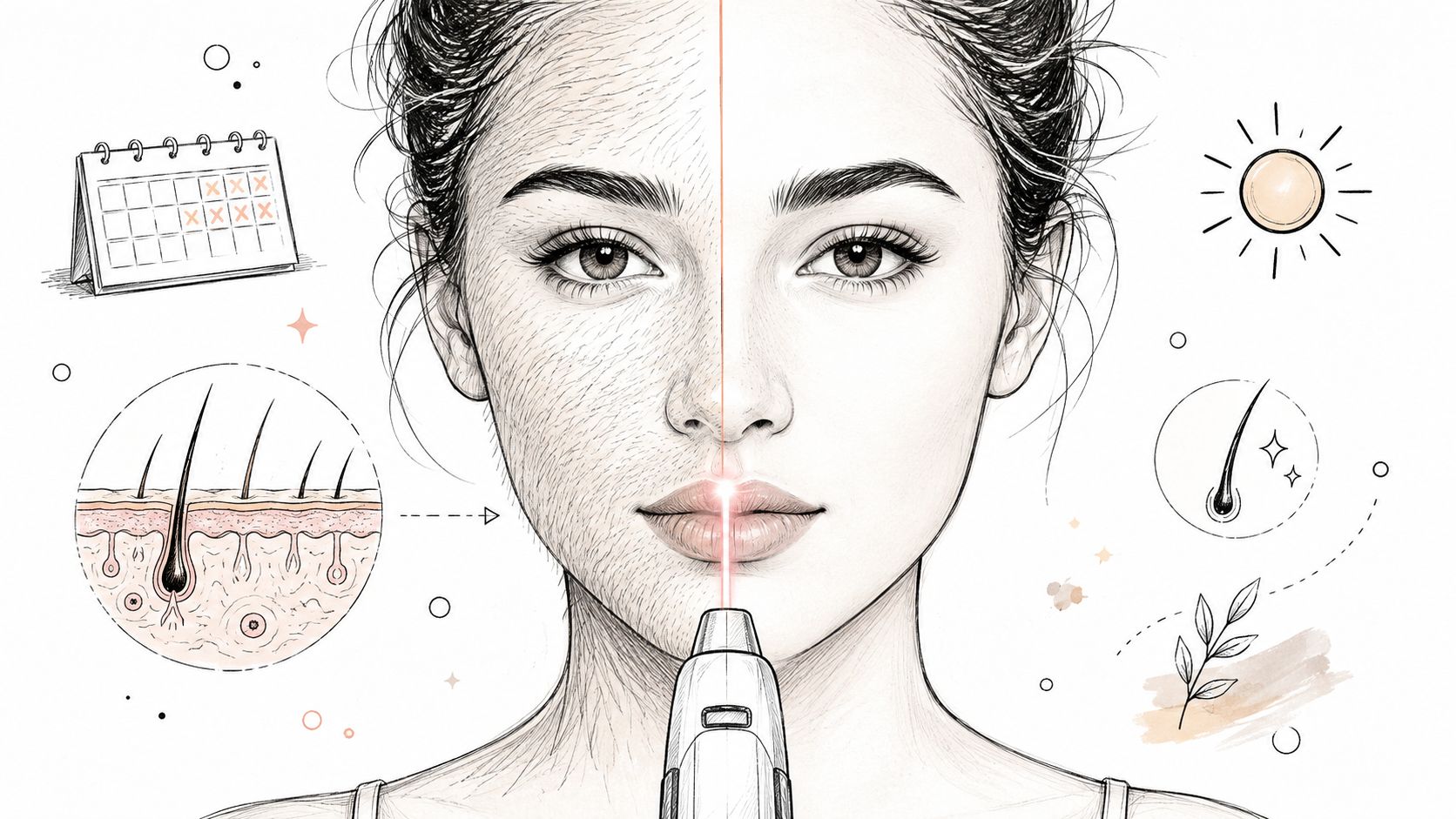
If you've been staring at facial hair in the mirror and comparing your skin to dramatic online photos, you're probably wondering what laser hair removal on face before and after really looks like in real life. That question comes up most often with the upper lip, chin, and jawline, where growth is visible, stubborn, and easy to obsess over between appointments.
The honest answer is that facial laser hair removal usually changes in stages, not in one dramatic jump. Early on, you may see shedding and patchiness, then thinner regrowth, then a much cleaner baseline after the full series. That's the pattern patients should expect, especially on the face, where hair tends to be more persistent and the treatment timeline is shaped by growth cycles rather than instant clearance.
Table of Contents
- What Real Facial Laser Hair Removal Results Look Like
- Why the Hair Growth Cycle Controls Your Results Timeline
- Session by Session Before and After Milestones
- How Skin Type and Hair Color Affect Your Outcome
- Pre-Treatment and Post-Treatment Care for Best Results
- Side Effects and Downtime You Should Expect
- Your Laser Hair Removal Journey at ProMD Health Bel Air
What Real Facial Laser Hair Removal Results Look Like
A patient comes in after spending an hour looking at photo galleries online. One image shows a smooth upper lip after a single visit. Another shows a jawline that looks nearly clear. By the time we talk through her history, she's already worried that her own face won't “work” the same way.
That reaction makes sense, but it's also where expectations go off track. Facial laser hair removal is usually a gradual process, and the first few changes often look uneven before they look polished. The best before-and-after photos aren't the ones that promise instant perfection, they're the ones that show the middle of the journey.
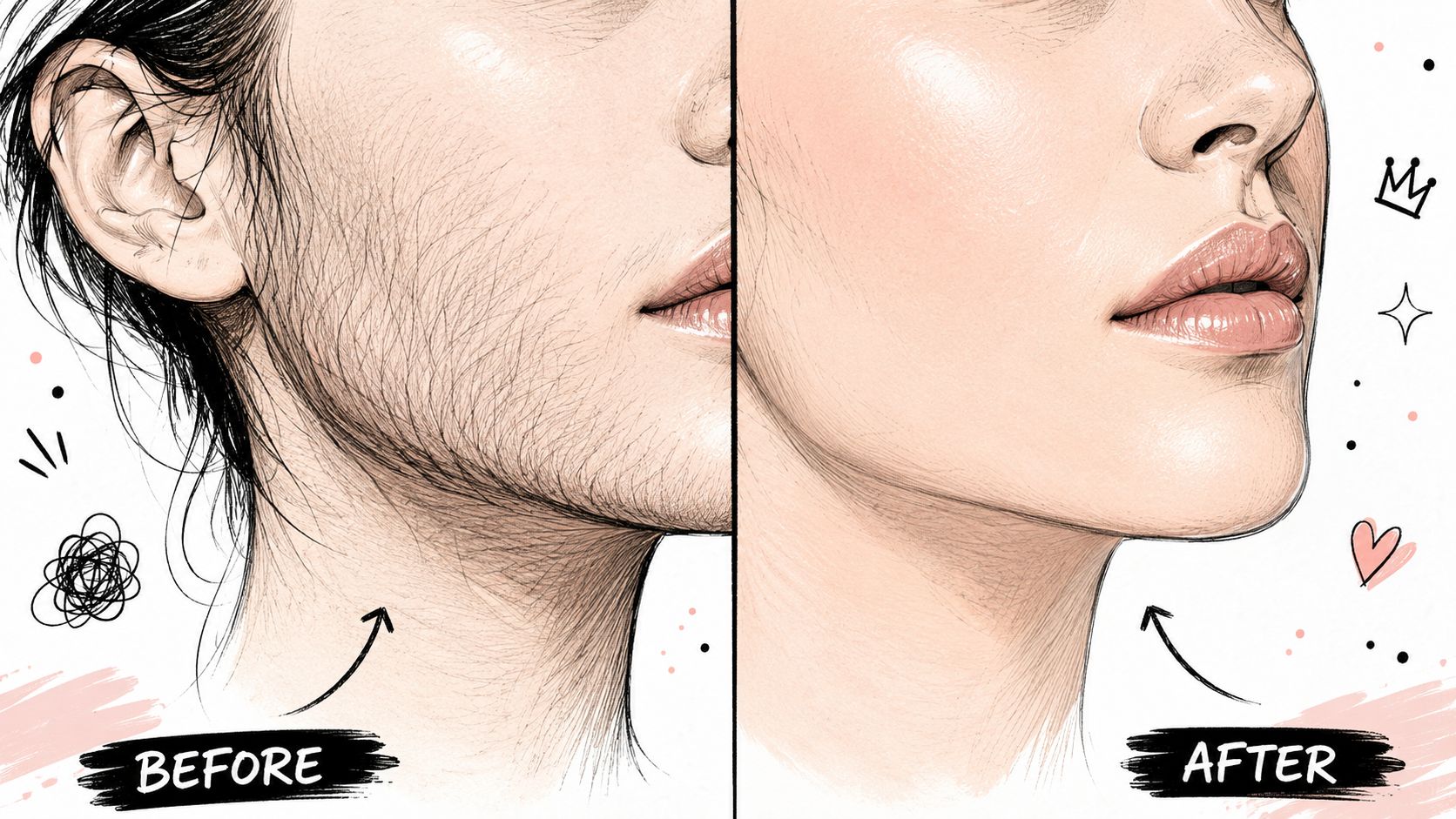
Practical rule: if a gallery makes facial hair look gone after one visit, it's showing a snapshot, not the full story.
What to look for in before-and-after photos
The most useful photos show shedding, patchiness, and then progressive thinning over time. That matters because the face doesn't usually clear in a single visual reset. It changes in layers, and those layers can be easy to miss if someone is only comparing “day one” to “final result.”
Realistic photos also tend to include the same angle, same lighting, and same treatment area. Without that consistency, it's hard to tell whether the hair changed or whether the image just looks different. For facial hair, especially around the chin and upper lip, that distinction matters more than people expect.
The historical evidence supports that this is about more than appearance alone. In a 2000 clinical study of women treated for unwanted facial hair, the Dermatology Life Quality Index improved from 9.42 ± 5.99 before treatment to 3.12 ± 3.40 after laser treatment (PubMed record). Later follow-up evidence also showed sustained benefit in female facial hirsutism, with a 72.7% mean improvement in DLQI over 0 to 6 months after laser hair removal, with benefits still significant in later follow-up windows (same PubMed record). That's a strong reminder that the face is treated for visible change, but also for the way visible hair affects daily life.
Why the Hair Growth Cycle Controls Your Results Timeline
Facial hair does not grow in one uniform wave. Some follicles are actively producing hair, some are shifting out of that active stage, and some are resting until a new cycle starts. Laser can only target follicles well when they are in the active growth stage, so timing shapes the results as much as the device itself.
Hair on the face grows in waves, so one treatment cannot address every follicle at the same time. Follicles that are ready for treatment respond first, while others stay quiet until a later visit. That is why the timeline stretches across several appointments, especially for patients at ProMD Health Bel Air in Harford County who are checking progress in photos and expecting each session to build on the last.
The three phases in plain language
Anagen is the active phase. The follicle is connected, growing, and most responsive to laser energy. Catagen is the transition phase, when the follicle starts to detach. Telogen is the resting phase, when the hair sits out the cycle and can shed before a new round begins.
That cycle explains why facial laser hair removal is not a one-and-done treatment. StatPearls notes that an initial course typically needs 4 to 6 sessions spaced 4 to 6 weeks apart, with maintenance often every 6 to 12 months because small vellus hairs can regrow (StatPearls). Those intervals are meant to catch different follicles at the right time, not to slow things down.
The face tends to demand patience because its follicles do not all move together. If appointments are skipped or pushed too far apart, you can miss the phase you were trying to target.
Why facial hair takes longer to settle
The face often responds less predictably than other areas because its growth cycle is shorter and less synchronized. A 2022 systematic review reported that long-term hair reduction with Alexandrite lasers ranged from 35% to 84.25%, Nd:YAG from 30% to 73.61%, and diode lasers from 32.5% to 69.2%, while noting that the lowest reductions were observed on facial hair and the greatest on leg hair (systematic review).
That does not mean the face is a poor candidate. It means the mirror changes more gradually, with improvements showing up as shedding, lighter regrowth, and fewer stubborn patches over time. Once patients understand that pattern, the process feels less mysterious and more predictable, which is how treatment should feel.
Session by Session Before and After Milestones
The first facial laser appointment rarely delivers the finished look people picture. Early progress usually shows up as shedding, thinner regrowth, and fewer active follicles over time. If you are tracking laser hair removal on face before and after, the better question is not whether everything is gone right away, it is what has changed since the last visit.
For ProMD Health Bel Air patients in Harford County, those changes can be easier to spot when you know what each stage usually looks like. A first pass often behaves like the opening chapter of a story, it starts the process, but it does not reveal the full ending. The face usually responds in layers, so the visual progress can feel uneven before it starts to feel obvious.
Early visits
After the first session, the most common change is not instant smoothness. Treated hairs often begin to shed, while some follicles quiet down and others keep growing for a while. That is why a patient may check the area two weeks later and feel unsure, one patch can look improved while another still looks unchanged.
In the next few visits, the pattern usually becomes easier to recognize. Hair often returns finer, slower, and in smaller clusters. Makeup may sit more evenly on the skin, and shaving or trimming may start to feel less frequent, even before the area looks fully clear.
Clinical takeaway: facial results usually look cumulative, not dramatic, and that is normal.
What the progress usually looks like
As noted earlier, the 2022 systematic review showed that facial hair tends to sit at the lower end of response compared with larger areas, even though meaningful reduction still happens over time. That matters because patients often expect one appointment to change everything, while the face usually gives you a series of smaller milestones instead.
| Treatment Stage | Average Hair Reduction | What You See in the Mirror |
|---|---|---|
| After early sessions | Not a fixed number, because facial areas change unevenly | Shedding, patchiness, less dense spots |
| Around mid-course | Not a fixed number, because results build gradually | Thinner regrowth, slower return, easier makeup application |
| After the full series | Not a fixed number, because maintenance may still be needed | Significant reduction, cleaner baseline, occasional touch-ups |
The table is most useful as a photo guide. Early on, the change may be easiest to see in the spacing between hairs rather than in a perfectly smooth finish. Mid-course, the difference often shows up in how long the hair stays away after shaving and how much softer the regrowth feels. After the full series, patients usually look for a cleaner baseline with fewer stubborn areas, while understanding that touch-ups may still be part of long-term care.
Hormone-sensitive areas like the chin and jawline can keep reactivating over time, so they often need more follow-up than someone expects at the start. A full course matters more than any single appointment. Facial laser hair removal rewards consistency, and the visual milestones tend to make sense only when you compare one visit with the next.
For readers who want to understand how device choice fits into those milestones, this Alma laser hair removal equipment guide explains the treatment logic in more detail.
How Skin Type and Hair Color Affect Your Outcome
Facial laser hair removal starts with contrast. The laser needs enough difference between the pigment in the hair and the surrounding skin to focus its energy on the follicle, so the treatment works best when the target is clear and the skin around it can be protected.
Classic candidates often have dark, coarse hair and lighter skin because that pairing gives the laser an easier target. Darker skin tones can still be treated, but the provider has to match the device and settings more carefully so the follicle is targeted without putting the skin at unnecessary risk.
Choosing the right wavelength
Different laser types behave differently across skin tones and hair types. The 2022 review found long-term reduction ranges across Alexandrite, Nd:YAG, and diode platforms, which reinforces that technology choice matters (systematic review). In practice, that is why the consultation matters more than any marketing image.
If someone has coarse dark facial hair, the treatment plan may be more straightforward. If someone has darker skin, mixed pigment, or finer facial hair, the provider has to balance safety and effectiveness more carefully. This individualized approach is why facial laser hair removal needs a consultation rather than a one-size-fits-all protocol.
For readers comparing devices and treatment logic, this laser hair removal equipment guide helps place the technical side in context for ProMD Health Bel Air patients in Harford County.
Good candidacy is not about wanting the treatment badly enough. It depends on matching the right skin, hair, and device combination to the right plan.
What patients should assess honestly
A thoughtful consultation should look at hair color, hair thickness, skin tone, and whether facial growth is hormonally influenced. Those details help predict whether the result will be fast, slow, or somewhere in between. They also help explain why one person's before-and-after photos may not resemble another person's at all.
The most common disappointment comes from assuming all facial hair behaves like body hair. It does not. The face often needs more patience and more maintenance, but that does not make treatment less worthwhile.
Pre-Treatment and Post-Treatment Care for Best Results
The photo you get after treatment starts before the appointment. If the skin is irritated, sun-exposed, or recently waxed, the result can look less even and the treatment can be less efficient. Good prep makes the process cleaner from the start.
What to do before treatment
In the two weeks before your visit, avoid sun exposure and tanning, because irritated or recently darkened skin is harder to treat safely. Don't wax, pluck, or thread the area either, since the follicle needs to be present for the laser to target it. Shaving is the exception, and many patients shave the area about a day before the appointment so the laser can focus on the follicle under the skin instead of hair above it.
The same logic applies to at-home products that increase sensitivity. If your skin barrier is already stressed, treatment and recovery tend to feel more intense than they need to. For people who use gentler skincare, a resource like discover Japanese beauty for sensitive skin can be useful background reading on choosing calming routines that don't overload reactive skin.
What to do after treatment
After the session, keep the skin calm. Use gentle cleansing, follow any cooling instructions given in the clinic, and wear daily sunscreen. Avoid makeup for the first day if your provider advises it, and hold off on exfoliation for at least the immediate recovery window so the surface can settle.
Here's the practical version patients remember best:
- Before treatment: skip waxing, plucking, and threading, since those remove the follicle.
- Before treatment: shave if you're instructed to, because shaving preserves the target under the skin.
- After treatment: protect the area from sun, because UV exposure can complicate healing.
- After treatment: keep friction low, because rubbing and heavy products can irritate freshly treated skin.
The strongest before-and-after photos usually come from patients who are consistent between visits. Preparation doesn't create results by itself, but it removes avoidable problems that get in the way.
Side Effects and Downtime You Should Expect
Many individuals can resume their normal activities immediately following facial laser hair removal. The typical reaction is temporary and expected, involving minor redness, slight swelling, and a sensation similar to a mild sunburn, which subsides naturally. This brief recovery period is a key reason why the treatment accommodates busy schedules so effectively.
What's normal and what isn't
Mild redness and swelling are common because the skin has just absorbed targeted heat. Those changes can fade within hours or linger a bit longer, depending on sensitivity and the area treated. That's not the same thing as a complication.
Rare issues like blistering or pigment changes are not what patients should expect, and careful technique plus proper aftercare helps keep that risk low. If the skin is treated conservatively and protected afterward, the face usually recovers quickly and predictably.
Normal downtime is light, but aftercare still matters. A calm recovery gives the next session a better starting point.
Why maintenance isn't failure
Facial hair can return in small amounts over time because hormones continue to shift throughout adulthood. That's especially true in areas like the chin and jawline, where even good results may need occasional upkeep. Maintenance sessions are part of long-term management, not proof that the treatment didn't work.
If you're comparing photos, that distinction matters. A strong result doesn't always mean every follicle is gone forever. It means hair has been reduced enough that grooming feels easier, the skin looks cleaner, and regrowth is slower and less dense than before.
For patients who want a more comfortable treatment experience overall, ProMD Health Bel Air also offers laser hair removal with Motus AX technology, which may be part of the conversation during a consultation.
Your Laser Hair Removal Journey at ProMD Health Bel Air
At ProMD Health Bel Air, the conversation starts with candidacy, not hype. The team at 2023 Emmorton Rd, Suite A, Bel Air, Maryland works in a medically supervised clinic setting, and patients can start with an in-person or virtual consultation if they want to talk through goals before coming in. If you're sorting out whether your facial hair is a good match for treatment, that first discussion is where the plan gets practical.
The experience is also local in the best sense. Patients come from Bel Air, Fallston, Forest Hill, Abingdon, and Havre de Grace, so scheduling has to fit real lives, not just ideal calendars. That matters for facial hair removal because consistency across sessions is part of what makes the before-and-after change visible.
For patients who want to explore the service directly, the clinic's laser hair removal page is a straightforward place to start. The visit can also fit into a broader skin plan, since the practice offers complementary services like facials and skincare support under one roof.
The best results usually come from a simple formula, the right candidate, the right interval, and honest expectations about facial growth. If your current routine is built around shaving, tweezing, or hoping the hair will calm down on its own, a consultation can help you decide whether a structured treatment series makes sense for your face.
If you're ready to stop guessing from online photos and see what a realistic facial treatment plan could look like for you, visit ProMD Health Bel Air to schedule a consultation. The team can walk you through candidacy, timing, and what your own before-and-after progress is likely to look like across the full series.