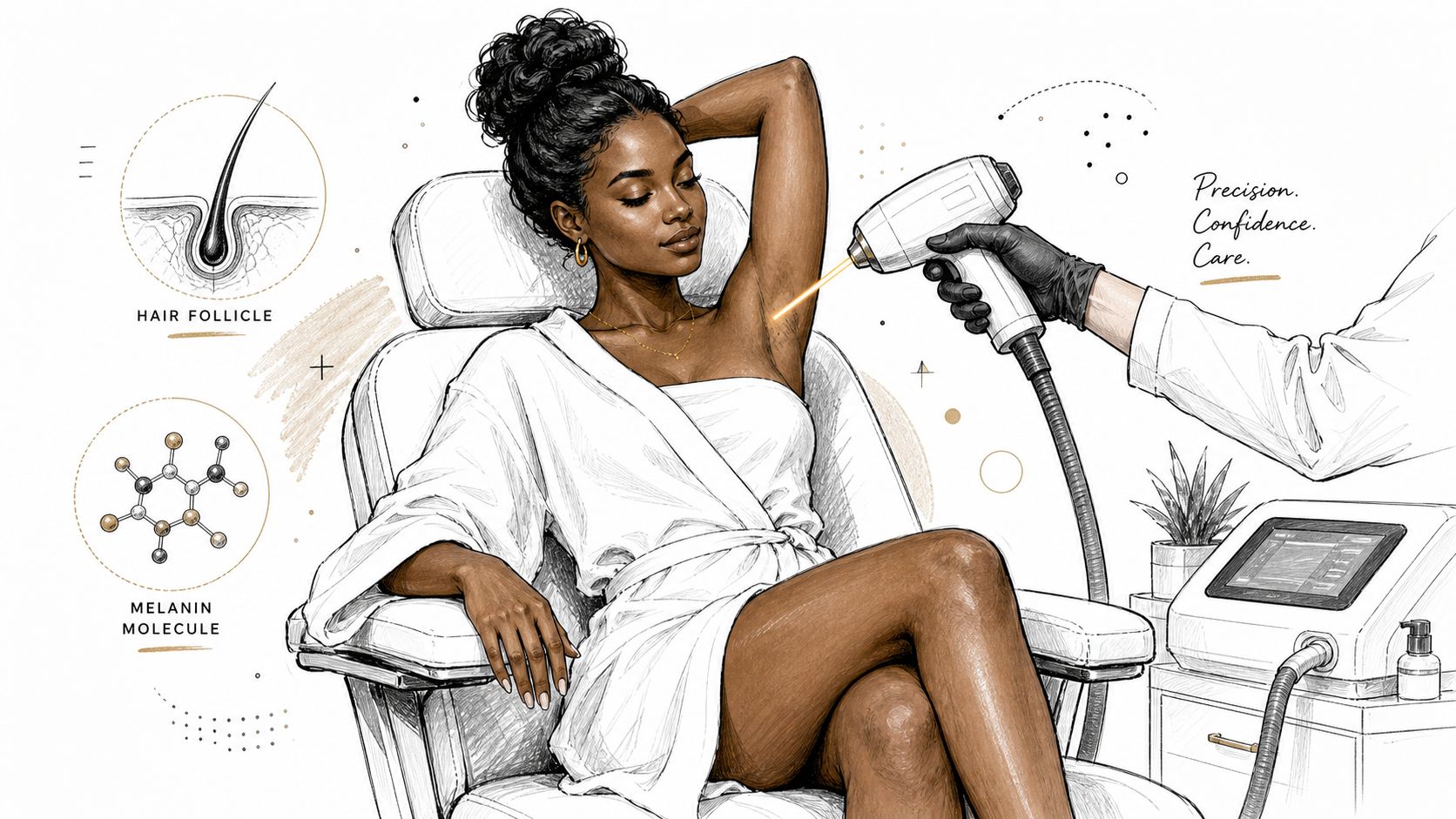
If you have dark skin and you've been dealing with razor bumps, ingrown hairs, shadowing, or dark marks after shaving, you're not imagining the pattern. Traditional hair removal often creates a cycle that feels hard to break. You remove the hair, the skin gets irritated, and then the area looks more uneven than it did before.
That frustration is especially common on the face, underarms, bikini line, and legs. For people with melanin-rich skin, even minor inflammation can linger as visible discoloration. That's why many patients start looking for something longer-lasting, but they also worry about whether laser hair removal is safe for darker skin tones.
It can be. The key is using the right laser, the right settings, and a safety-first process that respects how dark skin responds to heat. Laser hair removal for dark skin isn't a one-size-fits-all treatment. It has to be planned carefully, from the first consultation through aftercare.
Table of Contents
- Your Guide to Safe Laser Hair Removal for Dark Skin
- Why Dark Skin Requires a Specialized Laser Approach
- The NdYAG Laser The Gold Standard for Melanin-Rich Skin
- Your Consultation and Patch Test at ProMD Health Bel Air
- What to Expect During and After Your Treatment Series
- Essential Pre and Post-Care for Dark Skin Tones
- FAQs About Laser Hair Removal for Dark Skin
Your Guide to Safe Laser Hair Removal for Dark Skin
Laser hair removal has changed a lot. Older systems were more likely to overheat the skin surface, which made treatment riskier for deeper skin tones. That history still shapes how many people think about lasers today, even though modern treatment for dark skin follows a very different standard.
For melanin-rich skin, safety depends on choosing a wavelength that can reach the follicle without putting too much heat into the surrounding skin. It also depends on conservative settings, careful observation, and a provider who knows how to adjust the treatment plan instead of applying the same protocol to everyone.
A good laser hair removal process should answer practical questions, not just promise smooth skin. You should know how your skin type is assessed, why a patch test matters, what the session schedule looks like, and how aftercare helps prevent irritation and post-inflammatory hyperpigmentation.
Practical rule: If a clinic can't clearly explain how it adjusts laser treatment for darker skin tones, that uncertainty matters.
People also get confused by the phrase permanent hair reduction. It doesn't mean every single follicle disappears forever after one appointment. It means the treated hair gradually becomes less dense over a series of sessions, with many follicles no longer producing the same level of regrowth.
At ProMD Health Bel Air, laser hair removal is one approved service within a medically supervised setting. For patients in Bel Air, Fallston, Forest Hill, and nearby Harford County communities, that matters because darker skin does best with a methodical process, not rushed treatment.
Here's the big picture:
- The right candidate evaluation matters: Skin tone, hair texture, treatment area, and history of irritation all affect planning.
- The right wavelength matters: Darker skin needs a laser approach designed to reduce epidermal risk.
- The right timeline matters: Hair grows in cycles, so treatment has to be repeated at the right intervals.
- The right aftercare matters: Sun avoidance, hydration, and gentle skin care help the skin recover evenly.
Why Dark Skin Requires a Specialized Laser Approach
Darker skin isn't a problem to work around. It's a skin type that requires a precise plan.
Melanin is both the target and the challenge
Laser hair removal works by sending light energy toward pigment in the hair follicle. That sounds straightforward until you remember that melanin is also what gives skin its color. In lighter skin, there is usually more contrast between dark hair and the skin around it. In darker skin, that contrast is reduced, so the laser has to be more selective.
If the device or settings aren't appropriate, the skin can absorb too much heat instead of the follicle alone. That's where people worry about burns or lingering discoloration, and those concerns are valid when the wrong technology is used.
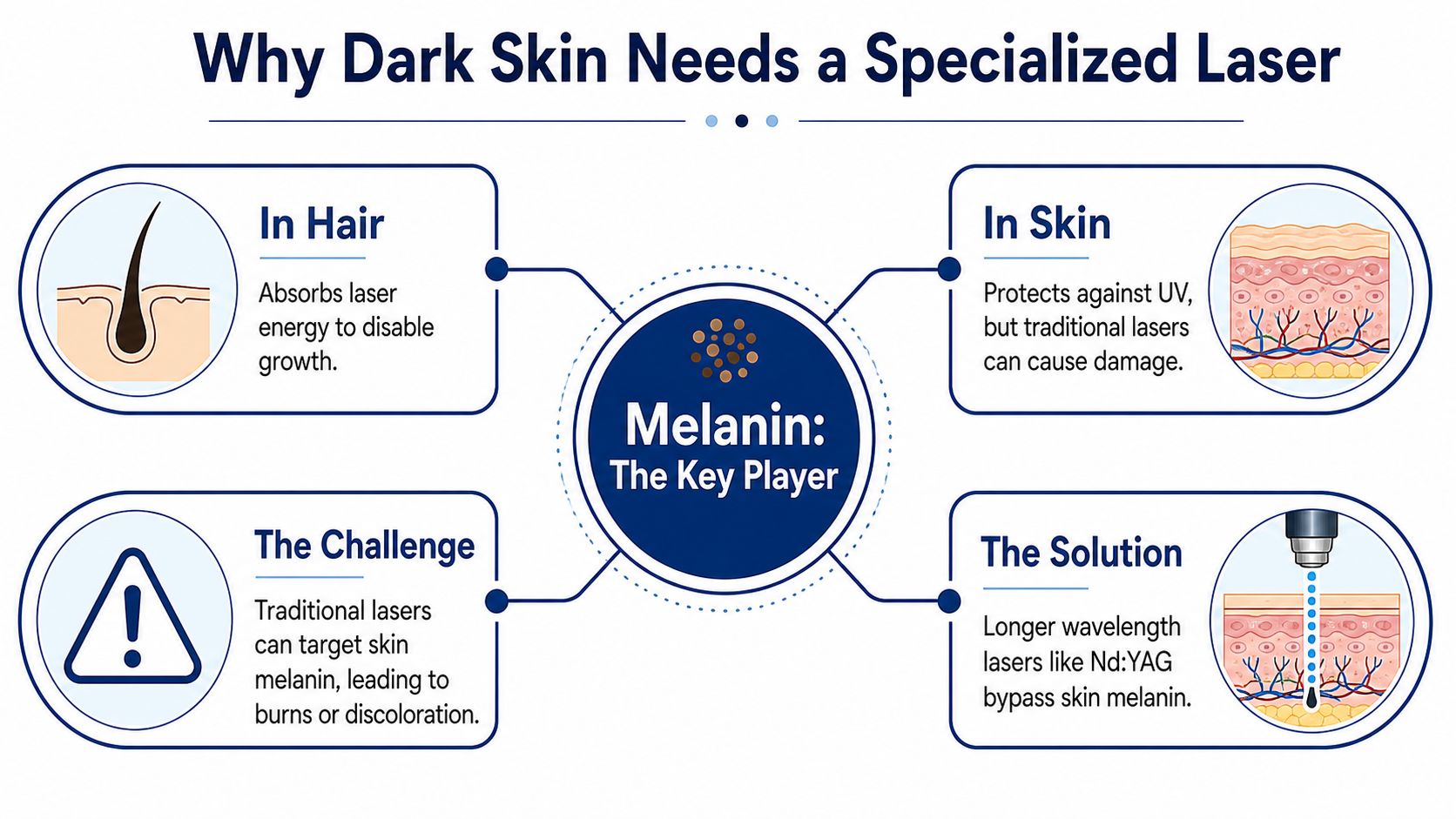
One easy way to think about it is this. The laser needs to recognize the hair as the target without mistaking the skin as part of that target. That's why a generic laser package or an overly aggressive setting can be a poor match for melanin-rich skin.
For a related look at how laser platforms are discussed in aesthetic treatment, see this overview of laser technology in practice.
Why skin typing matters before treatment
Providers often use the Fitzpatrick Skin Typing system to classify how skin behaves in response to ultraviolet light. In laser hair removal for dark skin, the most relevant range is Fitzpatrick types IV through VI, which includes moderate brown through the deepest black skin tones.
That classification helps guide treatment choices. It isn't there to label your skin. It's there to reduce risk by matching the laser strategy to your skin's pigment level and heat sensitivity.
A one-size-fits-all approach doesn't work here. Someone with type IV skin and coarse underarm hair may need a different plan than someone with type VI skin and facial hair that tends to curl back into the skin after shaving.
The more melanin present in the skin surface, the more careful the provider has to be about wavelength choice, pulse duration, and cooling.
A lot of online advice falls short, telling people laser hair removal is "safe for dark skin" without explaining why it can be safe now, or what has to happen for that to be true. The science matters because it changes the treatment decision from guesswork into a controlled process.
The NdYAG Laser The Gold Standard for Melanin-Rich Skin
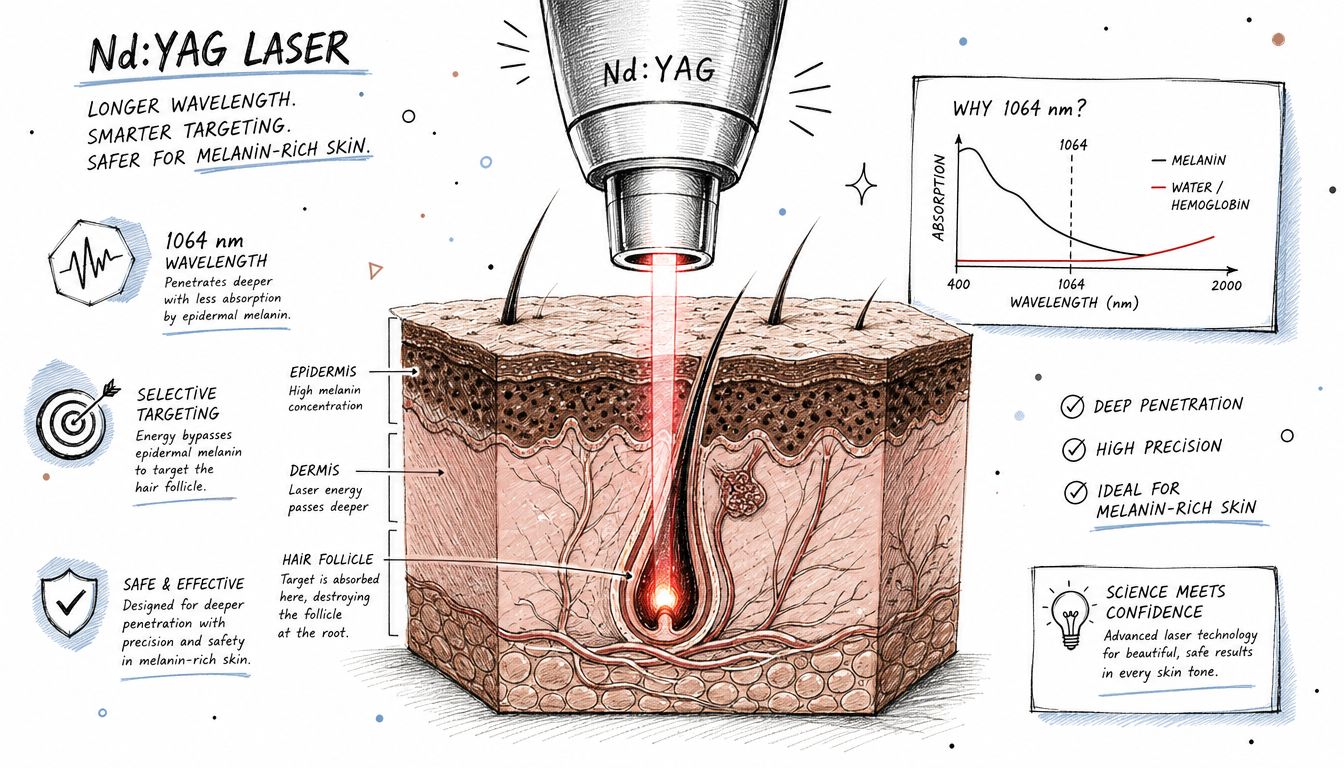
The laser that matters most in this conversation is the 1064 nm Nd:YAG. For darker skin tones, that wavelength is widely accepted because it can reach deeper hair follicles while reducing heat absorption at the skin surface.
Why the 1064 nm wavelength works differently
A shorter wavelength tends to interact more with surface pigment. A longer wavelength has a better chance of traveling past more of that superficial melanin and delivering energy where the follicle sits. For dark skin, that difference is central to both safety and effectiveness.
A simple analogy helps. Think of the skin surface as the front gate and the follicle as the house farther down the path. The Nd:YAG wavelength is better at getting farther down that path without dropping as much heat at the gate.
According to clinical guidance on dark skin treatment with 1064 nm Nd:YAG, this wavelength is the clinically accepted standard for Fitzpatrick skin types IV through VI because it bypasses more superficial melanin, penetrates further, and minimizes pigmentary complications. The same source notes that penetration can reach up to 4–5 mm, which is important because the follicle sits below the skin surface.
If you're comparing how clinics talk about laser systems, this professional equipment guide on laser hair removal is useful background.
What the clinical evidence means for patients
The strongest reassurance isn't marketing language. It's controlled treatment data. The 1064 nm Nd:YAG wavelength is the accepted standard of care for permanently reducing hair in individuals with Fitzpatrick skin types IV through VI, and a 2025 study involving 55 women with these skin types recorded zero adverse events, confirming that the longer wavelength has moved from a cautious option to a default recommendation for deeper skin tones, as summarized in this review of the study findings.
That doesn't mean every treatment everywhere is automatically safe. It means the science supports this wavelength when the treatment is done under controlled parameters.
What patients should take from that is simple:
- The device matters: Dark skin does best with a wavelength chosen specifically for melanin-rich skin.
- The settings matter: Safe treatment still depends on restraint and customization.
- The operator matters: Good outcomes come from matching the technology to the person in front of you.
When readers ask whether laser hair removal for dark skin is "really safe," the honest answer is this. It can be very safe when the technology and protocol are built for dark skin from the start.
Your Consultation and Patch Test at ProMD Health Bel Air
You finally book your appointment after years of shaving, razor bumps, or dark marks that linger longer than the irritation itself. Then a reasonable question shows up. What happens before the laser ever touches a full treatment area?
At ProMD Health Bel Air, the first visit is designed to answer that question carefully. For darker skin tones, a safe plan starts with observation, not assumptions. Two people can both have deep skin tones and still respond very differently based on hair thickness, recent sun exposure, history of pigmentation, and how their skin reacts to minor irritation.
What happens at the first visit
The consultation is part skin assessment, part medical history, and part treatment planning. Your provider looks at more than the color of your skin. They assess the contrast between your skin and hair, the density and texture of the hair, the treatment area, and whether you tend to develop post-inflammatory hyperpigmentation after shaving, waxing, or ingrown hairs.
That detail matters for patients with pseudofolliculitis barbae, or razor bumps. In melanin-rich skin, inflammation from trapped or curved hairs can trigger both bumps and lingering discoloration. Laser hair removal can help by reducing the number of active follicles producing those coarse, curl-prone hairs. At ProMD Health Bel Air, that history helps guide how cautiously treatment begins, especially in areas that have been repeatedly irritated.

Your provider may also ask whether you have had prior laser treatments, how your skin healed afterward, and whether any area is prone to swelling, itching, or dark marks. Facial hair, underarms, bikini area, and legs do not always behave the same way, so the treatment plan should not treat them as if they do.
A good consultation narrows the plan before the first full session. It also sets expectations. Dark, coarse hair often responds well. Finer hair can be slower to improve. Skin that marks easily may need a more gradual start.
Why the patch test is a required safety step
A patch test gives your provider a preview of your skin's response under real treatment conditions. It works like testing the oven before baking the whole tray. You do not guess based on the recipe alone. You check how the heat behaves first.
For dark skin, that step matters because the goal is selective heating of the hair follicle while protecting the pigment in the surrounding skin. A PubMed-indexed clinical study on laser selection and treatment protocol notes that clinicians should perform a test patch and wait several days before proceeding with a larger treatment area. That observation period helps the provider adjust settings such as fluence and pulse duration based on your actual skin response.
A patch test can show whether the skin stays calm, becomes overly irritated, or develops delayed pigment changes. Some reactions are immediate. Others take time to appear. That is why cautious clinics do not treat the patch test as paperwork with a pulse.
At ProMD Health Bel Air, patients should expect specific questions during this step, including:
- How does your skin react after shaving?
- Do you get ingrown hairs or dark spots easily?
- Have you had laser treatment before, and how did your skin respond?
- Have you had recent sun exposure or tanning?
Those questions are practical. They help determine where to begin, how conservative to be, and whether the skin needs more preparation time before treatment starts. For darker skin tones, safety comes from this kind of measured approach, where the consultation, patch test, and setting selection all work together.
What to Expect During and After Your Treatment Series
A laser hair removal series is a process of timing, not a race to one appointment. Hair grows in cycles, and the laser can only disable follicles that are active and connected to the root at the time of treatment. Some hairs are ready to respond on visit one. Others are not. That is why spacing matters.
At ProMD Health Bel Air, your series is planned with dark skin safety in mind from the first full session onward. After your consultation and patch test, we use your skin's response to guide the starting settings, treatment intervals, and any adjustments along the way. That measured approach matters because darker skin can respond differently from one area of the body to another.
How your series usually progresses
Most patients with melanin-rich skin need multiple sessions to see a strong reduction in density and regrowth. A common range is six to eight treatments, spaced several weeks apart depending on the area being treated. Coarser areas such as the underarms or bikini line often behave differently from the face or legs, so your schedule may not look identical everywhere.
Results tend to come in layers.
At the beginning of the series, the first change is often slower regrowth. Hair may also start coming back less evenly, with some patches responding faster than others. Midway through treatment, many patients notice that the hair feels finer, looks less dense, and causes fewer ingrown bumps. In later sessions, the remaining follicles are often more scattered and may need careful targeting based on how your skin has responded so far.
That pattern can feel confusing if you expect every hair to disappear at the same speed. It rarely happens that way. A better comparison is clearing weeds from a garden bed in rounds. You remove what is actively growing, then come back for the next group as it appears.
What the appointment feels like
Patients usually ask about comfort before anything else.
With the Nd:YAG laser used at ProMD Health Bel Air, many patients describe each pulse as a quick snap followed by warmth. The exact feeling depends on the treatment area, the thickness of the hair, and how sensitive your skin is that day. Areas with coarse, rooted hair often feel more intense than areas with finer growth.
During the session, we watch your skin closely. For dark skin, treatment is not just about delivering heat. It is about placing the right amount of heat in the follicle while keeping the surrounding skin calm. If your skin shows that it needs a more conservative setting, that adjustment is part of a safe plan, not a setback.
What happens right after treatment
Right after a session, mild redness, warmth, or a temporary sunburn-like feeling can happen. Around the follicle, you may see slight swelling. That reaction often tells us the hair root absorbed energy, which is the intended target.
Then comes the part that surprises many patients. Treated hairs do not always vanish on the same day. Over the next one to three weeks, they often rise to the surface and shed. It can look like the hair is still growing, but in many cases it is the treated shaft being pushed out.
That delayed shedding is one reason patience matters.
What improvement should look like over time
Look for gradual change, not instant clearing after one visit. The signs of progress usually show up in this order:
- Slower regrowth between appointments
- Softer or finer hair texture
- Lower overall density
- Fewer ingrown hairs or less shaving irritation
- Longer smooth periods between sessions
If one area responds faster than another, that does not automatically mean something is wrong. Hormones, hair thickness, friction, and past inflammation can all affect how quickly a body area improves.
The goal of your series is steady reduction with careful skin protection at every step. For patients with darker skin tones, that balance is what makes the journey both effective and safe.
Essential Pre and Post-Care for Dark Skin Tones
Good results do not depend on the laser alone. They also depend on how calm and protected your skin stays before and after each visit. For darker skin tones, that part of the process deserves close attention because melanin-rich skin can react to extra heat or irritation by making more pigment during healing.
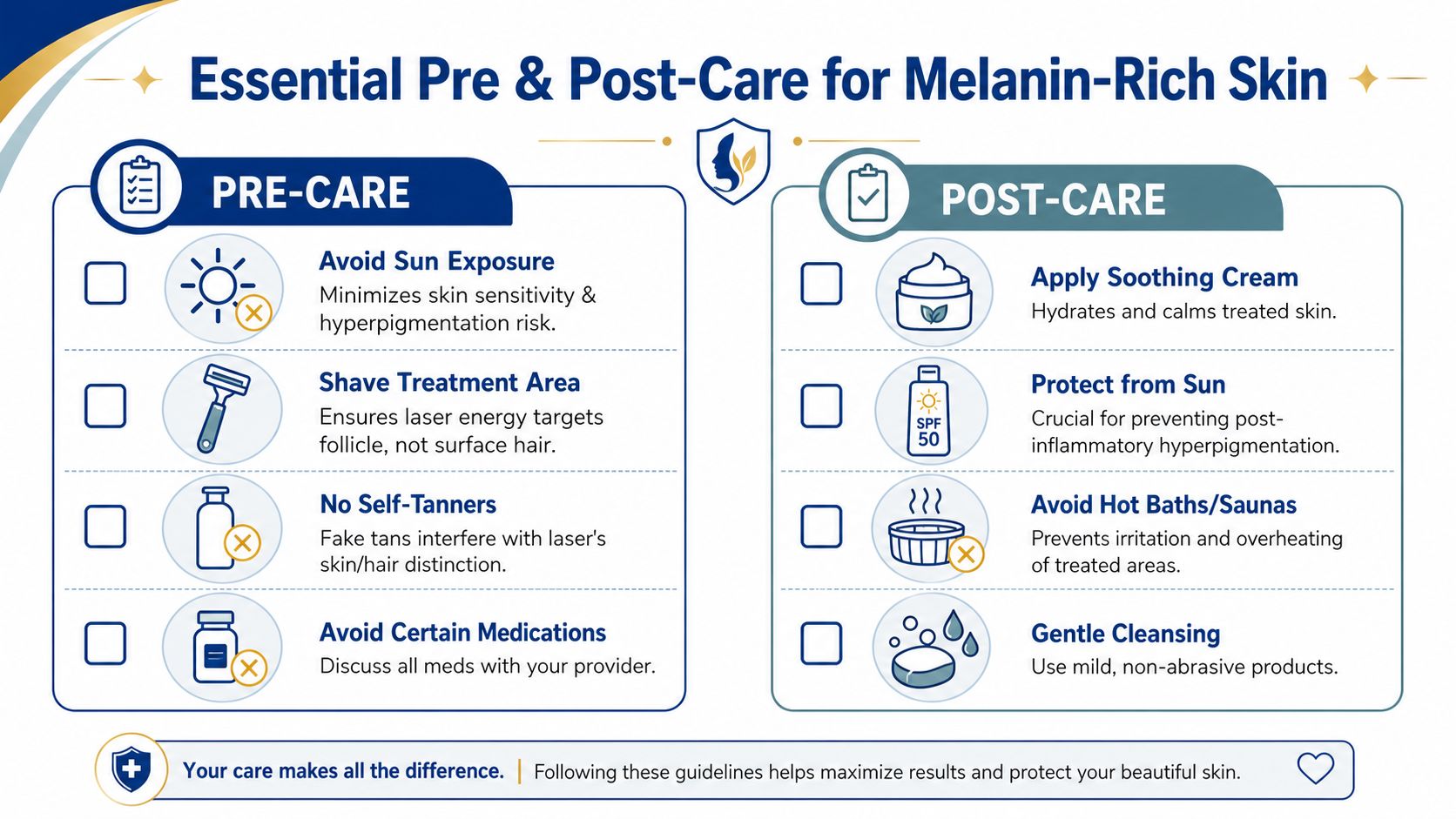
At ProMD Health Bel Air, we frame pre-care and aftercare as part of the same safety plan. The laser session starts the work. Your skin care routine helps finish it well.
Before your appointment
Pre-care is really about lowering background heat in the skin and keeping the treatment area predictable. If the skin is tanned, irritated, or coated with products that change the surface, it becomes harder to treat with the same level of precision.
Use this checklist before treatment:
- Avoid direct sun exposure: Sun-exposed skin can become more reactive and more likely to develop uneven pigment during recovery.
- Shave instead of waxing, threading, or plucking: The laser needs the follicle intact under the skin. Removing hair from the root takes away the target.
- Skip self-tanner: Artificial pigment can make it harder to assess your true skin tone and choose the safest settings.
- Come with clean skin: Avoid heavy creams, oils, and fragranced products on the treatment area unless your provider has told you to use something specific.
If you tend to pigment after irritation, our guide to chemical peels for hyperpigmentation gives more context on the importance of inflammation management and pigment control in melanin-rich skin.
After your session
Aftercare has one main job. Keep the skin quiet while it recovers.
The treated area may feel warm or look slightly pink for a short time, and darker skin tones benefit from extra caution during that window. Heat, friction, harsh products, and sun exposure can stir up unnecessary inflammation. Inflammation is the step that can lead to temporary discoloration, which is why we give clear aftercare instructions at ProMD Health Bel Air and tailor them to the area treated.
A few habits help support even healing:
- Protect the area from sun: Sun protection helps reduce the chance of post-treatment pigment changes.
- Keep skin moisturized: Comfortable, hydrated skin usually recovers with less irritation.
- Cleanse gently: Use mild skin care and hold off on rough scrubs or strong exfoliants.
- Avoid extra heat right after treatment: Hot showers, saunas, steam rooms, and intense workouts can increase redness and sensitivity.
Aftercare works like cooling a pan after cooking. The heat source is off, but the surface is still warm for a while. Giving your skin that cooling-off period helps it return to baseline more evenly.
Careful aftercare supports the work done in the treatment room. For dark skin tones, that steady, low-irritation approach is part of how we protect skin while building results across your series.
FAQs About Laser Hair Removal for Dark Skin
You may be reading this after years of shaving, dealing with razor bumps, or wondering whether laser treatment is safe for your skin tone. Those questions are reasonable. For patients with melanin-rich skin, the goal is not just hair reduction. The goal is hair reduction without triggering unnecessary irritation or pigment changes.
The answers below focus on what patients usually want to know after learning how the ProMD Health Bel Air process works, from consultation and patch testing to a treatment series with Nd:YAG technology.
| Question | Answer |
|---|---|
| Is laser hair removal safe for dark skin? | Yes, it can be safe when the laser, settings, and treatment plan are chosen for darker skin tones. At ProMD Health Bel Air, safety starts with evaluation, patch testing when appropriate, and conservative treatment parameters designed to protect melanin-rich skin. |
| Does laser hair removal work better than shaving or waxing? | It serves a different purpose. Shaving and waxing remove hair for the moment. Laser hair removal is designed to reduce how much hair grows back over time, which can also mean less friction, fewer ingrowns, and less day-to-day irritation. |
| Is electrolysis better? | It depends on the area and the goal. Electrolysis treats one follicle at a time, which can be useful for small, targeted areas. Laser treats many follicles in one pass, so patients often choose it for larger areas such as the legs, underarms, bikini line, chest, or back. |
| Will it help with razor bumps? | Often, yes. That is one of the main reasons patients with coarse or curly hair ask about treatment. By reducing repeated hair regrowth, laser hair removal can help calm the cycle that leads to ingrowns and shaving-related bumps. |
| What does permanent hair reduction mean? | It means long-term reduction in the amount, thickness, and density of hair after a full series of treatments. It does not mean every hair is gone after one visit, or that the body will never produce some regrowth over time. |
A helpful way to understand laser hair removal is to compare it to lawn care. Shaving cuts what you see above the surface. Waxing pulls the hair out, but the follicle remains ready to grow again. Laser treatment aims lower. It places controlled heat into the follicle so future growth becomes weaker, slower, and less dense across a series of sessions.
For many patients with dark skin, that matters because the problem is not just visible hair. It is the cycle around the hair. Shaving can lead to sharp regrowth. Sharp regrowth can curve back into the skin. Then inflammation follows. Laser treatment can reduce that cycle over time when the settings are chosen carefully.
Common concerns patients ask about
Will my skin get darker afterward?
Temporary pigment change is a valid concern in darker skin tones. That is why the device choice, pulse settings, skin assessment, and aftercare all matter. At ProMD Health Bel Air, the process is designed to lower unnecessary heat injury, because irritation is what can push skin toward post-inflammatory hyperpigmentation.
How do I know if I am a good candidate?
Candidacy depends on more than skin tone alone. We also look at hair color, hair thickness, treatment area, current skin condition, sun exposure, and any history of sensitivity or pigment changes. A consultation gives much better guidance than a generic online checklist because it allows the plan to be matched to your skin, not to an average patient.
Can men with beard bumps benefit too?
Yes. Men with darker skin who struggle with beard-area bumps often do well with a cautious laser plan. The key is using settings and spacing that respect the skin barrier while reducing the hairs that keep feeding the problem.
Comparing your main options
- Shaving: Quick, but repeated shaving can keep the ingrown hair cycle going.
- Waxing: Lasts longer than shaving, though it can still irritate reactive skin and does not reduce follicle activity long term.
- Laser hair removal: Best for patients who want gradual, long-term reduction over a series of treatments.
- Electrolysis: Precise for small areas, though it usually takes more time when many hairs need to be treated.
The best choice depends on what frustrates you most. If your main issue is maintenance, several methods can remove hair. If your main issue is repeated bumps, inflammation, and dark marks after hair removal, reducing follicle activity becomes much more relevant.
If you are considering Laser Hair Removal at ProMD Health Bel Air, a consultation is the right place to start. A medically supervised evaluation can review your skin tone, hair pattern, treatment goals, and whether patch testing should be part of your plan.