

Why So Many People Are Exploring a Thread Lift Under Eyes
A thread lift under eyes is one of the most-searched non-surgical options for people who want to look less tired — without fillers, surgery, or significant downtime.
Here’s what you need to know at a glance:
| Question | Quick Answer |
|---|---|
| What is it? | A minimally invasive procedure using dissolvable PDO threads to lift and tighten under-eye skin |
| How long does it last? | Typically 12–18 months, sometimes up to 2 years |
| How long does it take? | 30–60 minutes |
| Is it painful? | No — local anesthesia is used; mild pressure is normal |
| Who is it for? | Adults aged 30–60 with mild to moderate under-eye laxity or fine lines |
| What does it cost? | Usually $500–$1,000 per session for the under-eye area |
| Downtime? | Minimal — most people return to normal activity within 1–2 days |
The under-eye area is one of the first places that shows signs of aging. The skin there is almost ten times thinner than cheek skin, and the constant stress of blinking — up to 20,000 times a day — accelerates that process. Even people in their 30s can develop fine lines, mild puffiness, or a hollow, tired look that no amount of sleep seems to fix.
Many people find themselves caught between two imperfect options: fillers that add volume but don’t address laxity, or surgery that feels like too big a step. A thread lift sits in the middle — providing a subtle structural lift while also triggering the body’s own collagen production over time.
This guide covers everything you need to make a confident, informed decision: how the procedure works, who it’s right for, what recovery looks like, realistic results, and how it compares to other treatments.
My name is Ryan Pittillo, and as a Franchise Owner at ProMD Health Bel Air, I work alongside our clinical team to help patients in the Bel Air area understand their options for treatments like a thread lift under eyes — including what the research actually says about results. This guide is built from clinical data and expert knowledge so you can walk into any consultation fully prepared.
Thread lift under eyes vocab explained:
What a Thread Lift Under Eyes Is and How It Works
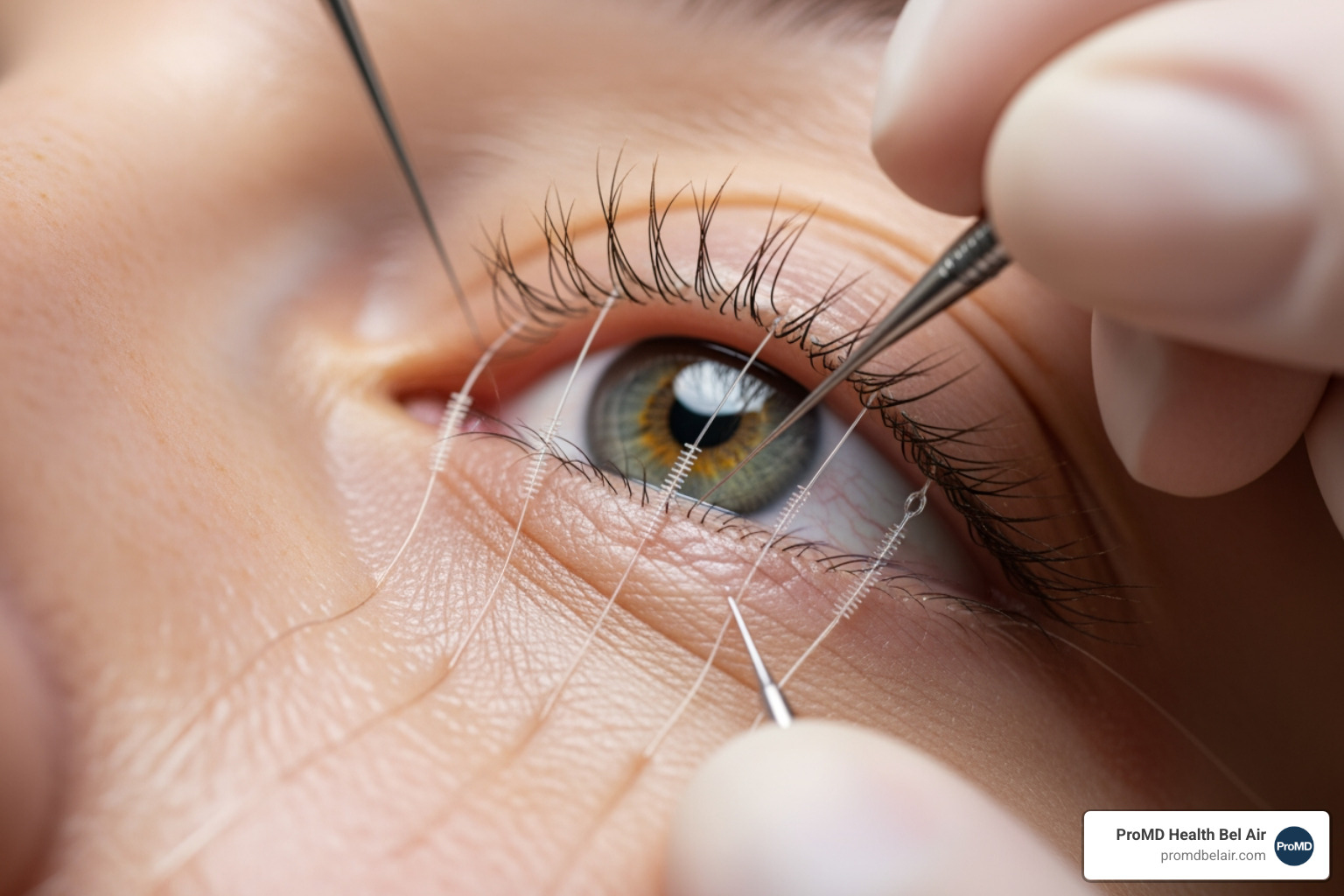
A thread lift under eyes is a minimally invasive treatment that places dissolvable PDO threads beneath the skin to create light support and encourage firmer-looking skin over time. PDO stands for polydioxanone, a material used in absorbable sutures for decades.
Unlike filler, which adds volume, under-eye threads are mainly about support and skin quality. They are often used for mild crepiness, early laxity, fine lines, and a tired look related to thinning skin. In some patients, they may also soften the appearance of tear troughs or mild under-eye bags, but they are not a fix for every under-eye concern.
If you want broader background on how thread lifting works, see our Thread Lift overview.
How PDO threads create support under the eyes
Threads work in two ways:
Immediate structural support
The thread acts like a tiny internal scaffold under delicate skin. Depending on the treatment plan, providers may use smooth monofilament threads for texture support or other thread designs for more lift in nearby areas.Longer-term collagen stimulation
As the threads dissolve, the body responds by producing more collagen around them. This process, called neo-collagenesis, helps improve firmness and texture. Fibroblasts, the cells involved in collagen production, are activated as part of the skin’s healing response.
That is why results are not just “instant.” Many patients notice early improvement first, then gradual refinement over the following weeks as collagen builds.
Why the under-eye area ages faster than other areas
The under-eye region is basically the overachiever of facial aging.
A few reasons:
- The skin is much thinner than cheek skin
- It has fewer oil glands, so it dries out more easily
- We blink thousands of times a day
- Collagen naturally declines with age
- Sun exposure speeds up photoaging
- The orbital septum and surrounding support structures weaken over time
This combination is why under-eyes often show fine lines, laxity, and “you look tired” energy before the rest of the face gets the memo.
Benefits, Limitations, and Ideal Candidates for Thread Lift Under Eyes
A thread lift under eyes can be a very appealing middle-ground treatment. It is less invasive than surgery, but it can do more for laxity than products or filler alone in the right patient.
For a broader primer, read The Ultimate Guide to Understanding Thread Lifts.
Main benefits of a thread lift under eyes
The main advantages include:
- Subtle lifting and tightening of mild under-eye laxity
- Collagen stimulation that can improve skin texture over time
- A natural-looking result rather than an overfilled appearance
- Minimal downtime compared with surgery
- No large incisions or visible scars
- Local anesthesia instead of general anesthesia
- Quick treatment, often within 30 to 60 minutes
- In some cases, threads can be adjusted or removed if needed
Some people also notice that dark circles look less obvious after treatment. That is usually because smoother, slightly thicker skin reflects light better, not because threads directly treat pigment.
Who is a good candidate for thread lift under eyes
Ideal candidates usually have:
- Mild to moderate skin laxity
- Fine wrinkles or crepey skin under the eyes
- Early signs of aging
- A tired look caused more by looseness than by deep hollowness
- Good overall health
- Realistic expectations about subtle improvement
Many candidates are between 30 and 60, though age is less important than anatomy, skin quality, and goals.
Threads can also make sense for patients who:
- Want a non-surgical option
- Are not good candidates for more invasive surgery
- Do not want filler under the eyes
- Want to improve skin quality, not just volume
Who is not a good candidate and when other treatments may fit better
Threads are not the answer for everything. Other options may be better if you have:
- Deep tear trough hollows that mainly need volume
- Prominent fat pads or true under-eye bags
- Significant excess skin
- Pigmented dark circles
- Severe static wrinkles
- Very thin skin where visibility risk is higher
Here is the simplest way to compare common options:
| Concern | Threads | Fillers | Lasers | Surgery |
|---|---|---|---|---|
| Mild laxity | Best fit | Limited | Helpful | Usually too much |
| Deep hollows | Limited | Best fit | Limited | Sometimes |
| Crepey texture | Helpful | Limited | Very helpful | Limited |
| Fat pads/excess skin | Limited | Not ideal | Limited | Best fit |
| Downtime | Low | Low | Low to moderate | Highest |
In real life, many patients need a combination approach rather than one hero treatment.
Procedure Steps, How Many Threads Are Used, and What Results to Expect
A consultation matters a lot for the under-eye area because small differences in anatomy can change the plan entirely. At ProMD Health Bel Air, we focus on personalized planning, and our AI Simulator can help patients preview treatment possibilities in a more visual way.
For a broader step-by-step look, visit our Thread Lift Procedure Complete Guide.
What happens before, during, and after the appointment
Before treatment, we review:
- Your medical history
- Prior filler or laser treatments
- Medications and supplements that increase bruising risk
- Whether your concern is laxity, volume loss, texture, fat pads, or a mix
During the procedure, the usual steps are:
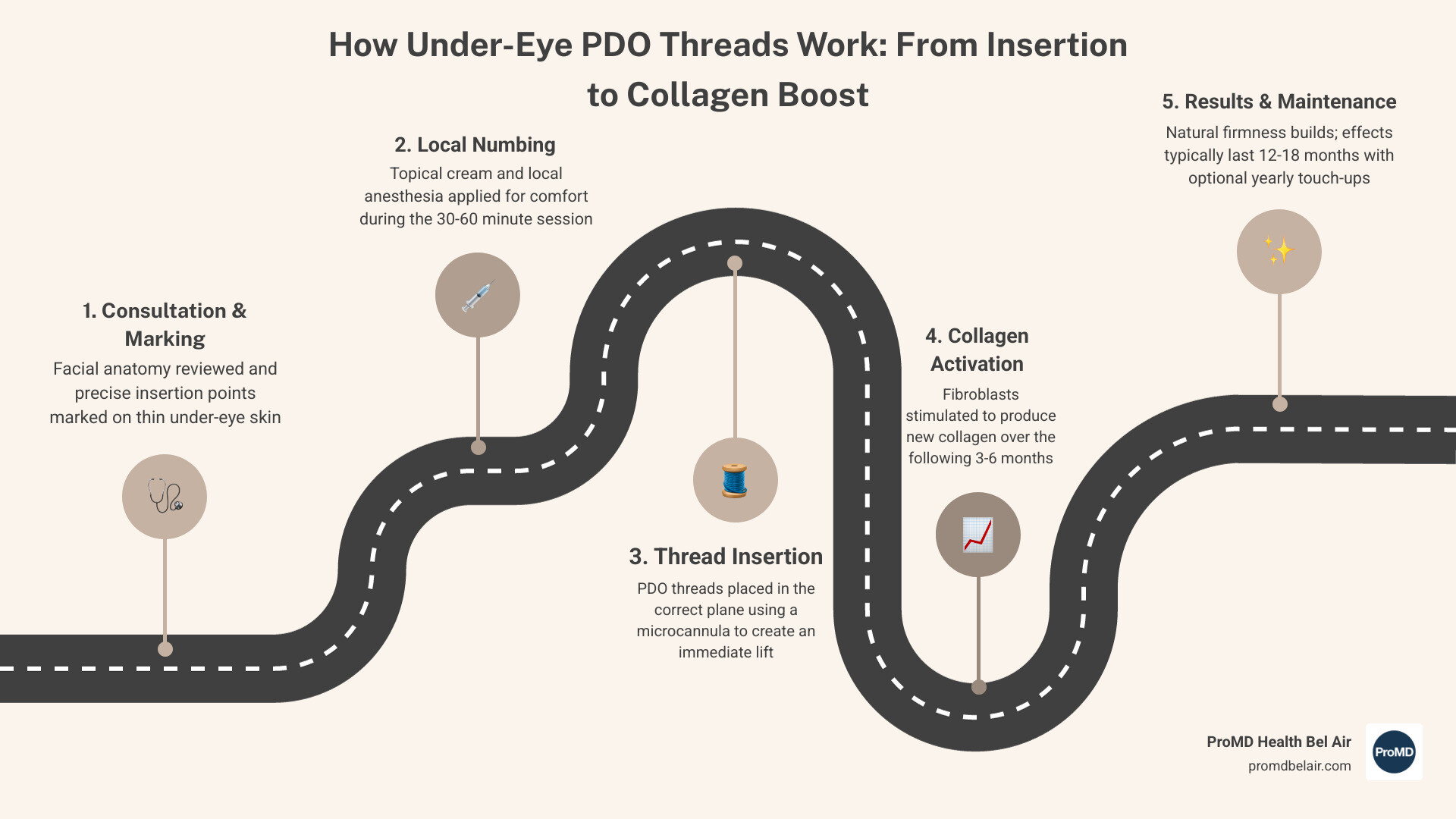
- Cleanse and mark the area
- Apply topical numbing and/or local anesthetic
- Insert the thread with a fine needle or microcannula
- Position the thread in the correct plane under the skin
- Trim any excess material
- Review aftercare instructions
The actual treatment usually takes about 30 to 60 minutes.
Afterward, you may see mild swelling, a little bruising, and some tightness. Most people do not look dramatically “done,” which is exactly the point.
How many threads are usually needed for the under-eye area
The answer is: it depends.
Research and clinical examples show a wide range because providers may use different thread types and techniques. Common estimates include:
- About 2 to 4 threads total in very delicate periorbital lifting plans
- About 2 to 6 threads per side in some under-eye rejuvenation plans
- Around 10 monofilament threads per side in certain texture-focused research protocols
Why the range? Because “under-eye threads” can mean different goals:
- Light support for laxity
- Texture improvement
- Blending the lid-cheek junction
- Support around a mild bag or hollow
The right number is based on:
- Skin thickness
- Severity of laxity
- Whether the goal is lift, texture, or both
- Provider technique
- Overall facial balance
More threads are not always better. Under-eyes reward precision, not overconfidence.
How long thread lift under eyes results usually last
Most patients can expect results to last:
- Around 6 to 12 months in some cases
- Commonly 12 to 18 months for PDO under-eye threads
- Occasionally up to 2 years, depending on skin quality, lifestyle, and treatment design
The threads themselves dissolve sooner than the full result lasts. The visible improvement can continue because the collagen response remains after the material is absorbed.
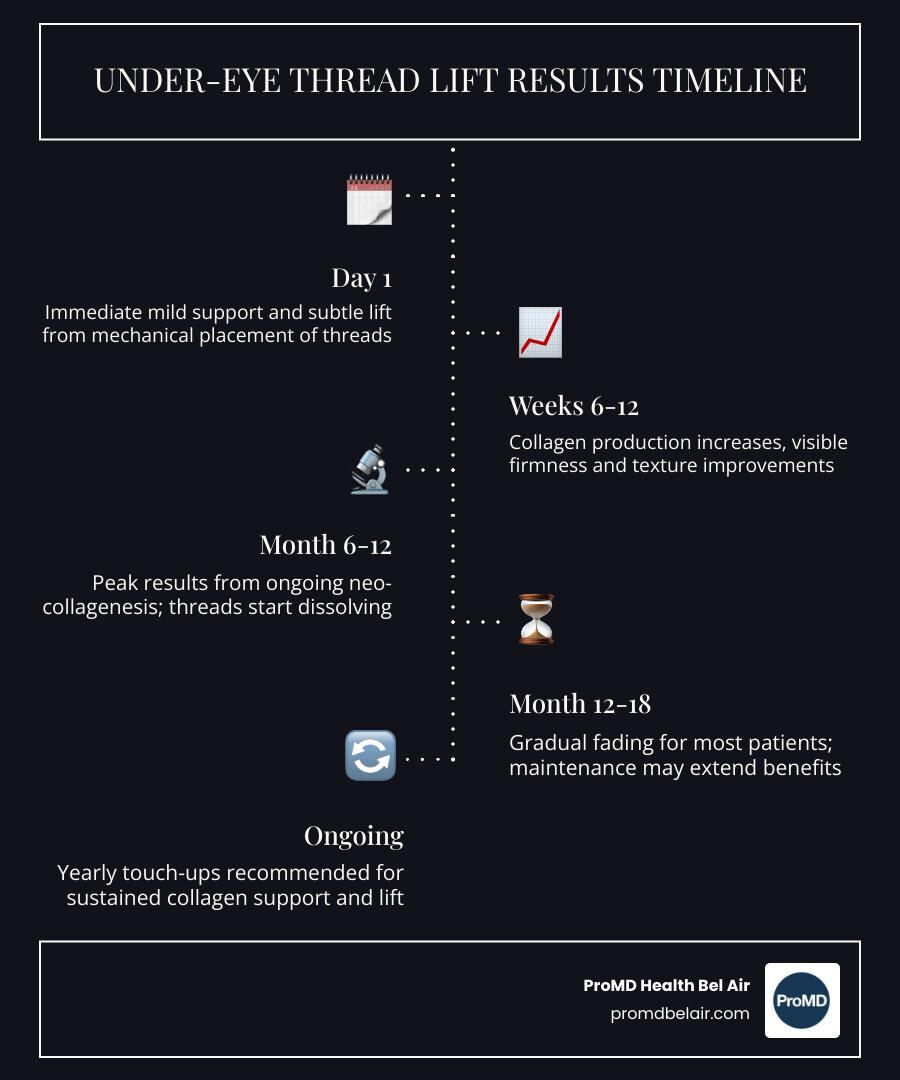
A typical timeline looks like this:
- Immediate: mild support and subtle lift
- Weeks 6 to 12: collagen effects become more noticeable
- Around 12 to 18 months: gradual fading for many patients
Yearly maintenance may help sustain results.
Recovery, Aftercare, Risks, and Warning Signs
Recovery after a thread lift under eyes is usually manageable, but “minimal downtime” does not mean “zero aftercare.” The under-eye area is delicate and visible, so even small side effects can feel dramatic in the mirror.
You can also read more in our article on Lifting Your Spirits and Your Skin with Thread Lifts and a physician overview of PDO thread lifts.
Recovery time after thread lift under eyes
Typical recovery looks like this:
- First 24 to 48 hours: swelling, tenderness, mild tightness
- First 3 to 5 days: bruising may appear or peak
- Around 5 to 7 days: many visible effects settle
- 1 to 2 weeks: the area usually looks more polished
Many people return to work within a day or two. Some return same day if bruising is minimal, though under-eye treatments are one of those procedures where a video meeting filter may feel emotionally supportive.
Makeup timing varies by provider, but many recommend waiting several days before applying makeup directly over the treated area.
Sleep with your head elevated for the first few nights to reduce swelling.
Best aftercare tips to protect results
Aftercare commonly includes:
- Use cold compresses during the first 48 hours
- Sleep on your back with your head elevated
- Avoid rubbing or pressing on the eyes
- Avoid strenuous exercise for about 1 to 2 weeks
- Avoid facial massage for about 2 weeks
- Limit exaggerated facial movements for several days
- Avoid smoking, which can impair healing
- Protect the area from excess sun exposure
- Attend follow-up visits if recommended
Some published protocols also include short-term antibiotics, though this is provider-dependent and based on clinical judgment.
Risks, side effects, and complications to know about
Most side effects are temporary and mild, but risks are real and should be discussed clearly.
Common short-term effects:
- Swelling
- Bruising
- Tenderness
- Redness
- Puffiness
- Mild asymmetry early on
Less common but more important complications:
- Infection
- Bleeding
- Thread displacement or migration
- Visible or palpable threads
- Lumpiness or irregular texture
- Pulling or dimpling
- Asymmetry that does not settle
- Rare allergic-type reaction
In one periorbital thread study of 21 patients, side effects included bruising in 2 cases, thread displacement in 1 case, and temporary erythema and puffiness in 4 cases.
Call your provider promptly if you develop:
- Fever
- Increasing redness
- Worsening pain
- Drainage
- Significant swelling that is not improving
- A severe headache
- A thread that becomes visible or appears to shift
The best way to lower risk is simple: choose an experienced medical provider with strong knowledge of facial anatomy, especially in the under-eye area.
Research, Cost, and How It Compares With Fillers, Lasers, or Surgery
Under-eye PDO threads are not just a social media trend. There is clinical literature showing meaningful improvement in the right patient group, especially for mild to moderate textural change and wrinkling.
You can also explore our broader thread content, including How to Snatch Your Jawline Back with Thread Lifts, to understand how thread techniques vary by area.
What clinical findings say about under-eye PDO threads
In a published study focused on periorbital rejuvenation with dermal threads used alone:
- The mean wrinkle score improved from 2.29 before treatment to 1 after treatment
- 16 of 21 patients reported strong satisfaction with textural improvement
- 4 reported mild improvement
- 1 reported no improvement
The study also noted a key limitation: patients with severe wrinkling, significant bags, or more advanced aging changes responded less well than those with mild to moderate concerns.
That matches what we see clinically. Threads can be a great option, but they are not magic fishing line for every under-eye issue.
Typical cost of a PDO thread lift under the eyes
For the under-eye area specifically, treatment often falls in the range of:
- $500 to $1,000 per session
For thread lifts more generally, the average U.S. cost is often cited around:
- $2,000 overall
The reason under-eye treatment may cost less than a full-face thread lift is simple: fewer threads and a smaller treatment area.
Cost varies based on:
- Number of threads used
- Provider experience
- Complexity of the anatomy
- Whether the treatment is combined with other services
- Maintenance frequency
Because results are temporary, cost should be evaluated over time, not just per visit.
How under-eye threads compare with filler, lasers, and surgery
Here is the practical version:
- Threads lift and support
- Fillers add volume
- Lasers improve surface texture and pigment
- Surgery removes or repositions tissue for the biggest change
Threads vs fillers:
- Threads are better for mild laxity and crepiness
- Fillers are better for deep hollows
- Fillers can worsen puffiness in the wrong patient
- Threads may look more natural for patients who do not want added volume
Threads vs lasers:
- Threads improve support and some texture
- Lasers are often better for fine lines, pigment, and skin resurfacing
- Lasers do not reposition sagging tissue
Threads vs surgery:
- Threads have much less downtime
- Surgery gives the most dramatic and longest-lasting result
- Threads suit patients who want subtle improvement or are not ready for blepharoplasty
In many cases, the best result comes from combination treatment planned carefully and sequenced appropriately.
Frequently Asked Questions About Thread Lift Under Eyes
Does a thread lift under eyes hurt?
Usually not much. Topical numbing and local anesthesia are commonly used, so most patients feel pressure, tugging, or movement rather than sharp pain. Afterward, mild soreness or tenderness is normal for a few days.
Will I feel or see the threads later?
Normally, no. When threads are placed at the right depth, they should not remain visible. In very thin skin, visibility or palpability can happen, but it is uncommon and often correctable if needed.
Can thread lifts be combined with fillers or Botox?
Yes. This is common. Botox or Dysport may be used for crow’s-feet, while filler may be added later for deeper hollows if volume loss is still present. The sequence matters, so treatment should be customized rather than stacked casually.
Conclusion
A thread lift under eyes can be a smart option for the right person: someone with mild to moderate under-eye laxity, fine lines, or early crepey skin who wants subtle rejuvenation without surgery.
The key is balanced expectations. Threads can lift, support, and stimulate collagen, but they do not replace filler for deep hollows or surgery for significant bags and excess skin.
At ProMD Health Bel Air, we believe the best consultation is an honest one. That means explaining what threads can do, what they cannot do, and whether another treatment may fit better. Our AI Simulator can also help patients in Bel Air, Fallston, and Forest Hill visualize personalized possibilities before moving forward.
If you are considering under-eye rejuvenation, learn more about our Thread Lift treatment and schedule a consultation to find out whether a thread-based approach matches your anatomy and goals.
Can PDO threads help with mild under-eye bags?
Frequently Asked Questions
Can PDO threads help with mild under-eye bags?
PDO threads can provide subtle support and firm crepey skin beneath the lower eyelid, which may soften the look of mild bags, though prominent fat herniation often requires surgical blepharoplasty.
