Determining How Much Lip Filler You Need
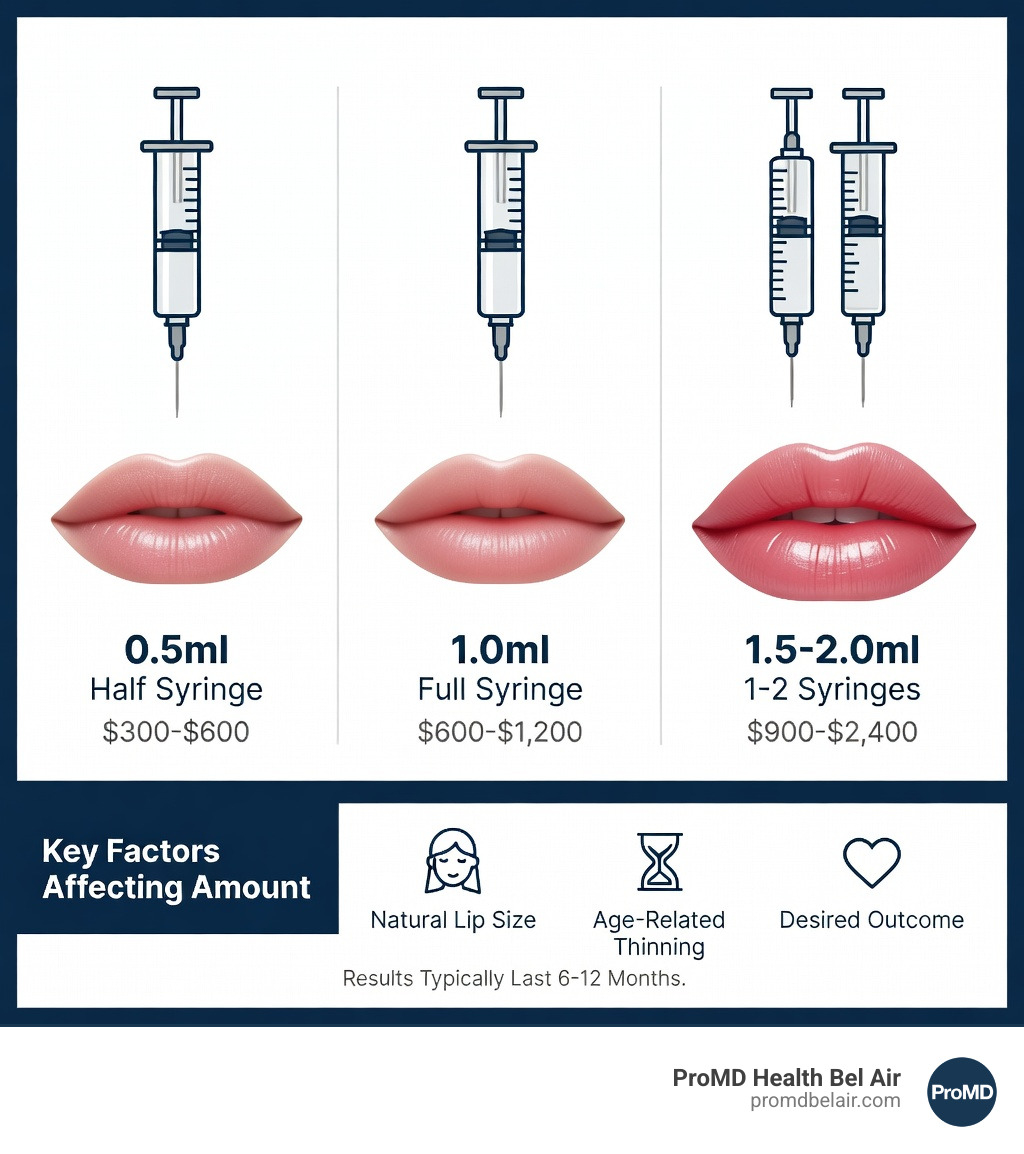
How much lip filler you actually need depends on your natural lip size, your goals, and your starting point. Here’s a quick answer:
| Goal | Amount | Typical Cost |
|---|---|---|
| Subtle hydration and definition | 0.5 ml (half syringe) | $300-$600 |
| Moderate plump for both lips | 1.0 ml (full syringe) | $600-$1,200 |
| Significant volume or age-related loss | 1.5-2.0 ml (1-2 syringes) | $900-$2,400 |
Most first-time patients start with 1 ml or less. Results typically last 6-12 months.
Lip fillers have become one of the most requested cosmetic treatments in the country – and for good reason. Modern hyaluronic acid (HA) fillers can add natural-looking volume, definition, and hydration with no surgery and minimal downtime. But the most common question people have before booking isn’t “does it work?” It’s: how much do I actually need, and what will it cost me?
Those are exactly the right questions to ask. The amount of filler you need isn’t one-size-fits-all. It depends on your anatomy, your goals, and the experience of the person holding the needle. Getting that calculation wrong – too much, too little, or the wrong product – is what leads to results that look unnatural or don’t last.
This guide breaks it all down clearly, so you can walk into your consultation informed and confident.
I’m Ryan Pittillo, Franchise Owner at ProMD Health Bel Air, and our team has helped countless patients navigate decisions around how much lip filler is right for their unique goals and facial anatomy. My background in team-first leadership means we always put your individual needs at the center of every treatment plan.
When you see those beautiful before-and-after photos, it’s easy to think there’s a magic number of syringes that works for everyone. In reality, determining how much lip filler you need is a blend of science and artistry.
The standard unit of measurement in Dermal Fillers is the milliliter (ml). Most filler syringes contain exactly 1.0 ml of product. To give you a mental image, 1.0 ml is about one-fifth of a teaspoon. It sounds like a tiny amount, but when placed strategically into the delicate tissues of the lips, it can create a beautiful transformation.
We primarily use fillers made of hyaluronic acid. According to scientific research on hyaluronic acid benefits, this substance is naturally occurring in your body. It is “hydrophilic,” meaning it attracts and holds onto water. This is why your lips don’t just look larger after treatment—they look more hydrated and healthy.
0.5 ml vs. 1.0 ml: What’s the Difference?
| Feature | 0.5 ml (Half Syringe) | 1.0 ml (Full Syringe) |
|---|---|---|
| Goal | Subtle “mini-plump,” hydration, or Cupid’s bow definition. | Noticeable volume increase, correction of asymmetry, and structural support. |
| Visibility | Very natural; friends might ask if you changed your lipstick. | Noticeable change; provides a clear “pout” while remaining balanced. |
| Best For | First-timers or those maintaining a previous treatment. | Most patients seeking a visible difference in lip height and projection. |
| Longevity | May seem to “disappear” faster as it is a smaller volume. | Standard 6-12 month duration. |
How much lip filler for first-time patients?
If it’s your first time, we almost always recommend a conservative approach. It is much easier (and more cost-effective) to add a little more filler later than it is to dissolve excess product.
For many first-time patients, 1.0 ml is the “sweet spot.” It provides enough volume to see a clear difference but isn’t enough to create the dreaded “duck lips.” However, if you are naturally blessed with very thin lips, we might even suggest starting with 0.5 ml to let the tissue stretch gradually. Scientific research on hyaluronic acid effectiveness suggests that building volume in stages often leads to the most structurally sound and natural-looking results.
How much lip filler for a “mini-plump” vs. full volume?
The “mini-plump” has become a huge trend in Bel Air and Fallston. This usually involves using a half syringe (0.5 ml to 0.6 ml depending on the brand). It’s perfect for the patient who says, “I just want my lips to look like they did ten years ago,” or “I want my top lip to match my bottom lip.”
On the other hand, “full volume” usually requires at least one full syringe (1.0 ml). Some patients with very high aesthetic goals or significant volume loss may eventually require 1.5 ml to 2.0 ml, but this is typically achieved over two separate sessions. You can find more details on these different approaches in our Dermal Fillers Page Blog Content.
Factors Influencing Your Syringe Count
Why does one person need 0.5 ml while another needs 2.0 ml? Several biological and aesthetic factors come into play:
- Natural Anatomy and Lip Thickness: If you have naturally thin lips (sometimes called “vermilion deficiency”), there is less “pocket” space for the filler to sit. We have to be careful not to overfill, which can cause the filler to migrate above the lip line.
- Facial Symmetry: Many of us have one side of the lip that is slightly higher or fuller than the other. We might use 0.7 ml on one side and 0.3 ml on the other to bring everything into balance.
- Age-Related Thinning: As we age, we lose collagen and even bone density around the mouth. Older patients often need more filler—not to look “fake,” but to replace the structure that has naturally dissolved over time. It’s common for mature patients to use 1 to 2 syringes to restore a youthful border.
- Tissue Integrity: Some lips are “firmer” than others. If the tissue is very tight, it may only accept a small amount of filler at a time.
- Desired Pout: Are you looking for a “keyhole pout,” more projection (side profile), or just a crisper border? Different goals require different amounts and different injection techniques.
For a deeper dive into how we categorize these treatments, check out our Category Dermal Fillers section.
Comparing Brands, Costs, and Longevity
Not all fillers are created equal. In our clinics in Bel Air, Fallston, and Forest Hill, we choose from several premium FDA-approved brands, each with its own “personality.”
- Juvéderm: Known for being very smooth and providing great “lift.” Juvéderm Ultra XC is a classic for plush volume, while Volbella is thinner and perfect for subtle hydration or vertical lip lines.
- Restylane: Restylane Kysse is specifically designed for the lips. It uses “XpresHAn Technology,” which allows the filler to move naturally when you talk or smile, preventing that “stiff” look.
- Revanesse: A popular choice for those looking for high-quality Canadian-made HA. Revanesse Kiss often comes in a slightly larger syringe (1.2 ml), providing a bit more “bang for your buck.”
- Belotero: This is a very “light” filler. It’s excellent for integrating into the skin without lumps, making it a go-to for very fine lines around the mouth.
National Averages vs. Local Reality
Nationally, the average cost for a lip filler treatment is around $750 to $950. However, prices can range from $300 for a mini-treatment to over $2,000 for a multi-syringe transformation.
In the Bel Air and Fallston areas, you can expect to pay approximately $650 per syringe. We also offer a “mini-plump” option for $450 (0.6 ml) for those seeking a subtler refresh. You aren’t just paying for the gel in the syringe; you are paying for the expertise, safety protocols, and artistic eye of your injector.
Maintenance and Touch-Ups
Lip fillers are not permanent. Your body naturally metabolizes the hyaluronic acid over time. Because the lips move constantly (talking, eating, kissing), the filler breaks down faster there than in “quiet” areas like the cheeks. Most patients return for a touch-up every 6 to 12 months to maintain their dream smile.
The Procedure and Recovery Timeline
The actual injection process is surprisingly quick, usually taking only 15 to 30 minutes.
- Preparation: We start by applying a high-strength topical numbing cream. Some fillers also contain lidocaine (a numbing agent) inside the gel to ensure you stay comfortable.
- The Injections: We use very fine needles or a blunt-tipped cannula to place the filler. You’ll feel a quick pinch and some pressure, but most patients rate the pain a 3 or 4 out of 10.
- The “AI Preview”: At ProMD Health Bel Air, we use our AI Simulator. This allows you to see a digital preview of your results before we even start, taking the guesswork out of the process.
Aftercare Advice
To minimize potential bruising, we recommend avoiding blood thinners like aspirin, ibuprofen, and even certain supplements (like fish oil) for 48 hours before your visit.
Post-treatment, follow these dermal filler aftercare tips:
- Apply a cold compress gently for 10 minutes at a time.
- Avoid strenuous exercise and high heat (saunas) for 24 hours.
- Stay hydrated! HA fillers love water.
- Don’t panic about swelling. Your lips will look their largest about 24-48 hours after the procedure. This is just “social downtime” and will settle into your final result within 1 to 2 weeks.
Frequently Asked Questions about How Much Lip Filler
How long do results typically last?
On average, 6 to 12 months. If you have a very fast metabolism or are very active, you might find you need a refresh closer to the 6-month mark. Denser products last longer, while softer “hydration” fillers may need more frequent touch-ups.
Does the injection process hurt?
We do everything possible to make it a “lunchtime” comfort level. Between the topical numbing cream and the lidocaine already mixed into the filler, most patients find it very tolerable. It’s a series of quick pinches, and the discomfort is over the moment the needle is removed.
Can I dissolve the filler if I don’t like it?
Yes! This is the biggest safety net of HA fillers. We keep an enzyme called hyaluronidase on hand. If you decide the look isn’t for you, or if there is a rare complication, we can inject the enzyme to dissolve the filler almost instantly. This makes HA fillers a very low-risk entry point into aesthetic treatments.
Conclusion
Deciding how much lip filler you need doesn’t have to be a guessing game. Whether you want a subtle boost in hydration or a significant change in volume, the goal is always the same: a result that makes you feel confident and looks like “you,” just enhanced.
At ProMD Health Bel Air, we pride ourselves on our “natural first” philosophy. We aren’t here to give you “duck lips”—we’re here to create balance and beauty. With our exclusive AI Simulator, you can even “test drive” your new look before your treatment begins.
Ready to see what’s possible for your smile? Our experts at our Bel Air, Fallston, and Forest Hill locations are ready to help. Book your lip filler consultation today and let’s create your dream smile together.