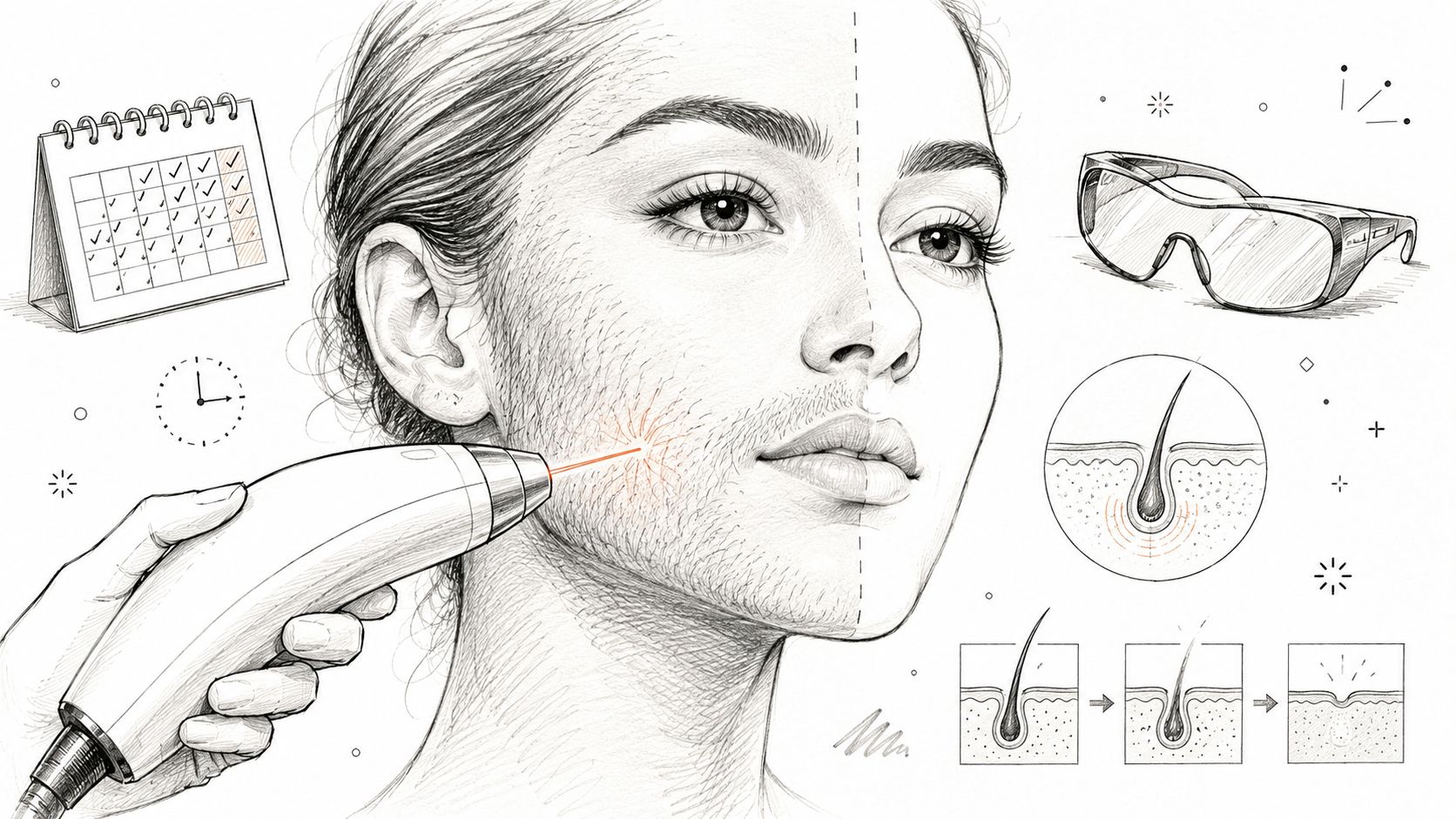
If you've been shaving your upper lip before work, tweezing a stubborn chin hair at night, or booking the same wax again because your sideburns are back, you already know the pattern. The hair returns, the skin gets irritated, and the routine starts over.
That's why full face laser hair removal gets so much attention from people in Bel Air and nearby Harford County communities. On the face, though, the treatment is more nuanced than a simple “remove the hair” promise. The skin is more visible, the contours are tighter, and the follicle response is often less predictable than on the legs or underarms, so the plan has to be thoughtful from the start.
Table of Contents
- Why Full Face Laser Hair Removal Deserves a Closer Look
- How Laser Hair Removal Actually Works on the Face
- Who Is Actually a Good Candidate for the Full Face
- What Happens During a Full Face Treatment Session
- Comparing Full Face Laser Hair Removal to Other Options
- Pre-Care and Post-Care for Facial Laser Hair Removal
- Realistic Results, Side Effects, and Long-Term Maintenance
- Choosing ProMD Health Bel Air for Full Face Laser Hair Removal
Why Full Face Laser Hair Removal Deserves a Closer Look
If your morning starts with a mirror, a razor, tweezers, or wax strips, the appeal of a longer-term solution is easy to understand. Facial hair isn't just a cosmetic issue for many adults, it can shape how often you touch your face, how much time you spend grooming, and how irritated your skin feels by the end of the week.
The face is not one single treatment zone
A full face plan usually means more than one patch of skin. In practical terms, it can include the upper lip, chin, jawline, cheeks, sideburns, and sometimes the forehead when facial hair is present in that area. Those zones don't behave the same way, so a careful provider treats them as a set of smaller decisions rather than one blanket session.
Practical rule: The face works best when the plan is built zone by zone, not treated as if every follicle will respond the same way.
That matters because full-face treatment sits at the intersection of hair biology and skin safety. The same face that gets shadowing on the upper lip may also be prone to redness on the cheeks or pigment changes after irritation, so the approach has to respect both the hair and the skin.
Who this guide is for
This is written for adults in Bel Air, Fallston, Forest Hill, Abingdon, and Havre de Grace who are considering laser hair reduction on the face and want a realistic explanation before they book. It's also for people who've already tried short-term methods and are asking a harder question, whether a laser series is worth it for their specific hair pattern.
The short answer is that full face laser hair removal is usually a long-term reduction treatment, not a one-visit cure. That expectation is more honest, and it's also more useful when you're trying to decide whether to start a supervised treatment plan.
How Laser Hair Removal Actually Works on the Face
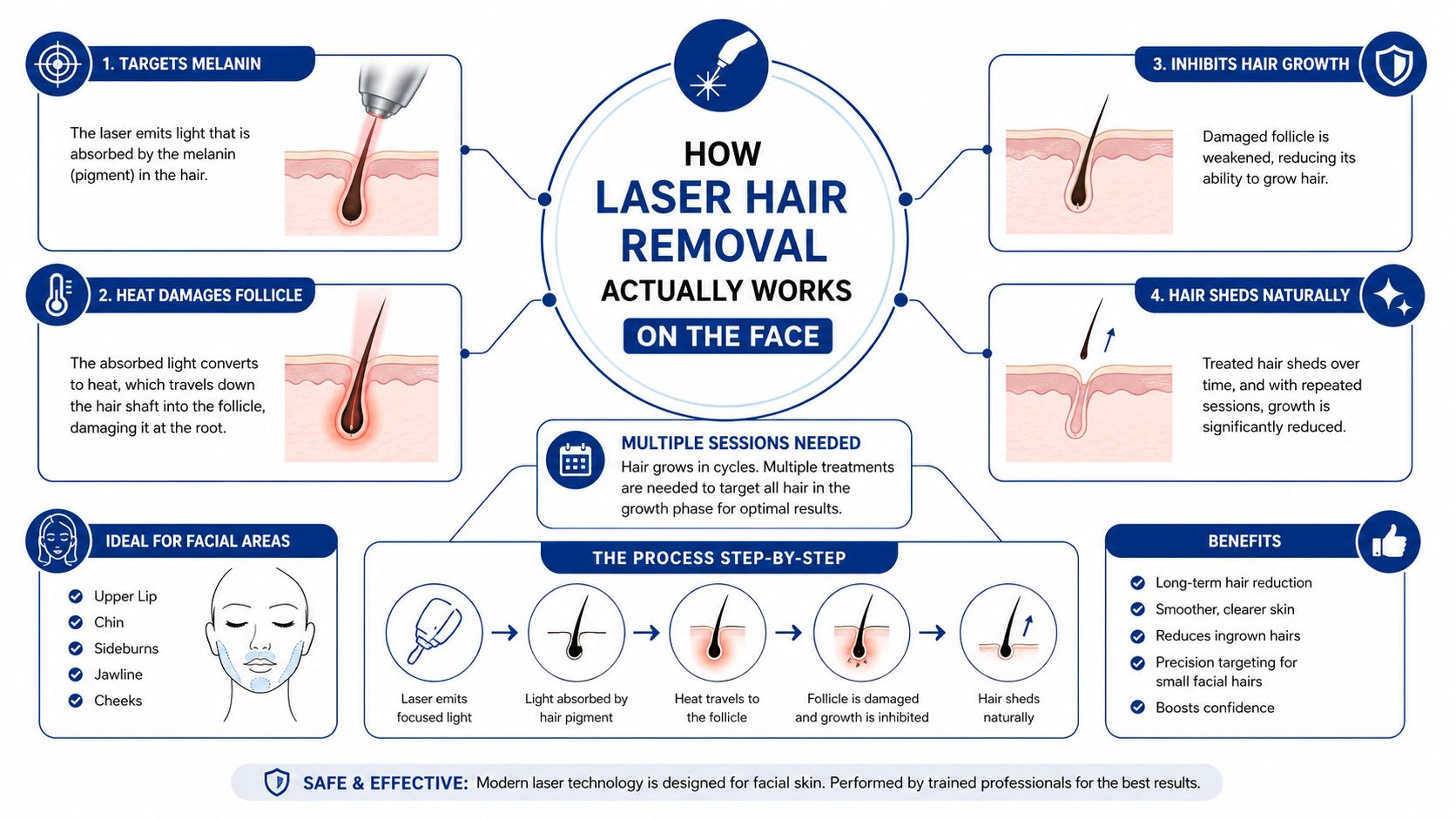
Laser hair removal depends on selective photothermolysis, which sounds technical but is straightforward. The laser energy is absorbed by melanin in the hair shaft and follicle, then converted to heat. That heat damages the follicle more than the surrounding skin, which is why the choice of wavelength, fluence, pulse duration, and spot size has to match the patient's skin and hair profile. Cleveland Clinic/StatPearls overview
Why facial hair needs a different mindset
The face is more technique-sensitive than many body areas. A major evidence review found that facial hair responds less strongly than other regions, while leg hair showed the greatest long-term reduction and the face showed the lowest reduction. In that same review, average long-term reduction ranged from 30% to 73.61% for Nd:YAG, 35% to 84.25% for Alexandrite, 32.5% to 69.2% for Diode, and about 27% to 52.7% for IPL, with lower results on the face than in the axilla. PubMed evidence review
Why one session can't do the whole job
Hair follicles are only vulnerable in the anagen phase, the active growth phase. That's why the treatment has to be repeated rather than done once. Clinical literature shows that a single treatment may reduce hair by 10% to 40%, while repeated treatments can reduce hair by as much as 90%. Short-term follow-up has also shown 37% to 72% reduction at 3 months after 1 to 3 sessions, and 38% to 49% reduction 1 year after 3 treatment sessions. Clinical review on hirsutism and laser hair removal
The same biology explains why a trained clinician has to think carefully about facial curves, nearby skin, and treatment settings. Facial hair may be stubborn, but it's not random, and the method works best when the parameters are individualized. For a deeper look at device selection, this equipment guide is a useful companion piece.
Who Is Actually a Good Candidate for the Full Face
The best candidate is not only the person who wants less hair. The strongest response tends to happen in Fitzpatrick skin types I to IV with dark terminal hair, because there's enough pigment for the laser to target. Lighter, finer, gray, red, or white facial hair often responds more poorly because there's less melanin to absorb the energy.
Hair color and skin type change the odds
That doesn't mean lighter skin is the only good candidate. It means the match between the hair shaft and the laser matters. On the face, where the growth cycle is shorter and the target zones are small, the margin for error is narrower than on larger body areas.
Practical rule: If the hair is very light or very fine, the treatment may reduce it somewhat, but it's less likely to behave like the dark terminal hair seen in the classic ideal candidate.
Hormonal drivers also matter. Facial hair linked to PCOS, perimenopause, or idiopathic hirsutism may improve, but it often comes with a maintenance expectation rather than permanent clearance. That's why two people with “full face” concerns can need very different plans even if they're the same age.
A simple self-check before you book
A useful way to think about candidacy is to ask three questions.
- Is the hair dark enough to target well? Dark terminal hair usually gives the clearest response.
- Is the growth pattern hormonal or persistent? If yes, expect maintenance rather than a one-time finish.
- Are the zones mixed? Upper lip, chin, jawline, and sideburns may each behave differently, so the plan shouldn't be treated as identical across the entire face.
A review focused on candidate selection notes that facial hair can be more difficult to clear long term than body sites, and that some patients need 2 to 4 maintenance sessions per year or 6 to 12 month touch-ups after the initial series. Clinical review on candidate selection
What Happens During a Full Face Treatment Session
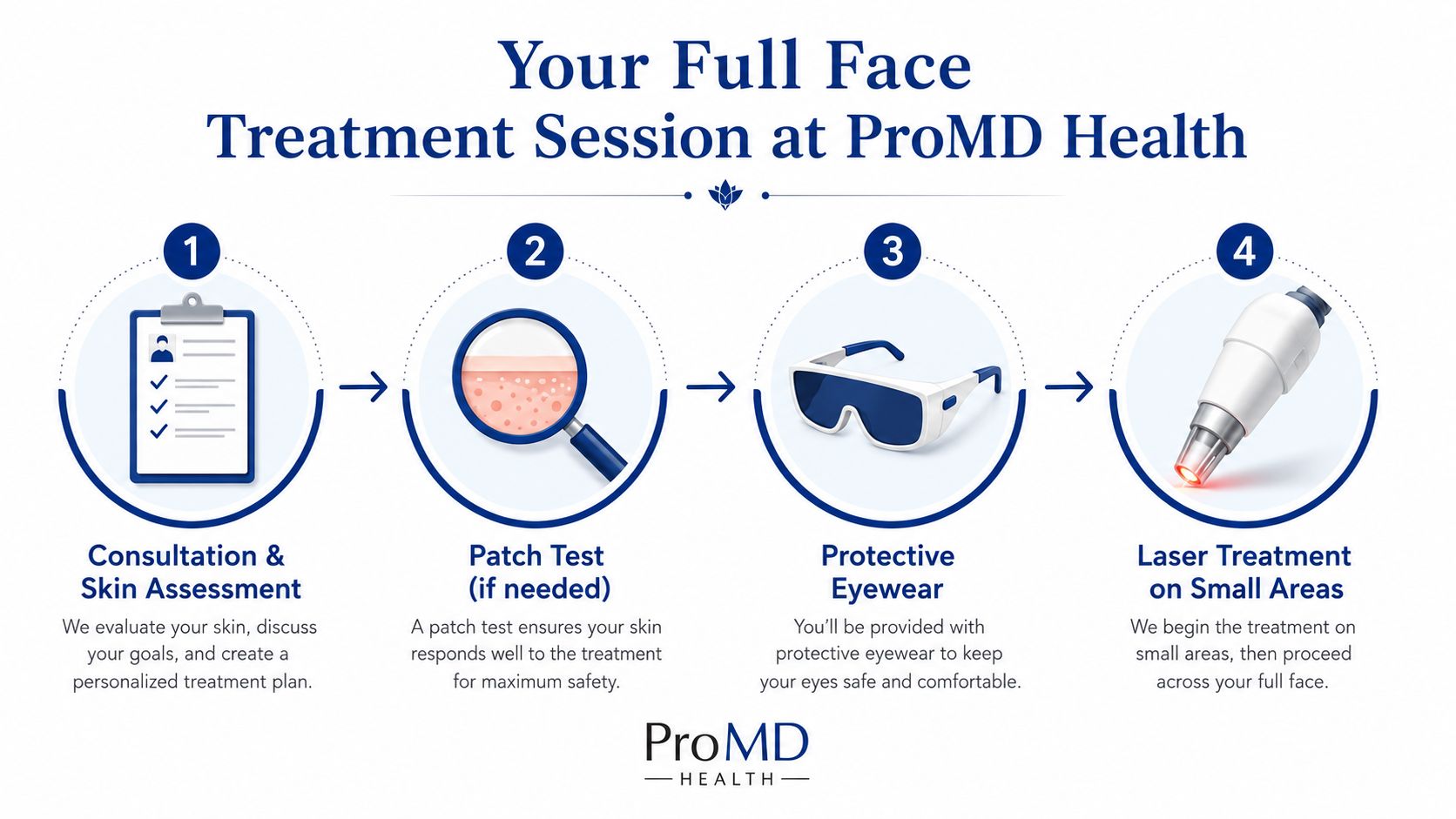
A well-run facial laser appointment is usually calm, methodical, and much more controlled than people expect. The visit starts with a skin assessment, because the face needs to be treated with more caution than a flat body area. If a patch test is indicated, that comes first, especially when the clinician wants to see how the skin responds to a conservative setting.
The visit moves in small, deliberate steps
Protective eyewear is essential. Then the provider works across the face in small areas, which helps manage curved surfaces like the forehead, temples, cheeks, upper lip, chin, and jawline. Those contours are exactly why the treatment is more technique-sensitive than a simple pass over a larger area.
A facial protocol is usually paced as a series, not a one-time event. Consumer-facing clinical guidance often describes a course of about 6 to 10 sessions spaced 4 to 6 weeks apart, which lines up with hair-cycle biology and the need to catch follicles as they enter active growth. Clinical timing guidance
What the treatment feels like
Most patients describe the sensation as a brief snap or quick heat pulse rather than prolonged pain. Some areas feel sharper than others, especially around the upper lip or jawline, because the skin is thinner and the hair can be denser.
A facial treatment also uses conservative technique. Technical guidance for facial work reports wavelength ranges of 755 to 1064 nm, spot sizes around 8 to 18 mm, fluence often in the 20 to 50 J/cm² range depending on the laser and skin type, and pulse durations that should stay within follicular thermal relaxation time. Terminal hair follicle TRT is roughly 10 to 50 ms, which is one reason overly long pulses can increase burn or pigment risk. Technical facial laser guidance
The important expectation is simple. A session is designed to treat the hair safely and methodically, not to force every follicle into the same response on day one.
Comparing Full Face Laser Hair Removal to Other Options
People usually compare laser against whatever they've been doing already. That means shaving, waxing, threading, dermaplaning, tweezing, depilatory creams, or sometimes an at-home IPL device. Each option solves a problem, but they don't solve it for the same length of time or with the same skin trade-offs.
| Method | Typical Duration | Best For | Key Trade-Off |
|---|---|---|---|
| Laser hair removal | Long-term reduction with series-based upkeep | Dark terminal facial hair and patients wanting less daily maintenance | Needs multiple sessions and the result is reduction, not guaranteed elimination |
| Waxing | Short-term smoothness | People who want quick removal across larger facial patches | Repeated irritation, regrowth, and time spent on upkeep |
| Threading | Short-term shaping and precision | Small zones like the upper lip or brow-adjacent facial hair | Can be slow on broader areas and still needs frequent repetition |
| Dermaplaning | Very short-term exfoliation and peach fuzz removal | Surface texture and fine vellus hair | Hair grows back quickly because the follicle isn't disabled |
| Tweezing | Very short-term spot removal | Isolated hairs | Not practical for full-face coverage |
| Depilatory creams | Short-term chemical removal | Some facial users with tolerant skin | Can irritate facial skin and don't address regrowth |
| At-home IPL | Variable and usually less predictable | Convenience-focused users | Less controlled than supervised treatment and not ideal for every face |
Why people switch after trying the short-term cycle
Short-term methods can be useful, but they keep the problem active. Waxing, threading, and tweezing all remove hair that is already visible, then the cycle starts again. Dermaplaning helps with surface smoothness, but it doesn't change follicle behavior.
If you're still scheduling facial maintenance on a tight loop, the real comparison isn't just how the skin looks today, it's how much effort the next six months will take.
For patients who are weighing facial hair removal against other facial upkeep, ProMD Health Bel Air also offers related services such as dermaplaning, and the timing matters. A useful internal read is this facial waxing guide, especially if you're trying to understand why some people switch from repeated wax appointments to a laser series.
Pre-Care and Post-Care for Facial Laser Hair Removal
Preparation changes both safety and results. Facial skin reacts quickly, so the goal is to come in with calm, untreated skin rather than a face that's already been stressed by waxing, plucking, or tanning.
What to avoid before the appointment
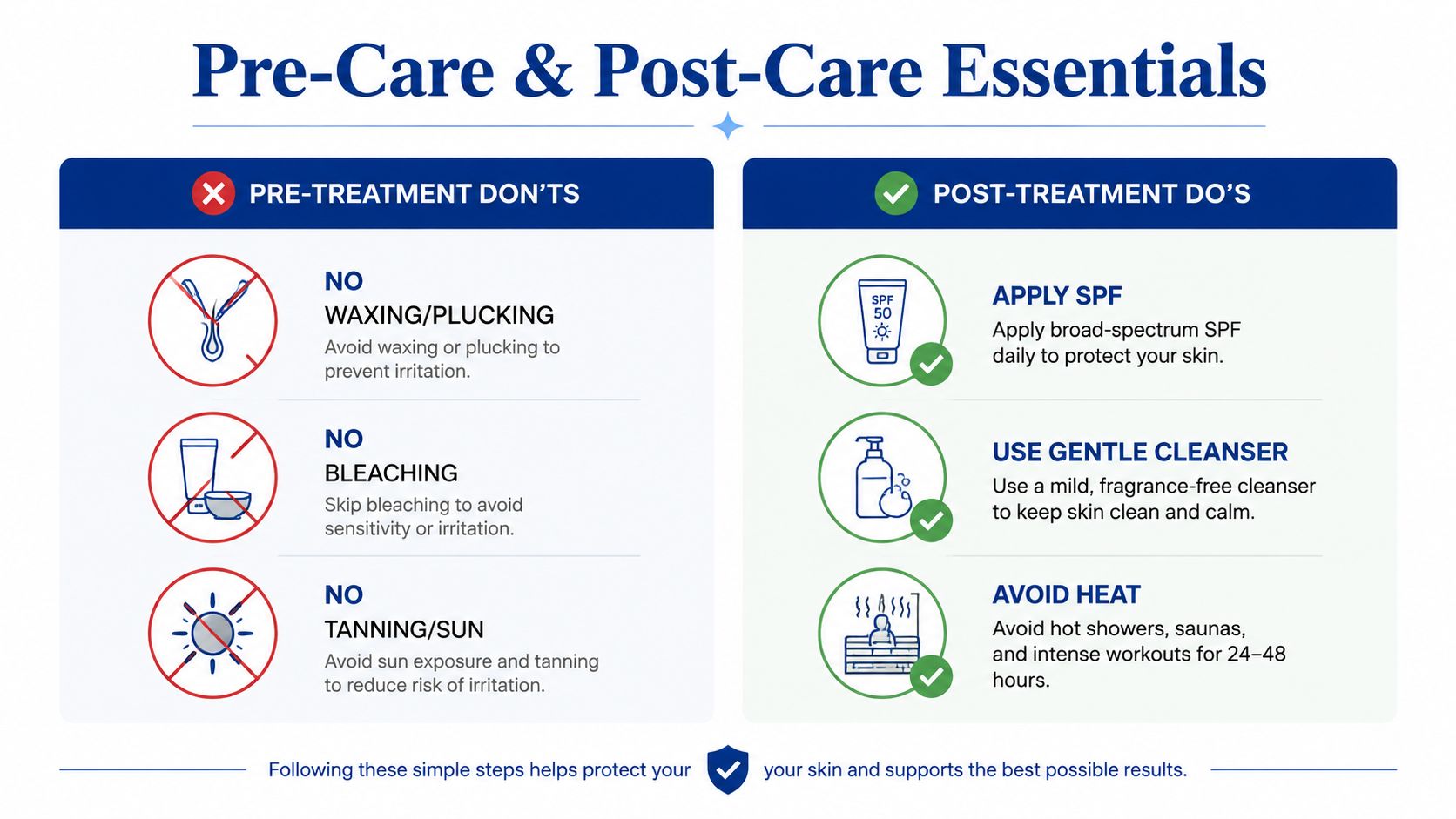
Before treatment, patients are generally told to avoid waxing, plucking, tanning, and direct sun exposure. Mayo Clinic also advises using SPF 30+ and protecting treated skin afterward, and it notes that facial laser hair removal can cause hyperpigmentation, hypopigmentation, blisters, burns, and rare scarring, with higher risk in darker skin types and on facial sites. Mayo Clinic patient guidance
Arrive with clean skin. That means no makeup, no heavy residue, and no aggressive active ingredients that could make the skin more reactive. If you've recently done a peel or another facial procedure, sequencing matters.
What to do after the session
Mild redness and warmth are common and usually temporary. Keep the skin protected, wear SPF 30+, and avoid extra heat and sweating for at least the immediate recovery window.
A recent review also notes that chemical peels and other laser procedures should be avoided on the face for two weeks before and after laser treatment. That timing is important for people who combine services, especially if your routine already includes facials, peels, microneedling, or dermaplaning.
- Before treatment: Skip waxing, plucking, tanning, and unprotected sun.
- After treatment: Use sun protection, keep the skin gentle, and avoid stacking other facial procedures too close together.
- For scheduling: Leave enough room around peels and other laser-based services so the skin isn't asked to recover twice at once.
If you're also dealing with breakouts, it helps to think about the acne plan separately. A practical resource on how to manage breakouts can be useful when you're deciding how to sequence skincare around laser appointments.
Realistic Results, Side Effects, and Long-Term Maintenance
The most honest way to talk about facial laser hair removal is to call it long-term reduction. A published review reported average long-term reduction ranges of 30% to 73.61% for Nd:YAG, 35% to 84.25% for Alexandrite, 32.5% to 69.2% for Diode, and 27% to 52.7% for IPL, with the face again tending to sit at the lower end of response. Systematic review of hair reduction outcomes
What success usually looks like
Success on the face often means less daily shaving, fewer coarse hairs, and less time spent on tweezing or waxing. It does not always mean a completely hair-free face, especially if the hair pattern is influenced by hormones or if the treated area is naturally more resistant.
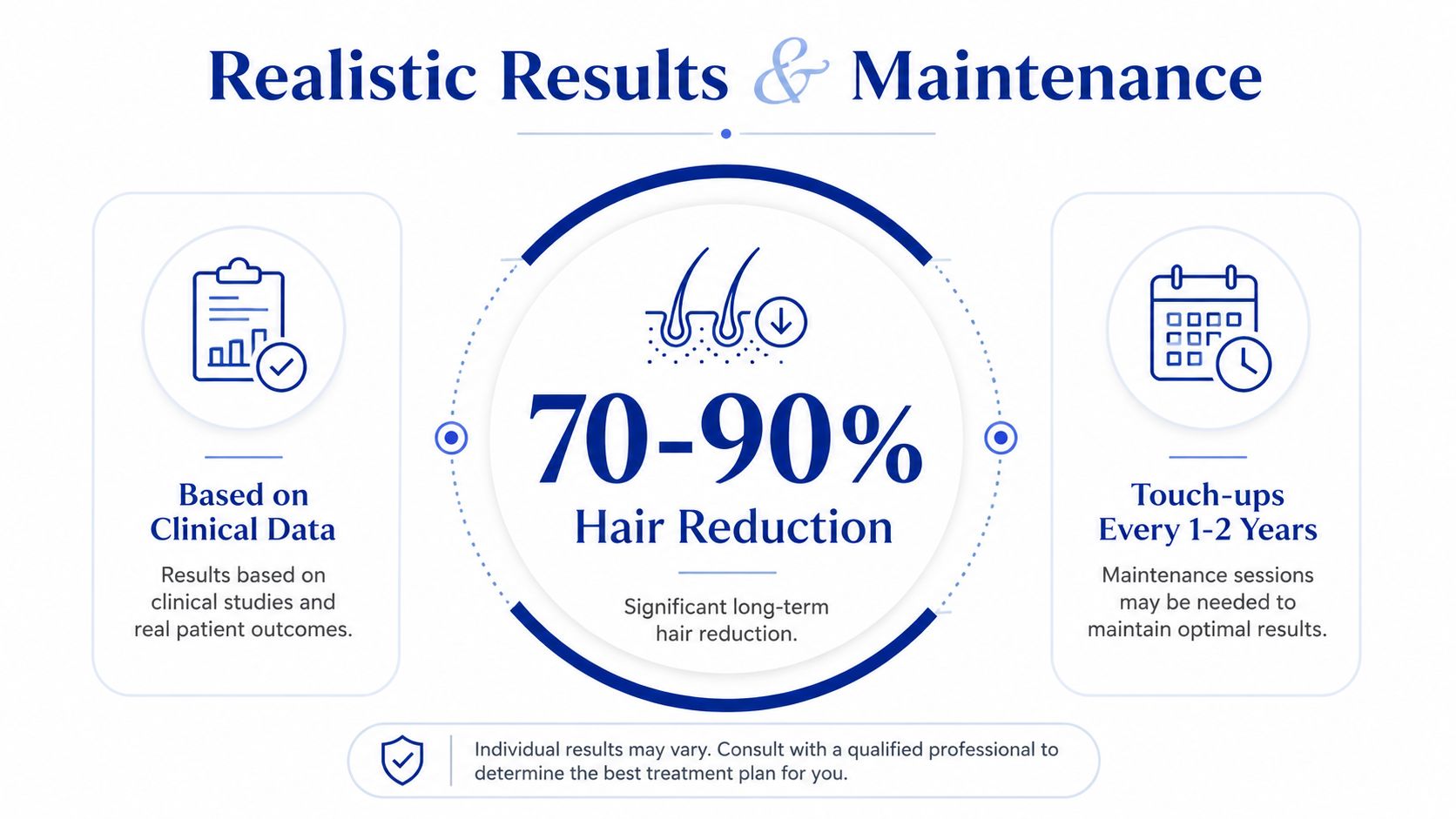
That's why maintenance matters. After the initial series, some patients need periodic touch-ups to keep the result consistent. In the literature, repeated treatments can produce substantial improvement, but facial hair often needs continued upkeep rather than a single endpoint.
What side effects patients should know about
Normal short-term effects can include mild redness and swelling around the follicles. Less commonly, the face can experience hyperpigmentation, hypopigmentation, blisters, burns, and rare scarring, and those risks rise when the skin is darker, tanned, or treated too aggressively. That's one reason conservative settings and a supervised setting matter.
Practical rule: If a treatment plan promises a perfect, permanent result on the face with no maintenance and no skin risk, the promise is too simple.
For many patients, the realistic maintenance pattern is periodic follow-up after the initial course. Some will need a touch-up every so often to stay ahead of regrowth, while others need more structured maintenance because the face keeps producing new active follicles. The important part is not to treat maintenance as a failure, it's part of how facial hair biology works.
Choosing ProMD Health Bel Air for Full Face Laser Hair Removal
A good facial plan starts with a conversation about your hair pattern, skin type, and the rest of your skin routine. At ProMD Health Bel Air, that conversation happens in a medically supervised clinic at 2023 Emmorton Rd, Suite A, Bel Air, Maryland, with appointments serving patients from Bel Air and nearby communities like Fallston, Forest Hill, Abingdon, and Havre de Grace. The practice also offers virtual consultations for people who want to talk through candidacy before coming in. Meet the Bel Air team
Why local planning matters
Full face treatment rarely exists in isolation. Some patients are also thinking about facials, peels, dermaplaning, or other skin maintenance, and the safest timeline depends on how those services are sequenced. A supervised setting helps keep those decisions coordinated instead of improvised.
The clinic also uses the Entity Med AI Simulator to preview potential post-treatment outcomes, which can help patients visualize what a treatment plan is aiming to do before they start. That's useful when the main question isn't whether laser works in general, but whether it makes sense for your own face and timeline.
What to expect when you reach out
Weekday availability is built into the practice schedule, and Saturday appointments are available by arrangement. If you're comparing options, ask for an evaluation that looks at your facial zones separately, since upper lip, chin, jawline, cheeks, and sideburns may not respond the same way.
Here's the simplest next step. If you're tired of the cycle of shaving, waxing, tweezing, or threading and want a realistic facial hair plan, book a visit that matches your skin and your goals.
If you're ready to talk about full face laser hair removal in a medically supervised setting, ProMD Health Bel Air can help you map out a plan that fits your skin type, hair pattern, and schedule. Visit ProMD Health Bel Air to book a virtual or in-person consultation and take the next step toward a more manageable face-care routine.