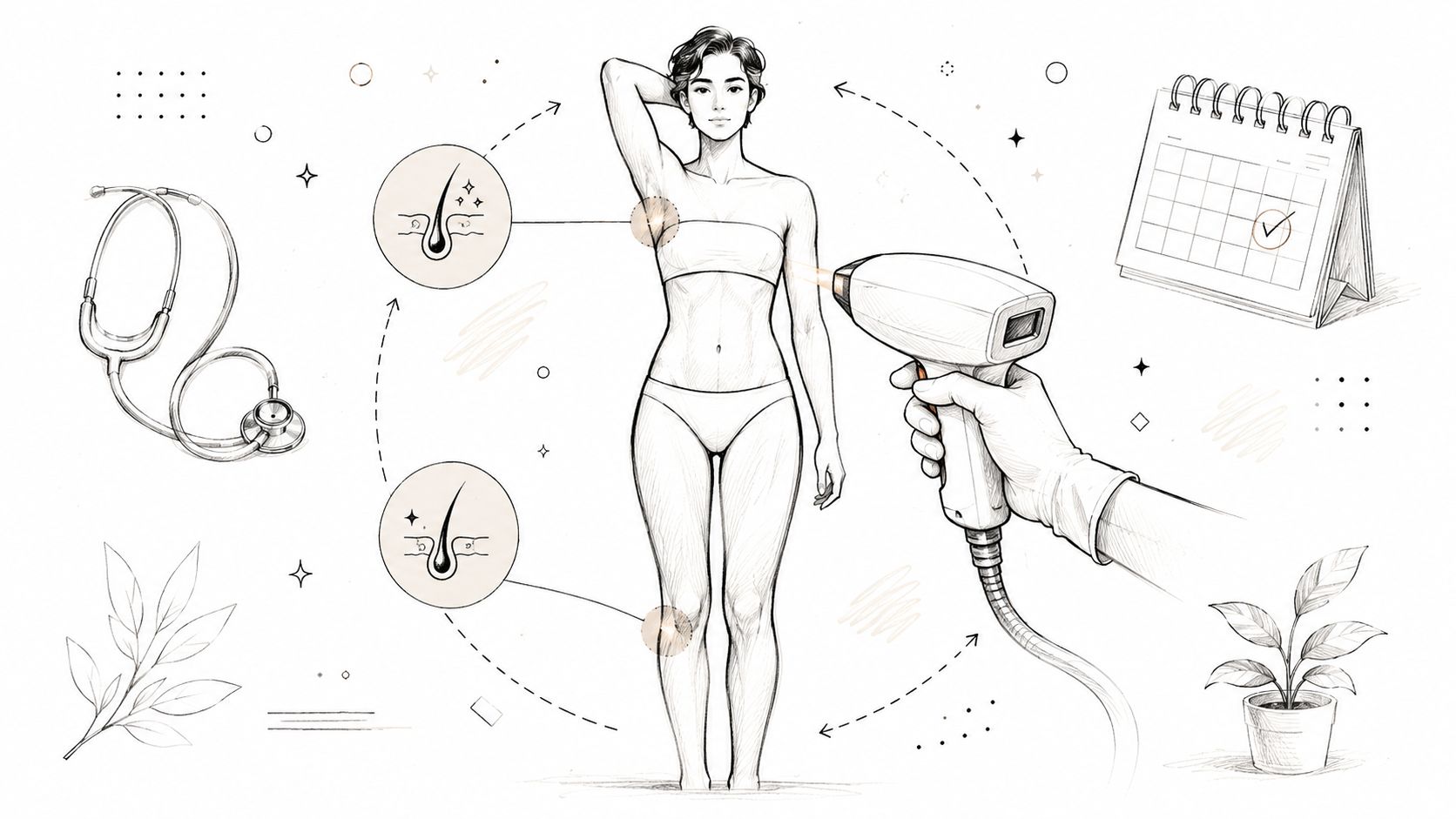
You've probably had the same thought after one more rushed shave or another waxing appointment that didn't last as long as you hoped. Full body laser hair removal sounds like the answer, but it also sounds like a big commitment, and that's because it is. The key question isn't whether the treatment works in general, it's whether you understand how it works across different body zones, how many visits it usually takes, and what your own biology might mean for the result.
For many adults, the appeal is simple. Less daily maintenance. Less irritation. Less time spent managing hair in places you'd rather not think about every week. Laser hair removal has been a major cosmetic procedure for decades, and by 2016 it was already described in the medical literature as the most common laser therapy and the third most commonly performed procedure in the United States, with more than 1 million treatments performed that year PubMed clinical review. That popularity makes sense, but popularity doesn't remove the need for realism.
Table of Contents
- Why Full Body Laser Hair Removal Is a Bigger Decision Than It Seems
- How Laser Hair Removal Works
- Treatment Areas and What Results to Expect by Zone
- Your Treatment Timeline from Consultation to Maintenance
- When Hormones and Health Conditions Change the Equation
- Laser Hair Removal Compared to Shaving, Waxing, and Other Alternatives
- Why ProMD Health Bel Air Is the Local Choice for Full Body Treatment
Why Full Body Laser Hair Removal Is a Bigger Decision Than It Seems
A woman who is tired of shaving her legs, underarms, and bikini line may assume full body laser hair removal is just a bigger version of a single-area treatment. The process is more layered. Each body zone brings its own growth pattern, sensitivity level, and response to laser energy, so the treatment plan has to account for several areas at once.
That is why the first consultation carries so much weight. A provider needs to look at skin tone, hair thickness, the areas being treated, and any hormonal or medical factors that could shift results. The medical goal is long-term reduction in coarse hair density and caliber across multiple body regions, not a one-time appointment that erases every hair. In a peer-reviewed study of a rotational full-body approach, the average hair reduction across all treated body areas was 75.07% at 6 months, along with a significant decrease in hair thickness and an increase in vellus hairs, the finer, lighter hairs that often replace terminal hair after treatment PubMed clinical review.
Why people choose full-body treatment
For many patients, the reason is convenience rather than vanity. They are tired of razor burn, ingrown hairs, constant stubble, or the repeated cycle of letting hair grow long enough for waxing and then starting over again. In clinical practice, laser hair removal is a noninvasive procedure that uses concentrated light to target pigment in the follicle, and the American Academy of Dermatology says many patients see only about 10% to 25% hair reduction after the first treatment AAD laser hair removal FAQs.
That first-treatment reality catches people off guard. It also shows why full body treatment is a planning decision, not a quick fix. If you want lasting change, you need to be comfortable with a series of appointments, not a single visit.
Practical rule: if a treatment promise sounds like instant, body-wide permanence, it is overselling what laser can realistically do.
The better way to think about it is this. Full body laser hair removal is an investment in fewer maintenance chores over time, but it works best when treated as a staged process. That means choosing a clinic that explains the timeline clearly, understands where one zone may respond differently from another, and does not blur those differences. For patients comparing treatment approaches, the laser hair removal 2026 guide offers a useful overview of how the process is usually explained. In practice, the equipment matters too, which is why clinics often discuss systems such as the one outlined in this Alma laser hair removal equipment guide.
How Laser Hair Removal Works
A laser hair removal visit starts with a simple chain of events. The device sends concentrated light into the hair shaft, pigment in the hair absorbs that light, the light converts to heat, and that heat damages the follicle enough to disrupt future growth Cleveland Clinic laser hair removal. The clinic is aiming energy at the follicle itself while protecting the surrounding skin, which is why skin tone, hair color, and device settings all matter.
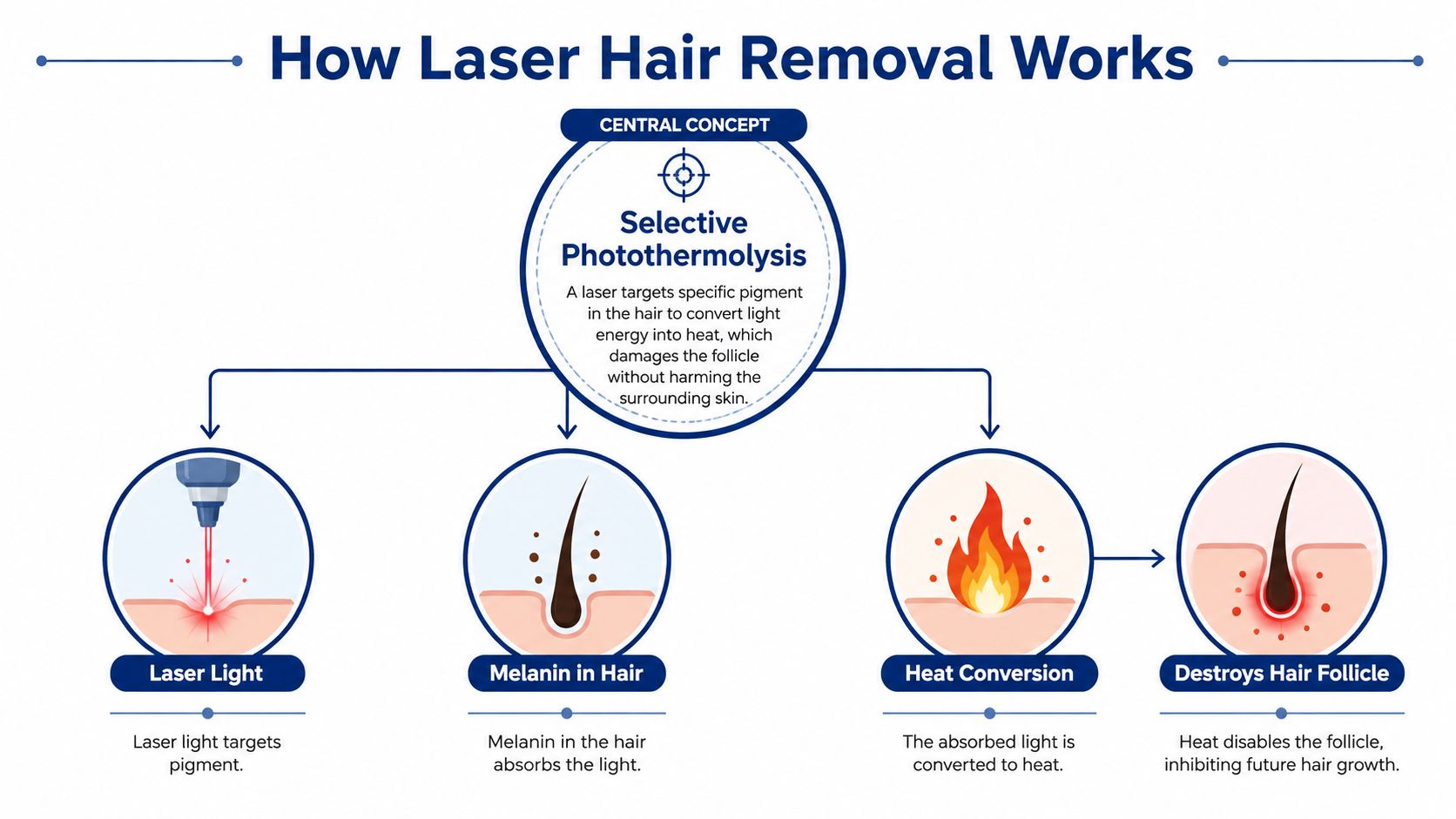
The next piece is the hair-growth cycle. Hair grows in phases, and only follicles in the anagen, or active growth phase, respond strongly enough for treatment to work well Cleveland Clinic laser hair removal. That is why one appointment cannot clear every visible hair at once. Some follicles are actively producing hair, while others are resting or transitioning, so a series of sessions is needed to catch more follicles at the right moment.
The wavelengths clinicians rely on
Clinicians commonly use 755 nm Alexandrite, 808–810 nm Diode, and 1064 nm Nd:YAG wavelengths for hair removal AABP laser hair removal reference. These wavelengths do not behave the same way in skin. Shorter wavelengths interact more readily with pigment near the surface, while longer wavelengths travel differently and can be better suited to certain skin tones and treatment goals.
For deeper technical background on how wavelength choice fits into treatment planning, the laser hair removal 2026 guide gives a helpful overview. In a clinic setting, the main point is simpler. Good treatment depends on matching the device and settings to the person in the chair, not using one fixed approach for everyone.
Nd:YAG is often chosen for medium to very dark skin tones, Fitzpatrick IV to VI, because its longer wavelength reduces epidermal melanin absorption compared with shorter wavelengths. That lowers the chance of unwanted skin heating. Equipment selection matters in a practical way, and this is why a clinic may point patients toward a professional equipment guide for Alma laser systems when discussing treatment planning.
The more carefully the wavelength and settings are matched, the easier it is to target the follicle while respecting the skin around it.
Treatment Areas and What Results to Expect by Zone
A full-body laser visit can sound simple until you start listing the zones. Legs, underarms, bikini area, arms, chest, back, and face do not all respond the same way, because each area has its own hair thickness, density, and growth pattern. In clinical reviews, body areas with longer growth cycles tend to show better long-term reduction, while facial hair usually needs more patience and more follow-up, as noted in the PubMed systematic review.
That is why zone-by-zone planning matters. The areas people usually notice first are the ones that create the most daily upkeep, especially legs and underarms. Facial zones often take longer to settle, so they ask more of the treatment plan and more of the patient's expectations.
| Laser Type | Legs | Underarms | Bikini | Face |
|---|---|---|---|---|
| Nd:YAG | 30% to 73.61% | Qualitatively variable | Qualitatively variable | Lowest reduction overall |
| Alexandrite | 35% to 84.25% | Qualitatively variable | Qualitatively variable | Lowest reduction overall |
| Diode | 32.5% to 69.2% | Qualitatively variable | Qualitatively variable | Lowest reduction overall |
The table stays cautious on purpose, because the evidence does not support one fixed outcome for every zone. Published results shift by device and body site, and the face still tends to lag behind the legs in overall reduction PubMed systematic review. Hair biology explains that difference, since not every follicle is behaving on the same schedule.
Where people feel the biggest difference
Underarms and bikini areas often stand out because they are shaved often and irritation shows up quickly. Legs often stand out for a different reason, since they cover a large surface and take time to maintain. Arms and chest can feel worthwhile for patients who want less daily grooming, while the back can be especially helpful when dense hair makes self-care frustrating.
For readers who want a closer look at one common zone, the clinic's underarm laser hair removal guidance is a practical place to compare prep, timing, and aftercare with a broader full-body plan.
Why expectations should stay zone-specific
A strong consultation separates areas likely to improve well from areas that may need more patience. If every part of the body is discussed as if it will behave the same way, the plan gets vague and the results can feel inconsistent later. Honest planning looks more specific. Legs and some other body zones often respond better, while the face and hormone-sensitive areas usually need more sessions and more maintenance.
Bottom line: full body treatment works best when you expect different outcomes in different zones and plan for them from the start.
Your Treatment Timeline from Consultation to Maintenance
The timeline usually starts before the first pulse of laser light. A consultation is where the provider checks skin type, reviews hair characteristics, and maps out which areas should be treated first. If the clinic offers virtual visits, that conversation may begin from home, but the purpose stays the same, building a plan that fits your skin and goals.
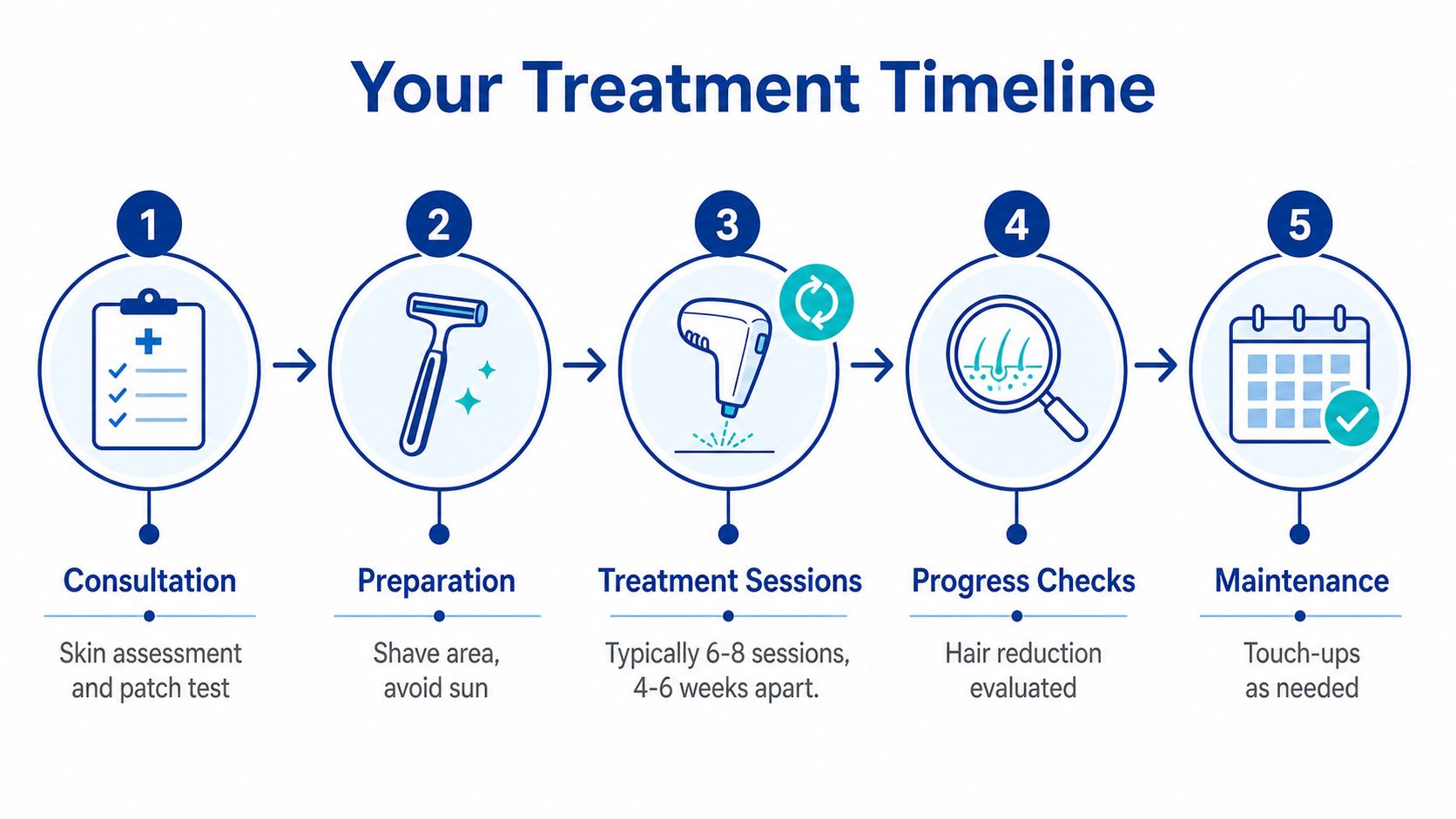
Once treatment begins, spacing matters. Clinical guidance describes an initial series of 4 to 6 sessions spaced 4 to 6 weeks apart, with maintenance sometimes needed every 6 to 12 months for regrowth control Cleveland Clinic laser hair removal. That spacing is planned to catch new hairs as they enter the active growth phase, since laser works best when a follicle is in the right part of its cycle.
What to do before a session
Preparation usually focuses on reducing variables. Patients are commonly told to shave the treatment area, avoid waxing, and limit sun exposure before the visit Cleveland Clinic laser hair removal. Shaving removes surface hair while leaving the follicle in place, which keeps the target available for the laser. Waxing removes that target, so it works against the treatment plan.
What happens during treatment
During the appointment, the provider positions the handpiece over the skin and delivers pulses in a planned pattern. Many people describe the sensation as tolerable but noticeable, especially in sensitive areas. Cooling and careful settings help keep the experience manageable, and proper device choice matters because skin tone, hair thickness, and body area all change how the laser should be used.
A short note from clinical workflow matters here. If a patient is uncomfortable, speaking up helps the provider adjust the treatment. Good sessions are collaborative, not passive.
What comes after
Aftercare focuses on calm skin and patience. Temporary redness can happen, and the main job after treatment is protecting the area from heat and sun while the skin settles. The bigger point is consistency. If you skip sessions, you miss the growth cycle timing that makes laser effective in the first place.
For people who like to see this mapped out in one place, ProMD Health Bel Air publishes a full-body laser hair removal timeline and treatment planning materials on its site, which can be useful when you are trying to picture the months ahead ProMD Health Bel Air full-body timeline and treatment planning.
When Hormones and Health Conditions Change the Equation
Some people assume laser hair removal is only about hair color and skin tone. Hormones can change the picture just as much. That matters most for patients with PCOS or other endocrine-driven causes of hirsutism, because the hair-growth signal doesn't behave like ordinary cosmetic hair growth.
A 2023 literature review reported that patients with PCOS needed substantially more sessions on average, 12.4 versus 7.1, and achieved lower overall hair reduction, 68% versus 82% at 12 months, than non-PCOS controls JCRM review. That's a major practical difference. It means some patients need a longer plan, more maintenance, and a more careful conversation about whether medical evaluation should happen alongside cosmetic treatment.
Why hormone status changes the result
Hair follicles respond to internal signals. If those signals stay active, new hairs can keep cycling into growth even after a solid treatment series. That's why hormonal hair growth can be more persistent than ordinary body hair. StatPearls lists hormonal status among the key factors that influence outcomes, and Mayo Clinic notes that hair can grow back over time even after substantial reduction Mayo Clinic hair removal overview.
That combination matters because it keeps expectations honest. Laser can still help, but the outcome may not look like the standard case people imagine when they hear “full body.”
Why a medical clinic is useful here
A medically supervised setting is helpful when hair growth patterns may be influenced by hormones, medications, or other health issues. In some cases, a patient may be a candidate for both laser hair removal and hormone optimization therapy, depending on the underlying concern and the clinician's assessment. That doesn't mean every patient needs a hormone workup. It does mean the conversation should stay open if the pattern of hair growth suggests a broader issue.
If you're comparing service options in the same local setting, one clinic offering both laser hair removal and hormone support is ProMD Health Bel Air. That kind of integrated approach can make it easier to align cosmetic goals with the bigger medical picture when the hair growth pattern isn't straightforward.
Practical takeaway: if the hair growth seems unusually stubborn, the right next step may be a medical conversation, not just a longer laser schedule.
Laser Hair Removal Compared to Shaving, Waxing, and Other Alternatives
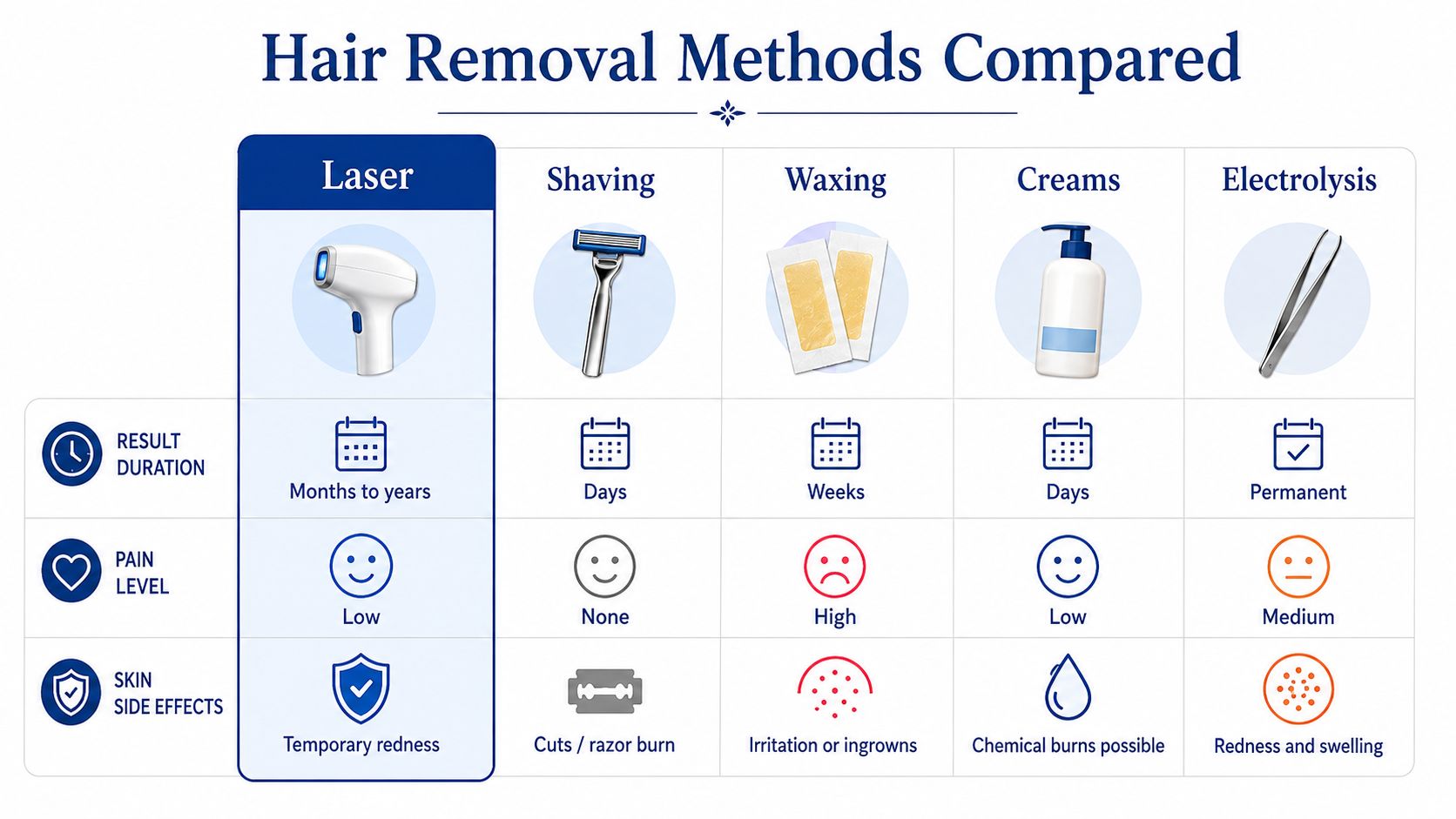
A person trying to keep up with body hair has a few familiar choices. Shaving clears hair quickly, then the stubble returns. Waxing pulls hair from the root, so the skin may stay smooth longer, yet the cycle of regrowth and appointments continues. Full body laser hair removal belongs in a different category because the aim is long-term reduction, not constant removal.
A more durable comparison chart from the American Academy of Dermatology shows that laser hair removal can offer results that last for months or even years after a treatment series is finished. That still does not mean every follicle is gone forever. It means the day-to-day upkeep usually drops well below what shaving or waxing require, which matters if you are tired of planning grooming around regrowth.
How the options feel in real life
Shaving asks the least of you in the moment, then asks for the same effort again and again. Waxing removes hair from the root, which is why it can feel more effective for longer stretches, yet it may also bring irritation and the need to keep booking appointments. Depilatory creams are simple to apply, but they do not change the fact that the hair grows back. Electrolysis is the method used for permanent removal on a follicle-by-follicle basis, although it follows a different workflow and is not built for the same kind of large-area efficiency.
For patients who want a traditional body-hair maintenance option rather than a light-based one, the clinic's waxing services are part of the broader conversation. The difference is straightforward. Waxing manages hair for the short term, while laser treatment is designed to lower how much hair returns over time.
Why people still choose laser
Convenience is the main reason. Once the series is underway, there is less daily shaving and fewer waxing appointments just to stay ahead of regrowth. Skin comfort matters too. Laser can reduce the loop of razor bumps and repeated mechanical irritation that some people experience with other methods.
The tradeoff is patience. You do not get instant smoothness everywhere, and you do not get the same outcome in every zone. If you are willing to accept a slower path in exchange for less ongoing maintenance, laser often makes sense. If you want a quick fix for a single event, a temporary method may fit better.
Best fit: laser makes the most sense when the goal is to simplify your grooming routine over the long term, not just remove hair this week.
Why ProMD Health Bel Air Is the Local Choice for Full Body Treatment

A strong full-body plan needs more than a device and a room. It needs a clinic that can look at hair removal as part of a larger skin and wellness picture. ProMD Health Bel Air, at 2023 Emmorton Rd, Suite A in Bel Air, serves patients in Bel Air, Fallston, Forest Hill, Abingdon, and Havre de Grace, and its medically supervised team includes providers such as Amanda Pittillo, PA-C and Lauren Mason, PA-C, MSHS.
That matters because full body laser hair removal isn't always a simple cosmetic decision. Some patients need a straightforward series and nothing more. Others may also be thinking about hormone-related hair growth, skin sensitivity, or how to coordinate treatment with other services in the same clinic setting. A place that offers virtual consultations can make the process easier to start, especially if you want to ask questions before you come in.
What helps a patient decide
A practical clinic visit should answer a few direct questions. Which zones are most likely to respond well. Which areas may need more patience. How often will maintenance be needed. And whether your hair pattern suggests the need for a broader medical conversation.
The Entity Med AI Simulator is another useful piece of the local workflow because it can help patients preview potential post-treatment outcomes before committing to a plan. That kind of visual preview won't replace a medical assessment, but it can make the decision feel less abstract.
If you're comparing options, the main advantage is not hype. It's coordination. One clinic can handle hair removal, skin care, and hormone-related concerns in one place, which is helpful when your treatment goals overlap.
Good next step: bring your questions, your hair-removal history, and your goals for each zone. The more specific you are, the better the plan can be.
If you're ready to stop guessing and want a clearer plan for smoother skin, visit ProMD Health Bel Air to explore full body laser hair removal, ask about a consultation, and see whether a medically guided approach fits your goals. The team can help you map out zones, timing, and maintenance so you know what to expect before you start.