

What Men Need to Know About PRP Hair Treatment in 2026
Men’s PRP hair treatment is a non-surgical procedure that uses concentrated growth factors from your own blood to stimulate weakened hair follicles and slow the progression of male pattern baldness.
Here’s a quick overview:
| Topic | Key Facts |
|---|---|
| What it is | Platelet-rich plasma injected into the scalp to reactivate hair follicles |
| Who it’s for | Men in early to moderate stages of androgenetic alopecia |
| How long it takes | ~60 minutes per session |
| Results timeline | Reduced shedding in 1-2 months; visible density by 4-6 months |
| Sessions needed | 3-4 initial sessions, then maintenance every 4-6 months |
| Is it permanent? | No — ongoing maintenance is needed as hair loss is progressive |
| Insurance coverage | Generally not covered; considered cosmetic |
Hair loss is more common than most men realize. Androgenetic alopecia — better known as male pattern baldness — affects roughly 50% of Caucasian men by age 50. For many, it starts in their 20s or 30s, long before they expect it.
The good news? As of May 2026, regenerative treatments like PRP have moved well beyond experimental status. There is now a meaningful body of clinical evidence supporting their use — and men are increasingly choosing this approach over daily medications or surgery.
But PRP isn’t right for everyone, and results vary. This guide will walk you through exactly how it works, what to expect, and whether it’s a good fit for you.
I’m Ryan Pittillo, Franchise Owner at ProMD Health Bel Air, where our team has helped men across the Bel Air area explore men’s PRP hair treatment as part of a personalized, results-focused approach to hair restoration. As someone who values a team-first mindset — both on the football field and in our practice — I believe you deserve clear, honest information before making any treatment decision.
Basic men’s prp hair treatment terms:
The Science Behind Men’s PRP Hair Treatment
To understand why men’s prp hair treatment is so effective, we first have to look at what’s happening beneath the surface of your scalp. Platelet-Rich Plasma (PRP) is what we call an autologous therapy. “Autologous” is just a fancy medical way of saying it comes from your own body. Because we are using your own blood, the risk of an allergic reaction or rejection is virtually zero.
The primary goal of PRP is to target the hair growth cycle. Hair grows in phases: Anagen (growth), Catagen (transition), and Telogen (resting). In men with androgenetic alopecia, a hormone called DHT causes hair follicles to shrink, or “miniaturize.” This shortens the Anagen phase until the hair becomes so thin it eventually stops growing altogether.
PRP works by extending that vital Anagen phase. When we inject concentrated platelets into the scalp, they release a “symphony” of growth factors that trigger cell reproduction and tissue regeneration. Research has shown that PRP has anti-apoptotic effects, meaning it helps keep hair follicle cells alive longer and prevents them from “shutting down.”
For a deeper dive into the biology of this process, you can read scientific research on PRP for male balding or explore more info about plasma hair regrowth solutions on our blog.
How Growth Factors Stimulate the Scalp in Men’s PRP Hair Treatment
What exactly is inside that “liquid gold” we inject? PRP contains a concentration of platelets that is typically 2 to 7 times higher than what is found in normal blood. These platelets are packed with specific proteins called growth factors. Here are the heavy hitters involved in men’s prp hair treatment:
- VEGF (Vascular Endothelial Growth Factor): This is the “construction crew” for blood vessels. It promotes neovascularization, which is the formation of new blood vessels, ensuring your follicles get the oxygen and nutrients they need.
- PDGF (Platelet-Derived Growth Factor): Stimulates cell replication and skin formation.
- IGF-1 (Insulin-like Growth Factor): A major player in regulating the hair growth cycle and follicle development.
- EGF (Epidermal Growth Factor): Promotes cell growth and differentiation.
- TGF-β (Transforming Growth Factor-Beta): Helps manage the growth matrix between cells.
- FGF-2 (Fibroblast Growth Factor): Promotes the growth of specialized cells.
These factors work together to influence dermal papilla cells—the command center at the base of your hair follicle. They activate signaling pathways, such as the WNT/β-Catenin pathway, which are crucial for telling a dormant follicle to start producing hair again.
The Procedure at ProMD Health Bel Air
At ProMD Health Bel Air, we don’t believe in “one size fits all” solutions. Your hair loss pattern is as unique as your fingerprint. That’s why we start every journey with our AI Simulator. This cutting-edge technology allows our patients in Bel Air, Fallston, and Forest Hill to preview personalized post-treatment results. It takes the guesswork out of the process, helping you visualize what a fuller hairline or a denser crown might look like before you even begin.
Our team, including experts like Amanda Pittillo, PA-C, and Lauren Mason, PA-C, MSHS, ensures that the clinical environment is comfortable and professional. We know that for many men, discussing hair loss can feel a bit vulnerable, so we keep the atmosphere relaxed and focused on your goals.

The Step-by-Step Men’s PRP Hair Treatment Process
If you’re wondering what a typical Tuesday morning session looks like, here is the breakdown:
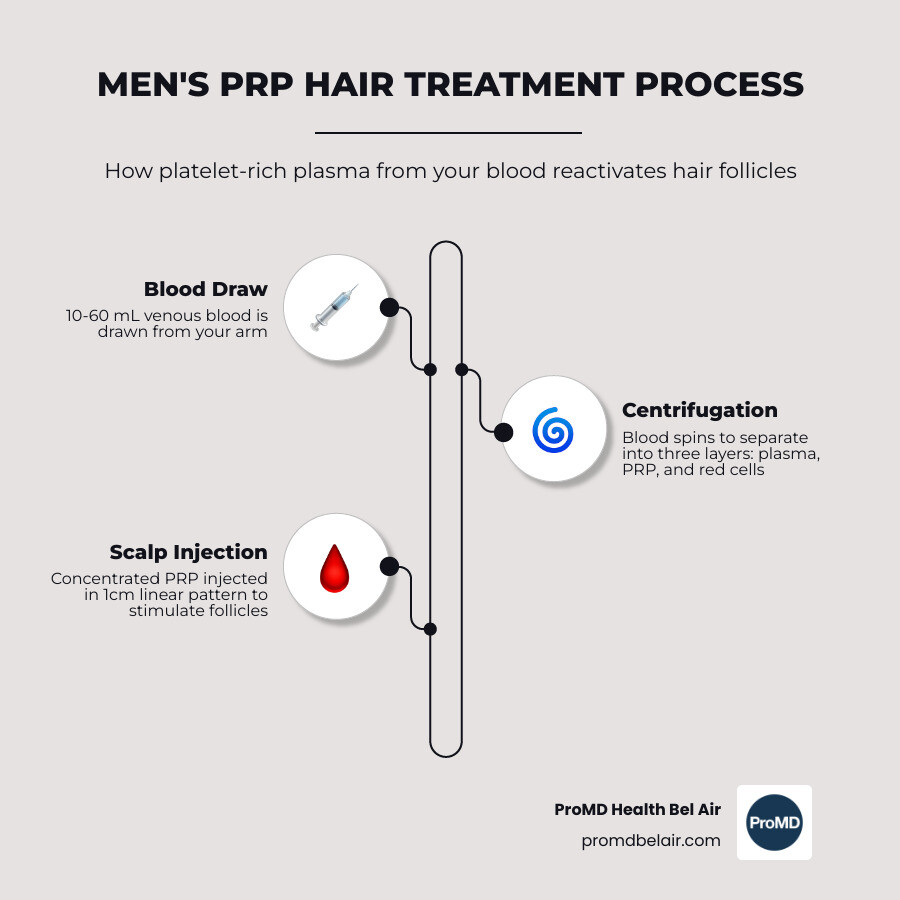
- The Blood Draw: We start by drawing a small amount of blood from your arm, usually between 10 mL and 60 mL. It’s no different than a standard blood test at your doctor’s office.
- The Centrifuge: We place your blood into a medical-grade centrifuge. This machine spins at high speeds to separate the blood into three distinct layers: red blood cells (which we don’t need), platelet-poor plasma, and the “buffy coat”—the highly concentrated Platelet-Rich Plasma.
- Extraction: We carefully extract the PRP into a syringe. For optimal results, we aim for a platelet concentration that is significantly higher than your baseline.
- The Injections: Using a very fine needle, we inject the PRP into the areas of the scalp experiencing thinning. We typically use a linear pattern with about 1cm of spacing between injections to ensure even coverage across the treatment area.
The whole process takes about 60 minutes, and because we can use topical numbing or local anesthetics, most men describe the sensation as a mild pressure or a slight sting rather than actual pain.
Efficacy and Realistic Results for Male Pattern Baldness
We’re big fans of data here. You aren’t just looking for “better” hair; you want measurable results. Clinical meta-analyses have shown that men’s prp hair treatment can lead to a significant increase in hair count—one study showed a mean difference of 17.90 hairs per cm² compared to control groups. Other research has shown even more dramatic boosts, with some patients seeing an increase of up to 33.6 hairs per treatment area.
It’s important to note that PRP doesn’t just grow more hair; it grows better hair. We often see an increase in follicle diameter, meaning the individual strands of hair become thicker and more robust.
You can find more localized insights in this scientific research on Maryland hair restoration.
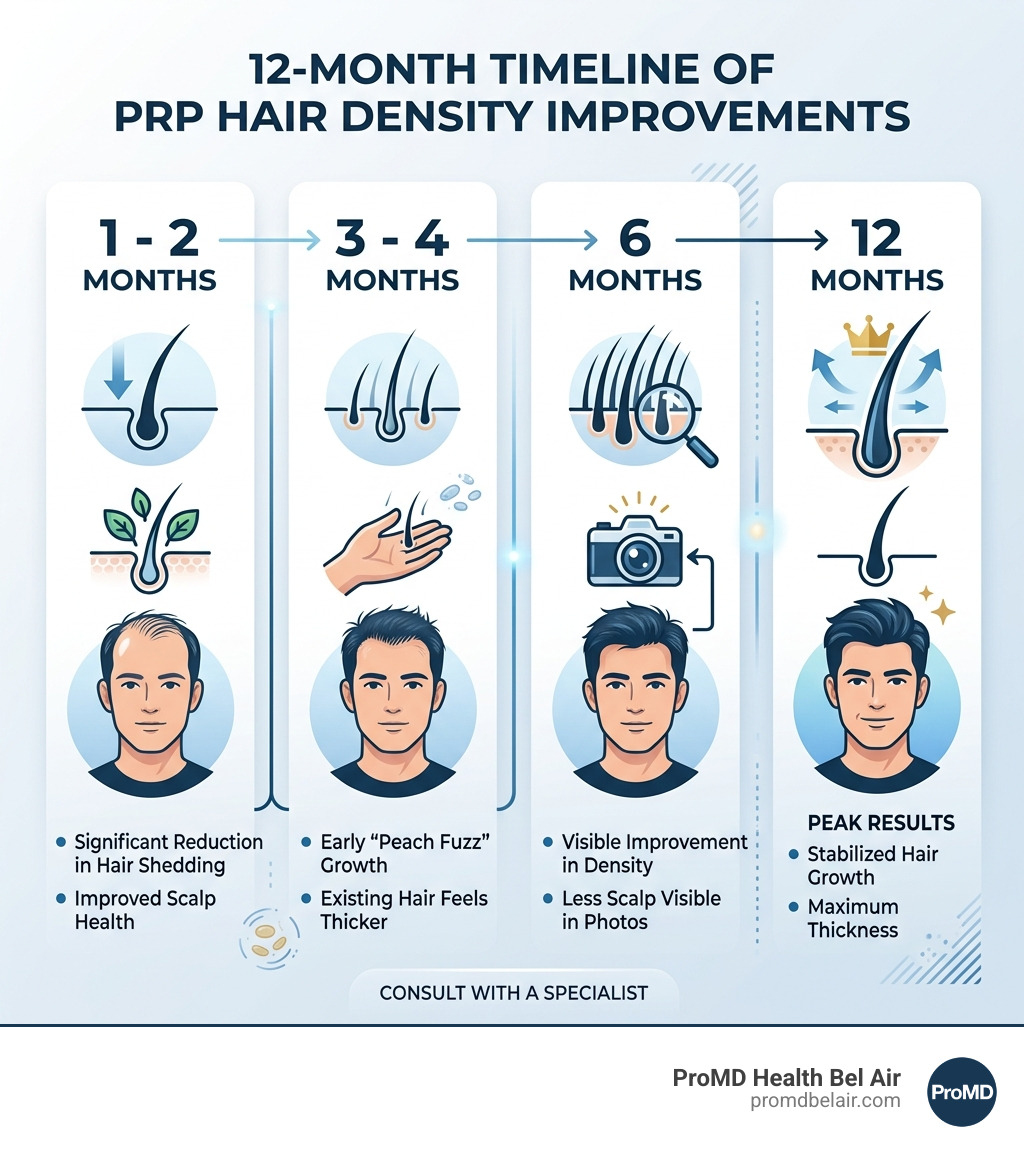
To give you an idea of the timeline, here is what a typical result looks like over the first year:
| Time Period | Expected Results |
|---|---|
| 1 – 2 Months | Significant reduction in hair shedding; improved scalp health. |
| 3 – 4 Months | Early “peach fuzz” growth; existing hair feels thicker to the touch. |
| 6 Months | Visible improvement in density; less scalp visible in photos. |
| 12 Months | Peak results; stabilized hair growth and maximum thickness. |
Comparing PRP to Other Hair Restoration Options
Many of our patients come to us already using over-the-counter or prescription options. It’s helpful to see how men’s prp hair treatment fits into the larger landscape of hair restoration.
- Minoxidil (Rogaine): A topical liquid or foam. It’s effective but requires twice-daily application for life. If you stop, the hair you saved typically falls out within months.
- Finasteride (Propecia): An oral medication that blocks DHT. It’s very effective but comes with a small risk of systemic side effects that some men prefer to avoid.
- Nutrafol: A high-quality supplement that addresses the internal “root causes” of hair loss like stress and nutrition. We often recommend this as a supportive therapy.
- Formula 82M: A prescription-strength topical that combines Minoxidil with anti-androgens and antioxidants for a more powerful punch than standard Rogaine.
The beauty of PRP is that it is a procedural treatment. You don’t have to remember to take a pill or rub a foam into your hair every single morning. Many of our most successful patients use a “multi-modal” approach, combining PRP with platelet-rich plasma as a hair tonic or daily supplements to attack hair loss from every angle.
Who is the ideal candidate for PRP?
- Men in the early to moderate stages of thinning (Norwood-Hamilton stages II to IV).
- Men with “active” follicles (PRP cannot grow hair on a completely bald, shiny scalp where follicles have died).
- Men looking for a natural, non-surgical alternative to transplants.
- Men who want to boost the results of a previous hair transplant.
Frequently Asked Questions and Conclusion
We know you probably have a few more questions before you’re ready to book. Hair restoration is a journey, and we want to make sure you have the map.
At ProMD Health Bel Air, we are committed to helping you take back your confidence. Whether you’re noticing a receding “M” shape at your temples or a thinning spot at the crown, early intervention is the key. You can find more info about hair restoration services on our dedicated service page.
Is PRP for hair loss permanent?
This is the most common question we get. The short answer is: no. Because male pattern baldness is a genetic and progressive condition, your body will continue to produce DHT, which will continue to try and shrink those follicles.
Think of PRP like fertilizer for a lawn. It makes the grass green and thick, but you still have to water it occasionally to keep it that way. Most men require an initial series of 3 to 4 treatments, followed by maintenance sessions every 6 to 12 months to sustain their results and keep their hair density high.
How much does the treatment cost?
The cost of men’s prp hair treatment can vary based on the extent of the thinning and the number of sessions required. In the Maryland region, individual sessions typically range from $600 to $1,500. Most clinics, including ours, offer package deals for the initial series (usually 3-4 injections) which can range from $1,500 to $3,500.
Because hair restoration is considered a cosmetic procedure, it is almost never covered by medical insurance. However, many men find the investment well worth it when compared to the lifetime cost of daily medications or the high price tag of a surgical hair transplant.
Are there any side effects?
One of the biggest selling points of PRP is its safety profile. Since it’s your own blood, there is no risk of transmissible diseases or allergic reactions.
Common side effects are mild and temporary:
- Mild redness: Usually resolves within a few hours.
- Scalp tenderness: You might feel a bit “tight” or sore for 24-48 hours.
- Minimal swelling: Occasionally occurs near the forehead but fades quickly.
There is virtually zero downtime. Most of our patients go right back to work or their daily activities immediately after their session. We just ask that you wait 24 hours before washing your hair or doing a heavy workout.
If you’re ready to stop wondering “what if” and start seeing what’s possible, our team at ProMD Health Bel Air—including Tyra Lindblad, Kate Maguire, Paige Scott, and Natalie Shek—is here to help.
Ready to see your future hair? Schedule your complimentary AI Simulator consultation today!
