What Are B-12 Shots Side Effects? A Quick, Honest Answer
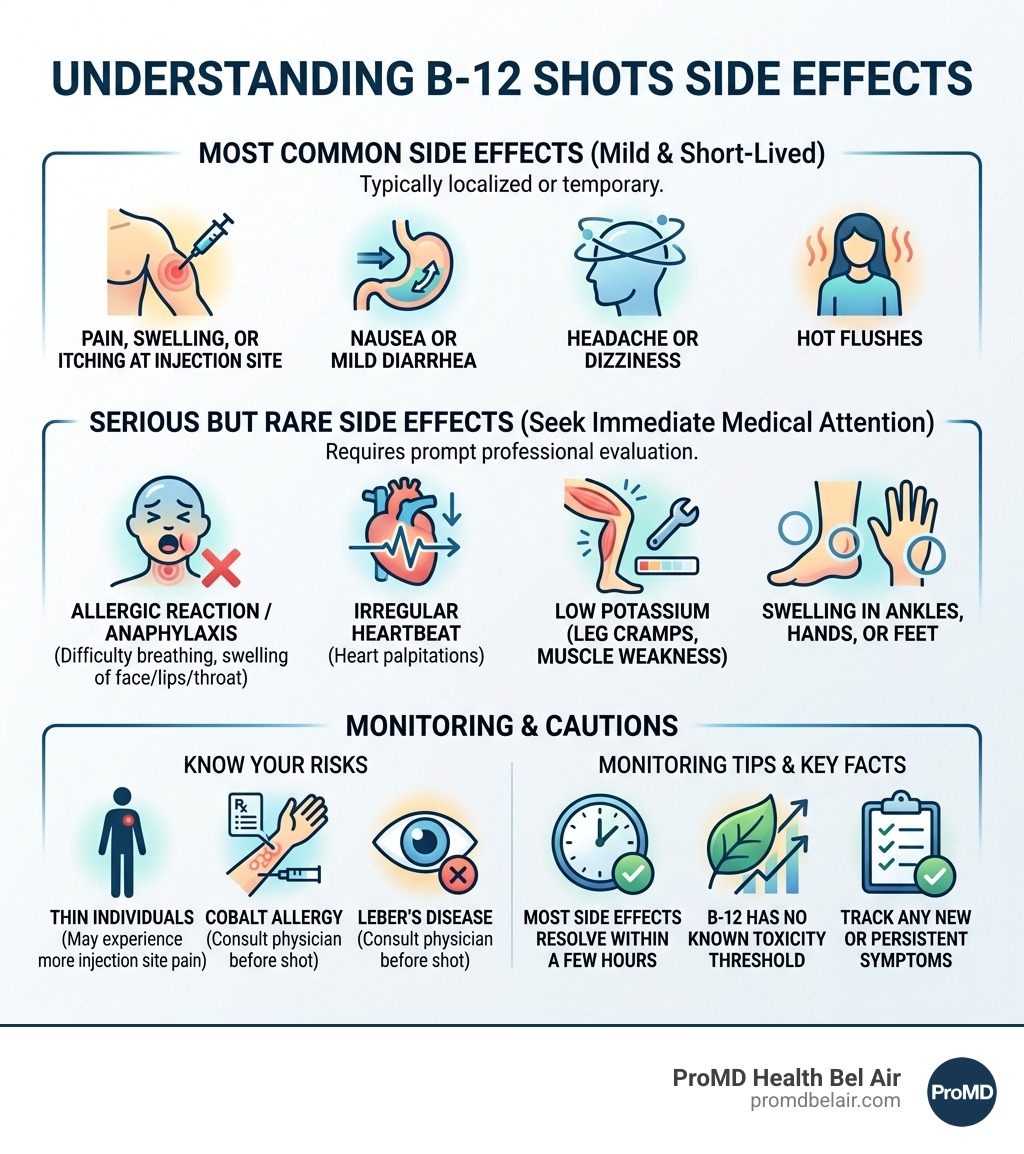
B-12 shots side effects are real — but for most people, they’re mild and short-lived. Here’s what you need to know upfront:
Most common side effects:
- Pain, swelling, or itching at the injection site
- Nausea or mild diarrhea
- Headache or dizziness
- Hot flushes
Serious but rare side effects:
- Allergic reaction or anaphylaxis (difficulty breathing, swelling of the face/lips/throat)
- Irregular heartbeat or heart palpitations
- Low potassium (hypokalemia) — leg cramps, muscle weakness
- Swelling in the ankles, hands, or feet
Who is at higher risk: Thin individuals tend to experience more injection site pain. People with a cobalt allergy or a condition called Leber’s disease should not receive B-12 injections without careful medical screening.
The good news: B-12 has no known toxicity threshold, and serious reactions are uncommon. Most side effects resolve within a few hours.
Getting a B-12 shot is a straightforward wellness treatment — but knowing what to expect before, during, and after makes all the difference. Whether you’re exploring B-12 injections for the first time or already on a regular schedule, understanding the full side effect picture helps you make a confident, informed decision.
I’m Ryan Pittillo, Franchise Owner at ProMD Health Bel Air, and my background in competitive athletics and team-driven health performance has given me a front-row seat to how B-12 shots side effects are discussed — and often misunderstood — in both clinical and wellness settings. Let’s clear up the confusion.
Understanding Common B-12 Shots Side Effects
When we talk about the most frequent Vitamin B12 Side Effects, we are usually looking at localized reactions. Because B-12 injections are typically administered intramuscularly (IM), the most common complaint we hear is significant pain at the injection site. This is particularly true for thinner patients who may have less muscle mass to cushion the needle.
In addition to site pain, you might notice:
- Localized swelling or itching: This is often just a minor inflammatory response to the needle or the solution itself.
- Mild diarrhea: Since B-12 plays a role in cell metabolism and the digestive tract, a sudden influx can occasionally loosen things up temporarily.
- Nausea and Vomiting: Some patients report feeling a bit “queasy” shortly after their appointment.
- Headaches and Dizziness: These are generally mild and resolve as your body adjusts to the dose.
- Hot Flushes: A sudden feeling of warmth or redness in the face and neck.
Most of these symptoms are manageable. For instance, if you experience dizziness, we recommend sitting or lying down immediately and avoiding driving until the feeling passes. For injection site discomfort, a mild painkiller or a cool compress can work wonders. If you want to learn more about how we handle these at our clinic, check out our More info about B-12 treatments page.
Serious Risks and Rare Adverse Reactions
While B-12 is a water-soluble vitamin with a very high safety profile, “rare” does not mean “impossible.” It is vital to monitor for more significant physiological shifts, especially during the first few weeks of treatment.

One serious concern is hypokalemia (low potassium). When B-12 helps your body produce new red blood cells at a rapid pace, it can “use up” your serum potassium. This might manifest as leg cramps, extreme fatigue, or an irregular heartbeat. Other rare but serious conditions linked to B-12 therapy include:
- Polycythemia vera: A condition where the body makes too many red blood cells, which can be triggered by B-12 in those already predisposed.
- Congestive Heart Failure (CHF) and Pulmonary Edema: In very rare cases, the fluid shifts associated with high-dose B-12 can strain the heart or cause fluid buildup in the lungs.
- Optic Nerve Damage: This is a specific risk for those with certain genetic conditions.
According to Scientific research on Cyanocobalamin safety, patients with kidney disease or severe megaloblastic anemia must be monitored closely for these systemic shifts.
Identifying Allergic Reactions to B-12 Shots Side Effects
An allergic reaction to a B-12 shot is rare, but it can be life-threatening. The most severe form, anaphylaxis, usually happens within minutes but can occasionally occur up to three days later.
Symptoms to watch for include:
- Hives or a widespread skin rash.
- Swelling of the face, lips, tongue, or throat.
- Difficulty breathing or wheezing.
- Sudden confusion or fainting.
If these occur, it is an emergency. At ProMD Health Bel Air, our team—including Amanda Pittillo, PA-C, and Lauren Mason, PA-C—prioritizes patient safety by screening for cobalt allergies before we ever pick up a syringe. Because B-12 (cobalamin) contains cobalt, anyone with a known metal sensitivity is at a much higher risk for a reaction.
Contraindications: Who Should Avoid Injections?
There are specific groups of people for whom B-12 shots are not just a “maybe,” but a “no.”
- Leber’s Disease: This is a hereditary optic nerve atrophy. If someone with Leber’s takes B-12, it can cause rapid, irreversible blindness.
- Cobalt Sensitivity: As mentioned, this is a hard contraindication for cyanocobalamin and hydroxocobalamin.
- Severe Kidney Disease: The kidneys are responsible for processing and excreting excess vitamins; impaired function requires adjusted dosing and extreme caution.
In these cases, we work as part of an interprofessional healthcare team to find safer alternatives, such as high-dose oral supplements, which have a lower risk of triggering systemic allergic responses.
Cyanocobalamin vs. Hydroxocobalamin: Comparing Profiles
Not all B-12 is created equal. In the United States, Cyanocobalamin is the most common synthetic form. It’s highly stable and cost-effective. However, in other regions and some specialized clinics, Hydroxocobalamin is used.
While both treat deficiency effectively, their side effect profiles differ slightly. Hydroxocobalamin is actually more “allergenic” than cyanocobalamin, meaning it’s more likely to cause a skin rash or itching, but it also stays in the body longer, requiring fewer injections over time.
| Feature | Cyanocobalamin | Hydroxocobalamin |
|---|---|---|
| Source | Synthetic | Natural bacterial |
| Allergy Risk | Lower | Slightly Higher |
| Persistence | Shorter (Excreted faster) | Longer (Stays in blood longer) |
| Common Use | Standard US deficiency | Cyanide poisoning/UK standard |
Long-Term B-12 Shots Side Effects and Monitoring
For many of our patients in Bel Air and Forest Hill, B-12 is a long-term commitment, especially for those with pernicious anemia. Prolonged use requires consistent monitoring to ensure the “good” stays good.
We recommend regular blood panels to track:
- Serum B-12 and Folate: Taking B-12 can “mask” a folate deficiency, which can lead to neurological damage if not caught.
- Hematocrit and Reticulocyte Count: We want to see your red blood cells normalizing, not over-producing (which leads to polycythemia).
- Potassium and Platelets: Monitoring for hypokalemia and thrombocytosis ensures your heart and blood vessels stay healthy during treatment.
B-12 Injections vs. Oral Supplements: Safety and Efficacy
Why get a shot when you could just take a pill? For many, the answer is “Intrinsic Factor.” This is a protein in your stomach that helps you absorb B-12. If you’ve had gastric bypass surgery, have Crohn’s disease, or have pernicious anemia, your body simply cannot absorb oral B-12 effectively.

However, for those with a simple dietary deficiency (common in vegans), high-dose oral supplements can be quite effective. About 1.2% of oral B-12 is absorbed passively even without intrinsic factor. The downside to oral supplements is compliance—taking a pill every day is harder for some than getting a monthly shot. Additionally, injections bypass the digestive system entirely, which is a major plus for those with malabsorption issues.
If you are interested in a holistic look at your health, you can find More info about wellness services on our main site.
Frequently Asked Questions about B-12 Injection Safety
What should I do if I experience side effects after a B12 shot?
If the side effects are mild, like a headache or site pain, rest and hydration are your best friends. You can use a mild over-the-counter painkiller for the injection site. However, if you experience heart palpitations, dizziness that doesn’t go away, or any swelling in your extremities, contact us or your primary care provider immediately. If you have trouble breathing, call 911.
How do B12 shots compare to oral supplements for high-risk groups?
For high-risk groups—like older adults or those who have had gastrointestinal surgery—shots are generally superior. These groups often lack the ability to absorb B-12 through the gut. Injections ensure 100% bioavailability, meaning the vitamin goes straight into the bloodstream where it’s needed, bypassing the “broken” absorption process in the stomach.
Are there long-term risks associated with frequent B12 injections?
Generally, no. B-12 is water-soluble, and the body is very good at excreting what it doesn’t need. The primary “risk” is simply the ongoing need for monitoring. If you are on lifelong therapy, the biggest risk is actually stopping the shots, which can lead to irreversible nerve damage and severe anemia.
Conclusion
At ProMD Health Bel Air, we believe that wellness shouldn’t be a guessing game. Whether you are coming from Fallston or right here in Bel Air, our goal is to provide B-12 treatments that are as safe as they are effective. By using our AI Simulator, you can even preview how our various aesthetic and wellness treatments might complement your journey toward a more energized, healthier you.
As of May 2026, our protocols remain the gold standard in the Harford County area. Under the expert guidance of Amanda Pittillo, PA-C, and Lauren Mason, PA-C, MSHS, we ensure that every injection is administered with precision and care. Don’t let the fear of B-12 shots side effects keep you from feeling your best—knowledge is the best antidote to anxiety.
Ready to boost your energy and protect your nervous system? We’re here to help you navigate the process safely.