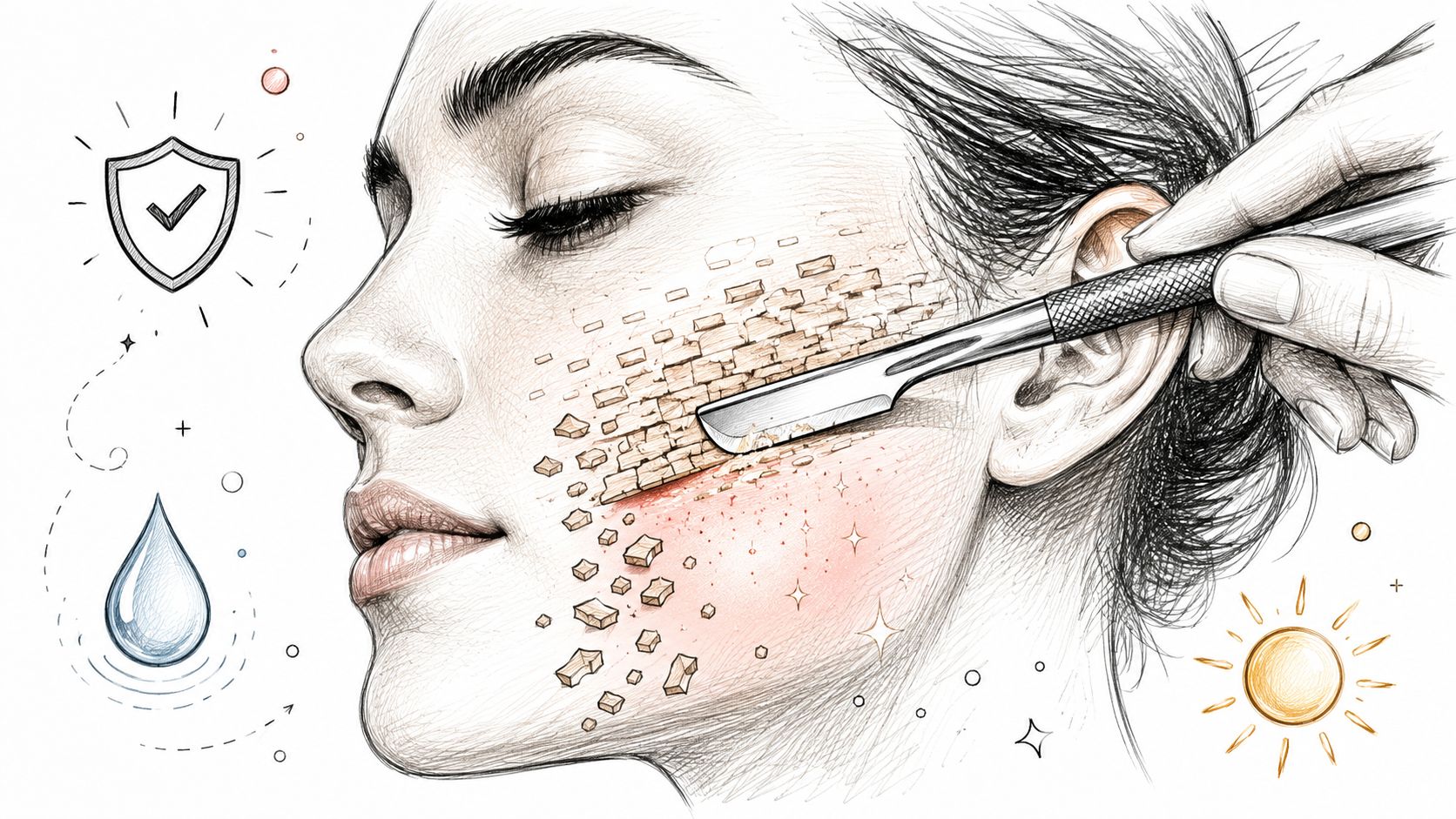
You probably didn't leave a dermaplaning appointment thinking about the glow. You left thinking about the mirror in the car, the pink flush on your cheeks, and whether those tiny bumps or that tight feeling mean something went wrong. That reaction is normal, and it's exactly why dermaplaning side effects deserve a calm, clinical explanation instead of a vague reassurance.
Dermaplaning is a controlled form of mechanical exfoliation. A trained provider uses a sterile blade to remove the outermost layer of dead skin cells and fine vellus hair, which is why the skin can look smoother right away. It also means the surface barrier has been temporarily thinned, so the most common reactions are usually the skin's expected response to that change, not a surprise complication.
What follows is a practical walk-through of what's common, what's less common, and what needs a closer look. You'll see how timing matters, why acne-prone skin can react differently, and how aftercare changes the odds of redness, breakouts, and irritation. If you're deciding whether dermaplaning fits your skin, understanding the mechanism makes the side effects much easier to interpret.
Table of Contents
- What Happens During Dermaplaning and Why Side Effects Occur
- How Dermaplaning Affects the Skin Barrier
- Common Side Effects and How Long They Typically Last
- Less Common but More Serious Complications
- Prevention and Aftercare Steps That Reduce Risk
- Dermaplaning Compared With Microdermabrasion and Chemical Peels
- Having Dermaplaning Safely at ProMD Health Bel Air
What Happens During Dermaplaning and Why Side Effects Occur
A first-time patient often notices the reaction before the result. The skin looks a little pink, the cheeks feel warm, and the brain jumps straight to, “Is that supposed to happen?” In most cases, yes. Those early changes are the body responding to a controlled procedure, not proof that something has gone wrong.

What the blade is actually doing
During dermaplaning, a clinician uses a sterile blade to skim the surface of the skin with light, controlled strokes. The goal is to remove the dull outer layer and the fine facial hair that can make makeup sit unevenly. Because the procedure is mechanical rather than chemical, the skin doesn't get “burned” in the way some people imagine.
That doesn't mean the skin stays untouched. Removing the top layer changes the way the surface handles friction, moisture, and environmental exposure. The immediate result can be redness, tingling, soreness, or dryness, which are predictable responses to a freshly exfoliated surface. Cleveland Clinic lists infection, scarring, and skin discoloration as recognized complications, while Johns Hopkins notes that some skin can look scraped for several days and stay sensitive and bright pink for about 3 months after the procedure Cleveland Clinic dermaplaning guidance.
The skin often looks calm in the treatment room, then becomes more reactive once you're home and the numbing effect of the moment wears off.
Why the side effects line up with the procedure
The reactions that show up after dermaplaning usually follow a simple pattern. The more the surface barrier is thinned, the more the skin can feel exposed to air, cleanser, sweat, sunlight, or products that never bothered it before. That's why the list of dermaplaning side effects tends to sound so familiar across medical guidance, temporary redness, swelling, soreness, burning, tingling, dryness, and breakouts WebMD dermaplaning overview.
This is also why readers get confused. A mild flush can be ordinary, but a worsening rash is a different story. A whitehead a day later can happen, but pus, spreading pain, or fever should never be brushed off. The sections below separate those outcomes so you can judge your own recovery without guessing.
How Dermaplaning Affects the Skin Barrier
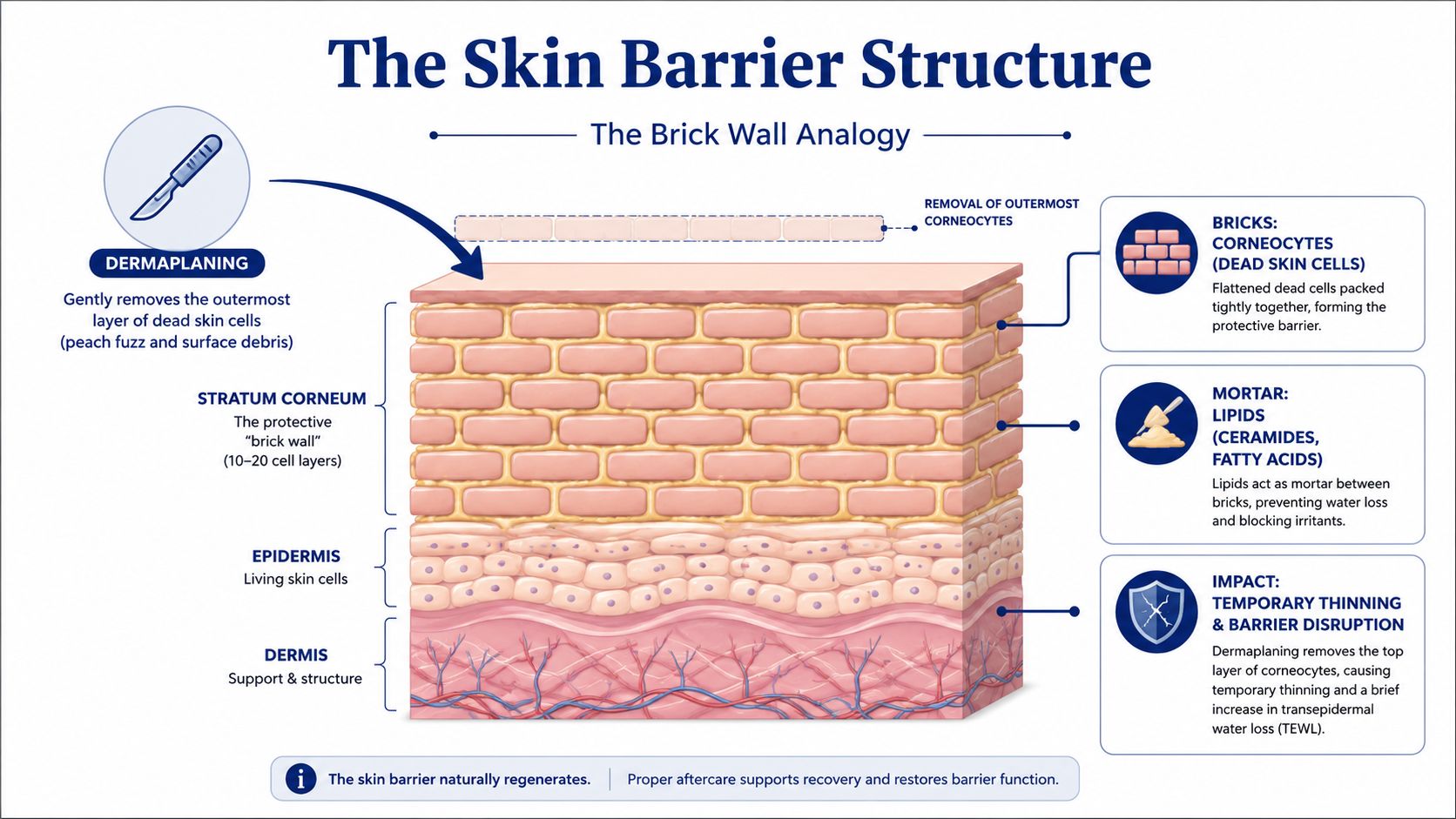
The easiest way to understand dermaplaning is to picture the outer skin as a brick wall. The corneocytes are the bricks, the lipids are the mortar, and the stratum corneum is the top protective layer that holds the structure together. Dermaplaning removes part of that outer layer, so the wall is still standing, but it is temporarily thinner and more permeable.
Why a thinner barrier feels different
That outer layer does more than make skin look smooth. It helps the skin retain moisture, defend against microbes, and buffer against sun exposure. When dermaplaning removes part of it, the skin can become more vulnerable to irritation, dehydration, and sunlight sensitivity for a short period Patient.info on dermaplaning safety.
That is why the face can feel tight or sting after a treatment that seemed gentle in the room. The surface has less padding between the outside world and the living skin below, so ordinary triggers can feel louder for a while. For many people, the reaction fades in hours or a few days, but the mechanism is the same each time. Remove part of the barrier, and the skin temporarily reacts as if it has less protection, because it does.
What the blade does
The blade does not reach deep skin layers. It skims away dead surface cells and fine facial hair from the outermost layer, which is why the skin can look brighter and feel smoother right away. That same surface change also explains why the skin may sting when a moisturizer is applied, or why a cleanser that usually feels mild suddenly feels sharp.
This is a barrier issue, not a mystery reaction. The outer layer acts like a buffer, and dermaplaning reduces that buffer before the skin has had time to rebuild it. The result can be transient redness, dryness, or sensitivity, especially if the skin was already dry, irritated, or overexfoliated before the appointment.
What that means for aftercare
Barrier repair matters more than fancy products. A simple routine gives the skin room to recover while it rebuilds its normal defenses. If you want a practical shopping reference for gentle, routine-based items, ProMD's skincare products guide can help you choose products that fit that calmer post-treatment window.
For readers comparing resurfacing options, it also helps to see how a stronger procedure affects the skin. A clear resource on understanding Fraxel CO2 for pharmacies shows how much more intense some treatments are when the barrier is intentionally disrupted. Dermaplaning is milder, but it still deserves respect because the same basic rule applies, if you disturb the barrier, the skin needs time, moisture, and sun protection to settle.
Common Side Effects and How Long They Typically Last
Instead of one dramatic reaction, you might experience a few small ones simultaneously. A little pinkness, a warm feeling, and a brief sting from moisturizer are all part of the same short recovery window. The important question isn't whether your skin feels different, it's whether the change is mild, improving, and staying within the expected time frame.
What usually shows up first
Redness is usually the earliest and most visible reaction. Health guidance notes that it can appear in the hours after dermaplaning, which makes sense because the skin has just had its outer shield removed and is temporarily more exposed Healthline on dermaplaning side effects. Swelling can travel with that flush, especially around the cheeks or jawline, but it's usually light rather than dramatic.
Burning or tingling can also appear in the same window, and WebMD says those sensations can last about 48 hours after treatment WebMD dermaplaning guidance. Dryness and tightness are common too, because the barrier isn't holding moisture quite as efficiently right away Patient.info on dermaplaning safety. These reactions are annoying, but they usually improve as the skin settles.
What can happen a day or two later
Some people are surprised when the skin looks fine at first, then develops whiteheads or breakouts in the day or two after treatment Healthline on dermaplaning side effects. That delayed timing happens because dermaplaning can disturb surface debris and shift bacteria around the skin, especially in acne-prone areas Healthline on dermaplaning regret. Cleveland Clinic's at-home guidance also warns that the procedure can increase susceptibility to bacteria and trigger more acne in acne-prone skin Cleveland Clinic dermaplaning guidance.
Mild pinkness and faint tightness are green flags. Increasing pain, spreading rash, pus, or fever are not.
| Side Effect | Typical Onset | Usual Duration | Expected or Concern? |
|---|---|---|---|
| Redness | Hours after treatment | Hours to a few days | Expected |
| Swelling | Hours after treatment | Usually short-lived | Expected if mild |
| Soreness | Right away or after the numbing feeling fades | Usually brief | Expected if improving |
| Burning or tingling | Right away to the first day | About 48 hours | Expected if mild |
| Dryness or tightness | First day | A few days | Expected |
| Whiteheads or breakouts | Day or two after treatment | Varies | Expected if limited and settling |
Less Common but More Serious Complications
The side effects that worry people most are usually not the common ones, they're the uncommon ones. That's understandable. A blade is involved, so patients naturally think about cuts, infection, and scars. Those outcomes are less likely in a medical setting, but they're real enough that they should be named plainly.
What rare complications can look like
Cleveland Clinic lists infection, scarring, and skin discoloration as recognized complications of dermaplaning Cleveland Clinic dermaplaning guidance. Healthline also notes that more serious complications can include small cuts, infection, and scarring, with risk reduced when a trained professional uses proper hygiene and technique Healthline on dermaplaning regret. That's the key clinical difference. The procedure itself isn't harmless, but technique matters a great deal.
Johns Hopkins' longer recovery description is useful here because it pushes back against the idea that dermaplaning is always zero-downtime. If the skin looks scraped for several days or stays bright pink and sensitive for a long stretch, that's not the usual short-lived flush people expect after a facial treatment Cleveland Clinic dermaplaning guidance.
Who is more likely to have trouble
Risk rises when the skin is already reactive or compromised. Patients with active acne, eczema, rosacea, or dermatitis can flare more easily because their barrier is already stressed. People using isotretinoin or blood thinners, those with a history of keloids, and anyone trying to dermaplane at home with non-sterile tools also face a less forgiving setup. The problem isn't just the blade. It's the blade plus the skin condition plus the environment.
Practical rule: the same treatment can be routine on one face and risky on another. Skin type, current inflammation, and the person performing the procedure all change the odds.
The useful takeaway is simple. Serious complications are uncommon, but they're not random. They cluster around active inflammation, poor hygiene, and inexpert technique, which is why a trained professional in a medical setting lowers the risk so much more than an improvised at-home version.
Prevention and Aftercare Steps That Reduce Risk
Good aftercare doesn't just make the skin feel calmer, it changes the recovery timeline. A face that's treated gently before and after dermaplaning is less likely to become stingy, breakout-prone, or persistently red. The rules are simple, but they work best when you follow them consistently.
Before the appointment
Arrive with clean skin, no makeup, and no heavy residue from other products. If you use retinoids or strong exfoliants, pause them ahead of time so the surface isn't already irritated before the blade touches it. If you have active breakouts, cold sores, eczema patches, or a new rash, tell the provider before they start. That lets them decide whether dermaplaning is appropriate that day.
One of the most useful questions is whether the clinic uses a sterile, single-use blade. That detail matters because hygiene is part of the risk reduction, not an extra. A careful pre-treatment review also helps the provider decide whether your skin is in a good state for mechanical exfoliation or whether it needs a different approach first.
The first 24 to 48 hours
For the rest of the day, keep the routine basic. Use a gentle cleanser, skip exfoliation, and avoid active ingredients like acids or retinoids. Don't put on makeup if your skin is still warm or reactive, and avoid workouts that create heavy sweat. That short pause lowers the chance of extra irritation and helps the barrier close back up.
For readers who like to plan product choices ahead of time, a useful reference is ProMD's chemical peel recovery time. The recovery details aren't identical, but the shared lesson is the same, freshly exfoliated skin needs simplicity, not experimentation.
The next two weeks
Focus on barrier repair. A ceramide-rich moisturizer helps replace what the skin is trying to rebuild, and mineral sunscreen should be part of the daytime routine because sunlight sensitivity is one of the most reliable short-term vulnerabilities after dermaplaning Patient.info on dermaplaning safety. Reapply sunscreen during the day if you're outside, and avoid direct sun, saunas, hot yoga, and other heat-heavy exposures while the skin is still settling.
For people who want a broader look at supportive nutrition, the skin healing vitamins guide can help frame the conversation around overall skin support, though topical care still does most of the work after dermaplaning.
Avoid for at least a few days after treatment
- Retinoids and strong acids because they can sting a freshly treated barrier.
- Physical exfoliants because extra friction can prolong redness.
- Heavy sweat sessions because sweat and heat can aggravate sensitivity.
- Direct sun exposure because the skin is more vulnerable to UV.
- Saunas and hot yoga because heat can intensify flushing.
Dermaplaning Compared With Microdermabrasion and Chemical Peels
Patients often want to know whether dermaplaning is gentler than the other exfoliation options they've heard about. The honest answer is that it's different, not automatically better. It has its own risk profile, and that profile makes sense once you compare the mechanism, the depth of exfoliation, and the kind of side effects each treatment tends to create.
The practical differences
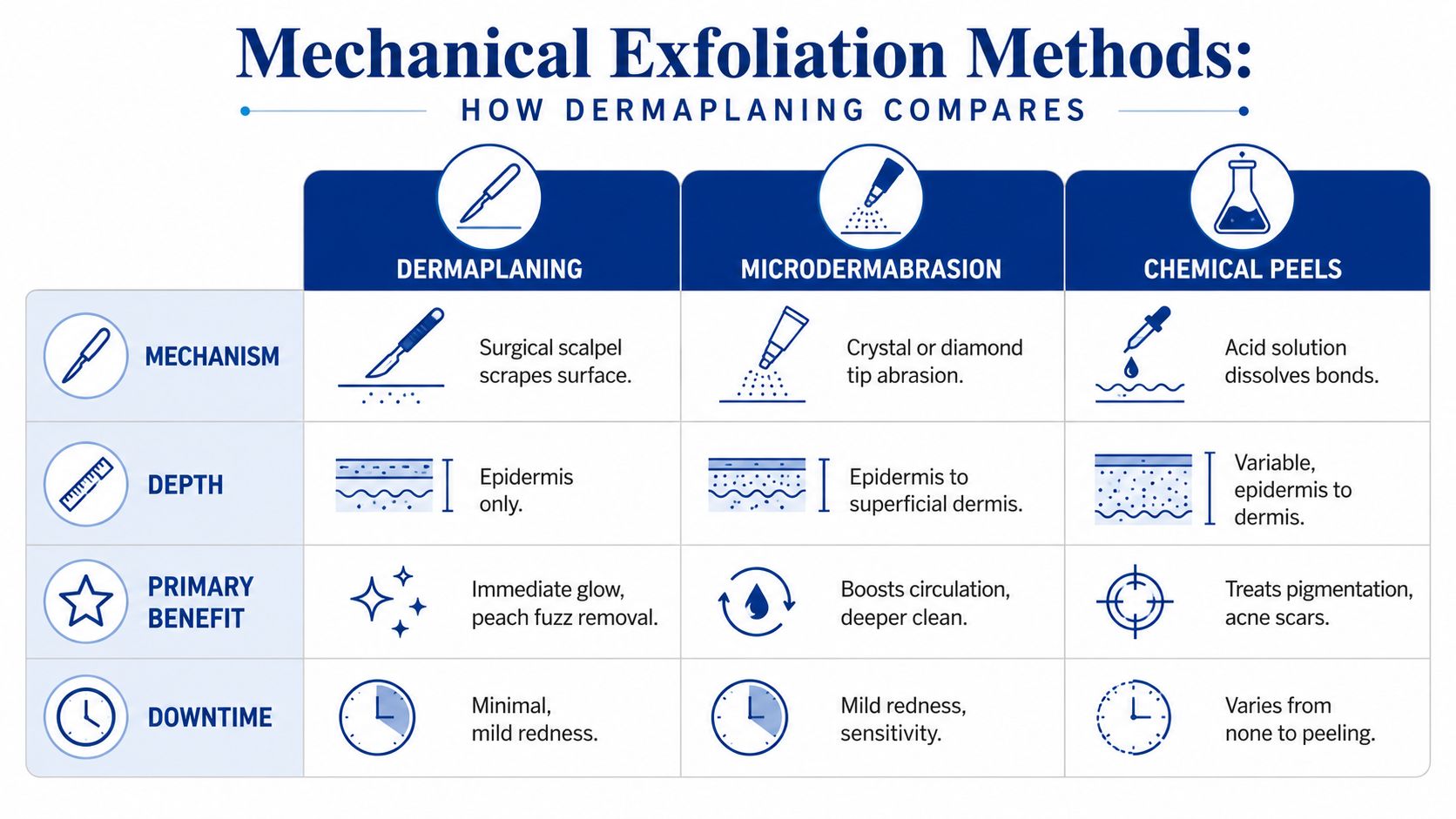
Dermaplaning uses a sharp blade to scrape the surface. Microdermabrasion, which is offered by ProMD Health, uses abrasive action rather than a blade, and chemical peels use acids to loosen the bonds between skin cells. That means dermaplaning introduces a small risk of nicks, while peels carry a different concern, chemical irritation or burn if the depth or skin tolerance is misjudged. Microdermabrasion has its own irritation profile, but it doesn't involve an exposed blade.
Dermaplaning also tends to stay at the surface. Chemical peels can reach deeper depending on the formulation, and that's why downtime varies more widely. For many people with sensitive skin who don't want acids or suction, dermaplaning feels more predictable.
Side effect comparison
| Treatment | Typical Downtime | Most Common Side Effects | Best For |
|---|---|---|---|
| Dermaplaning | Minimal, usually short-lived | Redness, tingling, dryness, occasional breakouts | Patients who want surface smoothing and peach fuzz removal |
| Microdermabrasion | Usually mild, but variable | Redness, sensitivity, dryness | Patients who want mechanical exfoliation without a blade |
| Chemical Peels | Ranges from none to visible peeling | Stinging, flaking, redness, sensitivity | Patients targeting tone, discoloration, or acne concerns |
The aftercare overlap is large. All three methods benefit from gentle products, sunscreen, and a pause on active ingredients for several days. If you're considering the mechanical route, ProMD's microdermabrasion page is a useful comparison point because it helps you think about your tolerance for suction versus a blade. The right choice depends less on trend and more on your skin's current state.
Having Dermaplaning Safely at ProMD Health Bel Air
A safe dermaplaning visit starts before the blade ever touches the skin. At ProMD Health Bel Air, the process begins at the 2023 Emmorton Rd., Suite A office with a consultation, a review of your skin history, and a discussion of whether dermaplaning makes sense for your face that day. The clinic also offers virtual consultations for patients who want to talk through candidacy before scheduling in person.
During the visit, a trained team member reviews your concerns, looks at any active breakouts or sensitivity, and performs the treatment with medical oversight. That matters because the biggest difference between a smooth recovery and an irritated one is often not the treatment itself, it's how well the skin is selected, prepped, and monitored. If you're trying to visualize a possible result before booking, the Entity Med AI Simulator can help preview outcomes in a way that supports the decision.
Call the clinic sooner rather than later if redness keeps spreading, pain increases, pus or yellow crusting appears, hives develop, fever shows up, or the reaction gets worse after 72 hours instead of improving.
Local access matters too. ProMD Health serves Bel Air, Fallston, Forest Hill, Abingdon, and Havre de Grace, so follow-up care doesn't have to mean a long drive if your skin needs a second look. That proximity can be reassuring if you're someone who wants a clinician to evaluate whether a reaction is routine recovery or something that needs treatment.
The main takeaway is straightforward. Dermaplaning side effects are usually predictable, manageable, and far less disruptive when the procedure is performed in a medical setting by a trained provider. That's the kind of setting designed to catch problems early, calm normal irritation, and help you decide whether dermaplaning is the right exfoliation choice for your skin.
If you're considering dermaplaning and want a medically supervised approach, ProMD Health Bel Air can help you sort out whether your skin is a good candidate and what aftercare will matter most. Visit ProMD Health Bel Air to explore dermaplaning, book a consultation, or ask about what to expect before your first treatment.