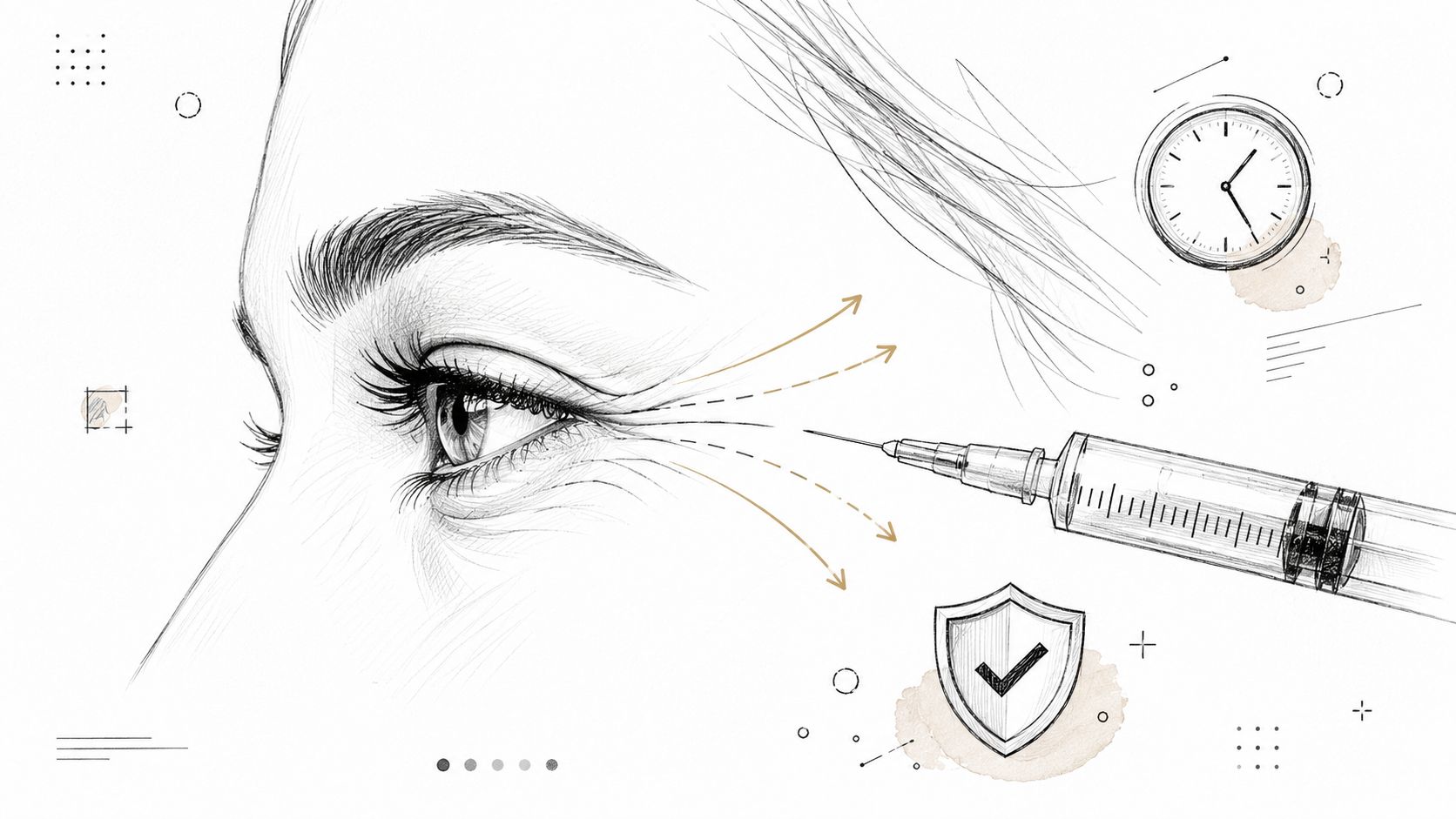
You've probably noticed the same thing in the mirror for a while now. The lines at the corners of your eyes show up when you smile, then linger a little longer than they used to. If you're thinking about Botox for crow's feet, the question usually isn't whether the treatment exists, it's whether it can soften those lines without making your face look stiff, overdone, or unlike you.
The honest answer is that Botox can be excellent for dynamic crow's feet, the lines that appear with expression. It's less satisfying for older, etched-in lines that stay visible at rest, because Botox works by calming muscle movement, not by filling creases. That difference matters, and it's what separates a realistic result from a disappointing one.
Table of Contents
- What Crow's Feet Are and Why They Show Up
- How Botox and Dysport Work on the Eye Area
- Choosing Between Botox and Dysport for Crow's Feet
- Your Consultation and Treatment Visit in Bel Air
- Results Timeline and Aftercare Essentials
- Safety, Side Effects, and Who Should Skip Treatment
- When Crow's Feet Need More Than Botox
- Cost, FAQs, and Booking in Bel Air
What Crow's Feet Are and Why They Show Up
A patient will often point to the same spot with both hands, right where the outer corners of the eyes crease during a real smile. That area is the lateral canthal region, and the lines there are what we call crow's feet. They're usually caused by repeated movement of the orbicularis oculi, the thin muscle that helps you squint, smile, and soften light around the eyes.
Dynamic lines versus lines that stay at rest
Some crow's feet only appear when your face is active. Others are still visible when your expression is neutral, which is where people often start saying, “These lines don't go away anymore.” That's the point where the discussion shifts from simple softening to realistic expectations.
Dynamic crow's feet are expression lines, so they tend to respond well to neurotoxin treatment. Static crow's feet are etched-in lines, so they may improve, but they usually don't vanish with Botox alone. Many patients have a mix of both.
| Feature | Dynamic Crow's Feet | Static Crow's Feet |
|---|---|---|
| When they show | With smiling, squinting, or laughing | Even when the face is relaxed |
| Main driver | Muscle contraction | Repeated folding plus skin change |
| Best response to Botox | Usually strong | Often partial |
| Treatment goal | Soften expression lines | Reduce movement, then consider other support |
Practical rule: if the line appears only when you smile, Botox has a better chance of giving you the result you want.
Why the same wrinkle behaves differently over time
Crow's feet aren't just a sign of age, they're a record of movement. Over time, repeated folding can make a line easier to see even when the muscle is quiet. That's why a first-time patient who still has mostly dynamic lines may see a bigger payoff than someone with long-standing etched creases.
The most useful question at consultation is simple. Do the lines disappear when you relax your face, or do they stay? That answer helps guide whether toxin alone is enough, or whether you're better served by a layered plan.
How Botox and Dysport Work on the Eye Area
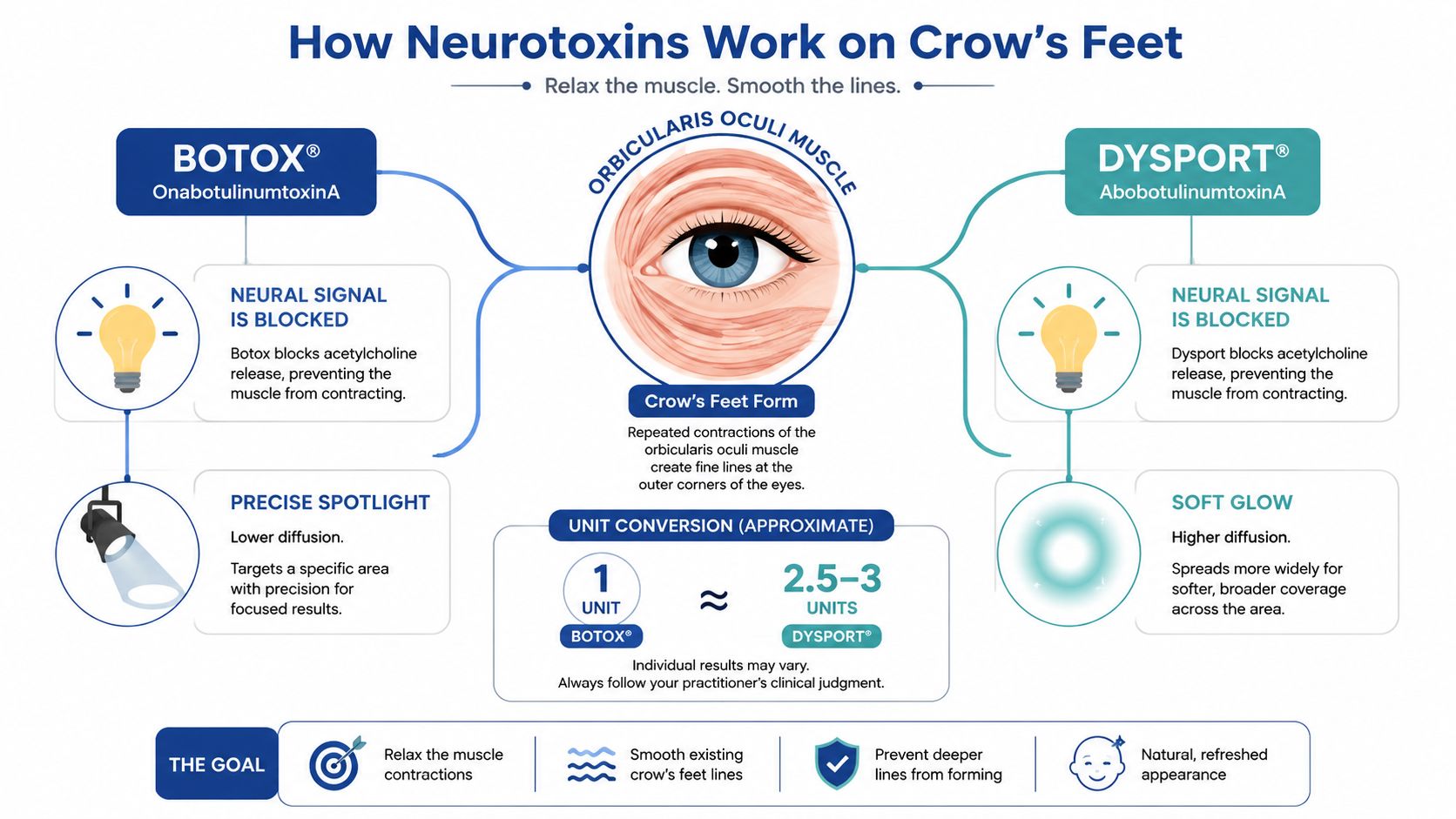
When the nerve signal reaches the orbicularis oculi, the muscle contracts and the skin at the outer eye folds. OnabotulinumtoxinA, the active ingredient in Botox Cosmetic, temporarily blocks acetylcholine release at the neuromuscular junction, which creates a short-lived chemical denervation and reduces that contraction (PMC review). The same basic principle applies to Dysport, since both products are neurotoxins used to quiet the small muscles that crease the skin around the eyes.
Crow's feet are not all the same problem. Dynamic lines appear with smiling, squinting, or laughing, and they usually soften well when muscle movement is reduced. Static lines stay visible at rest, which means toxin can reduce the folding that keeps deepening them, but older etched-in lines often need more than toxin alone to disappear.
Why placement matters as much as product
The eye area is technically delicate. Expert guidance places injections superficially, about 1 cm from the lateral orbital rim, and spreads them across 3 small sites per side so the toxin stays where it's meant to work (technical guidance). That spacing helps soften the lines without interfering with eyelid function or drifting into nearby muscles.
For patients who want to preview a realistic result before treatment, the Entity Med AI Simulator can help set expectations by showing how softer movement may look without promising a full erasure of older creases. It is useful because the best result around the eyes usually comes from matching the plan to the wrinkle type, not from assuming every line will behave the same way.
More toxin is not automatically better. The eye area responds to precision, not flooding.
What that feels like in practice
The goal is not to stop smiling. It is to quiet the muscle just enough that the skin does not bunch as sharply. When the injection pattern is correct, patients usually keep their natural expression, with less creasing at the outer eye.
A helpful detail for first-timers is that the regimen is unit-based, not guesswork-based. That is why a consultation matters so much, and why a careful plan at ProMD Health Bel Air's Botox and Dysport page can help match dose and placement to whether the lines are mostly dynamic, mostly static, or a mix of both.
Choosing Between Botox and Dysport for Crow's Feet
Botox and Dysport are close cousins, not opposites. Both are used for upper facial lines, both are neurotoxins, and both can soften crow's feet when they're placed correctly. The difference is usually in how a provider thinks about spread, feel, and dosing style.
What patients usually notice
Botox is often chosen when the injector wants very precise control in a compact area. Dysport is often discussed when a provider wants a slightly different diffusion pattern. In day-to-day patient language, that can translate to subtle differences in how the area relaxes, but it doesn't make one universally superior.
A practical conversion point often used in education is that 1 unit of Botox is roughly equivalent to 2.5 to 3 units of Dysport. That's not a patient-to-patient rule, it's a planning concept, which is why the injector's experience matters more than the brand name alone.
How to think about the choice
If your crow's feet are small and concentrated, a tighter dosing pattern may make sense. If the lines fan more broadly, your injector may think differently about placement. Either way, the key question is whether the provider understands your face and your goal.
The strongest decision-making framework is simple.
- Ask about the target pattern: Some faces need a narrow, focused approach, while others need a wider softening pattern.
- Ask about your expression style: Heavy squinting, strong cheek lift, and broad smiles can change how the product behaves in the eye area.
- Ask what natural means to you: Some people want a barely-there softening, others want a clearer reduction in line depth.

If you want a simple patient-facing overview of both options at the same practice, this Botox and Dysport treatment page is a useful place to start.
Your Consultation and Treatment Visit in Bel Air
The best first appointment feels more like a calm assessment than a sales pitch. You sit down, the provider looks at how your face moves, and you discuss openly what bothers you when you smile. If your crow's feet are mostly dynamic, the conversation may stay focused on neurotoxin alone. If they're partly static, the plan may become more layered.
What happens before the injections
At consultation, the provider should look at your resting face and your expressive face. That matters because the treatment plan changes depending on whether the lines disappear when you relax. This is also the point where an AI preview can be useful, because a realistic visual helps set expectations before anyone commits to treatment.
At ProMD Health Bel Air, the Entity Med AI Simulator is used as a preview tool during the planning process. It doesn't replace medical judgment, but it can help you see the kind of softening that may be realistic before you move forward.
What the appointment itself feels like
The injection visit is usually brief. The provider cleans the area, marks the small points of entry, and places tiny amounts of product at a few precise sites on each side. Most patients describe the sensation as quick and sharp rather than painful.
You don't need to “prepare” your face beyond showing up with realistic goals and a list of any medications or health concerns. The useful questions are straightforward.
- What result is realistic for my wrinkle pattern?
- How much movement will I still have?
- How should I plan around an event or photo date?
- What should I do if one side usually squints harder than the other?
The visit should end with clear aftercare, a timeline for follow-up, and a sense of how the result will unfold rather than a promise of instant perfection.
Results Timeline and Aftercare Essentials
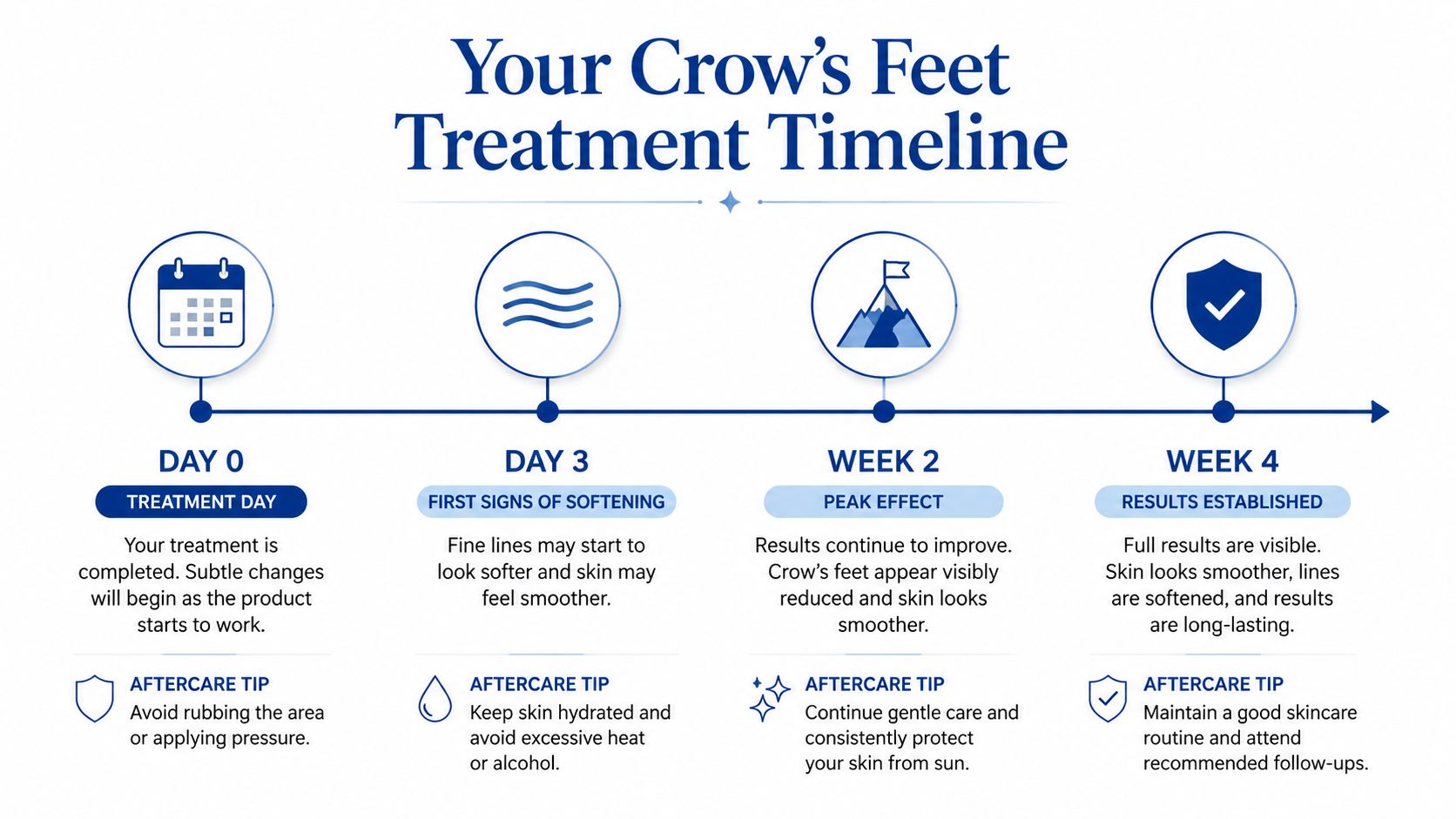
The timeline matters because Botox for crow's feet does not change the eye area all at once. A review source notes that smoothing often starts in about three days, another says the effect often peaks by day 7 to 14, and a separate source says visible results can appear within one week (timeline summary). Early softening comes first, then the result settles as the muscle relaxes.
What to expect over the first month
The first week is usually when patients notice the earliest shift, especially if the crow's feet are mostly dynamic, meaning they show up with smiling or squinting. By two weeks, the result is easier to judge because the treated muscles have had time to quiet down. Older static lines, the ones that stay etched in even at rest, may soften but often do not disappear completely with toxin alone.
That difference matters for expectations. Dynamic lines are like a crease in fabric that forms when you fold it, while static lines are more like a fold that has been pressed in over time. Botox can relax the folding motion, but it cannot fully erase skin texture that has already been set into place. That is why some patients see a smoother look right away, while others notice only partial improvement in lines that were already very visible at rest.
The benefit can persist for about 4 months in key evidence and may remain visible through 6 months in some clinical and postmarketing data (pivotal evidence and pooled safety review, pooled safety review). Duration varies with muscle strength, dose, and how expressive the area is day to day.
Practical aftercare steps
The first few hours matter more than people think. Keep the area calm, avoid rubbing, and stay upright for a bit so the product stays where it was placed. If you are trying to picture the result before committing, an AI preview can help set a realistic expectation for how much softening is likely, especially when some of the lines are already etched in.
- Avoid pressure: Do not massage or lean hard on the treated area right after injection.
- Keep movement normal but gentle: Light daily activity is fine, but the first stretch of time should stay low-key.
- Sleep thoughtfully: If you are worried about pressure on the area, sleep in a way that does not compress the outer eyes.
- Watch the mirror, not the minute: Results change over days, not minutes.
The first day is about protecting placement. The following week is about letting the muscle quiet down naturally.
If you are planning treatment around an event or photos, count backward from the two-week mark rather than the day of injection. That gives the treatment time to settle, and it also gives you a better read on whether the remaining lines are dynamic or partly static.
Safety, Side Effects, and Who Should Skip Treatment
Crow's-feet Botox has been studied carefully, so the safety profile is familiar rather than guesswork. A pooled meta-analysis of people treated for upper facial lines found that onabotulinumtoxinA stayed within the product label, without new safety signals in the combined data. That is reassuring, but it does not mean side effects never occur.
The first thing to understand is that the eye area has two different kinds of lines. Dynamic lines show up with smiling or squinting, while etched-in static lines can remain visible even when the face is relaxed. Botox is designed for the movement piece, so the treatment can soften expression lines without completely erasing older creases that are already set into the skin.
Common reactions and rarer problems
The usual reactions are local and short-lived, such as pinpoint redness, mild swelling, tenderness, or a little bruising. Those changes generally settle on their own, and they are the sort of temporary effects a first-time patient should expect to discuss before treatment.
Rarer problems usually happen when product spreads into nearby muscles. That can look like eyelid heaviness, temporary asymmetry, or a subtle change in smile balance if the injection diffuses beyond the intended area. The same pooled review found that treatment-related adverse events were generally mild to moderate and mostly local, injection-associated reactions.
If you want a better sense of what is realistic around the eye area before committing, the under-eye filler safety and results article is a helpful companion, because it shows how different treatments handle different kinds of lines and shadowing.
Who should wait or skip treatment
Some people should pause treatment on the day they ask. Pregnancy, an active infection at the injection site, and certain neuromuscular conditions are common reasons to wait or avoid treatment altogether. A careful provider will also review medications and health history, because those details matter just as much as the wrinkle pattern.
The safest approach is simple. If anything about your health or your eye area feels unusual, say so before the injection. That gives the provider room to decide whether to proceed, delay, or choose a different plan.
When Crow's Feet Need More Than Botox
Botox does one job very well, it relaxes muscle-driven movement. It does not fill skin, rebuild collagen overnight, or erase deep creases that are already present at rest. That's why some people are happy with toxin alone, while others need a combined plan.
Dynamic lines versus etched-in lines
Dynamic lines are the ones that show up when you smile. Static lines are the ones you still see when your face is still. If you're dealing with both, toxin can reduce the movement piece, but another service may be needed for the texture or depth that remains.
That's where the broader treatment menu becomes useful. Dermal fillers can support deeper static lines in selected cases, microneedling can help texture, lasers can help tone and crepey skin, and medical-grade skincare can support maintenance between visits. None of those replaces the muscle-relaxing effect of Botox, but they can address the parts Botox can't reach on its own.
If you want to read more about how under-eye volume work can interact with the eye area, this filler safety and results article is a helpful companion piece.
How a thoughtful plan gets built
The important part is not chasing every line. It's matching the treatment to the problem. A wrinkle that disappears when your face is relaxed is a different problem from a crease that stays put.
Simple rule: if movement creates the line, neurotoxin is usually the first conversation. If the line is already etched, you may need more than toxin.
ProMD Health Bel Air offers several of the services that can be layered when crow's feet aren't purely dynamic, including Botox, Dermal Fillers, Microneedling, Lasers, and Skincare. The right combination depends on what's showing up around your eyes.
Cost, FAQs, and Booking in Bel Air
Crow's-feet Botox pricing depends on how many units your face needs, how the practice structures treatment fees, and whether the eye area is the only concern or part of a broader plan. One promotional page from ProMD Health Bel Air notes a Botox special that includes crow's feet with 20 units for $169. For patients who want a fuller look at the current offer and booking details, the Bel Air Botox page is the place to start. The central question is not the sticker price alone, it is whether the dose and placement fit the pattern of movement lines and any older etched-in creases that may still remain.
Quick FAQs
Will it look natural?
It should. The goal is softer motion around the eyes, not a stiff or overcorrected look.
How often do I need it?
Many people repeat treatment every few months, because the muscle gradually regains activity over time.
Do results improve with maintenance treatments?
Maintenance can help keep the lines from forming again, especially when your crow's feet are mostly dynamic. If some lines are already set into the skin, repeated toxin can soften the movement that deepens them, but it may not erase the crease completely.
What if I smile a lot?
That is fine. A good treatment plan should fit your expression style instead of trying to flatten it.
For patients in Bel Air, Fallston, Forest Hill, Abingdon, and Havre de Grace, the most useful next step is a consultation at ProMD Health Bel Air, 2023 Emmorton Rd, Suite A. A careful visit can separate the lines that appear only with movement from the lines that stay visible at rest, which helps set realistic expectations before treatment.