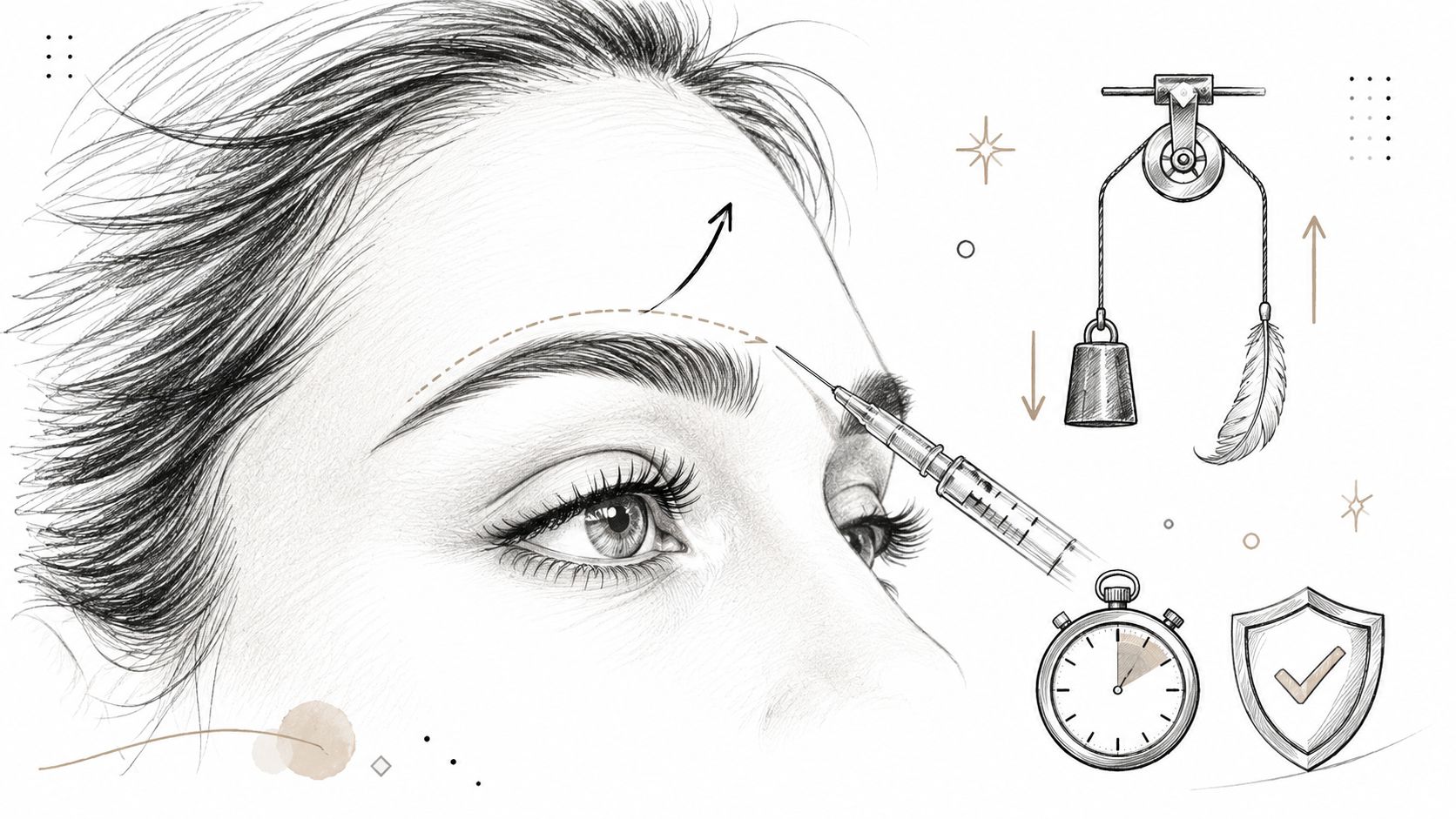
1 to 3 mm is the right expectation for a Botox brow lift, and the result usually lasts 3 to 6 months. That means it's a subtle, temporary technique, not a surgical replacement, and the change is usually most noticeable at the outer brow tail.
A lot of people notice the issue first in the bathroom mirror. The outer brow looks lower, eye makeup starts disappearing into the crease, and the upper face can feel heavier even when the rest of the face still looks rested. That's exactly where the botox brow lift technique fits, because it's built to open the eye area a little, not remake the whole forehead.
Table of Contents
- What a Botox Brow Lift Actually Does for the Upper Face
- How the Technique Works on the Brow Muscles
- Realistic Results and What the Numbers Mean for You
- Your Consultation, Treatment Day, and Preview Options
- Comparing Botox Brow Lift with Fillers and Thread Lifts
- Aftercare, Recovery Timeline, and When Results Show Up
- Risks, Side Effects, and Who Should Skip the Treatment
- Frequently Asked Questions About the Botox Brow Lift
What a Botox Brow Lift Actually Does for the Upper Face
A woman in her 40s often comes in saying the same thing in a slightly different way. Her brows used to look balanced, but now the outer third sits lower, her eyeshadow vanishes into the lid crease by noon, and she keeps lifting her forehead just to look awake. That's the point where the conversation shifts from “Can Botox help?” to “What kind of lift can Botox realistically create?”
A Botox brow lift does not pull the brow up like surgery does. It relaxes the muscles that are tugging the brow downward, so the muscles that lift the forehead can work with less resistance. In the right face, that creates a cleaner upper lid frame and a more open look, especially through the tail of the brow, which tends to show the most change.
What patients usually mean when they ask for a brow lift
A dramatic arch isn't the typical request. The goal is for the eyes to look a little less tired, the outer brow to sit a bit higher, and the upper face to appear more balanced in photos and in the mirror. That's why this treatment is best thought of as a maintenance-based aesthetic technique, not a one-time correction.
The clinical literature on botulinum toxin brow lifting shows that the effect is measurable but modest. One classic report documented statistically significant brow elevation, with mean changes up to 1.86 mm in the right central brow and 3.06 mm in the left central brow in one set of measurements, while another study found average elevation of 1.02 mm from the midpupil and 4.83 mm from the lateral canthus after selected injections of brow depressors, with temporary results lasting 3 to 6 months (PubMed clinical report).
That's the practical reality. The technique can soften heaviness and open the upper face, but it won't move tissue by centimeters. If someone expects a surgical-looking repositioning, Botox alone usually won't meet that goal.
Practical rule: if the change you want is subtle opening, better symmetry, and a little lift at the brow tail, Botox may fit. If you want a big structural change, you should think beyond neurotoxin.
How the Technique Works on the Brow Muscles
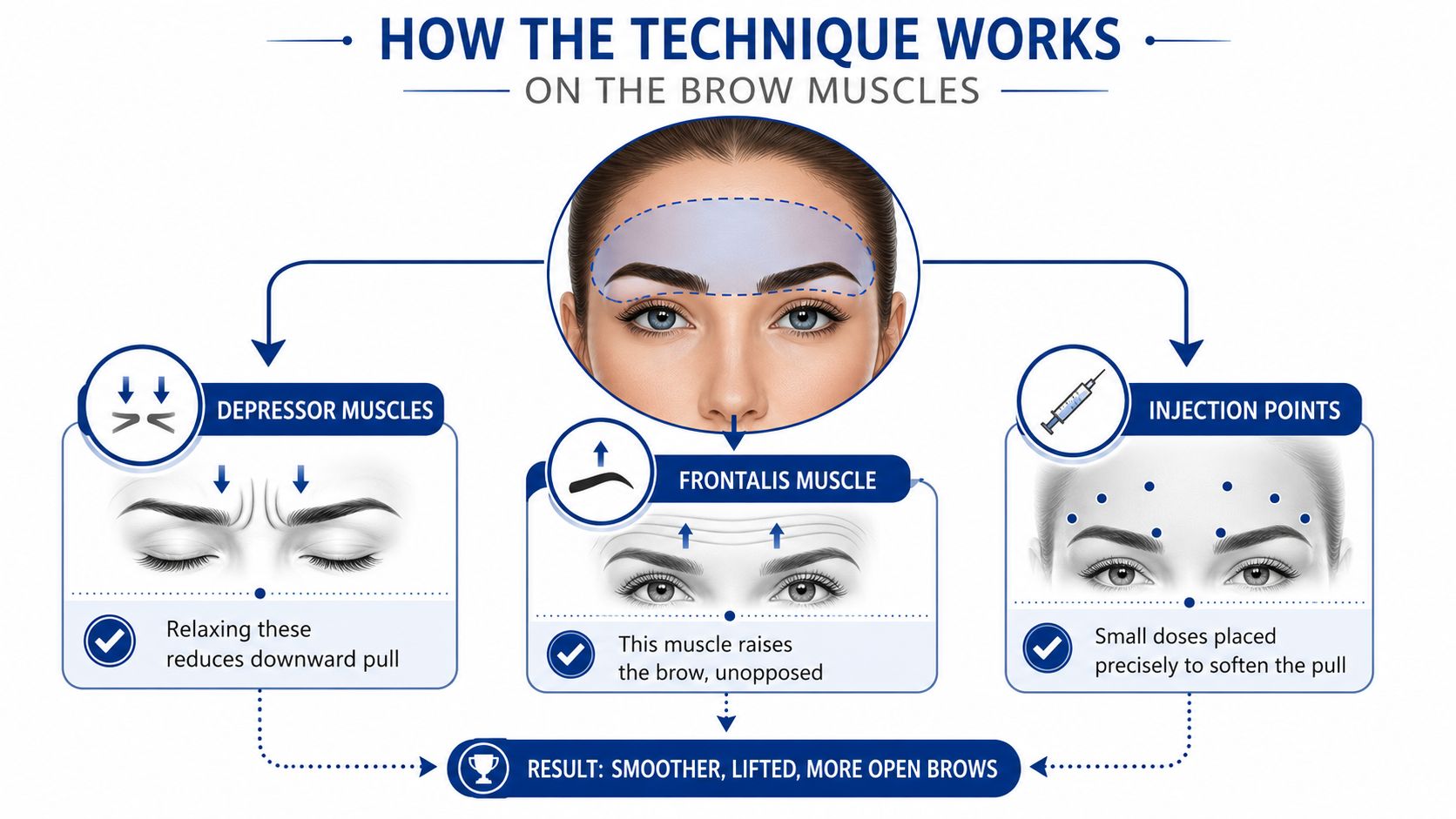
The brow moves through a balance of opposing muscles. The frontalis lifts the brows, while the corrugator, procerus, and lateral orbicularis oculi pull them down or inward in different ways. A careful botox brow lift technique does not shut down the whole forehead. It softens the downward pull enough for the elevator muscle to do more of its job.
Why the tail of the brow changes first
The lateral third of the brow usually shows the most visible change. The outer brow responds when the depressor muscles around the outer eye relax, while enough frontalis activity remains to let the brow rise. The result is not a frozen forehead, it is less resistance against lift.
That muscle balance is why the technique depends so much on anatomy. A forehead that over-recruits frontalis behaves differently from a forehead where the brows already sit low and the eyelids carry more of the weight. In one clinical summary, the average effect was about 1 mm at the central brow and 4.8 mm at the lateral brow, which matches the pattern that the tail is where the change is most noticeable (technique review).
A careful injector reads the brow like a map, not a fixed recipe.
Why safety zones matter
The frontalis is the main brow elevator. If it is weakened too much, the brow can drop instead of rise. That is why experienced injectors keep a safety margin and avoid treating the forehead uniformly. A narrative review recommends keeping frontalis injections at least 2 cm above the orbital rim to reduce ptosis risk, and a technique paper advises staying about 1.5 cm away from the orbital septum for lateral brow-lift placement to reduce diffusion toward the eyelid elevator (safety guidance review).
This muscle balance also helps with patient selection. A person with mild brow heaviness and strong depressor activity may get a satisfying subtle lift from Botox, especially when the outer brow is the main concern. Someone whose brow position is low because of true tissue excess, heavy hooding, or broader structural descent often needs a surgical consult instead, because there is only so much the muscles can change.
Preview tools and micro-dosing have changed the consultation itself. Small test adjustments, careful marking, and conservative placement let the injector estimate how much lift the brow can tolerate before committing to a full pattern. That approach reduces guesswork and makes the result easier to match to the face in front of you.
If you want the simplest version, it is this. Relax the muscles that press the brow down, keep enough lift in the forehead, and stay clear of the eyelid structures. That is the difference between a clean, natural result and a brow that looks flat or oddly shaped. For patients comparing options, a discussion like the one offered at ProMD Health Bel Air's botox and Dysport overview can help frame how a subtle neurotoxin change differs from a surgical approach.
Realistic Results and What the Numbers Mean for You
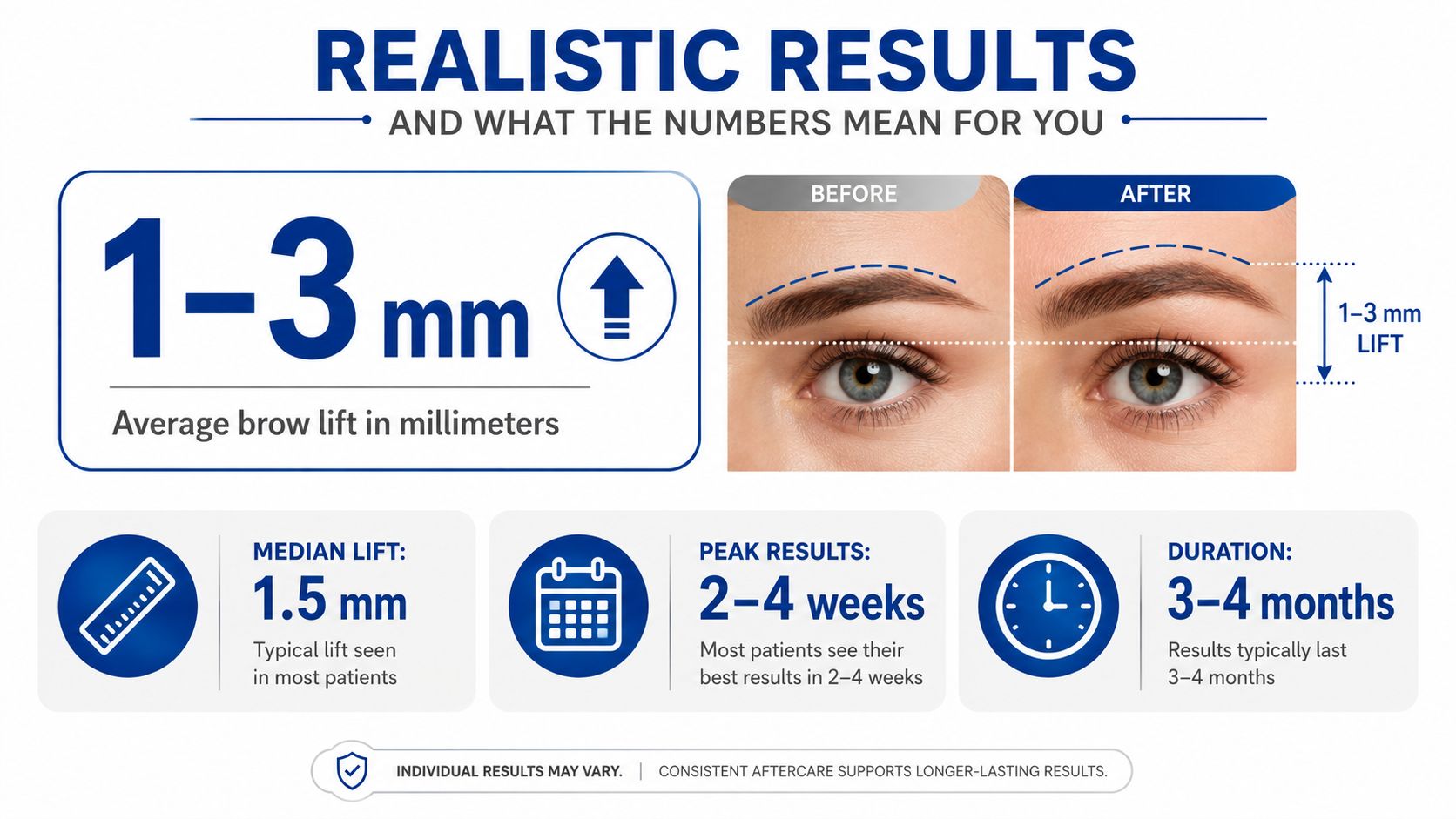
A Botox brow lift is measured in millimeters, not marketing language. That sounds modest because it is modest. The point is a small but visible change, usually a subtle opening of the upper face rather than a dramatic repositioning, and the effect fades over time as muscle activity returns. For patients comparing how long different injectables tend to last, this dermal filler longevity guide is useful for thinking about maintenance in the same practical way.
The best evidence shows that Botox brow lift effects are usually small, visible, and temporary, with the central brow changing about 1 mm and the lateral brow changing about 4.8 mm on average, then fading over 3 to 6 months (PubMed clinical report).
What those millimeters look like in real life
A millimeter seems tiny until you see it at the brow tail. In a patient with a heavy outer brow, even a small change can make the eye area feel less crowded and the makeup sit better. In someone whose brow already sits well, the same amount may look barely noticeable.
That is why anatomy matters so much. A strong candidate usually has a brow position that needs a little opening, not a major repositioning. If the upper lid is heavily hooded because of true tissue excess, or if the brow descent is significant, Botox can feel underwhelming even when the injection pattern is technically correct.
The survey data from the American Society of Plastic Surgeons member group also helps place Botox in context. In that survey, 8.7% of respondents identified chemical brow lifting with neuromodulators as the most common brow-lift technique they performed, while the endoscopic approach led at 28.32% (ASPS member survey). That places Botox as a real option, but one that fits a narrower set of patients than surgery.
What not to expect
Botox does not erase heavy hooding, rebuild lost structure, or create a large arch change. It also does not help if too much relaxation would leave the forehead flat or create a brow ptosis pattern. The best outcome is often a subtle opening, not a dramatic makeover.
If the lift you want would be obvious from across the room, you are probably looking at the wrong tool.
For readers comparing maintenance-based facial options, the same logic that applies to repeat treatments matters here too, because the result depends on upkeep rather than one-time correction. A subtle brow change works best for patients whose problem is muscle imbalance, especially when depressor activity is stronger than lift. When the issue is true tissue descent or heavier structural hooding, the more honest answer is a surgical consult.
Your Consultation, Treatment Day, and Preview Options
A useful consultation starts with the brow at rest and in motion, because the result depends on which muscles are pulling and which ones are holding the lift in place. A patient may come in thinking the brow itself needs to be raised, but the issue is often a stronger depressor pattern, a heavier lid shape, or a brow that sits unevenly from side to side. The clinician studies symmetry, forehead movement, and the outer eye area, then decides whether a Botox brow lift fits the anatomy or whether another plan is the better match.
How a strong consultation should feel
A good visit leaves room for honest direction. The conversation should cover what you want to improve, what should stay unchanged, and whether the concern is mainly the tail of the brow, the frown balance, the forehead, or the lid heaviness that shows up in photos. That distinction matters because a subtle brow change comes from relaxing the muscles that pull the brow down, while a more structural issue may need support or a surgical opinion instead.
In a Bel Air setting, that assessment can happen in person or through a virtual consult. It also works for adults in Bel Air, Fallston, Forest Hill, Abingdon, and Havre de Grace who want to start the conversation from home.
Some patients also benefit from preview tools before they decide. A visual preview can show the kind of change you might expect, which helps when someone is trying to decide between a small tail lift and a broader treatment plan. ProMD Health Bel Air also offers Botox and Dysport within the same treatment family, which matters when the question is muscle balance rather than one isolated wrinkle.
What treatment day usually looks like
Treatment day is usually brief. The clinician marks the injection points, places a small number of precise injections, and then reviews aftercare so the product has the best chance to settle where it was intended. The placement is selective because a brow lift depends on millimeter-scale changes, not blanket forehead treatment.
That is also why the plan has to match the face in front of the injector. Two patients can ask for the same brow change and still need different dosing, because one may have stronger depressor muscles while another may have a brow that already sits low from structure rather than motion.
After the visit, the early rules stay simple. Stay upright for a while, avoid rubbing the area, and do not treat the appointment like a massage. That gives the product time to settle and helps the muscle balance shift in the intended pattern.
The right consult answers two questions clearly, can Botox create the result you want, and is your anatomy a better match for something else?
Comparing Botox Brow Lift with Fillers and Thread Lifts
A Botox brow lift, dermal fillers, and a thread lift can all improve the upper face, but they do it in very different ways. Botox relaxes muscle pull. Fillers replace lost support and contour. Thread lifts create more direct tissue elevation. That's why the best choice depends on what's causing the brow to look low.
| Option | Mechanism | Typical Longevity | Downtime | Best Candidate | Combination Potential |
|---|---|---|---|---|---|
| Botox Brow Lift | Relaxes brow depressors and preserves enough frontalis activity for a subtle lift | 3 to 6 months | Usually minimal | Mild heaviness, outer brow drop, patients wanting a natural opening effect | Can pair with fillers or a thread lift when support or stronger elevation is needed |
| Dermal Fillers | Restores volume and contour, which can support the brow area indirectly | Varies by product and area, discussed in consultation | Often brief swelling or tenderness | Volume loss at the temple or brow tail, patients needing structural support | Often combined with Botox for a more complete upper-face plan |
| Thread Lift | Mechanically elevates tissue for a more noticeable lift | Longer than Botox, with longevity discussed case by case | More recovery than injectables | Patients wanting a more direct lift than neurotoxin can give | Can be planned with injectables when the face needs both support and lift |
The practical difference is simple. Botox is best when the muscle pattern is the problem. Fillers help when the brow tail has lost support. Threads help when the patient wants a stronger lift than a maintenance-based injection can provide. The right consult doesn't force one option, it matches the problem to the tool.
For Bel Air patients, that matters because all three services are part of the same local conversation. A patient can discuss them in one place instead of piecing together advice from different offices, which makes combination planning more coherent and less guess-based. If you want a deeper look at the mechanical side of tissue elevation, this thread lift guide is the natural comparison point.
Aftercare, Recovery Timeline, and When Results Show Up
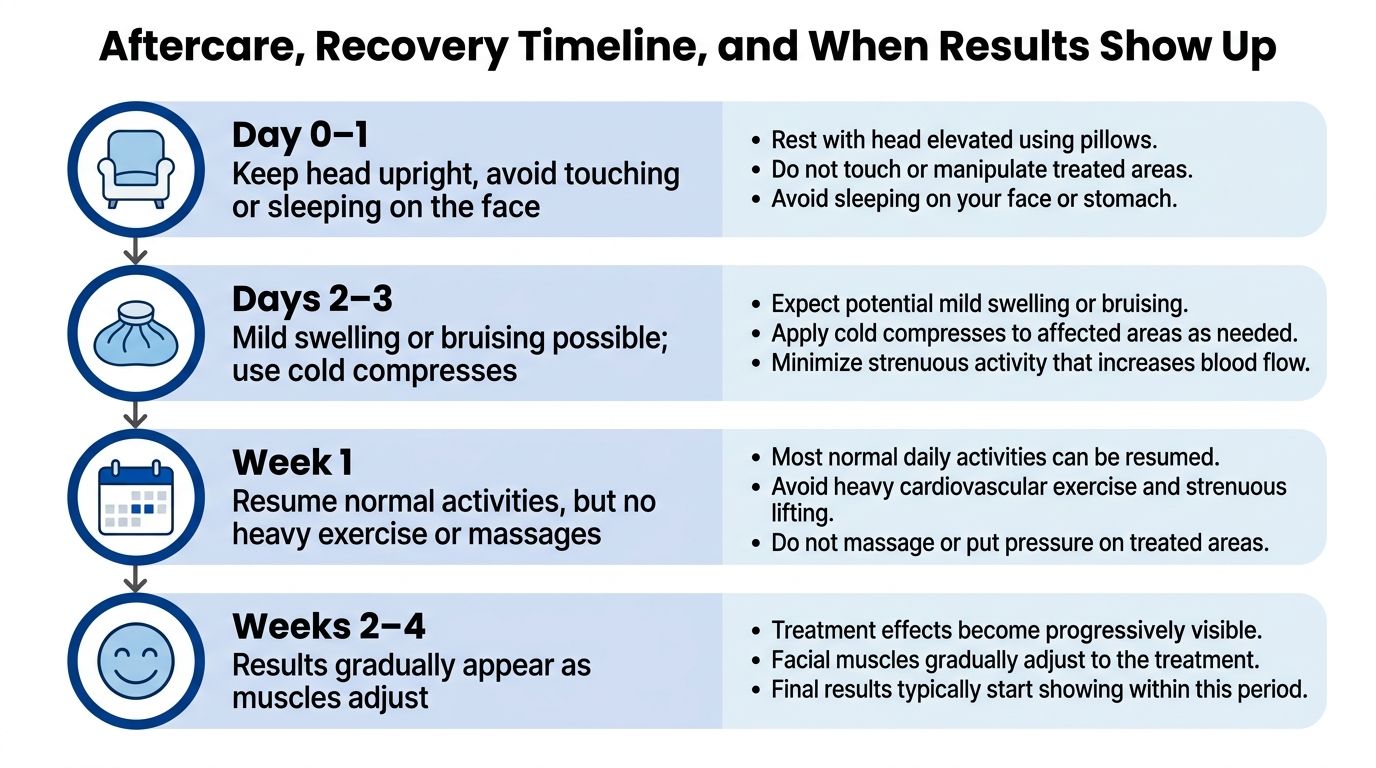
The first day is mostly about not interfering with the treatment. Keep your head upright for several hours, don't rub the brow area, and skip anything that heats the face or puts heavy pressure on it. If you want the result to settle cleanly, treat the area gently.
What to do in the first few days
Mild tenderness or a small bruise can happen, and that's usually short-lived. If the skin feels a little tight or uneven at first, that doesn't mean the final result has failed. Early movement changes are gradual, not instant.
By the end of the first week, many patients can see the softening begin. Full effect typically shows up around two weeks, which is also the usual follow-up window if a touch-up is needed. That timing matters, because judging the result too early can make a good treatment look worse than it is.
How maintenance fits into the timeline
If a patient likes the look, the treatment is usually repeated as part of a maintenance rhythm. The 3 to 6 month window from the clinical literature is why this is treated as an ongoing plan rather than a one-time event (PubMed clinical report). The goal is consistency, not chasing a stronger and stronger lift each cycle.
Good aftercare doesn't create the result, it protects the result you already paid for.
For most patients, the smartest approach is to book the next visit before the brow fully settles back to baseline. That keeps the tail lift from disappearing all at once and helps the injector compare the same face to the same face, which makes adjustments cleaner.
Risks, Side Effects, and Who Should Skip the Treatment
The most common mistakes happen when people assume every low brow can be lifted the same way. That's not true. If the frontalis is over-weakened, the brow can drop. If the outer forehead is over-treated, the patient can end up with a Spock brow, where the tail looks oddly over-raised while the rest of the forehead flattens out.
The side effects worth discussing honestly
Bruising is the most common botulinum toxin adverse effect reported in the broader literature, at 1.7% (ASPS complication review). Eyelid ptosis or excessive elevation was reported at 0.3% in that same review, which is why placement and safety zones matter so much. Brow ptosis, eyelid ptosis, bruising, asymmetry, and an over-lifted tail are the main concerns to keep in mind.
A careful injector lowers those risks by respecting the anatomy. That means staying about 2 cm above the orbital rim for frontalis treatment and avoiding placement too close to the levator structures near the eyelid (safety guidance review). The point is not fear, it's precision.
Who should pause and ask for a different plan
- Pregnant or nursing patients should skip treatment until a clinician says it's appropriate.
- People with neuromuscular disorders need a medical review before considering neurotoxin.
- Anyone with an active skin infection at the injection site should wait until the skin is clear.
- Patients expecting a surgical-level lift should consider that Botox is built for subtle change, not structural repositioning.
If you need more lift than muscle relaxation can safely provide, the right answer may be a different treatment, not more product.
The safest patient is the one who wants the right amount of change and understands the limits before sitting down.
Frequently Asked Questions About the Botox Brow Lift
Can one brow be lifted more than the other
Yes, but only when the injector maps the asymmetry carefully. One side may need a lighter or more selective pattern because brows often sit differently at rest and when the frontalis fires. The goal is balance, not forcing both sides into identical positions.
How do I know if I'm a good candidate at home
A simple self-check is to look in the mirror and lift your brows lightly with your fingers. If that makes your eyes look noticeably more open, you may be a reasonable candidate for a subtle lift. If the skin still hangs heavily even with that lift, Botox alone may not be enough.
Do I need an in-person visit first
A virtual consult can help start the conversation, especially if you want to discuss goals, symmetry, and whether preview options make sense. An in-person assessment is still valuable when the anatomy looks borderline or when the decision may involve Botox, fillers, thread lift planning, or a surgical opinion.
What should I bring to the first appointment
Bring a short list of what bothers you most, any prior injectable history, and a realistic idea of whether you want a small opening or a broader upper-face refresh. Photos of how your brows looked a few years ago can also help frame the discussion without turning it into guesswork.
If you want a thoughtful consultation with the ProMD Health Bel Air team, including Amanda Pittillo, PA-C and Lauren Mason, PA-C, MSHS, start with a visit that respects your anatomy instead of trying to fit you into a fixed pattern. The clinic's virtual consults and preview tools can help you decide whether a subtle Botox brow lift is the right next move.
If you're considering a Botox brow lift technique for a heavier outer brow or a more open eye area, the next step is a consultation that looks at your anatomy, not just your wrinkle pattern. Visit ProMD Health Bel Air to explore brows treatment planning, preview options, and a conversation about whether Botox, another injectable, or a different approach fits your face best.