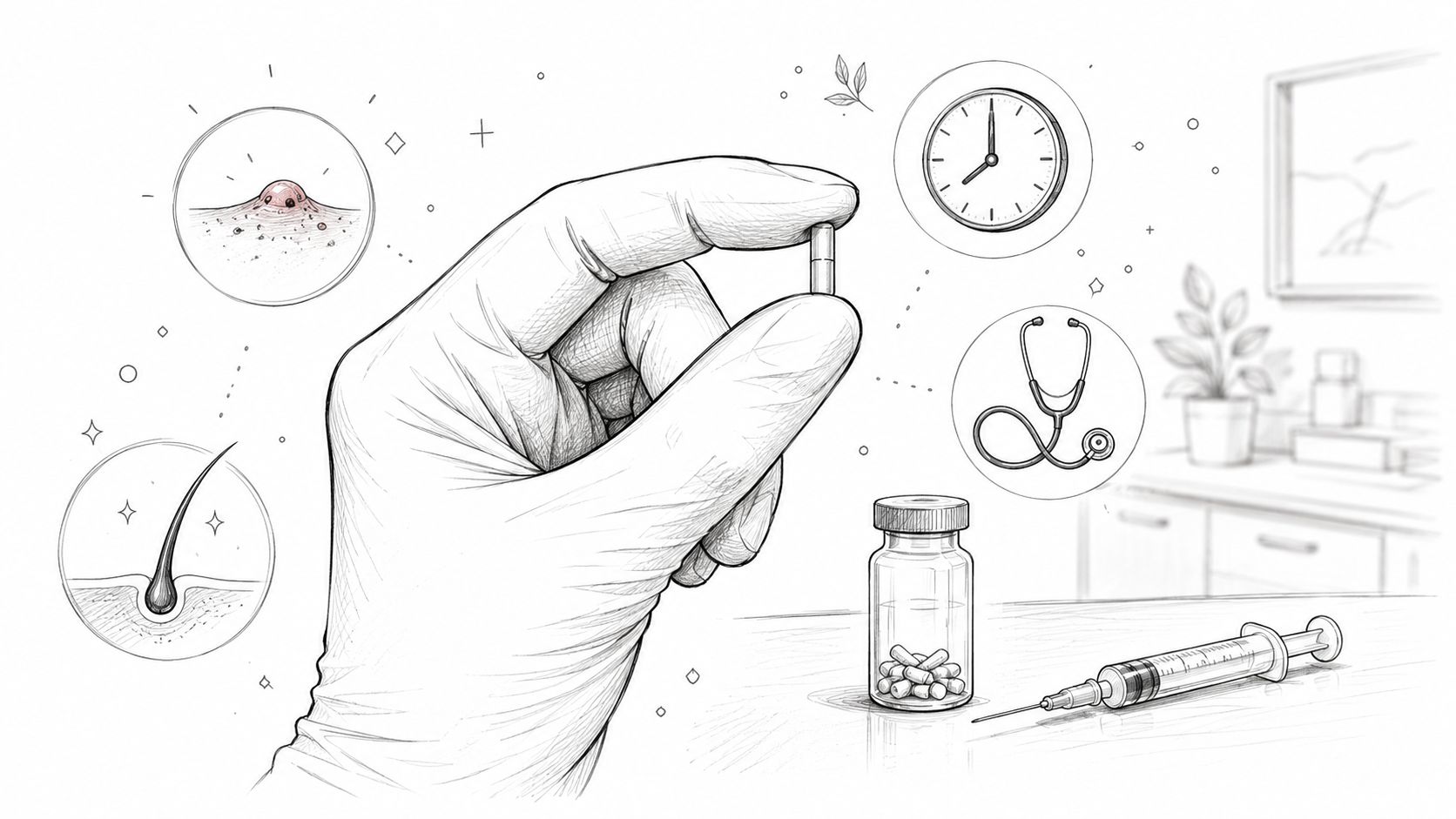
A woman from Bel Air walks into the office thinking the same thing many patients think at first, “Will this help me feel like myself again, or will I end up trading one problem for another?” That question usually comes up when fatigue, brain fog, mood shifts, sleep disruption, or low energy have started to interfere with daily life, and the fear of bioté pellet side effects can make the decision feel bigger than the treatment itself. If you're comparing options and want a plain-English explanation of what's normal, what's not, and how follow-up works, this guide is for you. For readers also sorting out menopause-related exhaustion, Venus Health Co. on menopause fatigue is a useful companion resource, and ProMD Health Bel Air also has a dedicated overview of BioTE hormone pellets.
Table of Contents
- Introduction to BioTE Pellet Therapy at ProMD Health Bel Air
- How BioTE Pellets Work and Why Side Effects Happen
- Common Side Effects and Rare Adverse Events
- Timeline of Side Effects and What to Expect
- Risk Factors That Increase Side Effect Odds
- Monitoring and Managing Side Effects at ProMD Health Bel Air
- Comparing BioTE Pellets with Other HRT Delivery Methods
- FAQs and Next Steps for Bel Air Patients
Introduction to BioTE Pellet Therapy at ProMD Health Bel Air
A lot of people start here with a simple goal. They want hormone support that feels private, consistent, and manageable, but they also want to know whether the tradeoff includes acne, mood changes, spotting, or more serious problems. That hesitation is rational, because pellet therapy is delivered under the skin and doesn't disappear from the body instantly if the dose feels wrong.
At ProMD Health Bel Air, BioTE pellet therapy sits inside a broader hormone replacement therapy visit, so the discussion is not just “Do you want treatment?” It's also “What symptoms are you trying to fix, and what side effects would be unacceptable for you?” For some patients, that conversation begins after weeks of fatigue and sleep problems. For others, it starts after skin changes, bleeding changes, or new hair concerns make them wonder whether their hormones are part of the picture.
The reason this matters is simple. Side effects are easier to manage when you can separate expected adjustment from possible overdosing or a complication that needs attention. That's especially helpful for patients who are already juggling work, family, and symptoms they can't quite pin down. In clinic, the most useful conversations are the ones that ask, “What changed, when did it start, and how intense is it?”
A careful patient also wants to know the safety context. Large retrospective data published in 2021 found an overall complication rate of less than 1% across 1,204,012 subcutaneous implant procedures in 376,254 people, with no allergic reactions to pellets and no keloids reported (PMC 2021 safety study). That doesn't mean side effects never happen, it means the discussion should be precise, not alarmist.
How BioTE Pellets Work and Why Side Effects Happen
BioTE pellets are inserted under the skin so they can release hormone over time instead of delivering a big spike all at once. A helpful way to think about them is like a slow-release capsule that sits in the tissue rather than a pill that passes through the stomach. That steady release is the reason many patients like the format, and it's also why side effects can feel different from patches, gels, or injections.

Why the body reacts the way it does
Hormones don't just influence mood or energy. They can affect skin oil production, hair growth patterns, fluid balance, sleep, and the lining of the uterus in women who still have one. That is why independent and clinical-review sources note that the main side effects are usually androgenic or insertion-site related, including acne, increased facial or body hair, mood changes, hair thinning, bruising, swelling, infection, and pellet extrusion (BioTE FAQ review).
A useful rule in clinic, if a symptom looks like a hormone effect, it may be a dose question, not just a “getting used to it” question.
The body also responds to the physical procedure itself. A pellet has to be inserted through the skin, so brief tenderness, bruising, or swelling can happen at the site. Those are different from generalized symptoms like acne or mood change, which are more likely tied to the hormone exposure itself.
Why steady release can still cause side effects
Steady release does not mean the level is always perfect for every person. Two patients can receive a similar pellet regimen and still experience different outcomes because of differences in metabolism, tissue response, activity level, and baseline hormone status. That's why monitoring matters. The goal is not just to place the pellet, it's to make sure the dose matches the person who is wearing it.
There's also a time factor. Some symptoms show up early, some show up later, and some mean the dose is too high. The challenge for patients is that those categories can overlap. Acne can be a temporary adjustment for one person and a sign of overexposure for another, which is why symptom tracking matters more than guessing.
The most practical takeaway is this. BioTE pellet side effects happen because hormones act on multiple body systems at once, and because a subcutaneous delivery method can't be “turned down” instantly after insertion. That's why the conversation about benefits has to include the plan for follow-up, not just the placement procedure.
Common Side Effects and Rare Adverse Events
A patient may come in expecting a quick fix for fatigue or low libido and leave more concerned about a new breakout, breast tenderness, or spotting. That kind of shift can feel unsettling, but it helps to separate common adjustment symptoms from signs that the dose may be too high. In women, the most common complaints can include weight gain, breast tenderness, acne, mood shifts, and spotting. In the comparative literature summarized in a 2024 review, 57.6% of women on pellet therapy reported side effects versus 14.8% on FDA-approved hormone therapy, with weight gain in 34.4%, anxiety in 18.5%, hair-pattern change in 13.5%, breast tenderness in 10.1%, acne in 8.6%, and mood swings in 7.0% (2024 review).
What patients usually notice first
Acne or oily skin often shows up before anything else, and that pattern usually points to an androgenic response rather than a local procedure problem. Spotting can be harder to interpret, because many patients expect hormone therapy to make bleeding calmer, not more erratic. The same review reported abnormal uterine bleeding in 55.3% of women with an intact uterus on pellet therapy versus 15.2% in the comparator group, and hysterectomy due to abnormal bleeding in 20.3% versus 6.3% (2024 review).
If bleeding changes after a pellet, it should be tracked carefully if it keeps happening or feels heavier than expected.
The practical question is whether the symptom fits a normal adjustment pattern or a dose problem. A few acne lesions or a brief mood shift can happen while hormones are settling, but persistent hair-pattern change, worsening breast tenderness, or ongoing spotting deserves a closer look because those symptoms can reflect overexposure rather than simple adaptation.
Patients also worry about the events that sound more serious, so the procedure itself and the hormone effect should be separated. A large retrospective study found an overall complication rate of less than 1%, with the most frequently reported issues being extrusion, cellulitis or infection, and bleeding. It also reported operative-site bleeding at 0.1% and cellulitis in women at less than 0.1% of insertions, with no allergic reactions and no keloids (PMC 2021 safety study).
What is rare but important
Rare events still matter because they change what the patient should do next. Pellet extrusion, infection, and more substantial bleeding need prompt attention when they appear, especially if redness is spreading, drainage starts, warmth increases, or fever develops. Those signs point away from a normal settling period and toward a problem that should not be watched casually.
A real-world Biote cohort reported a 0.785% complication rate for bioabsorbable testosterone pellet procedures, with extrusion, cellulitis or infection, and bleeding at the delivery site among the most common events (Biote IR report). That fits the broader clinical picture, serious complications are uncommon, but side effect counseling has to be specific enough to help patients know what is expected, what suggests the dose is too high, and what needs prompt follow-up.
Timeline of Side Effects and What to Expect
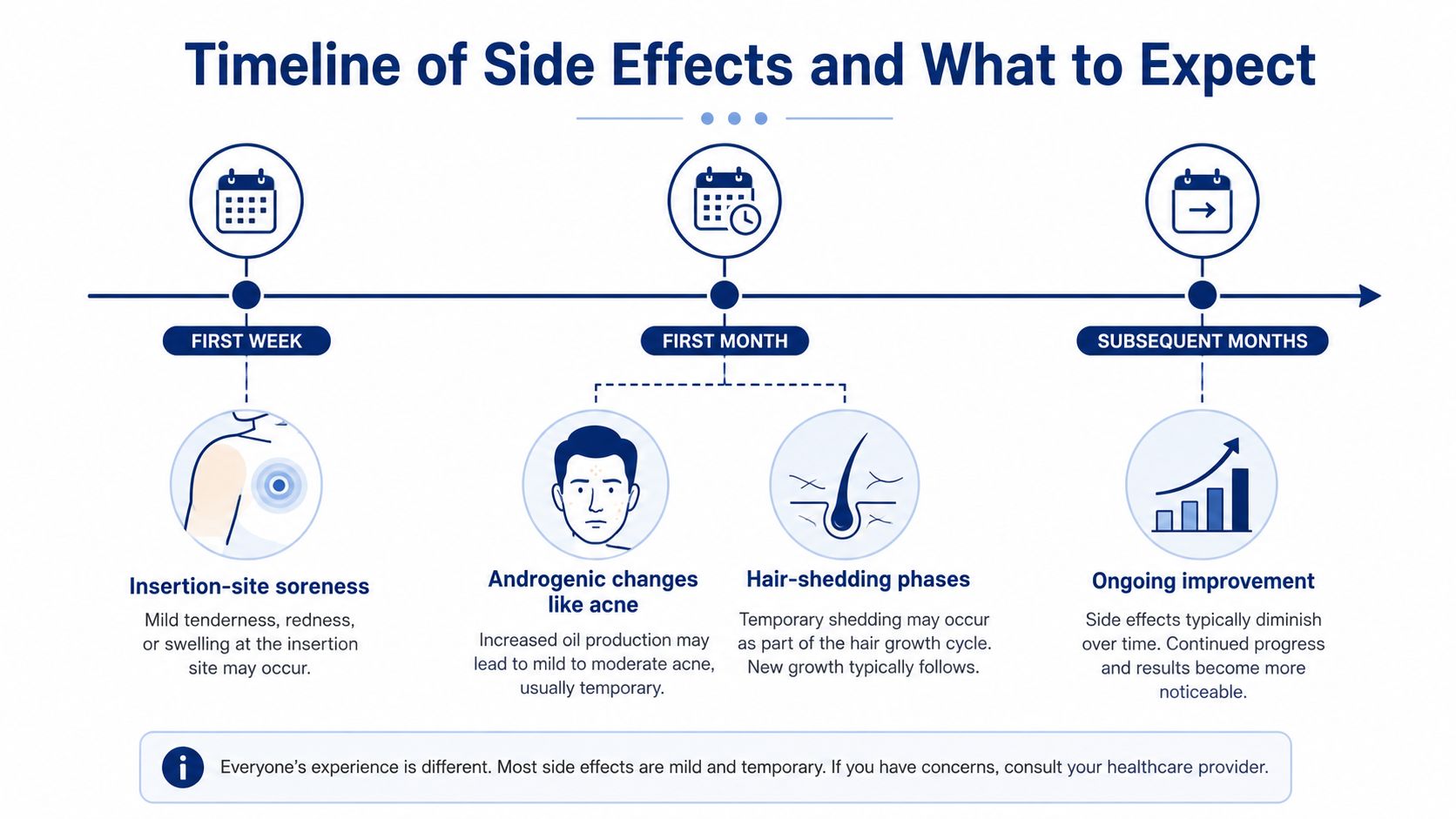
A patient may feel fine on the day of insertion and then start worrying when soreness, skin changes, or mood shifts appear later. The timing matters because the first day, the first week, and the first month do not mean the same thing clinically. A tender insertion site right after the procedure points to local healing, while redness that keeps spreading or a new breakout several weeks later points to a different process.
The first week
In the first week, the most common changes are local. Mild soreness, bruising, swelling, or short-lived tenderness can follow the small incision used for placement, much like a bruise after a blood draw or vaccine. Those symptoms should gradually settle, because normal healing usually moves toward less discomfort, not more.
A pattern of increasing redness, warmth, or streaking is more concerning than ordinary adjustment. Those changes can suggest infection rather than expected recovery, especially if they continue past the first few days (time-dependent side effects guidance). A clinic team looks for the direction of change, because a symptom that improves is different from one that expands across the skin.
The first month
The first month is often when patients begin to notice hormone-related changes. Acne or oily skin may appear during this window, especially in women who are new to testosterone exposure (time-dependent side effects guidance). That can feel confusing when the reason for treatment was fatigue, low drive, or brain fog, because the skin may react before the patient feels the intended benefits.
This is also the period when ProMD Health Bel Air pays close attention to whether symptoms look like expected adaptation or possible overexposure. Persistent acne, breast tenderness, mood swings, sleep disruption, or bleeding changes call for review of the dose and the overall response, rather than waiting for the next visit. A pellet acts like a steady drip of medication, so the concern is not only whether a symptom appears, but whether it keeps building instead of settling.
Later shedding can also show up after the early adjustment phase. Temporary scalp hair thinning is often described in the months after treatment, and the practical question is whether the shedding is easing, holding steady, or worsening over time (time-dependent side effects guidance). Patients often notice it first in the shower or on a brush, which is why timing and trend matter more than a single bad day.
ProMD Health Bel Air uses follow-up to separate normal adjustment from a dose that may be too strong for the person in front of the clinician. That means asking when the symptom started, whether it is improving, and whether it fits the expected pattern after insertion. The question is whether the symptom is fading, stabilizing, or escalating.
Risk Factors That Increase Side Effect Odds
Some people are more likely to notice side effects because their bodies handle hormone exposure differently. That can come down to baseline hormone levels, prior hormone therapy, activity patterns, body composition, and how quickly a person tends to metabolize medications. It can also come down to the procedure itself, because insertion technique and early post-procedure activity can affect extrusion risk.
The most important distinction is between normal adaptation and possible overdosing. Many side effects that get labeled as a “rough start” can reflect fluctuating hormone exposure or a dose that's too high for the patient in front of you. That's why persistent acne, mood shifts, breast tenderness, or bleeding changes should prompt a reassessment instead of another wait-and-see period.
Why the same dose can feel different in different people
Hormones are not one-size-fits-all. Two patients can look similar on paper and still have very different responses because their tissues respond differently to testosterone or estradiol. A patient who is highly active may notice a different release pattern than someone who is sedentary, and someone who has used hormone therapy before may compare every new symptom against a past experience.
That's one reason clinic conversations should focus on the person's actual symptoms, not just whether they are “supposed” to have side effects. If the skin breaks out, sleep worsens, or bleeding becomes irregular, the question becomes whether the exposure is too much, too uneven, or not the right fit.
When symptoms should trigger a dose check
Symptoms deserve a dose check when they are stronger than expected, keep getting worse, or don't fit the usual pattern of early adaptation. Acne alone can be temporary, but acne plus mood change plus fluid retention deserves a closer look. Spotting that persists or becomes heavy needs attention for a different reason, because uterine bleeding is not something to normalize just because a pellet was placed.
The practical take-home is straightforward. A patient doesn't need to diagnose the problem at home, but they do need to recognize when “this is probably fine” stops being the safest assumption. That's where follow-up and lab review become useful instead of optional.
Monitoring and Managing Side Effects at ProMD Health Bel Air
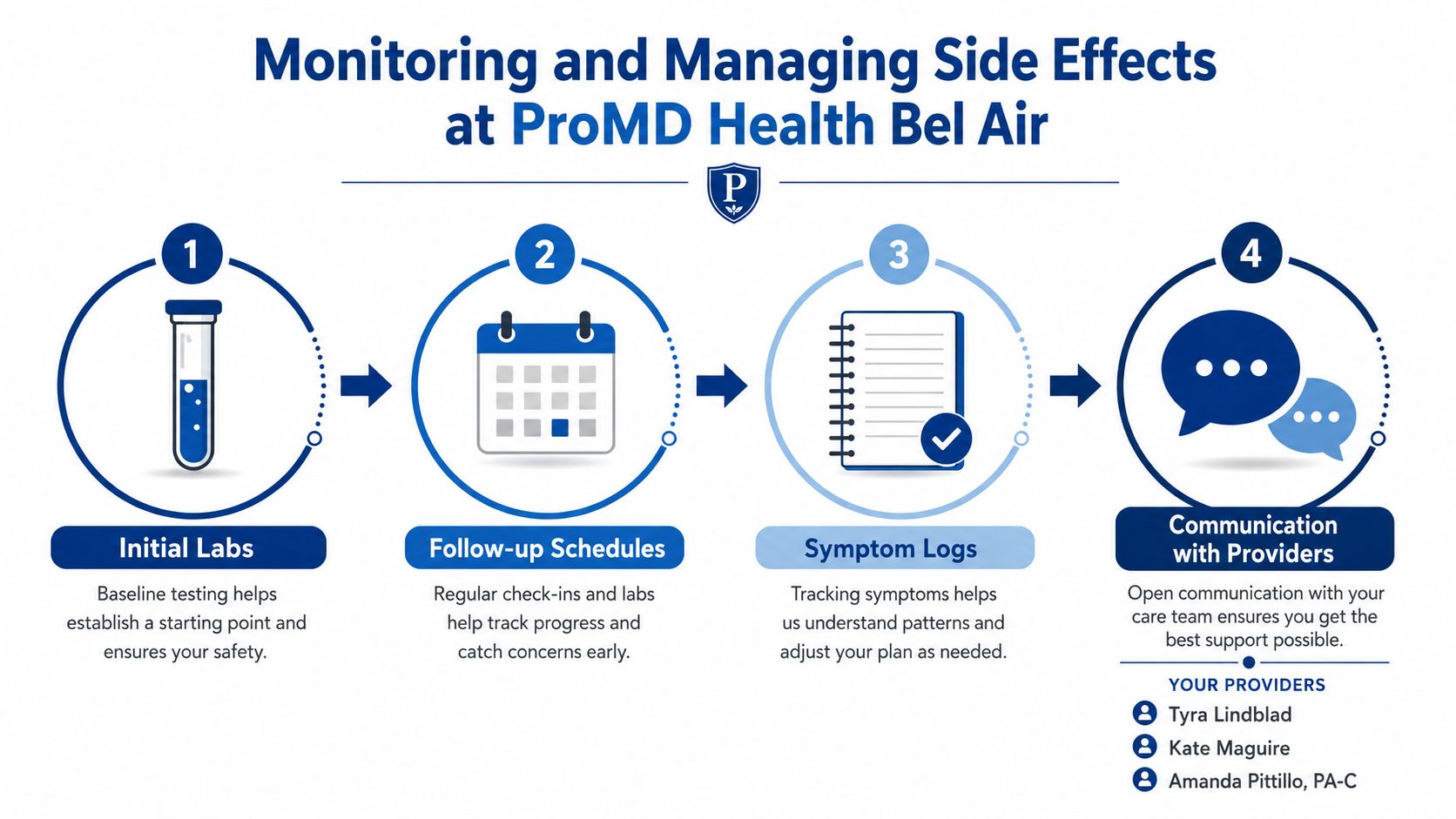
A patient feels fine after pellet placement, then a few days later notices acne, sleep changes, or spotting and wonders whether that means the dose is wrong. That is the kind of situation ProMD Health Bel Air is set up to sort through. The clinic starts with baseline labs, symptom review, and dose selection, then adds a clear plan for follow-up if the body does not respond as expected. That structure matters because hormone side effects are often easier to correct early than after they have had time to build.
What the clinic looks for
The monitoring process begins with the patient's current symptoms and the labs that give those symptoms context. A hormone visit is not only about the procedure itself, it is about reading the pattern. If acne, spotting, headaches, or mood swings appear after insertion, the team looks at timing, severity, and whether the picture fits temporary adjustment or too much hormone exposure.
ProMD Health Bel Air also separates local healing from whole-body effects. Bruising and soreness at the insertion site belong in one category. New breast tenderness, mood change, or irregular bleeding belong in another. That distinction helps the team respond to the problem that is happening, rather than treating every complaint the same way.
How communication supports safer care
Providers such as Tyra Lindblad, Kate Maguire, and Amanda Pittillo, PA-C can use follow-up visits and symptom logs to decide whether to observe, adjust, or investigate further. A patient who records when a symptom began, how long it lasts, and whether it is worsening gives the team far more useful information than a vague “I just feel off.”
Bring the symptom pattern, not just the symptom name.
That pattern matters because the FDA has raised concerns about compounded hormone pellets and the need for careful adverse-event reporting, especially around long-term systemic risks including cardiovascular and gynecologic events (FDA statement). Careful follow-up is part of safety, not just comfort.
Patients who want their testing plan organized can also review affordable hormone lab work before they discuss treatment. The point is not to test every feeling. The point is to use labs in a way that supports a real clinical decision, whether that means reassurance, closer observation, or dose review.
If a patient needs supportive care, management can include insertion-site care, reassessment of dosing, and sometimes adjustments in related therapies or supplements. ProMD Health Bel Air also frames this process within the larger care pathway described on its hormone replacement therapy page. The aim is not to force the body to tolerate a mismatched regimen. The aim is to match the treatment to the response.
Comparing BioTE Pellets with Other HRT Delivery Methods
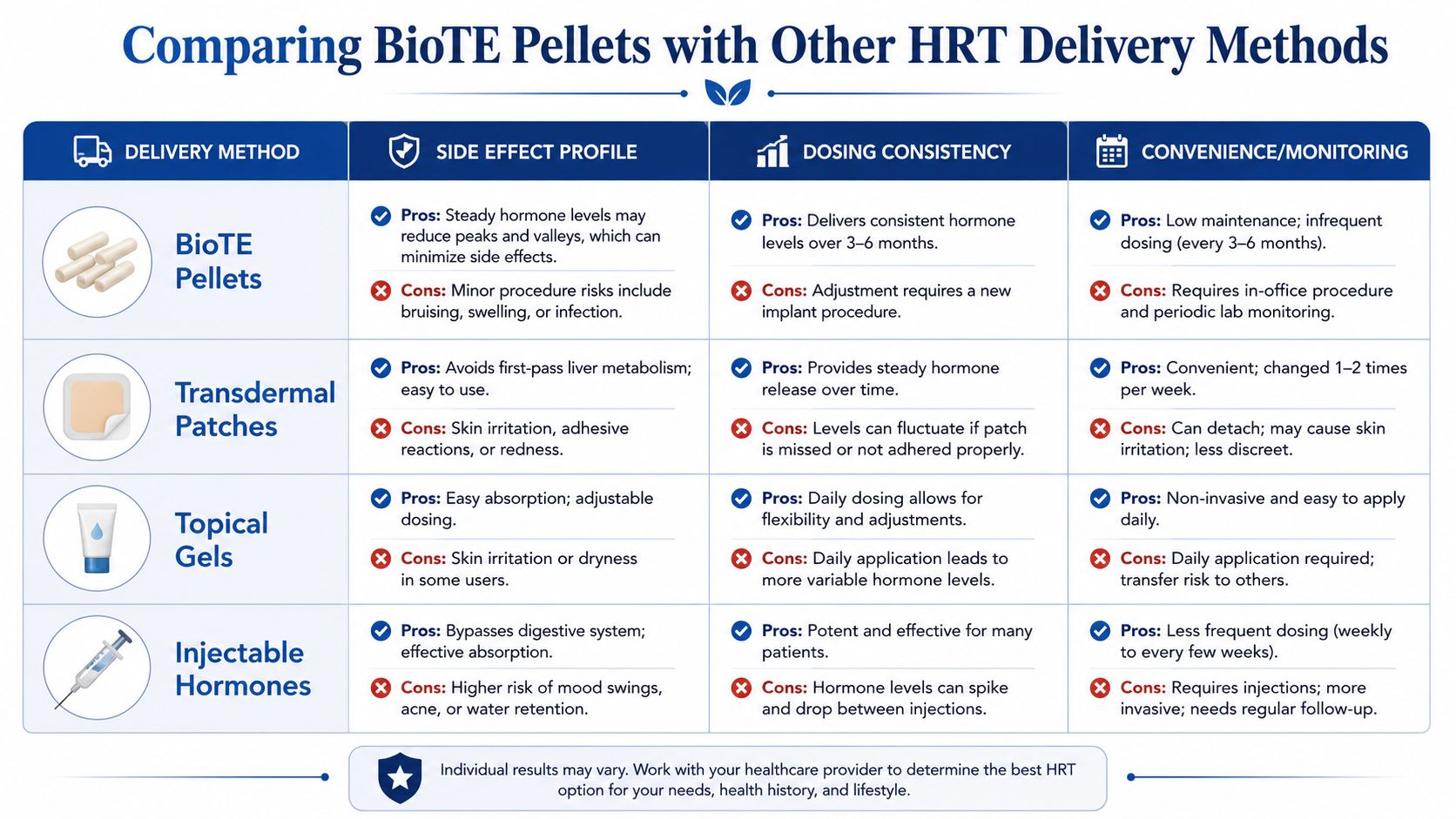
BioTE pellets are only one way to deliver hormone replacement therapy. The side effect profile and monitoring demands feel different depending on whether a patient uses pellets, patches, gels, or injections. That matters because convenience is only helpful if the side effects are tolerable and the dosing is predictable.
How pellets differ from skin-based options
Pellets provide a longer-release approach, which some patients like because they do not have to remember daily application. The tradeoff is that if the dose feels wrong, you can't wash it off or remove a patch at home. That makes follow-up and symptom review especially important when side effects appear.
Transdermal patches and topical gels are often discussed because they can be easier to adjust. If a patient gets too much exposure or develops an unwanted response, changing the dose or stopping the product can be simpler. Those formats can also make side effects easier to interpret because the exposure is more immediately tied to daily use.
Where injections fit
Injectable hormones create a different challenge. They can be convenient for some people, but they may create peaks and troughs that feel different from the steadier release many patients expect from pellets. Those fluctuations can matter if someone is sensitive to mood changes, energy swings, or skin responses.
A good comparison is this, pellets are more like a long-running faucet, while injections can feel more like periodic surges. Neither approach is automatically better. The right choice depends on how a patient tolerates change, how often they're willing to monitor, and what side effects they want to avoid.
For patients discussing options with the team, Bioidentical hormone replacement therapy at ProMD Health Bel Air is one place to review the service in context. That conversation is most useful when it includes lifestyle, symptom history, and how much control the patient wants over future dose changes.
FAQs and Next Steps for Bel Air Patients
The main takeaway is simple. BioTE pellet side effects can be mild, time-limited, and manageable, but they can also signal a dosing mismatch or a complication that needs attention. Patients should pay close attention to timing, worsening patterns, bleeding changes, and any redness that spreads or persists.
When should I call the clinic about acne? If it starts early, stays mild, and improves, it may be part of the adaptation period. If it keeps getting worse, comes with mood changes or fluid retention, or feels out of proportion, it deserves a dose review.
Do labs matter if I'm already having symptoms? Yes. Labs help separate a dosing issue from something else and give the team objective information to work with.
Is spotting always normal? No. Spotting can happen, but persistent or heavy bleeding should be discussed, especially if the patient still has a uterus.
What should I bring to my visit? A list of symptoms, when they started, what makes them better or worse, and any prior hormone history.
Bel Air and nearby patients who want a practical, monitored discussion can schedule a consultation, arrive with symptom notes, and ask how the team would respond if side effects show up after treatment. That kind of appointment is much more useful than a generic hormone checkup, because it turns symptoms into a plan.
If you're weighing hormone therapy and want a clinician-led conversation about symptoms, dosing, and follow-up, visit ProMD Health Bel Air to learn how the team approaches BioTE pellet therapy and side-effect monitoring. Bring your questions, your symptom history, and your priorities, and let the visit focus on whether this treatment fits your body and your goals.