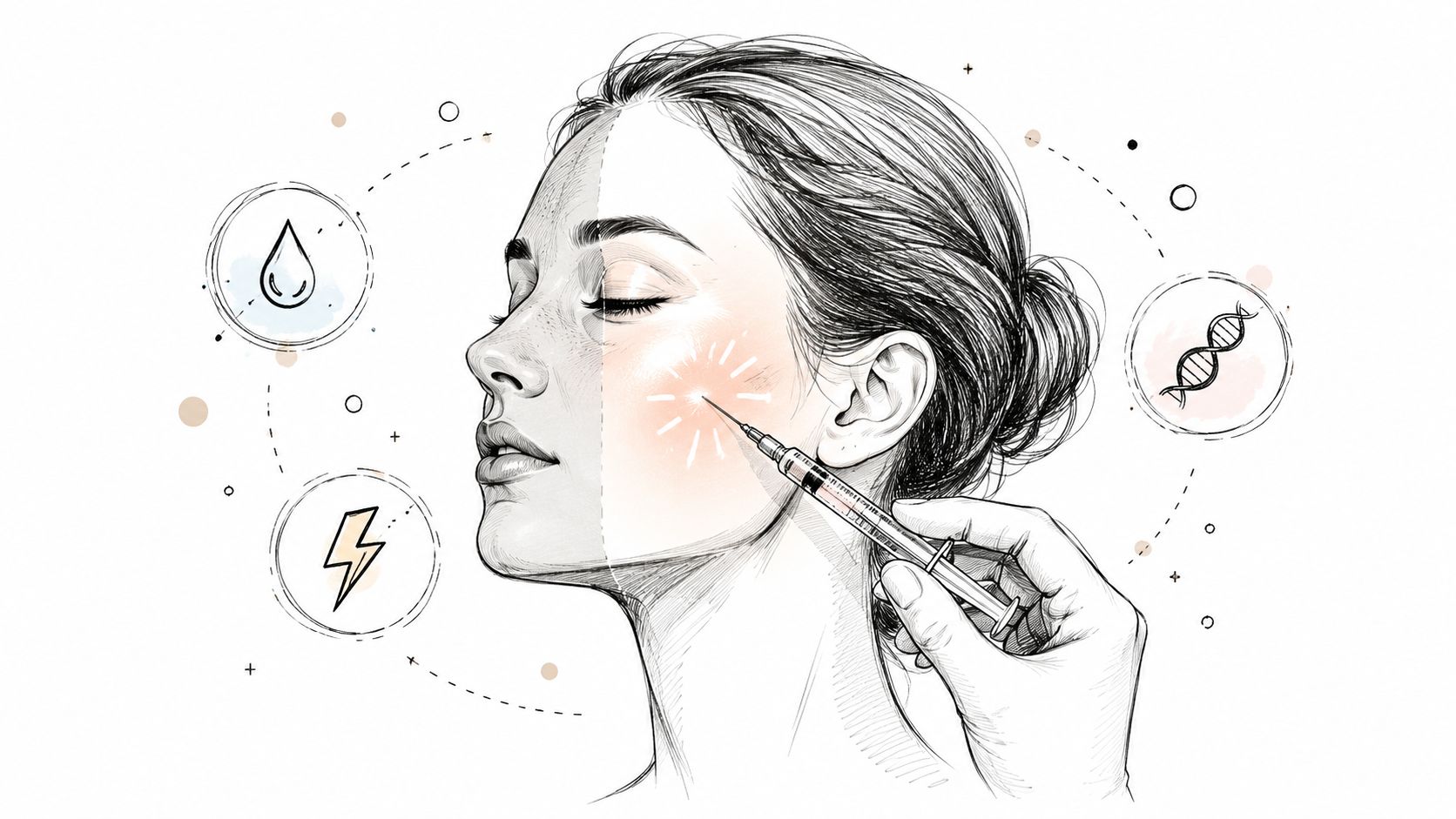
You might be looking in the mirror after a long week and seeing the same thing many patients ask about. Tired eyes, dull skin, uneven tone, and a general sense that your face looks as worn out as you feel. That's usually when B12 enters the conversation, often framed as a quick “glow shot.”
There's some truth inside that idea, but it needs context. Vitamin B12 is essential for normal cellular metabolism, DNA synthesis, and red blood cell formation. Those functions matter to skin because skin depends on constant repair, turnover, and oxygen delivery. At the same time, not every person with lackluster skin needs a B12 injection, and not every person with normal B12 levels will see a cosmetic change.
That's where a more honest discussion helps. The story behind B12 injection benefits for skin is less about hype and more about biology, deficiency status, and realistic expectations.
Table of Contents
- Tired of Looking Tired? An Introduction to Vitamin B12
- How B12 Injections Directly Support Skin Regeneration
- The Indirect Skin Benefits of Enhanced Energy and Mood
- A Balanced View on B12 Benefits Evidence and Limitations
- Your B12 Treatment at ProMD Health Bel Air
- Frequently Asked Questions About B12 Injections
Tired of Looking Tired? An Introduction to Vitamin B12
A patient comes in saying the same thing I hear every week. “I look exhausted even when I've slept.” Sometimes that concern starts with the skin. Duller tone, less bounce, under-eye shadows that seem harder to hide. Sometimes the skin is signaling a broader issue, including low B12, poor recovery, or ongoing fatigue.

Vitamin B12 supports red blood cell production and normal cell turnover, both of which affect how well the body oxygenates tissue and maintains healthy skin. In a deficient patient, that can show up on the surface. Clinicians may see pigment changes, pallor, slower recovery, or a generally tired appearance that does not improve with topical skin care alone.
The conversation requires honesty. B12 is often marketed as a universal “glow shot,” but the evidence is much stronger for correcting deficiency-related changes than for creating dramatic cosmetic improvements in someone whose levels are already adequate.
That distinction matters in practice. The right candidate is usually someone with symptoms or risk factors that make deficiency plausible, not someone looking for a shortcut around sleep, stress, or a skin care routine that is not working. For patients also exploring skin rejuvenation treatments in Bel Air, B12 can be a useful supportive treatment in the right context, but it does not replace targeted aesthetic care.
For patients trying to understand where B12 fits within the bigger vitamin picture, Peptoro's B vitamin guide is a helpful plain-English overview of how B12 differs from broader B-complex support.
B12 can help the skin look healthier when low levels are part of the problem. It also has limits. Some patients notice no visible skin change, and a small number can break out after injections, which is a side effect many glossy marketing pages leave out. At ProMD Health Bel Air, the goal is to match treatment to the reason behind the concern, not to promise a result the science does not support.
How B12 Injections Directly Support Skin Regeneration
Skin renews itself constantly, and that process depends on adequate nutrient support. Vitamin B12 helps with DNA synthesis, normal cell metabolism, and red blood cell production. If a patient is low in B12, those basic repair functions can lag, and the skin can reflect it through dullness, slower recovery, or a generally depleted look.
Why deficiency can show up in the skin
In practice, I frame B12 as a correction tool, not a cosmetic shortcut. When deficiency is part of the picture, restoring B12 can help skin cells turn over more normally and support the fibroblasts involved in collagen and elastin production. That can improve texture and overall skin quality over time. In someone with normal B12 status, the same injection may do very little for visible skin change.
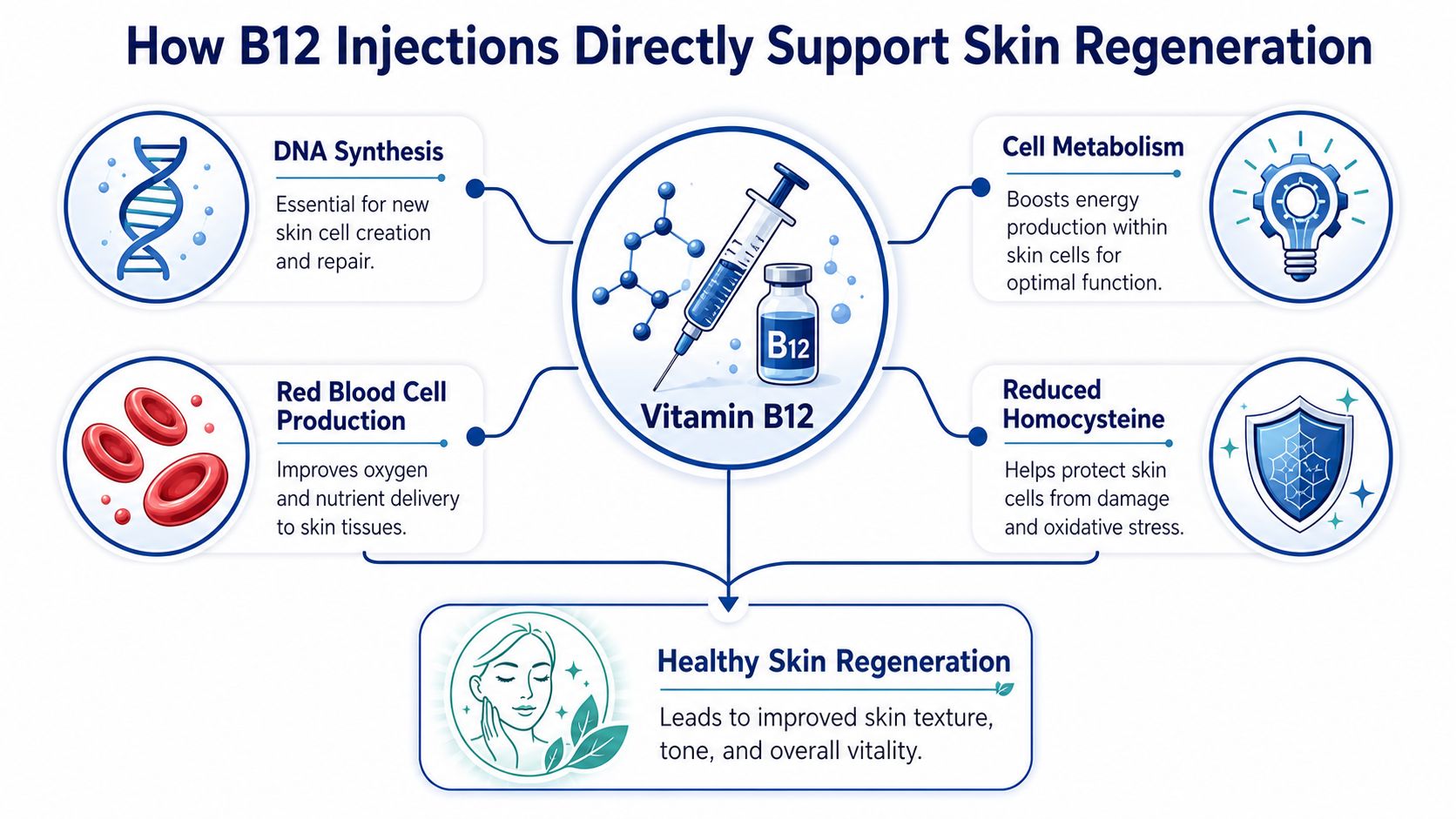
B12 also supports healthy red blood cell formation, which affects oxygen delivery to tissues, including the skin. That does not turn B12 into a resurfacing treatment or a collagen stimulator in the way patients sometimes assume from marketing. It means the skin is working under better internal conditions once a true deficiency is corrected.
For readers interested in broader skin-repair science, including collagen signaling, GHK-Cu peptide analysis for researchers gives useful context on another research area often discussed alongside regenerative skin biology.
What patients may realistically notice
The direct skin benefits tend to be subtle and supportive. Patients who were deficient may notice:
- Less roughness as cell turnover returns to a healthier baseline
- Better recovery after minor irritation because normal repair processes are no longer held back
- Improved tone or vitality if poor oxygen delivery was contributing to a tired appearance
- Stronger support for skin structure through healthier fibroblast function
Results still have limits.
B12 injections do not replace targeted treatment for acne scarring, pigmentation, laxity, or significant texture concerns. If those are the main goals, a more direct option such as skin rejuvenation treatments in Bel Air usually makes more sense than relying on systemic vitamin support alone.
There is also a trade-off that glossy wellness content often skips. Some patients notice no visible skin improvement, especially if B12 deficiency was never the issue. A smaller group can develop acne or worsening breakouts after injections. That does not make B12 unsafe for everyone, but it does mean treatment should be matched to the patient in front of you, not to the promise of a universal “glow shot.”
The Indirect Skin Benefits of Enhanced Energy and Mood
Not every skin change from B12 happens at the level of collagen or cell turnover. Some of the most noticeable improvements are indirect.
When people are run down, self-care usually slips first. They skip skincare at night, drink less water, grab whatever food is convenient, sleep poorly, and stop doing the small things that keep skin steady. If B12 helps correct a deficiency that's contributing to fatigue, people often return to routines that their skin benefits from.
Better self-care usually shows up on the skin
This is the part many patients underestimate. Better energy can mean better follow-through. That can look like:
- More consistency with cleansing, moisturizing, and sun protection.
- Better recovery habits such as regular sleep and less skipped downtime.
- More stable nutrition instead of long stretches of poor intake.
- Less neglect during stressful periods when skin usually starts to look depleted.
Those aren't glamorous mechanisms, but they're real. Skin often looks better when the person feels more capable of taking care of it.
Mood and stress still matter
B12 also plays a role in neurologic health, so when deficiency is corrected, some people feel more mentally steady and less worn down. That can matter for skin because stress often travels straight to the face. Patients prone to flushing, picking, or inflammation during stressful periods usually know that connection well.
When someone feels better overall, they usually make better day-to-day decisions for their skin. That change can be visible even when the vitamin itself isn't acting like a cosmetic treatment.
This is why some people describe a “healthier look” after starting B12. The skin benefit may be partly direct, but it's often also the result of improved daily function.
A Balanced View on B12 Benefits Evidence and Limitations
Patients often come in asking for a “glow shot.” Some have seen social posts that make B12 sound like a fast cosmetic fix for dull, tired-looking skin. In practice, the answer is more specific than that.
The clearest skin benefit shows up when B12 is correcting a real deficiency. If low B12 is contributing to pallor, poor tissue support, or a run-down appearance tied to anemia or poor absorption, bringing levels back to normal can help skin look healthier over time. That is a medical correction, not a cosmetic shortcut.
There is also a category error that gets skipped in a lot of marketing. Research on topical B12 for inflammatory skin conditions is not the same as evidence for injectable B12 as a beauty treatment. Topical forms may have a role in certain dermatologic settings, but that does not mean a B12 injection will reliably improve skin quality in someone whose levels are already normal.
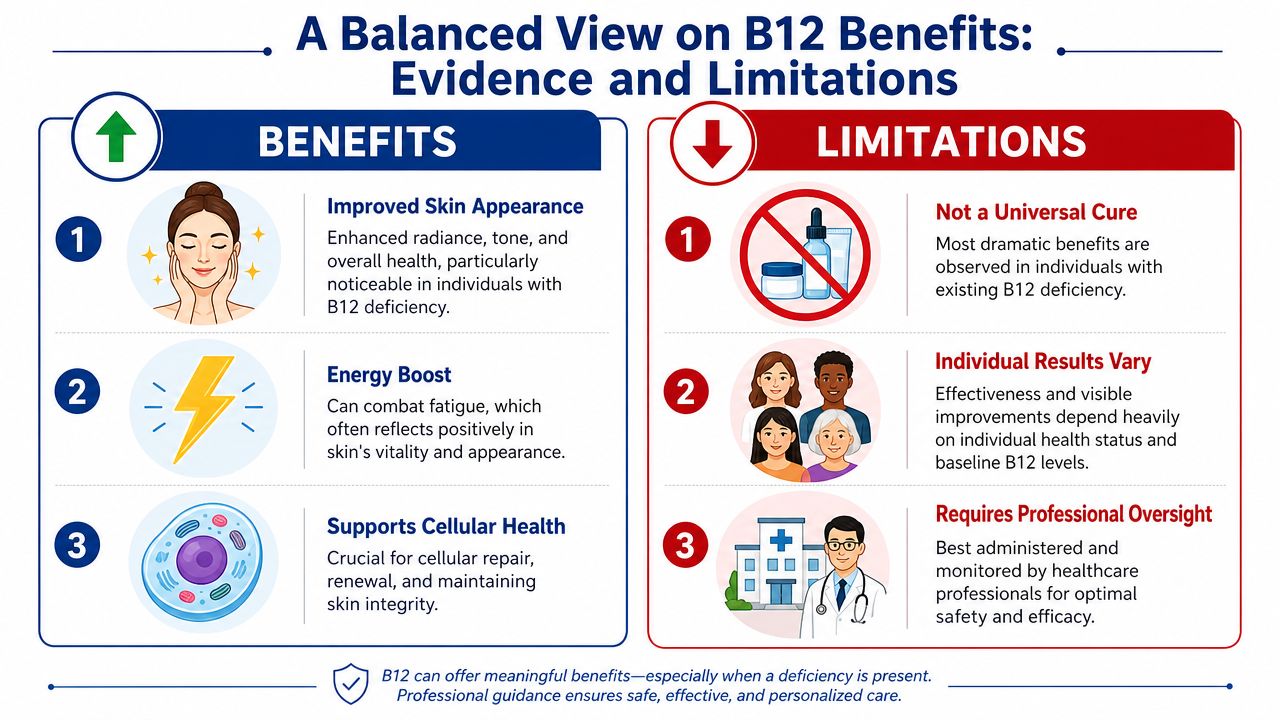
For B12-sufficient patients, the evidence is limited. Some people report that they look better after treatment, but that can reflect correction of fatigue, improved routine, better sleep, or placebo effect as much as any direct skin change. I tell patients the same thing in consults. If your goal is brighter skin and your B12 status is normal, injections are not a predictable substitute for targeted skin care, sun protection, acne treatment, or procedures chosen for your actual skin concern.
Side effects also matter, especially for acne-prone patients.
B12 injections are generally well tolerated, but they are not automatically a win for every skin type. Some patients can break out or notice worsening acneiform eruptions after supplementation. That risk does not mean B12 should be avoided across the board. It means candidacy should be judged carefully, with your skin history, deficiency risk, and goals in mind. If you want a clearer summary of those trade-offs, read our guide to B-12 shot side effects and skin reactions.
That balanced approach is what ethical treatment should look like. B12 can be helpful for the right patient. It is less convincing as a universal skin booster for someone who is already replete, feels well, and is mainly hoping for a cosmetic glow.
Your B12 Treatment at ProMD Health Bel Air
A good B12 visit shouldn't feel like a beauty trend appointment. It should feel like a medical service with clear reasoning behind it.
What the appointment usually looks like
At ProMD Health Bel Air, the process starts with a consultation. A provider such as Amanda Pittillo, PA-C or Lauren Mason, PA-C, MSHS can review your symptoms, health history, and goals to decide whether B12 makes sense for you. That matters because candidacy isn't just about wanting brighter skin. It's about whether your overall picture suggests deficiency, poor absorption, or another reason B12 support may be appropriate.

The injection itself is quick. Most patients describe it as brief and manageable. There may be minor soreness at the injection site, but it's generally a simple in-office treatment performed in a clinical setting.
A thoughtful consultation usually covers:
- Your reason for seeking treatment such as fatigue, dullness, or a known deficiency history.
- Your skin pattern including whether you're acne-prone or prone to flushing.
- Your treatment expectations so the likely outcome stays realistic.
- Your maintenance plan because one injection and an ongoing protocol are different decisions.
The best B12 candidates aren't the people chasing hype. They're the people whose symptoms and history make B12 a logical fit.
What kind of timeline makes sense
A common injection protocol for correction, cited in this dosing overview for B12 skin support, is 1,000 mcg daily for 10 days, then weekly for one month, then monthly maintenance. That same source notes visible improvements in skin tone and radiance may occur in 2–8 weeks.
That timeline is important because it keeps expectations realistic. B12 is not like makeup, and it's not like a same-day tightening procedure. If it helps, the change is usually gradual and tied to improved internal function.
Patients who want details on scheduling and treatment logistics can learn more about B-12 treatments.
Frequently Asked Questions About B12 Injections
The questions I hear most often are less about the injection itself and more about whether it is worth doing for skin. That is the right place to focus. B12 can help the right patient, but it is not a universal glow treatment.
B12 Injection FAQ
| Question | Answer |
|---|---|
| Will B12 injections make my skin glow if I'm not deficient? | They might, but that outcome is not predictable. In practice, the clearest skin benefit comes from correcting a true deficiency, especially when dull tone, pallor, or slow recovery are part of the picture. If your levels are already normal, the cosmetic upside is much less certain. |
| How soon might I notice skin changes? | Skin changes tend to be gradual. If B12 is addressing an underlying deficiency, some patients notice improvement over several weeks rather than days. It should be approached as a corrective treatment, not a same-day cosmetic result. |
| Can B12 help with eczema? | B12 injections are not a standard eczema treatment. Some dermatology research has looked at topical B12, which is different from an injection. If eczema is the main concern, a targeted skin plan usually makes more sense than relying on B12 shots alone. |
| Can B12 injections cause breakouts? | Yes. Acne flares can happen in some patients, and that risk deserves a clear discussion before treatment. I am more cautious in patients who already break out easily or have a history of inflammatory acne. |
| Do B12 injections help hyperpigmentation? | They can help if pigment changes are tied to B12 deficiency. In that setting, correcting the deficiency may allow the skin to normalize over time. If pigmentation is caused by sun damage, melasma, acne marks, or irritation, B12 is usually not the main answer. |
| Are B12 shots a replacement for skin treatments? | No. They can support skin health from the inside when medically appropriate, but they do not replace treatments aimed at texture, discoloration, acne scarring, or laxity. Those concerns often need a separate plan. |
| What does the appointment feel like? | The injection is quick and usually well tolerated. The more important part is the medical screening, because the best result comes from choosing B12 for the right reason, not adding another wellness shot without a clear indication. |
A fair takeaway is simple. B12 injections can support skin health when deficiency, symptoms, and history line up. They are less convincing as a blanket beauty treatment for every patient.
If you're considering B12 for fatigue, wellness support, or skin-related concerns, the team at ProMD Health Bel Air can help you decide whether it fits your goals and health history. A medically supervised consultation can clarify whether B12 is likely to support real improvement, or whether another treatment path makes more sense for your skin.