You might be looking in the mirror on a normal morning, tilting your face toward the light, and realizing the under-eye groove is the first thing you see. That moment sends a lot of people straight into filler research, but the core question isn't how to erase a shadow, it's whether that shadow is a filler problem at all.
Under-eye rejuvenation is one of those topics that sounds simple until you look closely at the anatomy. The tear trough can reflect volume loss, skin thinness, pigment, or true fat herniation, and those causes don't all respond the same way. In practice, the best outcomes usually start with a candid discussion about what the groove means, what filler can realistically improve, and what it can't.
Table of Contents
- Why the Under-Eye Area Misleads So Many Patients
- What Tear Trough Filler Actually Is
- Who Is and Is Not a Good Candidate
- Filler Types Used in the Tear Trough
- How the Procedure Actually Unfolds in Bel Air
- Safety, Risks, and How to Think About Complications
- Recovery, Aftercare, and How Long Results Actually Last
- What Tear Trough Filler Costs in Bel Air
Why the Under-Eye Area Misleads So Many Patients
A patient often walks in saying, “I just need one syringe under my eyes.” That assumption makes sense, because the tear trough looks like a single line or hollow. In reality, it's a transition zone between the lower eyelid and the cheek, and the visible darkness is often a shadow problem, not just a volume problem.
Why a shadow is not always a filler problem
The under-eye area can look tired for different reasons at the same time. Skin can be thin. The cheek can be deflated. The lid can sit a little loose. Fat can bulge forward. When those issues overlap, the eye area stops behaving like a simple hollow and starts behaving like a structural change.
Practical rule: if the puffiness is already obvious in bright light, filler is not automatically the first fix.
That's why the first useful question is what's creating the groove, not how much a treatment costs. Someone with a mild hollow and decent skin may do very well with careful filler placement. Someone with prominent bags, laxity, or a lot of surface darkness may need a different plan, or at least a more cautious one.
For patients trying to separate a cosmetic wish from a medical-style decision, it helps to look at broader wellness habits too. A useful outside resource is compare anti aging supplements, especially if you're thinking about skin health as part of a bigger maintenance routine rather than a single procedure.
What the under-eye is really asking for
The tear trough doesn't usually need a dramatic change. It needs the right kind of support in the right place. That's why a good consult sounds less like a sales pitch and more like a diagnosis. A careful injector is looking at the groove, the lid-cheek junction, skin quality, and the way light falls across the face before suggesting anything.
That framing matters because the under-eye is easy to over-market as a universal fix. It isn't. In many people, the smartest outcome is subtle, conservative, and based on what the anatomy can safely tolerate. That's the mindset that keeps the rest of the discussion honest.
What Tear Trough Filler Actually Is
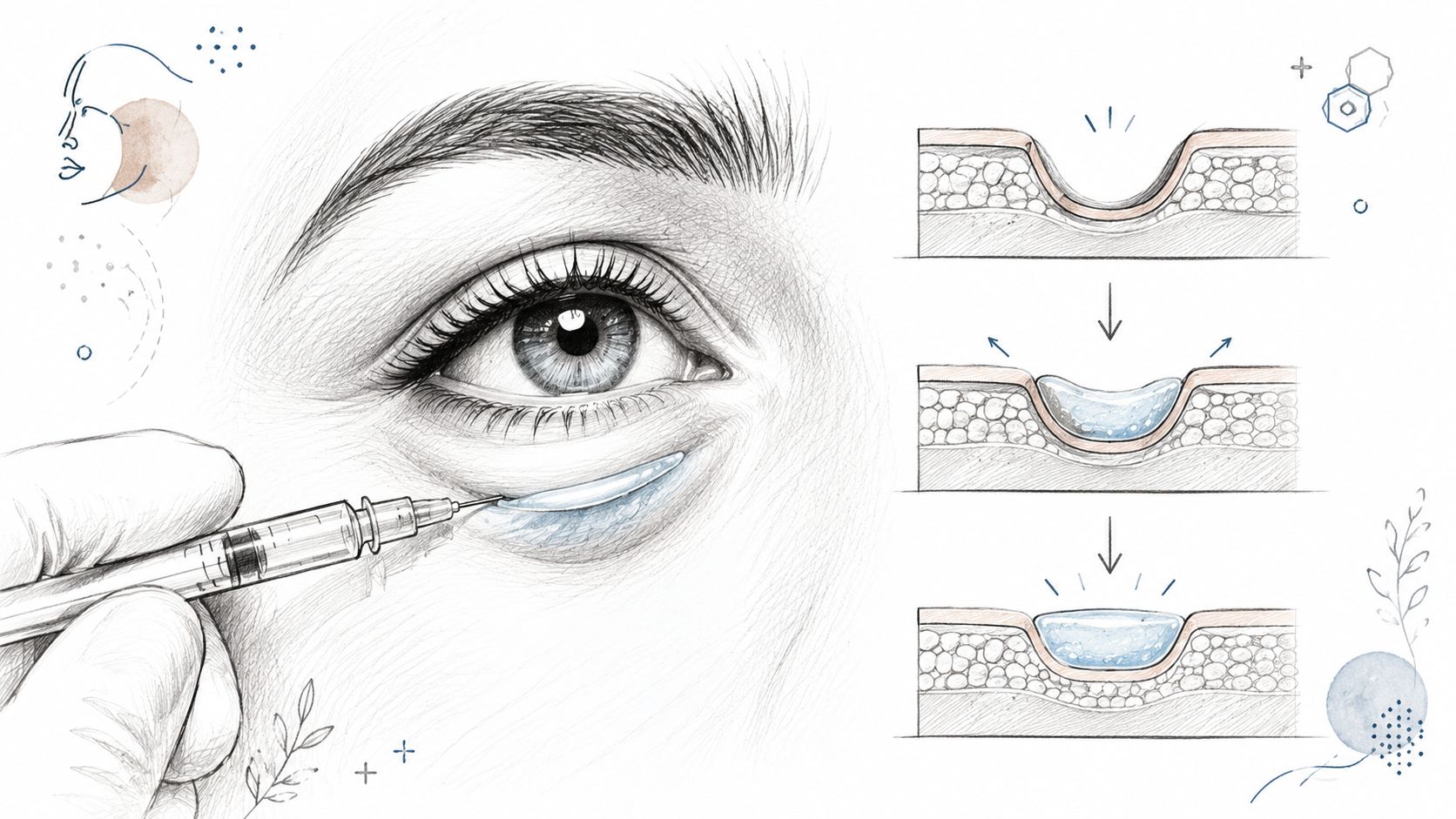
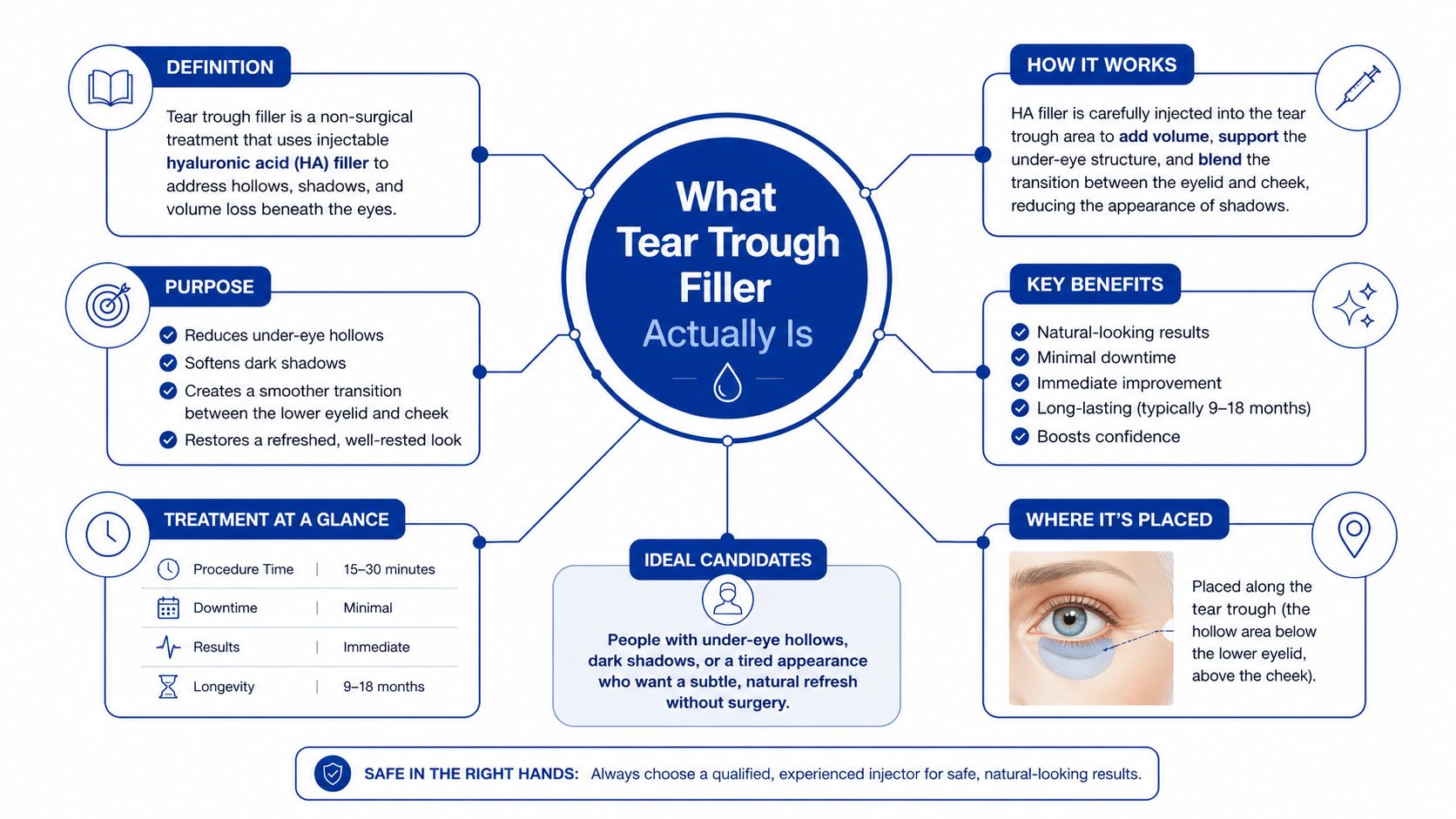
Tear trough filler is a non-surgical injectable that supports the hollow beneath the lower eyelid. In most modern cases, that means a hyaluronic acid gel placed deep near the orbital rim, where it can soften the transition from eyelid to cheek without sitting visibly in the skin.
Think of it as backfilling a trench
The easiest mental model is not “painting over dark circles.” It's backfilling a shallow trench. The filler doesn't erase the anatomy of the tear trough. It adds support beneath the fold so light can reflect more evenly across the lower eyelid and upper cheek.
That's also why the treatment lives or dies on depth and dose. If the product sits too shallow, it can show through. If too much is placed, the under-eye can look heavier instead of smoother. The goal is a small structural correction, not a big volume event.
Why it's part of a midface assessment
A skilled injector rarely evaluates the tear trough in isolation. The cheek supports the under-eye, and the lower lid affects how any added volume reads on the face. If the midface is flat, correcting only the trough can sometimes make the transition look incomplete. If the cheek already projects strongly, the under-eye may need very little.
That's why the treatment is best understood as a precision contouring procedure. It's not the same as filling lips or cheeks, and it shouldn't be approached with the same mental model. Under the eye, small changes can make a big visual difference, which is exactly why the technique has to stay disciplined.
Who Is and Is Not a Good Candidate
The best tear trough candidate is usually the person with mild to moderate hollowing, decent skin quality, and minimal lower-lid laxity. That patient may look tired or shadowed, but the anatomy still gives filler a clean place to work. When the under-eye issue is more about a groove than a bulge, outcomes tend to be more predictable.
When filler makes sense
A good candidate usually has enough tissue quality to hide a small amount of gel. The skin isn't paper-thin to the point of broadcasting product. The lower lid isn't loose enough to drift downward after treatment. And the hollowing is the main concern, not a major bag or festoon.
The right patient asks, “Will filler help my hollow?” The wrong patient often needs to ask, “Why is my under-eye puffy in the first place?”
That distinction matters because filler can improve a shadow, but it can also make puffiness more obvious if the problem is really herniated fat or excess laxity. In those cases, nonsurgical treatment can look busy instead of refreshed.
When to pause or choose something else
Academic guidance says nonsurgical tear-trough treatment is best for carefully selected patients, while moderate-to-severe cases are often better served by surgery or a different approach. The literature also warns against treatment in the setting of active periocular infection, and poor selection can worsen contour issues or create the bluish Tyndall effect when product sits too shallow. Academic review on tear trough candidacy and limitations
That's the part consumer pages often soften. They focus on the promise of instant rejuvenation and skip the part where the wrong anatomy makes filler a poor match. In a real consult, that conversation should be direct. If the issue is true bagging, marked laxity, or obvious festooning, a provider should say so clearly instead of forcing a syringe into the wrong plan.
Bottom line: good candidacy is the treatment. Bad candidacy is where most disappointment starts.
Filler Types Used in the Tear Trough
Most tear trough corrections rely on hyaluronic acid fillers because they are soft, adaptable, and reversible. In review data published by the American Academy of Ophthalmology, hyaluronic acid was the dominant material used in the studies they examined, which matches what many injectors see in practice. The same review also reported that patient satisfaction was high after treatment and remained strong at follow-up, while the most common problems were the kinds we expect under the eye, bruising, swelling, and small contour irregularities. AAO review of tear trough filler outcomes
Why HA is the default
Under-eye tissue is thin, so product choice matters more here than in many other filler areas. A soft HA gel can be placed deep, move with the tissue, and be dissolved if the result is not right. That reversibility is one of the main reasons HA stays the default in a high-visibility zone where small mistakes show quickly.
The logic is straightforward. If the area swells, looks overfilled, or develops an uneven contour, an HA filler gives the injector a correction pathway. That safety net matters more under the eye than in many other locations because the area does not hide error well.
Where other fillers fit, and where they do not
Calcium hydroxyapatite can have a role in selected deeper cases, but it is not the usual first choice for the classic tear trough hollow. Biostimulators, including products such as Sculptra, are more often adjunctive tools than primary under-eye volume products. They can support collagen in broader facial work, but the tear trough itself usually calls for a more controlled, softer approach.
If a product is known for building structure in the cheeks or supporting contour elsewhere, that does not automatically make it a fit under the eyes. The tear trough needs precision and restraint, not just volume. Product selection should be tied to anatomy and risk, not to a one-size-fits-all catalog.
For patients who want to compare product-based approaches before booking, buy Andalou dermal filler online offers a very different context from in-office injection, and the distinction should stay clear. Topical products may fit a skincare routine, but they do not replace a structural correction placed by an injector.
How the Procedure Actually Unfolds in Bel Air
The appointment usually starts before anyone picks up a syringe. During a virtual or in-person consult, the team reviews medical history, looks at the under-eye in different lighting, and decides whether filler, skin work, or a referral makes the most sense. At ProMD Health Bel Air, that same planning visit can also include the Entity Med AI Simulator, which helps patients preview a possible result before they commit to treatment.
The visit from start to finish
Once candidacy is confirmed, the skin is marked and cleaned, then topical numbing is applied. The injector may choose a cannula or a needle, depending on anatomy and technique preference. In either case, the placement is usually deep, near the bone, with small amounts of filler to build support rather than surface fullness.
The most common sensation is pressure, not sharp pain. After injection, the patient is checked upright, because the under-eye looks different when gravity is back in the picture. That upright assessment helps catch contour issues immediately, while they're still easy to evaluate.
| Tear Trough Filler Appointment Flow at ProMD Health Bel Air | What Happens | Approximate Time |
|---|---|---|
| Consult | Medical history, under-eye assessment, treatment planning | Variable |
| Marking and prep | Skin is marked, cleaned, and numbed | Short |
| Injection | Small-volume placement with a cannula or needle | Brief |
| Upright check | Immediate visual review and final adjustment | Short |
Why the consult matters more than the injection
A careful consult decides whether the plan is filler at all. That's where the anatomy gets sorted out, and that's where patients hear the honest version of what the treatment can and can't do. If the under-eye needs a different strategy, the best result is often the one that avoids treating too early.
That's also why the Bel Air workflow feels slower than people expect. The pace is deliberate because the area is unforgiving. A calm consult, conservative placement, and immediate review are not extras here. They're the procedure.
Safety, Risks, and How to Think About Complications
The under-eye area deserves a stricter safety standard than a lot of filler content admits. Patients see the appeal quickly, and clinics market the fix aggressively, but the anatomy is tight, the skin is thin, and small mistakes show up fast. In published reviews, most problems are minor, yet the area still carries real risk because bruising, swelling, and unevenness are easy to see under the eyes.
A 2023 clinical series using the three-point tangent technique reported 1,452 applications in 583 patients. The median age was 41 years, 84% were women, and the first-treatment volume averaged 0.34 mL per orbit. Those numbers reflect how conservative tear trough work usually is. In that series, 82% reported no complication, while bruising, contour irregularities, Tyndall effect, and rare vascular events still occurred, which is why injector judgment matters as much as product choice. Thieme clinical series on tear trough technique and outcomes
A few risks are common enough that patients should expect them as part of the conversation. Bruising and swelling happen, and a little lumpiness can show up while the filler is settling. The key question is whether the injector is using a method that keeps those issues limited and easy to manage.
What the realistic risk profile looks like
Technique changes the risk profile more than product branding does. Cannula use has been associated with less bruising than needles, 7.2% vs 17.2%, which is one reason many injectors prefer it in the tear trough. Deep placement, usually supraperiosteal or pre-periosteal, also helps keep product away from the visible surface planes. The goal is support, not a brightened ridge of filler sitting too close to the skin.
Reversibility matters here too. With a hyaluronic acid filler, the plan is not just to place product and hope for the best. It is to stay conservative enough that, if the result is not right, there is a way to correct course rather than force more product into an area that already looks crowded. That is the practical difference between treating under-eyes thoughtfully and treating them like a routine wrinkle line.
Patients often focus on whether the filler is trendy. The more useful question is whether the injector understands infrabital anatomy well enough to avoid superficial placement, vascular compromise, and visible contour problems. For a broader patient-facing explanation of under-eye safety and result planning, the internal guide on under-eye filler safety and results gives a straightforward companion view.
What lowers risk in practice
The safest tear trough plan usually starts before the syringe comes out. Patient selection has to be honest. Some under-eyes are hollow enough to benefit from filler, while others need a different approach because puffiness, laxity, or skin quality will not improve with volume alone. If the anatomy is not right, the better result is often to hold off.
That same caution shows up in the clinic workflow at ProMD Health Bel Air. The consult is where the under-eye is studied upright, the likely trade-offs are discussed, and the plan stays conservative rather than chasing a dramatic change. Immediate reassessment after injection matters for the same reason, because the area looks different once gravity is back in play. Small corrections are easier to judge early, before swelling or overfilling makes the picture harder to read.
Patients who are already thinking about the whole eye area often want to keep adjacent habits in check too. A calm approach to lashes, rubbing, and irritation helps avoid adding noise to the under-eye assessment. The Afterglow guide to lash health is useful if you want to look at eye-area care as one system instead of separate cosmetic pieces.
The main point is simple. Tear trough filler can be done well, but the margin for error is smaller than most marketing suggests. Conservative dosing, correct depth, immediate upright review, and a willingness to stop early are what keep minor issues minor.
Recovery, Aftercare, and How Long Results Actually Last
The first few days after tear trough filler are usually the part patients worry about most. In practice, they are often manageable when the injection is conservative and the aftercare is followed. Swelling is expected, bruising can happen, and the under-eye may look more noticeable before it looks smoother. That is common during the first 72 hours, when tissue reaction is still stronger than the final cosmetic effect.
What the first few days usually feel like
Cold compresses can help with swelling, and sleeping with the head slightly raised is a sensible choice. Strenuous exercise is usually best avoided for a day or two because heat, blood flow, and movement can make swelling and bruising linger. If bruising occurs, it usually fades on its own, although the timing depends on the person and on where the filler was placed.
Small uneven areas can settle as the product integrates. The immediate result is not the final result, especially in a region as unforgiving as the lower eyelid. The tissue still needs time to calm down after the injection, and that early adjustment period can make the area look different from what it will show later.
The two-week settling window
By about two weeks, the under-eye usually shows a more reliable result. That is the point when the provider can judge whether the balance is right, whether a small touch-up makes sense, or whether the plan should stay exactly as it is. With hyaluronic acid, a light adjustment is often smarter than adding more product to an area that already has enough support.
For patients who want broader context on maintenance, the article on how long dermal fillers really last explains the general pattern of filler longevity. In the tear trough, the practical expectation is still measured in months, not permanence.
How long results tend to hold
Clinical experience typically shows that hyaluronic-acid results last for several months, and maintenance is often needed if the patient wants to keep the effect. Some people hold their result longer than others because metabolism, placement, product choice, and under-eye anatomy all play a role. That is why follow-up planning matters as much as the injection itself.
The main point is straightforward. Tear trough filler does not disappear overnight, but it also should not be treated as a one-time fix. If the result is a good fit, the under-eye may look better for a meaningful period, then gradually soften enough that reassessment or repeat treatment becomes part of the plan.
Practical rule: if the under-eye still looks puffy after swelling should have settled, more filler is not automatically the answer.
What Tear Trough Filler Costs in Bel Air
A price quote for tear trough filler rarely tells the full story. Under-eye treatment is driven as much by judgment as by product volume, and that judgment affects whether the result looks rested or puffy. Cost depends on provider expertise, the filler chosen, whether one side or both sides are treated, how much product is used, and whether the visit includes a broader under-eye or midface assessment. That is why this treatment is usually discussed per area or per syringe instead of as a flat fee.
What changes the price
A conservative plan can cost less at the start if it avoids overcorrection and unnecessary product. A rushed plan may look cheaper on paper, but it can become more expensive if correction or dissolution is needed later. In the tear trough, a careful first step is often to place less product and reassess, rather than try to solve every contour issue in one visit.
That approach also reflects the value of reversibility. With hyaluronic acid, there is a practical route to adjust or dissolve if needed, which is one reason many first-time patients and injectors prefer it in this zone. The price conversation should include that safety margin, not just the syringe count. For a broader look at how fees are built and how to judge value, see understanding filler pricing and value.
How to approach the consult as a patient
Bring a clear medical history, a list of current supplements and medications, and a few realistic photos of your under-eye area in different lighting. Those details help the provider decide whether the hollow is the right target and whether the skin can support filler cleanly. If you are unsure whether to book virtual or in person, either can work as a first step, but an in-office exam usually gives the best read on anatomy.
ProMD Health Bel Air offers virtual consultations, financing options, and periodic specials, so the most accurate pricing conversation happens after the consult, not before it. The clinic is at 2023 Emmorton Rd, Suite A, Bel Air, Maryland, and it treats tear trough filler as part of its dermal filler service line. If you want a realistic plan instead of a rushed purchase, compare candidacy, technique, and cost in one appointment.
If you are thinking about the under-eye area, start with a consult, not a syringe. ProMD Health Bel Air can assess whether tear trough filler fits your anatomy, explain the safety trade-offs, and map out a conservative plan if you are a good candidate. Visit ProMD Health Bel Air to book a virtual consultation or an in-person visit in Bel Air.