
Many people think an injectable has to fill the face to make it look younger. Sculptra works differently, it asks your skin to rebuild its own support over time, which is why the change can look softer and more natural than an instant volume fix. That slower pace is the point, not a drawback.
For patients in Bel Air who want a clearer mental model before they book anything, the easiest way to understand Sculptra is to think of it as a collagen-based rejuvenation treatment. The product is designed to help replace what time has taken away, and the evidence behind it ties the benefit to measurable improvement in wrinkles, contour, and skin quality, not just temporary puffiness (FDA Summary of Safety and Effectiveness Data, Sculptra patient information).
Table of Contents
- Why Sculptra Is Built Around Rebuilding, Not Filling
- How Sculptra Stimulates Collagen Under the Skin
- The Core Benefits of Sculptra for Bel Air Patients
- What the Treatment Timeline and Downtime Look Like
- How Sculptra Compares to Dermal Fillers and Other Bel Air Options
- Common Misconceptions About Sculptra
- Candidacy, Safety, and Your Next Steps at ProMD Health Bel Air
- Key Takeaways and How to Move Forward
Why Sculptra Is Built Around Rebuilding, Not Filling
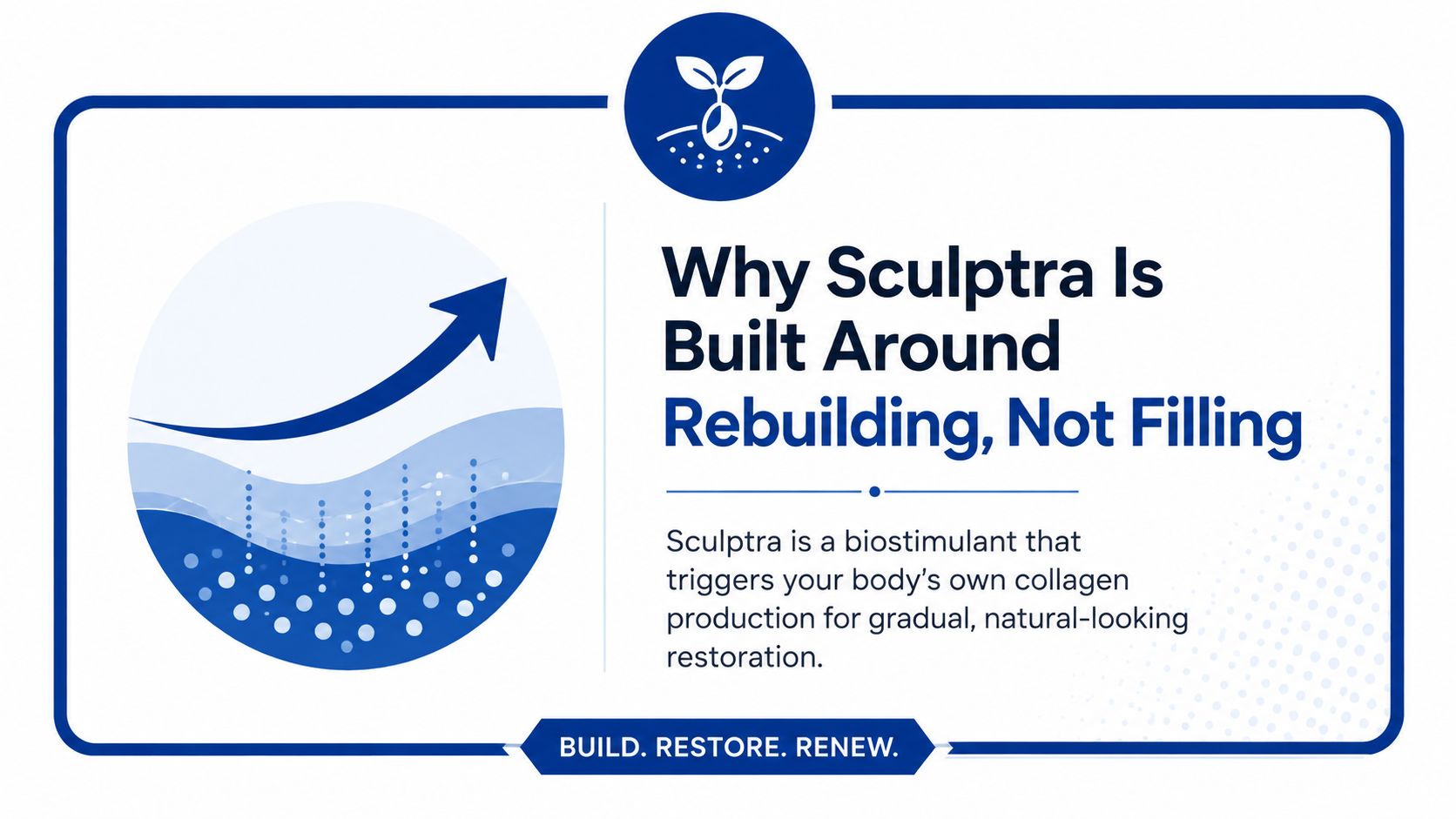
Sculptra rebuilds collagen rather than placing volume in one spot. That difference shapes how you should read every benefit that follows. If you expect an immediate puffed-up result on day one, you can miss the work it is doing under the skin.
Why the distinction matters
Traditional fillers add volume where contour has been lost. Sculptra works more like a signal to your skin, encouraging it to restore structure gradually instead of just occupying space. For people noticing facial aging, that matters because the concern is usually broader than one line or one hollow. It is often a general loss of support.
The manufacturer's patient information says results can appear as early as 1 month and last up to 2 years, with 95% of patients reporting improved skin glow at the 2-year mark. That longer timeline fits the biology behind treatment, because collagen loss is part of aging, and the same source notes that after age 20, people lose about 1% of collagen per year.
Practical rule: If the goal is structural support with a natural finish, a slower treatment often makes more sense than a fast one.
What that means for a first-time patient
A patient in Bel Air who wants to look refreshed without looking treated usually appreciates this approach once it is explained clearly. The change is meant to build gradually. Instead of chasing a dramatic one-day correction, Sculptra aims for improvement that blends into your own facial features.
That is why the benefits of Sculptra are easiest to understand as a rebuilding process. It is about giving your skin the conditions it needs to create a better foundation over time. If you want a broader look at the science behind that process, this local guide to collagen induction therapy explains the same basic principle. A result built this way usually feels more like your own face, just better supported.
How Sculptra Stimulates Collagen Under the Skin
Sculptra uses poly-L-lactic acid, or PLLA, to prompt a healing response under the surface. Think of it less like placing a soft cushion and more like giving your skin a reason to repair itself. That's why the visible changes don't show up immediately, and why the results feel more earned than pushed.
What happens after injection
After Sculptra is placed, the body responds to the material over time. The treatment doesn't act like a temporary gel, it works beneath the skin to encourage new collagen production. In plain language, the skin is being nudged to rebuild some of the support that naturally weakens with age.
That aging process matters. The manufacturer notes that after age 20, people lose about 1% of collagen per year. As that scaffold thins, the face can look flatter, softer, or more shadowed even when nothing else has changed.
The delay is part of the mechanism. If you see change slowly, that usually means you're watching the tissue respond rather than just watching product sit in place.
For readers who like a bigger-picture explanation, the science behind collagen induction is also described in this local guide to collagen induction therapy. The core idea is the same, when the skin is guided to make more of its own support, the result tends to look more integrated.
Why gradual results are useful
A lot of first-time patients worry that slow means weak. In aesthetics, that's not always true. A gradual build can be easier to blend across the face, especially when the concern is overall softening rather than one isolated wrinkle.
A detailed review of PLLA-SCA reported that the treatment can increase the thickness of the dermis and dermal adipose layers by 26.1% and 27.0%, respectively, 9 months after injection, and it also noted wrinkle improvement lasting up to 25 months in published studies. That tissue-level change is exactly why Sculptra is usually discussed as a rebuilding treatment instead of a classic filler.
The Core Benefits of Sculptra for Bel Air Patients
Collagen-based rejuvenation
Sculptra's main advantage is straightforward. It helps the skin rebuild its own support instead of relying on instant surface volume. That distinction matters because the face is not a flat canvas, it is a layered structure. When the deeper support improves, the skin can look less hollow and less worn, even before anyone notices a specific wrinkle disappearing.
The FDA's summary of safety and effectiveness data links the approval evidence to improvement in the visual appearance of fine lines and wrinkles in the cheek region, assessed by blinded evaluators using a wrinkle scale (FDA Summary of Safety and Effectiveness Data). For a patient, the takeaway is practical. The change comes from support rebuilding under the skin, so the result often reads as healthier and better rested rather than obviously “done.”
Gradual, natural-looking volume
Sculptra is designed for progressive improvement. That slower pace is not a delay in the treatment working, it is the treatment working through the tissue. A wrinkle can be smoothed in a day by placing volume directly under it, but collagen rebuilding asks the skin to change its own structure, so the face tends to soften in stages.
In a clinical trial reported by Sanofi, results began 3 weeks after the last treatment and continued through 13 months of follow-up, with 49% of Sculptra patients reaching wrinkle-assessment scores of less than 2, compared with 4% for the collagen-implant comparator (Sanofi trial report). The same report said the treatment effect lasted up to 13 months, while the comparator lasted only 3 months (Sanofi trial report). That kind of progression helps explain why the result can look more natural than a quick volume correction. The face changes with its own tissue, not on top of it.
Long-lasting satisfaction and glow
Another reason patients like Sculptra is that the benefits are not limited to one visible line or fold. The manufacturer reports that results can last up to 2 years, and that 95% of patients reported improved skin glow at the 2-year mark. A separate manufacturer report says 86% of patients had improved jawline contour and over 84% reported natural-looking results and interest in repeat treatment (Galderma report). Those outcomes matter because they point to more than one effect, contour, skin quality, and how patients feel about the result.
That broader satisfaction is one reason Sculptra is often discussed alongside other non-surgical approaches in Bel Air. If you want a wider look at how longer-lasting aesthetic results are framed, this discussion of the lifespan of youth in non-surgical facelifts gives useful context. Sculptra sits in that category of treatments that aim to improve the face gradually, then let the change hold through rebuilt support.
Structural support rather than surface filling
Sculptra is especially useful for patients who feel that the face has lost its framework. It does not try to correct every line at once. Instead, it supports the larger structure beneath the skin, which can help the cheeks, jawline, and overall contours look more balanced without calling attention to the procedure.
That difference is easier to understand if you compare treatment goals. Surface fillers are built for direct, immediate filling. Sculptra is built for collagen support over time. If you are deciding which approach matches your goals, this dermal fillers overview can help you separate instant volumizing from gradual rebuilding. Some patients need one approach, some need the other, and many do best with a plan that respects both the structure of the face and the pace of the change they want.
What the Treatment Timeline and Downtime Look Like
Sculptra is easiest to live with when you plan for the process instead of the instant moment. You start with a consultation, then move into a treatment series based on facial structure, degree of volume loss, and how much change you want.
A practical timeline
The first visit is usually about assessment and planning. From there, the injections happen in a series rather than a single one-and-done session, because the goal is to let the skin respond and then decide whether more support is needed. The literature background notes that multiple sessions are common, and results develop over several weeks or months.
The manufacturer says results may appear as early as 1 month and last up to 2 years. In the U.S. clinical study summarized in FDA materials, 92.0% (81/88) of treatment-group subjects reported improvement in the overall aesthetic appearance of fine lines and cheek wrinkles at 12 months. That's a helpful marker for people who want to know whether the benefit is fleeting or durable.
Planning rule: If you have an event coming up soon, don't assume Sculptra is the right last-minute fix. It's a timeline treatment.
Downtime and day-to-day planning
Downtime is usually modest compared with more invasive procedures. Most patients can return to normal routines quickly, though they should still plan for a little swelling, tenderness, or bruising around the injection sites. The main thing to understand is that early puffiness isn't the final result.
That means the safest way to schedule Sculptra is with patience, not pressure. If you give the collagen-building phase room to do its work, the outcome tends to fit the face more naturally and last longer. Patients who like to track progress often find the treatment more satisfying when they think in months, not days.
How Sculptra Compares to Dermal Fillers and Other Bel Air Options
Sculptra fits best when the concern is broader structural loss that has made the face look less supported over time. Hyaluronic acid fillers still have an important role, especially for patients who want precise shaping or an immediate visible change. The difference comes down to mechanism, pacing, and the kind of result you want.
| Aspect | Sculptra | Hyaluronic Acid Fillers |
|---|---|---|
| Main mechanism | Collagen stimulation | Direct volume replacement |
| Onset | Gradual | Immediate |
| Longevity | Can last up to 2 years | Varies by product and treatment plan |
| Best fit | Broader structural support, natural-looking change | Targeted shaping, faster visible correction |
| Look and feel | Subtle, progressive | More immediate, more defined |
That table is useful because it shows the treatment logic in plain terms. Sculptra works more like a rebuild process, while dermal fillers act more like targeted replenishment. If a patient wants to soften overall hollowness and let the face change gradually, Sculptra often matches that goal well. If the need is to refine a single line, restore a specific contour, or see a faster adjustment, dermal fillers are usually the more direct option.
The same framework helps patients compare Sculptra with other aesthetic services in a clinic setting. Microneedling is aimed at texture, while a thread lift changes tissue position. Sculptra sits in its own category because it builds support from within instead of resurfacing the skin or physically lifting it from outside.
If you are sorting through those choices, the article on best practices for spa visibility can help frame how patients often evaluate services by pace and expected outcome. The clearest choice is usually the one that matches the main concern, whether that is gradual support, surface refinement, or immediate contour correction.
Common Misconceptions About Sculptra
A common misunderstanding is expecting Sculptra to look obvious right away. The treatment is designed to change gradually as collagen rebuilds under the skin, so the early result can feel quiet if someone is waiting for a classic filler-style change on day one.
Four misunderstandings that come up often
- “It works overnight.” It does not, and that slower pace reflects how collagen stimulation works. The face is being encouraged to rebuild support over time, so the result appears in layers rather than all at once.
- “It's the same as every other filler.” Sculptra works differently because its main role is stimulation, not replacement. That difference matters because the goal is to improve the skin's support structure, not just place volume in a single spot.
- “It's only for older patients.” Adult patients can consider it earlier when they want subtle support before hollowing becomes more noticeable. The treatment is about the pattern of volume loss, not a fixed age group.
- “Natural results mean no visible change.” Natural-looking results can still be meaningful. They are more progressive and less dramatic than a fast correction that makes one area stand out immediately.
Another point of confusion is where Sculptra fits beyond the face. The MedicalSparx overview discusses use in areas such as the hands, neck, décolleté, atrophic scars, and post-breast-reconstruction chest wall correction, but those applications are off-label and separate from the FDA-labeled facial indication. That distinction matters because a treatment with a defined facial purpose should not be treated as if every other use has the same evidence base or the same approval status.
Clear education also helps patients make better decisions. A resource on best practices for spa visibility makes the same larger point from a clinic-communication angle, clear explanations usually help people understand what a service can realistically do, while vague marketing tends to create confusion.
The main takeaway is straightforward. Sculptra is a gradual tissue-building treatment with a specific role, and it makes the most sense for patients who value patience, subtlety, and a result that develops the way healthy support tissue develops.
Candidacy, Safety, and Your Next Steps at ProMD Health Bel Air
Sculptra is a good fit for adults who want gradual facial support, especially when the concern is softening, hollowing, or broader contour loss. That makes it a different kind of choice from a treatment meant to create instant, highly precise correction in one spot.
Who needs a careful consult
A careful consultation should review allergies, skin conditions in the treatment area, scarring history, and whether the patient is pregnant or breastfeeding. Those details shape both safety and suitability, and they matter just as much as the aesthetic goal. The FDA materials note that the key clinical benefit was measured in cheek wrinkles, so the treatment should be matched to the right concern rather than stretched into every possible use case.
A good clinician also helps separate what Sculptra can do from what it cannot do. Because it works by encouraging collagen support over time, it is better suited to people who are comfortable with a slower, more layered result. Patients who want a single-area correction with immediate precision may do better with a different approach.
Next steps that make sense
At ProMD Health Bel Air, the next step is a consultation, in person or virtually, so the team can look at your facial pattern and discuss whether Sculptra fits your goals. The office also uses the Entity Med AI Simulator to preview potential outcomes, which gives you a clearer way to talk through expectations before you commit to a treatment plan.
That kind of preview matters because Sculptra is not about chasing a dramatic before-and-after moment. It is about matching the treatment to the way your face loses support, then planning for a gradual rebuild that feels believable on your features.
Bel Air patients from Fallston, Forest Hill, Abingdon, and Havre de Grace can use the same local route into care, which keeps planning simple and nearby. That local convenience matters when the result develops over time rather than in one visit.
Key Takeaways and How to Move Forward
Sculptra is best understood as a long-game collagen investment. It's not built to flood the face with instant volume, it's built to encourage your skin to rebuild support so the result can look softer, steadier, and more natural.
The main points worth remembering are simple:
- It rebuilds, it doesn't just fill.
- Results arrive gradually, often starting around a month and continuing to improve.
- The benefits can be durable, with manufacturer-reported results lasting up to 2 years.
- It's especially useful when the concern is contour, glow, and overall facial support.
- It should be matched to your goals, not treated as a replacement for every other injectable.
That's why the benefits of Sculptra resonate with patients who want change that fits their face instead of overpowering it. If you're still deciding between Sculptra, fillers, or another clinic service, the right consultation can make the choice much clearer. A simple preview through the Bel Air office can help you see whether gradual collagen support matches what you want to look like over time.
If you're thinking about Sculptra in Bel Air, ProMD Health Bel Air can walk you through candidacy, planning, and a realistic results timeline. Visit ProMD Health Bel Air to book a consultation and explore whether this collagen-building approach fits your goals.