You notice it first in the side mirror or in a tagged photo. Your smile still looks like yours, but the little lines at the outer corners of your eyes seem deeper than you expected, especially when you squint, laugh, or turn toward bright light. If that's the moment you're in, Dysport for crow's feet is really about one practical question, how much softening do you want, and how much of your natural smile do you want to keep?
Table of Contents
- What Dysport for Crow's Feet Really Means
- How Dysport Actually Softens Crow's Feet
- Dysport vs Botox for Crow's Feet
- Dosing Logic and What Happens at Your Appointment
- Results Timeline From Day One to Day One Hundred
- Why More Units Is Not Always the Better Result
- Safety Candidacy and Smart Aftercare
- Booking Your Dysport Consultation in Bel Air
What Dysport for Crow's Feet Really Means
Crow's feet are the lines that fan out from the outside corners of the eyes when you smile or squint. That matters because these lines are usually a dynamic-expression issue, not a skin-quality issue. The muscle movement is doing most of the work, so a treatment that relaxes that movement is the right tool.
Dysport is an abobotulinumtoxinA injectable used in adults under 65 for the temporary improvement of moderate to severe lateral canthal lines. The labeled crow's-feet dose is 10 U at each of 3 injection sites per side, which comes to 30 U per side and 60 U for both sides. That label gives you the framework, but the discussion is how your own smile moves and how much softening still looks natural on your face.
At ProMD Health Bel Air, this treatment sits inside the clinic's Dysport service, and consultations are available in person at the Emmorton Rd office. That local setting matters because the most useful plan comes from seeing your face at rest and in motion, not from guessing from a photo alone.
Practical rule: if your crow's feet mainly show up when you smile, a neurotoxin can help. If the lines are prominent at rest, you may still benefit, but the conversation changes.
A lot of people come in thinking they need the strongest possible result. The better question is what level of smoothing still looks like you. That is the lens for the rest of this guide.
How Dysport Actually Softens Crow's Feet
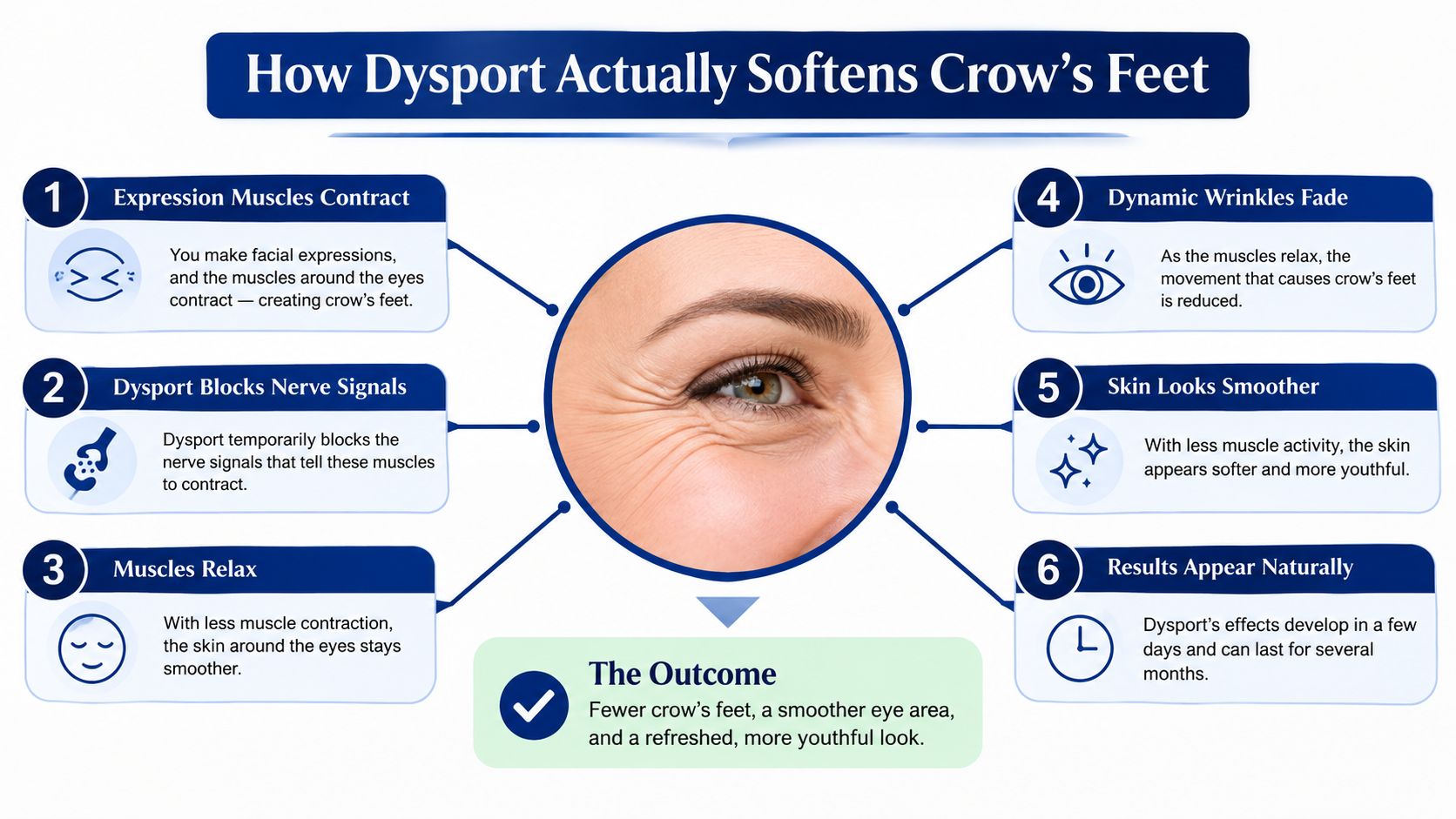
Dysport works like a brief dimmer switch on the small eye muscle that helps create crow's feet, the orbicularis oculi. Instead of letting that muscle pull as hard every time you smile or squint, the treatment temporarily quiets the nerve signal that tells the muscle to contract. The skin above it gets creased less often, so the lines look softer.
Dynamic lines and static lines are not the same problem
This is the part many people miss. Dynamic lines are the ones you see when the face moves, while static lines stay visible even when you're relaxed. Dysport is built for the first problem. It reduces the repeated folding that happens with expression, which is why it's especially useful for crow's feet that flare during a genuine smile.
That's also why the effect is temporary. Botulinum toxin A products work by interrupting the signal between nerve and muscle, then the nerve endings regenerate over time. As that happens, movement gradually returns. The treatment doesn't erase your anatomy, it just gives the skin a break from the same repeated crease pattern.
Why the eye area responds the way it does
Crow's feet sit at the edge of a very expressive zone. A small change in muscle pull can alter how the outer eye looks, which is why experienced injectors tend to be conservative there. Too little treatment can leave the lines unchanged, while too much can make the smile look stiff. The goal is not to freeze the area. The goal is to reduce the crease enough that your eyes still animate naturally.
The best crow's-feet treatment isn't the one that erases every line. It's the one that leaves your smile recognizable.
That balance is the whole game around the eyes. Once you understand that, dose and product choice make a lot more sense.
Dysport vs Botox for Crow's Feet
A first-time patient usually wants to know which product is better right away, and that question makes sense. For crow's feet, both can work well in skilled hands. The difference is not a simple winner or loser; it is how each option fits the way your face smiles, squints, and relaxes.
Dysport tends to spread a little more from the injection point, which can help create a softer blend when the plan is placed carefully. Botox is often described as more localized. Around the outer eye, that difference is less about one product being stronger and more about matching the treatment to the shape of the lines and the amount of movement you want to keep.
The most useful comparison is the one that asks how the face looks when it is animated. A split-face trial published in 2011, discussed in Reuters coverage of the trial, reported that 90 participants received one product on each side of the face. At maximum smile, about two-thirds of subjects preferred the Dysport-treated side, while at rest there was no statistically significant difference between the two products. That matters because crow's feet are usually judged in motion, not just in a relaxed mirror view.
What that means in a real consultation
If your crow's feet show up most when you grin, laugh, or squint in bright light, Dysport can be a very reasonable choice. If the lines bother you more at rest, the brand choice matters less than the treatment plan itself. The result comes from where the product is placed and how much movement the injector is trying to preserve.
There is a simple way to frame the decision. Dysport may spread a bit more, but the injector still controls the outcome. The person placing the product matters more than the name on the vial.
For readers comparing treatment details before booking, this overview of Botox and Dysport options can help you see how a clinic explains the two treatments for different facial patterns.
Dosing Logic and What Happens at Your Appointment
The labeled crow's-feet protocol is straightforward, 10 U at each of 3 injection sites per side. That gives you the starting map, but it does not decide the final look by itself. In real treatment, the bigger question is how much smile expression you want to keep, because the goal is usually softer lines, not a frozen smile.
For that reason, dosing stays individualized. A published comparison looked at Dysport at 15, 30, and 45 units per eye and described the 15-unit dose as a reasonable starting point for younger patients, while higher doses gave more benefit in older patients MDEdge report on the study. The practical takeaway is simple, a smaller dose may preserve more movement, while a larger dose may soften the crow's feet more completely.
What a visit usually feels like
The appointment begins with a brief intake and a close look at how your eyes move. The injector checks your face at rest, then asks you to smile or squint so the line pattern becomes clear. From there, the injection points are marked, the product is placed in just a few minutes, and you get a quick post-treatment check before you leave.
Most first-time patients are surprised by how fast it goes. The injections feel like quick pinches, not a long procedure. The whole visit is often short enough to fit into a normal day without much disruption.
Why a preview can help
Some people like to see a rough sense of possible change before they commit. ProMD Health Bel Air offers the Entity Med AI Simulator for that kind of preview, which can help when you are deciding whether you want subtle softening or a more noticeable reduction in movement. It does not replace an exam, but it can make the conversation more concrete.
Good dosing starts with restraint. Around the eyes, it is usually easier to add a little more later than to undo a heavy-handed first pass.
That is why an experienced injector looks at motion first, dose second, and symmetry all the way through.
Results Timeline From Day One to Day One Hundred
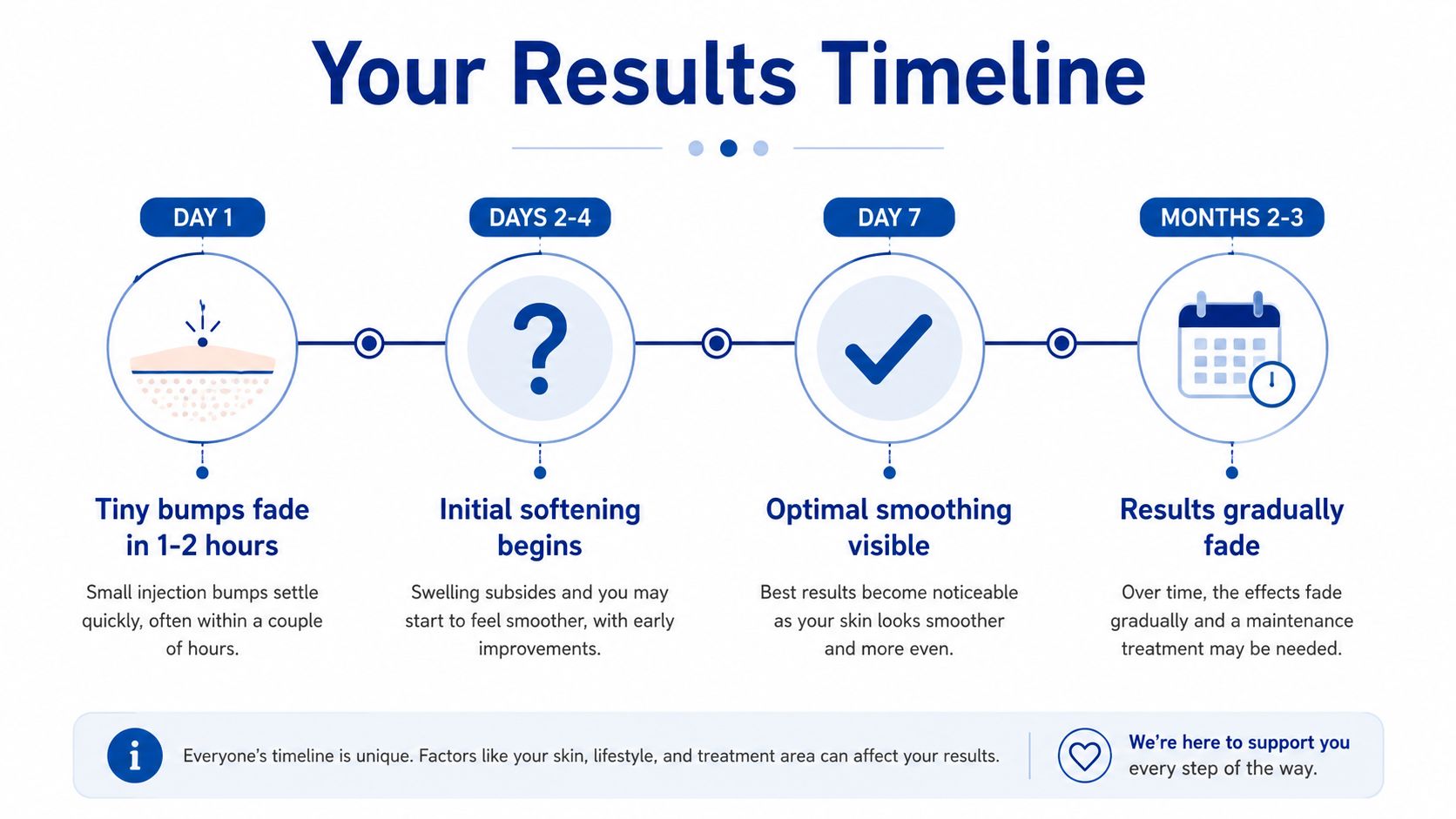
The first change after treatment is often the least glamorous one, a little swelling or a tiny bump where the needle entered. Those spots usually fade quickly. Real crow's-feet softening builds after that, so the timeline matters if you do not want to judge the result too early.
What the first weeks often look like
During the first few days, you may start to notice that the outer eye area moves a little less sharply when you smile or squint. The practical question is not whether the lines disappear completely. It is whether enough motion stays in place to keep your expression natural while the creases soften.
A placebo-controlled botulinum toxin A study found 63.9% of treated subjects reached none or mild severity at day 30 versus 5.0% with placebo, and the median duration of effect was at least 5 months PMC study. Those figures are not a promise for every person getting Dysport for Crow's Feet, but they do explain why this treatment is usually discussed as a durable cosmetic option rather than a same-day change.
A phase III program in the same treatment category reported at least a two-grade improvement in crow's-feet severity in 45% of single-area patients and 55% of simultaneous-treatment patients at one month, with investigator-rated none-or-mild responses of 79% to 84% depending on treatment design PMC study. That kind of data helps set expectations. The goal is not to turn a face into a chart entry. It is to show that the smoothing people look for has a real clinical basis behind it.
How to read your own timeline
Day 1 can look almost unchanged apart from the injection points. Days 2 to 4 are often when people first catch softer movement in the mirror. Weeks 2 to 4 are usually when the result feels most settled, which is why many injectors judge symmetry and expression at that stage before deciding whether anything needs refining. After that, movement slowly returns as the effect wears off over months.
The timeline helps keep the focus on expression preservation instead of maximum flattening. A good result around the eyes is a careful balance. You want the lines to soften without erasing the smile that makes the area look alive.
Why More Units Is Not Always the Better Result
The urge to ask for more is common. If a little smoothing helps, a stronger treatment must help more, right? Around the outer eye, that logic can backfire. Too much weakening can leave the area looking flat, and the smile is often the part patients want to keep.
The question is not how much motion disappears. It is how much expression you want to preserve while the lines soften. The comparison data points in that direction, since the difference showed up more clearly at maximum smile than at rest. That kind of pattern matters because crow's feet live in movement, not just at rest.
A useful way to think about dosing is to start with the face you already have. If your smile is naturally strong, if the skin around the eyes is thin, if one side pulls more than the other, or if this is your first time with a neurotoxin treatment, a lighter plan often makes more sense. It gives the injector room to see how your muscles respond before deciding whether anything should be adjusted.
A follow-up visit helps protect that balance. At a check-in, the injector can compare both sides of the face, look at how the lines are settling, and decide whether a small touch-up would improve symmetry. The first visit should be treated as a starting point, not a final statement.
For readers comparing facial wrinkle treatments more broadly, wrinkle treatment options can help place crow's-feet care alongside other goals for the face.
Best result, not most result. Around crow's feet, that usually means keeping the warmth of your smile while softening the lines that pull attention away from it.
Experience shows up here. Some injectors push for the strongest possible relaxation. A better plan leaves the face looking like your face, just with less distraction around the eyes.
Safety Candidacy and Smart Aftercare
Crow's-feet injections are routine, but routine does not mean casual. The most common effects are small injection-site bumps, mild redness, occasional bruising, and sometimes a brief headache. Less common problems can include eyelid or brow ptosis, an uneven smile, or dry eye symptoms. If they happen, they are temporary, but they still matter because the area around the eyes is close to muscles that shape both expression and comfort.
Who should pause and who should proceed carefully
A strong candidate is usually an adult under 65 with dynamic crow's feet and otherwise stable health. People who are pregnant, breastfeeding, have a neuromuscular condition, or have an active skin infection at the injection site should wait. During consultation, disclose medications, supplements, and any recent aesthetic treatments so the injector can judge bruising risk and spacing. That review helps match the dose to the face in front of you, which ties back to the same expression-preservation question raised in wrinkle treatment options.
The goal is to soften the lines without flattening the smile. Around the eyes, a light touch often makes more sense than chasing the cleanest possible result, because the skin there moves with every expression.
The aftercare that actually matters
Stay upright for four hours after treatment. Skip intense exercise for the rest of the day. Do not rub the area, and if your skin feels warm or tender, a cool compress is the simplest comfort measure. Around the eyes, it also helps to pause retinol or other strong actives for a day or two.
Early asymmetry can be part of the normal settling process. A two-week touch-up window is common if the injector wants to fine-tune symmetry. That is responsible treatment, not proof that anything went wrong. If you are planning visits and reminders around your treatment schedule, it can also help to compare spa appointment platforms, since a smooth booking process makes follow-up easier to keep.
Booking Your Dysport Consultation in Bel Air
The most useful next step is a real consultation, not another hour of scrolling before-and-after photos. Bring a list of your current medications and supplements, note any recent aesthetic treatments, and if you can, bring a photo of your crow's feet at full smile. That last one helps the injector see your natural expression, which is the whole issue you're trying to balance.
ProMD Health Bel Air sees patients at 2023 Emmorton Rd, Suite A, in Bel Air, and the practice also offers virtual consultations and Saturday appointments by arrangement. The team serves Bel Air, Fallston, Forest Hill, Abingdon, and Havre de Grace, so patients in Harford County can usually fit a visit into a normal week without much hassle.
If you're comparing appointment logistics, it can help to think about how smooth scheduling affects follow-through. Even a good treatment plan can stall if the booking process feels clumsy, which is why some readers also like to compare spa appointment platforms when they're figuring out how modern clinics manage consults and reminders.
If you're ready to take the guesswork out of your crow's-feet plan, start with the clinic's booking page at get started now. A consultation gives you the chance to talk through expression preservation, dose, and timing with an injector who can see your face move.
If crow's feet are bothering you when you smile, ProMD Health Bel Air can walk you through Dysport, the dosing logic, and what kind of softening fits your face best. Visit ProMD Health Bel Air to book a consultation and talk through a plan that keeps your expression looking like you.