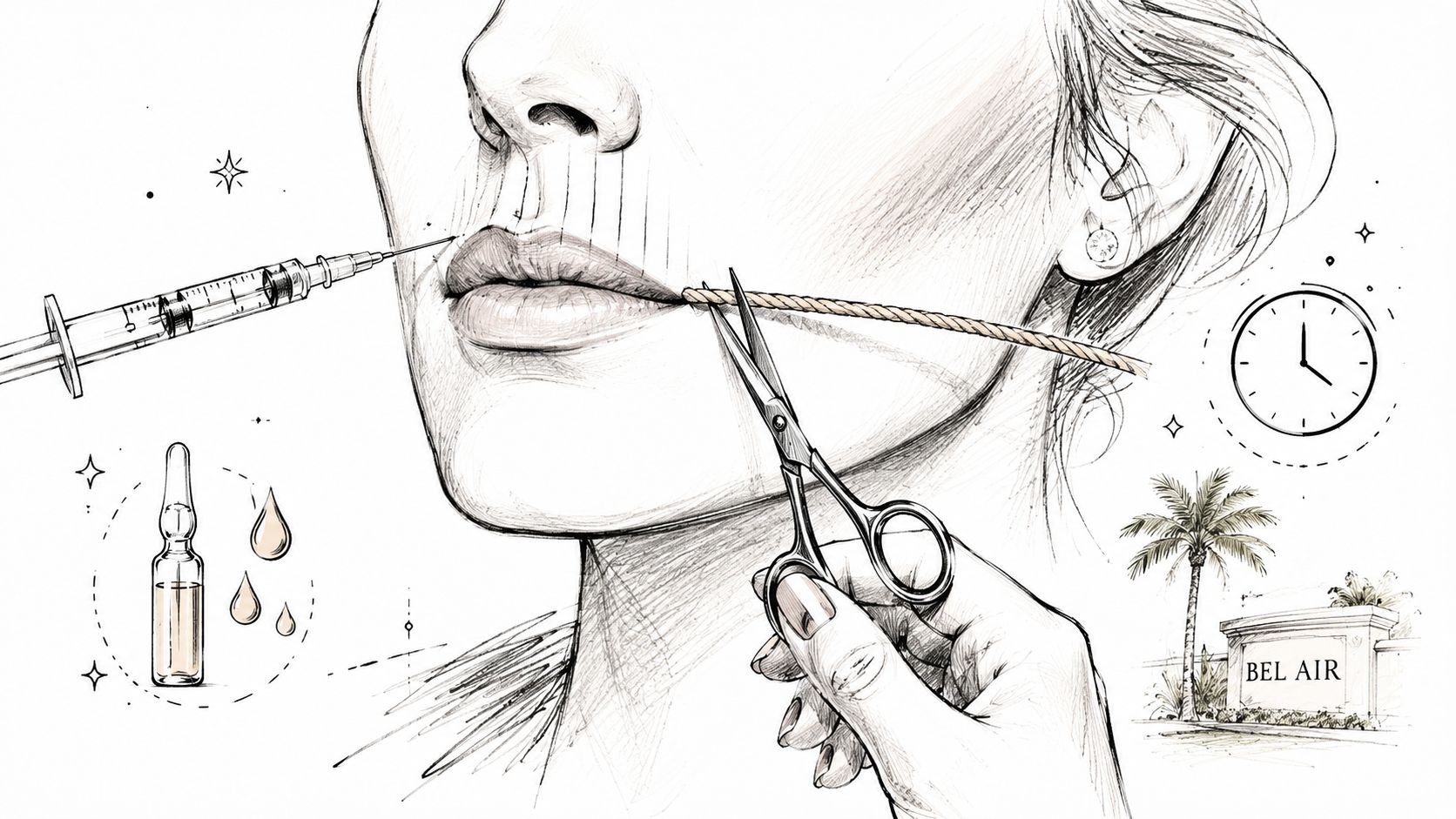
You know the moment. You tilt your head toward the mirror, apply lipstick, and watch color sneak into tiny vertical creases above the upper lip. Maybe you've never smoked a day in your life, but those lines are still there, and they're getting harder to blur with makeup alone. In consult, this is usually where the question starts, not “How do I erase them,” but “What caused them, and what will meaningfully help without making my mouth feel odd?”
Botox for smokers lines works best when you understand what it's treating. It relaxes the muscle that puckers the lip, it doesn't rebuild lost collagen or fill in a crease that's already etched at rest. That distinction matters, because the right plan for a line that appears only when you purse is different from the plan for a line that stays visible when your face is completely relaxed.
Table of Contents
- Why Smoker's Lines Show Up Even If You Never Smoked
- How Botox Actually Softens Lip Lines
- Technique, Placement, and Units Used Around the Mouth
- Realistic Results and Timeline for Smoker's Line Botox
- Candidacy, Contraindications, and Functional Trade-Offs
- How Botox Compares to Other Bel Air Treatments for Lip Lines
- Combining Botox With Fillers and Resurfacing for Deeper Lines
- Aftercare, Follow-Up, and Booking in Bel Air
Why Smoker's Lines Show Up Even If You Never Smoked
A lot of patients sit down and say the same thing. “I don't smoke, so why do I have smoker's lines?” The name is misleading. These are really perioral expression lines, and they're often driven by the same mechanical habits that crease other expression wrinkles, repeated pursing, talking, sipping through straws, and years of lip movement layered on top of thinner skin.
The lip area is a high-motion zone
The orbicularis oris is the circular muscle that lets you purse, pucker, sip, and form speech sounds. Every time it contracts, the skin above the lip folds a little. Over time, that repeated fold can become a visible line, especially when collagen support and skin elasticity have declined with age. A patient who never smoked can still develop the exact same pattern because the anatomy, not the label, is what creates it.
Practical rule: if the line deepens when you purse your lips, muscle motion is part of the problem.
Lipstick makes the issue easier to see. Color catches in the vertical creases, and what looked faint under bare skin suddenly becomes obvious. That's why so many people notice the problem first in the mirror during makeup application, not when they're casually looking straight ahead.
Why the label matters less than the mechanism
Smoking can worsen the picture, but it's not the only driver. Repetitive pursing, sun exposure, and the gradual thinning of skin all matter, and once a line is etched, the muscle alone isn't the whole story anymore. That's why a treatment that only quiets movement can soften the crease, but it won't automatically restore smoothness where the skin has already settled into a fold.
That's the central tension with smoker's lines. Botox can reduce the motion that keeps creating the wrinkle, but it can't replace lost volume or rebuild the skin surface on its own. If the line is mostly dynamic, neurotoxin can help a lot. If it's already static, the answer usually gets more layered.
How Botox Actually Softens Lip Lines
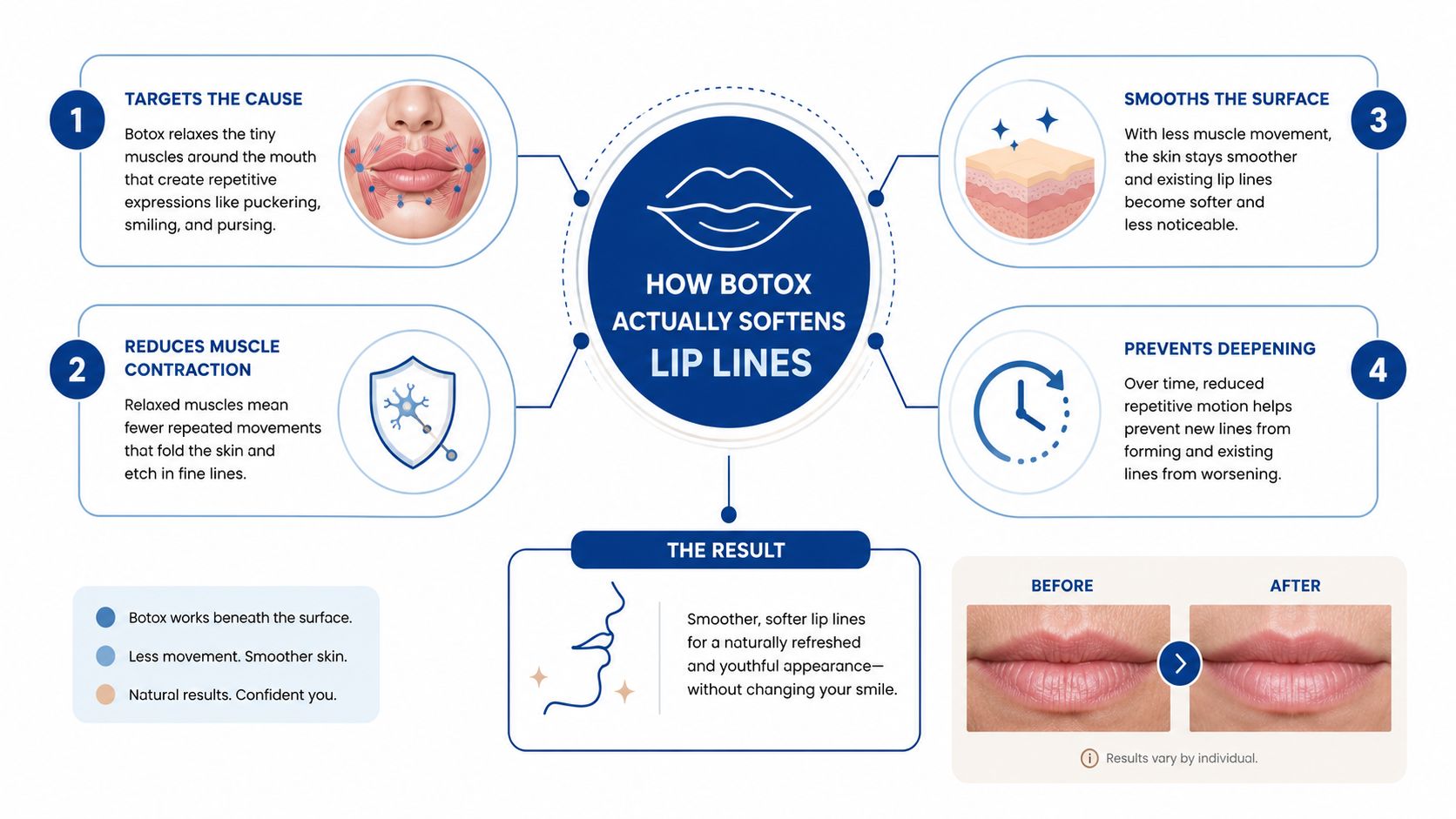
Think of the muscle as a hand pulling on a rope. The nerve uses acetylcholine to tell the orbicularis oris to contract, and Botox temporarily interrupts that signal so the muscle relaxes. In the literature, that temporary chemical denervation is what reduces lip-pursing force and softens the vertical creases that show up with motion. The point isn't to freeze the mouth, it's to tone down the repeated pull that etches the lines.
Dynamic lines versus static lines
This is the concept patients need most. Dynamic lines show up when you move. Static lines stay visible even when your face is at rest. Botox is designed for the first group, not the second. That's why someone can get a real improvement in puckering lines and still see faint etched creases if the skin itself has already lost elasticity.
A conservative injector thinks in terms of motion, not erasure. If the goal is to soften repeated puckering, the dose is chosen to reduce contraction without flattening normal expression. If the goal is to smooth a crease that never fully disappears, Botox alone usually won't deliver the kind of finish people picture in their head.
What timing usually feels like
The effect doesn't happen instantly. The muscle starts relaxing over the first several days, and the visible softening builds as the signal fades. That timing matters because a patient can't fairly judge the result the same afternoon, and a rushed early assessment can make a good treatment look underdone when it's still working.
Botox changes movement first. The line softens after the muscle quiets down.
That's also why technique matters so much around the mouth. The orbicularis oris is small, highly functional, and unforgiving if treated too broadly. The goal is precision, not coverage.
Technique, Placement, and Units Used Around the Mouth
Around the mouth, conservative dosing is not a nice-to-have, it's the whole point. A typical approach uses tiny injection points along the white lip, meaning the skin just above the vermilion border, not the red lip itself. Published protocols commonly describe 1 to 3 units per point and roughly 2 to 6 units total across the upper lip, which tells you how small the treatment is when done carefully.
Why placement is more important than brand
The anatomy around the mouth is crowded and functional. If the dose lands too low or too heavy, the muscle that shapes speech and lip seal gets weakened more than intended. That's why a skilled injector treats the white lip with restraint and keeps the red lip alone. The difference between a natural result and a clumsy one often comes down to exact placement, spacing, and respecting how much movement the patient needs to keep.
A good session around the mouth usually starts with a low-dose plan. That gives the injector room to reassess instead of overcorrecting. If the lip lines are very faint at rest and clearly dynamic, that conservative first pass is often enough. If the lines are deeper, the injector can decide whether a subtle touch-up makes sense later, or whether another tool is needed instead.
What a careful protocol protects
The main reason conservative technique matters is function. Weakening the orbicularis oris too much can affect speech clarity, straw use, lip shape, and symmetry. That's not alarmist, it's basic anatomy. The more precise the placement, the more likely you keep normal mouth movement while still reducing the puckering that creates the lines.
For readers who want a deeper related breakdown of how perioral planning fits into the rest of facial treatment strategy, this detailed guide to marionette line planning is a useful companion.
What to ask in consultation
- Where exactly will the injections go? You want to hear white lip, not red lip.
- How many units are you planning first? Conservative dosing should be the default.
- What happens if I'm too weak afterward? A real plan includes follow-up, not just the injection visit.
The mouth rewards restraint. If a provider sounds eager to load the area, that's the wrong energy for smoker's lines.
Realistic Results and Timeline for Smoker's Line Botox
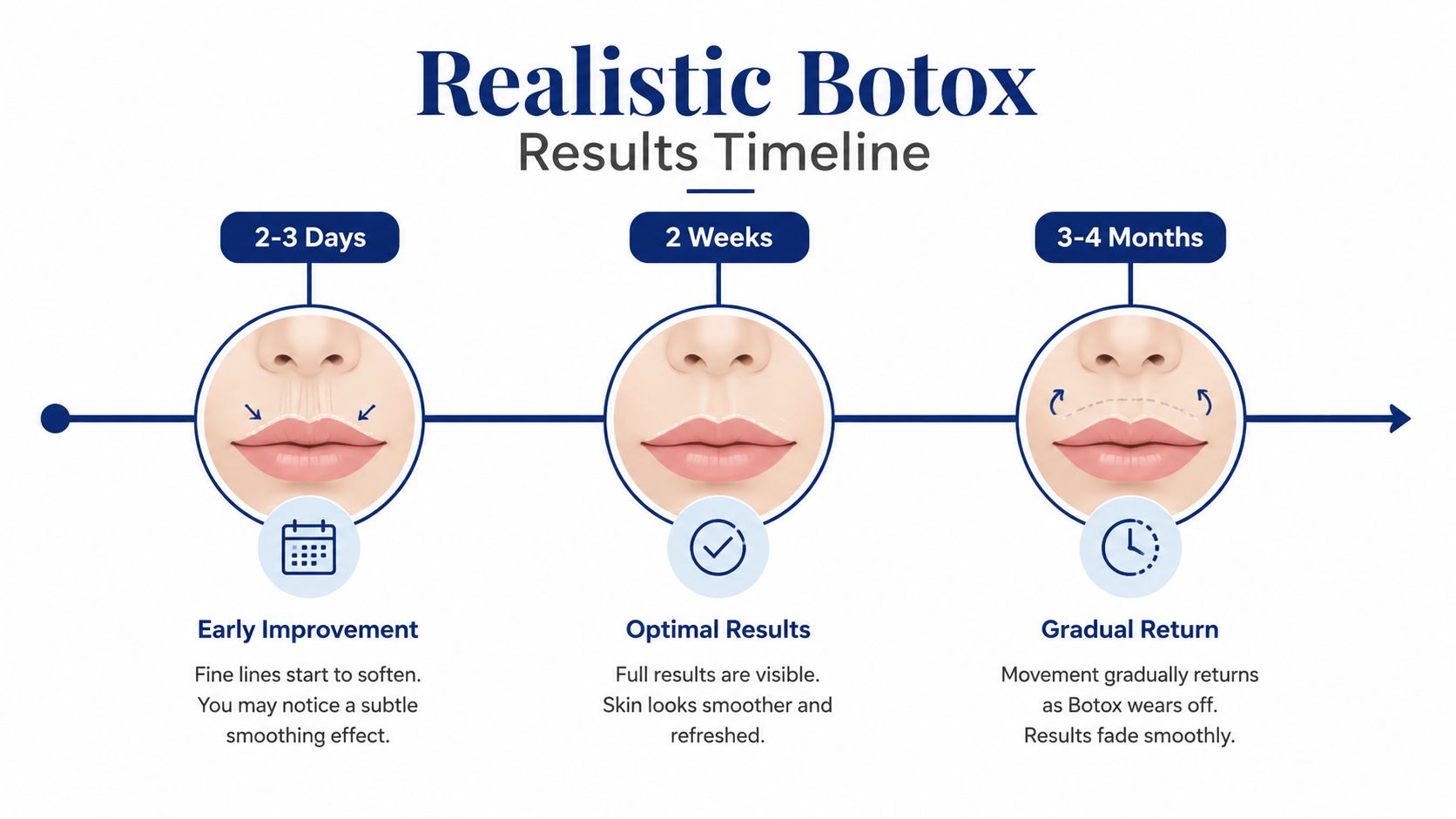
Patients usually want two things at once, speed and honesty. The honest timeline is straightforward. In published clinical descriptions, initial improvement shows up in about 2 to 3 days, with fuller softening around 10 to 14 days or roughly the two-week mark, and results typically last about 3 to 4 months. The evidence base for botulinum toxin type A in facial wrinkles also shows measurable benefit in randomized trials, including a 65% patient-assessed success rate versus 3% with placebo at 4 weeks in one pooled comparison across 575 participants in 4 randomized controlled trials (Cochrane review).
What “realistic improvement” looks like
The result most patients want is softer lipstick bleed, less visible puckering, and a smoother transition when they speak or drink. That's a meaningful cosmetic win, but it's not the same as deleting every crease. If the line is mostly dynamic, Botox can make it look substantially softer. If the line is already seated in the skin, you're usually looking at partial improvement unless another modality is added.
A useful way to think about it is this. Botox can reduce the muscle pull that deepens the wrinkle, but it doesn't rebuild the surface that's already creased. That's why a patient can be thrilled with how much softer the lines look while still seeing a faint trace when the skin is at rest.
Why maintenance becomes part of the plan
Because the muscle gradually reactivates, patients who like the result often return several times a year to maintain it. The cadence is driven by how long the relaxation lasts, not by a need for over-treatment. If the pattern is mild and dynamic, you may only need occasional upkeep. If the lines return quickly because pursing is frequent, maintenance becomes a normal part of the routine.
Good results around the mouth should look like softening, not a frozen upper lip.
That's the standard I use in consultation. The mouth has to keep working, so the best result is always the one that still lets the patient speak, smile, sip, and live normally.
Candidacy, Contraindications, and Functional Trade-Offs
The best candidates are usually people whose lines get more obvious when they purse, pucker, or sip, and who understand that the result is a softening, not a total wipeout. They're typically patients who want a conservative change and can tolerate the idea that a natural mouth still moves. The 2022 review of cosmetic botulinum toxin use also shows smoker's lines are a recognized lower-face indication, accounting for 18.8% of lower-face and neck indications, which helps explain why this is a mature, common request rather than a niche one (review).
Who should pause before booking
A patient should slow down and think twice if the main concern is an etched line that's visible at rest. Botox can quiet the motion that worsens it, but it won't make a static line disappear. People who depend heavily on precise lip function, including clear enunciation, drinking through straws, or playing wind instruments, should also be extra cautious, because the orbicularis oris is doing real work every day.
Pregnancy, breastfeeding, and certain neuromuscular conditions are standard reasons to avoid or defer treatment. Those aren't cosmetic opinions, they're medical boundaries. If someone has a complex history or a concern about muscle weakness elsewhere, the first step is a proper medical conversation, not a quick injection.
The trade-offs around the mouth are real
Even with excellent technique, small temporary changes can happen. A lip may feel a little heavy. Certain sounds can feel less crisp. Mild asymmetry can show up if one side responds differently than the other. These effects are exactly why the first treatment should be cautious, especially in someone new to perioral neurotoxin.
Around the mouth, less is safer than more.
That's not a slogan, it's a practical rule. The orbicularis oris is too important to the mouth's normal function to treat aggressively just to chase a perfect photo. A patient who wants the safest path should expect a detailed history, a conservative dose, and a follow-up visit to check how the lip settled.
How Botox Compares to Other Bel Air Treatments for Lip Lines
Botox is only one tool in the perioral toolbox. It's the right tool when movement is driving the wrinkle, but etched lines often need surface or volume support too. A helpful way to think about it is this, Botox quiets the muscle, fillers restore support, and resurfacing improves the skin itself. That logic is why combination planning usually makes more sense than chasing one treatment to do everything.
The broader facial-line conversation is also well covered in a dermatologist guide to face lines, which is a useful reminder that different wrinkle patterns need different solutions.
| Treatment | What It Targets | Best For | Typical Role |
|---|---|---|---|
| Botox | Muscle movement | Dynamic pursing lines | Softens the motion that keeps creasing the lip |
| Dermal fillers | Lost volume and etched creases | Static lines at rest | Adds support where the skin has already folded |
| Microneedling | Texture and collagen stimulation | Mild texture change and fine surface lines | Helps improve the skin quality around the mouth |
| Lasers | Resurfacing and skin renewal | Sun damage and surface roughness | Improves the look of the skin itself |
| Chemical peels | Surface exfoliation and renewal | Fine lines with dull texture | Helps refresh the outer skin layer |
| Sculptra | Collagen support | General tissue support and gradual firmness | Supports broader collagen rebuilding |
The sequence matters
For deep perioral lines, I usually think in stages. First, quiet the movement if the lines are dynamic. Then decide whether the remaining crease needs filler or resurfacing. If you fill a line while the muscle is still aggressively puckering, you're asking the product to hold up against the same force that created the crease in the first place.
That's why the conversation should be about the whole perioral area, not just one injection point. The line above the lip may need a different strategy than the skin texture around it, and that's where a clinic with multiple facial services can tailor the plan instead of forcing one solution to do all the work.
For patients comparing options more broadly, this facial resurfacing guide helps frame how the skin-smoothing side of treatment fits in.
Combining Botox With Fillers and Resurfacing for Deeper Lines
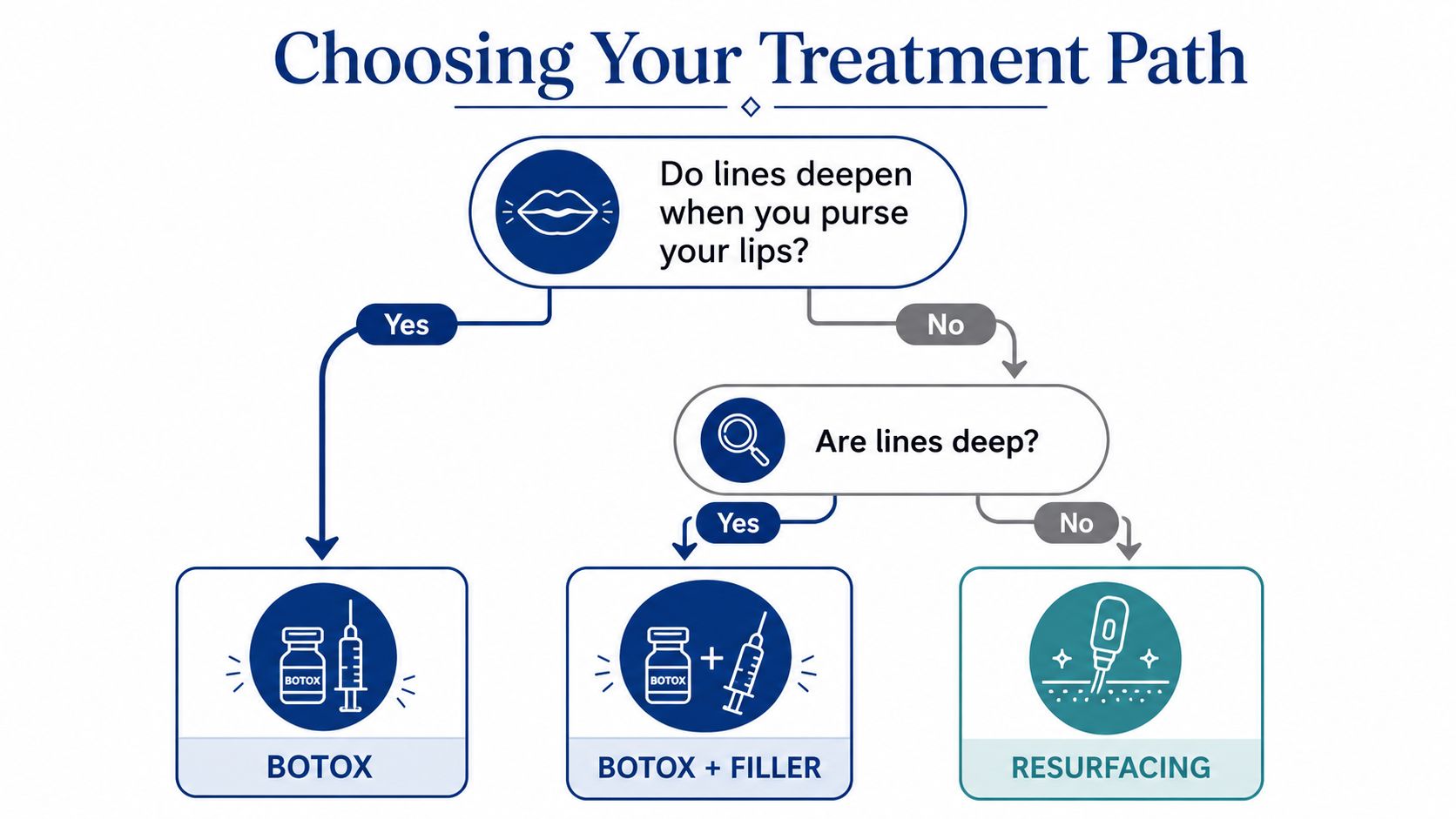
When the line deepens with pursing, start with Botox. When the line stays visible at rest, Botox alone is usually not enough, and that's when a layered plan starts to make more sense. For deeper etched lines, a hyaluronic acid filler or a resurfacing treatment such as microneedling, a chemical peel, or a laser series can address the skin and support that Botox can't replace.
Why order matters
Relaxing the muscle first changes the environment around the crease. Once the repeated puckering is quieter, filler is less likely to be constantly compressed, and resurfacing work isn't fighting the same motion every day. That doesn't mean everyone needs multiple treatments, but it does mean the right order makes the outcome more stable.
A simple decision framework
- Lines deepen only when you purse. Start with Botox.
- Lines are visible when the face is at rest. Think Botox plus filler or resurfacing.
- Texture is the main complaint. Resurfacing deserves more attention.
- The whole perioral area looks tired, not just wrinkled. A combined plan is usually the smarter discussion.
For patients who want a fuller explanation of how volume restoration fits into lip-line planning, this lip filler guide is a solid next read.
One option in that broader toolkit at ProMD Health Bel Air is dermal fillers, which restore volume in the areas where the skin has already folded. In practice, that's often how the deepest static lines are handled, not by asking Botox to do a job it wasn't built for.
Aftercare, Follow-Up, and Booking in Bel Air
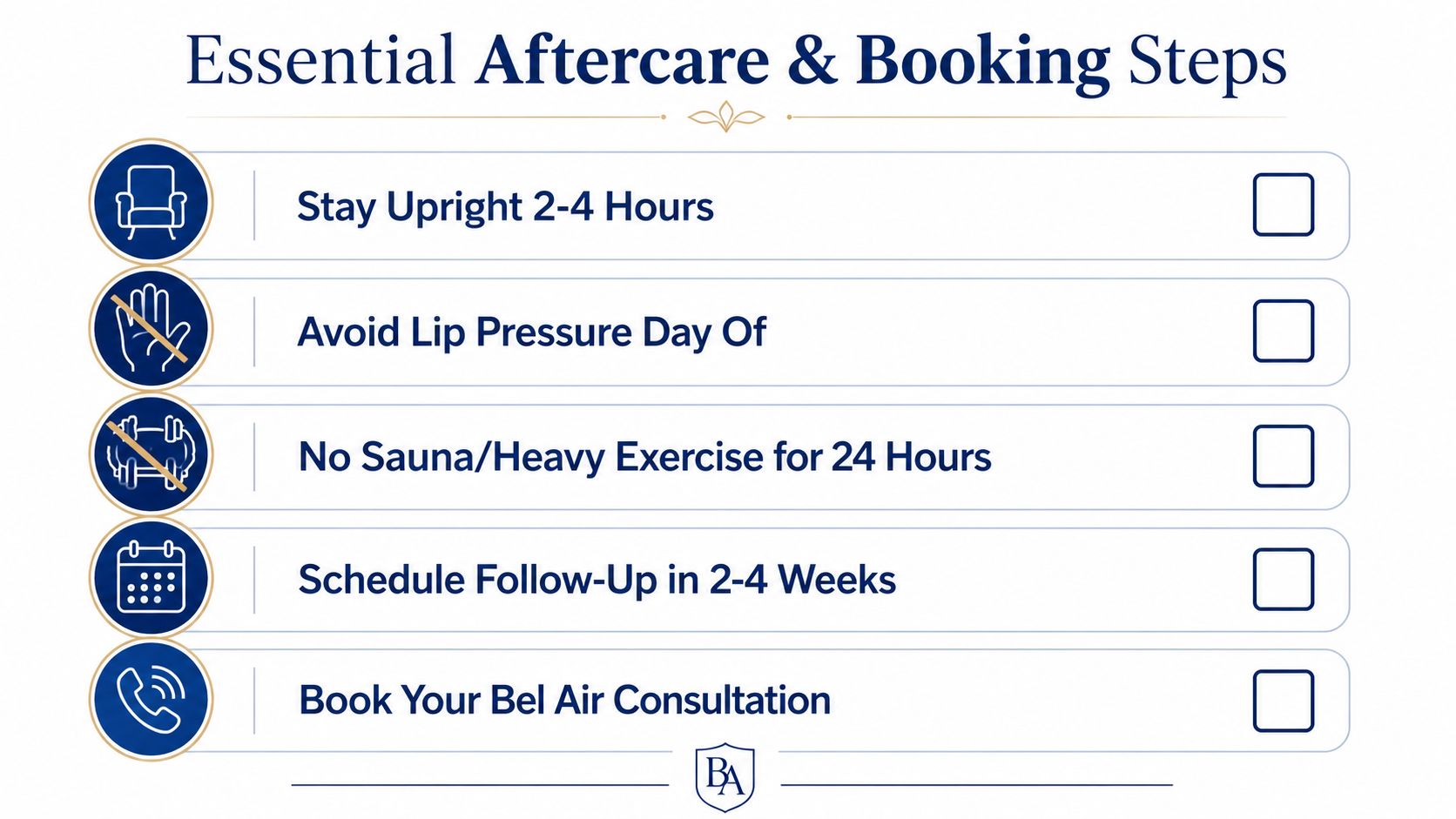
The aftercare is simple, but it matters. Stay upright for a few hours, avoid heavy pressure on the lips the day of treatment, and skip saunas and strenuous exercise for 24 hours. Then give the product time to settle before judging the result. A follow-up around two weeks is the right time to check symmetry, softness, and whether a tiny touch-up is needed.
What to flag at the review visit
If the lip feels heavy, if one side looks a bit different, or if certain sounds feel harder to pronounce, say so at follow-up. Those details help determine whether the dose was just right or whether the next session should be even more conservative. The review is where a careful injector earns trust, because mouth treatment is rarely about a single and done visit.
ProMD Health Bel Air supports this kind of conversation with virtual consultations, Saturday appointments by arrangement, and the Entity Med AI Simulator to preview potential outcomes. That makes it easier to talk through expectations before treatment instead of guessing after the fact.
The best perioral result is the one that still lets your mouth do its job.
If you've been staring at lipstick bleed, fine upper-lip lines, or deeper etched creases and wondering whether Botox is enough, the next step is a consult that looks at your lips, your movement, and your goals together. Visit ProMD Health Bel Air to book a consultation and talk through whether Botox, filler, resurfacing, or a combination plan makes the most sense for your smile.