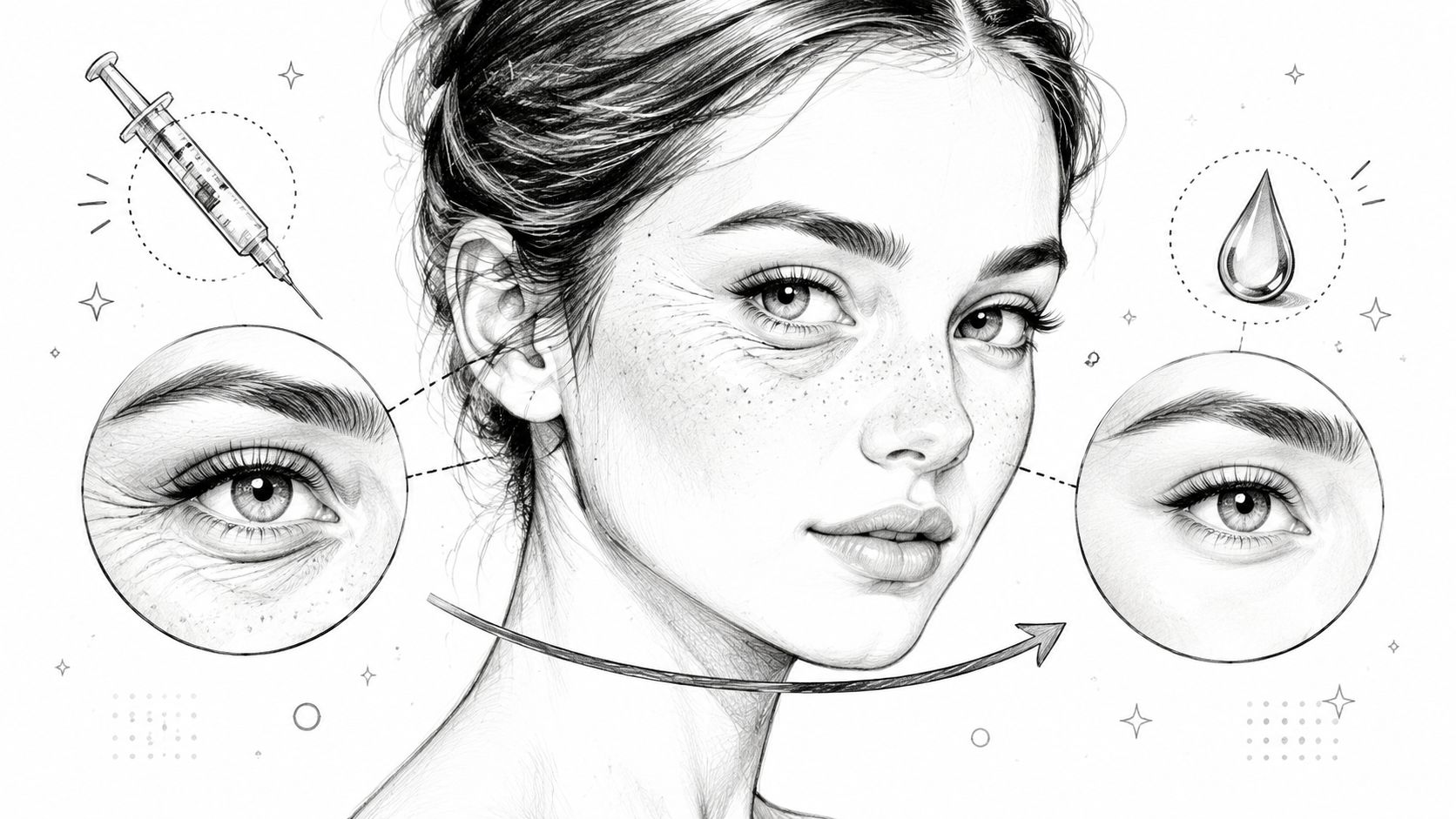
You catch it in ordinary light. The tiny lines at the corners of your eyes look deeper when you smile, and the puffiness beneath them seems to linger even when you're rested. A lot of people assume one treatment should fix both problems. That's where confusion starts.
Crow's feet and under-eye bags can sit close together, but they're not the same issue. One is usually driven by repeated muscle movement. The other is often tied to fat prominence, fluid retention, skin laxity, or a hollow-to-bag transition. Botox can be excellent for one of those problems and a poor match for the other.
If you've been searching for Botox crow's feet bags under eyes, the primary question is usually this: “What can Botox improve near my eyes, and what needs a different approach?” That's the right question to ask before treatment. If you're specifically looking into Botox and Dysport options for eye-area lines, it helps to understand where neurotoxin treatment shines and where it doesn't.
Table of Contents
- Introduction to Botox and Under Eye Concerns
- Understanding How Botox Treats Crow's Feet
- Why Botox Does Not Fix Under Eye Bags
- Comparing Alternative Treatments for Under Eye Bags
- Determining Candidacy for Eye Area Treatments
- Risks Downtime and Results Timeline
- Pricing and Financing at ProMD Health Bel Air
- Scheduling a Consult at ProMD Health Bel Air
Introduction to Botox and Under Eye Concerns
Most eye-area consultations start with two complaints that sound similar but behave very differently. One person says, “I hate the lines that show when I smile.” Another says, “I look tired because of the bags under my eyes.” Sometimes it's the same person saying both.
That distinction matters. Crow's feet are dynamic wrinkles, which means they form from repeated contraction of the muscle around the eye. Under-eye bags are usually structural, which means they don't disappear just because a muscle relaxes. Patients often mix those together because both live in the same small area of the face.
A simple mirror test can help. Smile hard. If the lines beside your eyes deepen with movement, that's the pattern Botox is built to treat. If the fullness under your lower lids still looks puffy when your face is relaxed, that calls for a different conversation.
The closest treatment isn't always the correct treatment. Eye-area anatomy rewards precision.
People also worry that if Botox helps crow's feet, maybe it should help everything nearby. It doesn't work that way. The right plan depends on whether your main issue is muscle activity, volume loss, skin quality, or a true bag.
Understanding How Botox Treats Crow's Feet
Botox works well for crow's feet because it targets the actual cause of those lines. When you squint, smile, or laugh, the orbicularis oculi muscle contracts and folds the skin at the outer corners of the eyes. Over time, those repeated folds become more visible.

What Botox is doing in the muscle
Think of the muscle around the eye like a spring that's constantly tightening and releasing. Botox softens that cycle by blocking acetylcholine at the neuromuscular junction, so the muscle can't contract as strongly. Less contraction means less skin folding. Less folding means smoother crow's feet.
For this specific area, the evidence is strong. Botox is clinically proven to treat crow's feet with a responder rate over 99%, using FDA-recommended doses of 12 units per side for consistent improvement with minimal side effects according to clinical data on onabotulinumtoxinA for lateral canthal lines.
Why dose and placement matter
The eye area isn't forgiving of casual injection patterns. Good crow's feet treatment depends on using the right dose in the right spots, not just placing product “near the eyes.” If treatment is too weak, the muscle may still crease strongly. If it's placed poorly, the result can look unbalanced or affect nearby structures you didn't want to relax.
That's why experienced injectors map movement first. They watch how your smile pulls, where the lines fan out, and whether one side works harder than the other.
Practical rule: Treat the wrinkle by treating the muscle that causes it, not by chasing every visible line with more product.
What patients usually notice
The first change is often subtle. You smile and the lines don't pinch as sharply. The skin at the outer eye looks softer, and makeup tends to sit more smoothly. The goal usually isn't a frozen expression. It's less crinkling with more rested-looking movement.
That's the narrow but important role of Botox in the Botox crow's feet bags under eyes conversation. It's a targeted fix for dynamic side-eye wrinkles, not a cure-all for every tired-eye concern.
Why Botox Does Not Fix Under Eye Bags
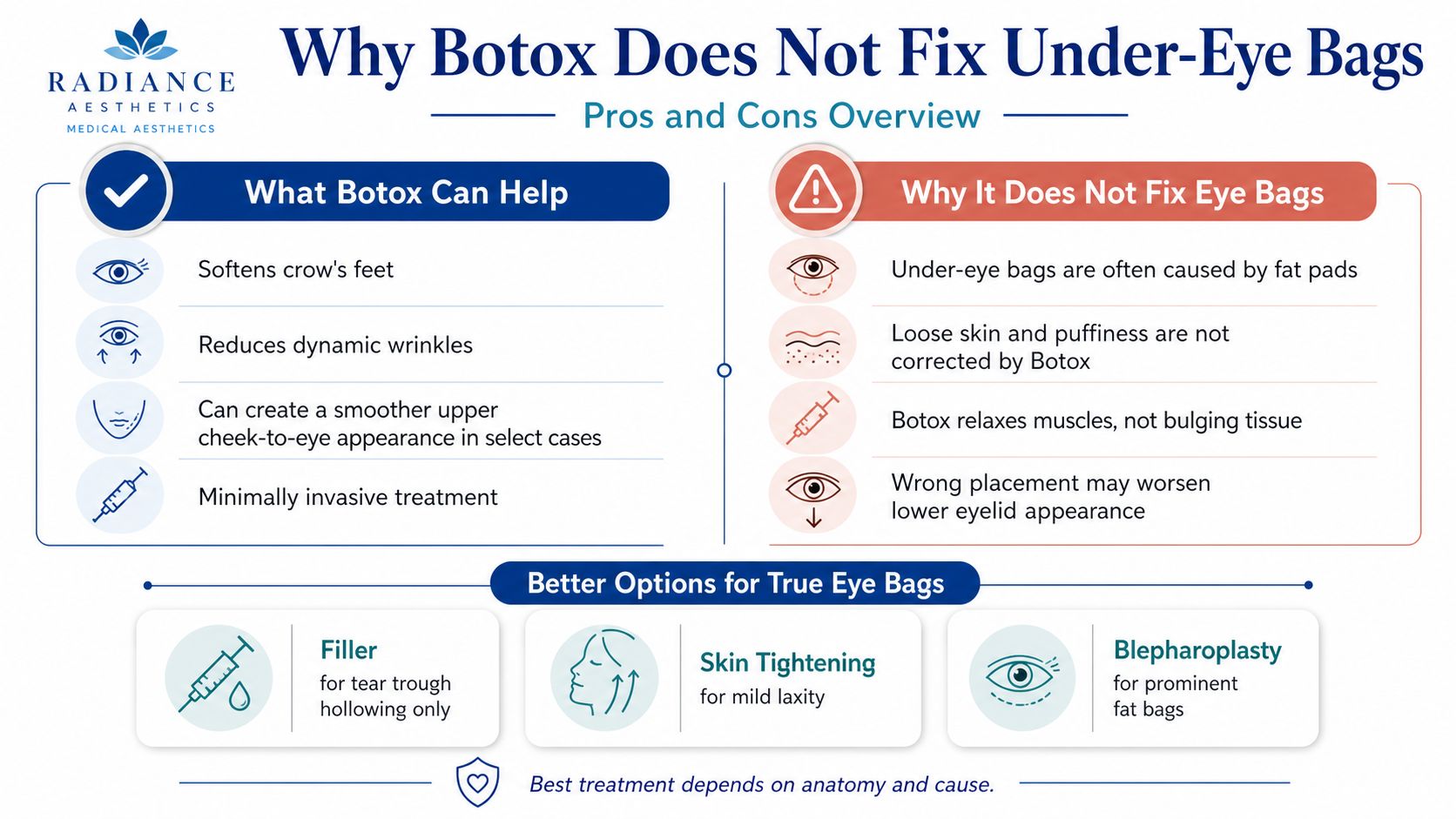
The reason Botox falls short under the eyes is simple. Under-eye bags usually aren't caused by the same problem as crow's feet. A bag can come from fat pushing forward, fluid collecting, loose skin, or a contour change between the lower eyelid and upper cheek. Relaxing a muscle doesn't remove any of those.
Dynamic wrinkles versus structural fullness
A good way to separate these concerns is to ask whether the problem changes mostly with expression or mostly with anatomy.
- Dynamic issue: Lines appear or deepen when you smile, squint, or animate.
- Structural issue: Puffiness, bulging, or hollowness remains visible at rest.
- Mixed issue: Fine wrinkling plus volume loss plus some bagginess. This is common.
Botox is designed for the first category. It can soften movement-related creasing. It does not dissolve fat pads, drain fluid, or tighten lower-lid tissues enough to erase a true bag.
Why Botox can sometimes make bags look worse
This is one of the least understood parts of eye-area treatment. If the orbicularis oculi is over-relaxed in the wrong place, the lower lid can look less supported. That may make sagging or puffiness seem more obvious, not less.
There's another practical point patients should know. If this happens, there isn't an instant “undo” button for Botox. In most cases, management is conservative and time-based. You wait for the product to wear off and adjust future dosing or placement.
Botox near the lower lid can change the way the area looks without solving the actual reason the bag is there.
What the evidence says
Botox injections are effective for crow's feet but are not FDA-approved for treating under-eye bags, which result from fat or fluid protrusion and require volume restoration or tissue tightening, as summarized in this review of Botox use under the eyes.
That's why a patient can be an excellent Botox candidate for crow's feet and still need a completely different strategy for the lower eyelid. The treatment isn't failing. It's being asked to solve the wrong problem.
Comparing Alternative Treatments for Under Eye Bags
Once you stop expecting Botox to do everything, the next step gets easier. You match the treatment to the anatomy. In practice, non-surgical eye rejuvenation often centers on four options: dermal fillers, thread lift, lasers, and microneedling.
Here's a side-by-side view.
Comparison of Treatments for Under-Eye Bags
| Treatment | Primary Benefit | Ideal Candidate | Downtime | Cost Range |
|---|---|---|---|---|
| Dermal Fillers | Softens hollowing and camouflage between lid and cheek | Someone with tear-trough hollowing or a shadowed transition more than a true bulging fat pad | Mild swelling or bruising may occur | Varies by treatment plan |
| Thread Lift | Mild support and repositioning for tissue laxity | Someone with early descent or laxity who wants subtle lift without surgery | Short recovery period may be needed | Varies by treatment plan |
| Lasers | Improves skin quality and tightness | Someone whose lower eyelid looks crepey, thin, or lax | Depends on laser intensity and skin response | Varies by treatment plan |
| Microneedling | Improves texture and supports smoother skin surface | Someone with mild wrinkling or textural change rather than a pronounced bag | Usually limited downtime | Varies by treatment plan |
Dermal fillers for the hollow-to-bag transition
A lot of people say they have “bags” when the bigger problem is a hollow beneath the bag. That contrast creates shadowing, which makes the area look more tired. Filler can sometimes smooth that transition so the eye looks less sunken and less harsh.
The key is restraint. Under-eye filler isn't about stuffing the area. It's about subtle contour correction in the right candidate. If the lower lid is already puffy or fluid-prone, filler may not be the first move.
For a deeper look at candidacy and safety, this guide on under-eye filler safety and results breaks down common concerns in patient-friendly terms.
Thread lift for mild support
Thread lift enters the conversation when the issue is more about tissue laxity than hollowing alone. It can provide support in selected cases, especially when the upper cheek and lower lid junction has started to descend. This is not a replacement for surgery when someone has a heavy, prominent bag, but it can help in mild to moderate non-surgical plans.
A thread-based approach usually works best when the patient wants structural support and accepts that results are subtler than surgery.
A good under-eye plan often starts one level below the eye, at the cheek-lid junction, not in the bag itself.
Lasers for skin tightening and surface change
When patients point to “bags,” they sometimes mean crepey lower-lid skin. That's a very different target. In that situation, laser treatment may be more relevant because it focuses on skin quality, tone, and tightening rather than muscle relaxation or volume replacement.
Lasers are useful when the lower eyelid looks loose, etched, or sun-damaged. They won't remove a true fat pad, but they can improve the way the skin overlying the area reflects light and handles texture.
Microneedling for fine wrinkling and texture
Microneedling usually fits milder concerns. It can help when the lower eye area has fine lines, early textural changes, or a thin, crepey look. It doesn't replace filler for hollows or a thread lift for lax support, and it won't flatten a substantial bag. What it can do is improve the surface quality of the skin.
That makes it a useful option for people who don't need volume and don't want a more structural treatment yet.
When combination plans make sense
Eye rejuvenation often works best when providers separate the concerns instead of forcing one treatment to do too much.
- If the issue is side-eye wrinkling, Botox may handle that piece.
- If the issue is hollowing, filler may be the better fit.
- If the issue is lax skin, lasers or microneedling may be more appropriate.
- If the issue is early descent, thread lift may enter the plan.
A combined approach can be reasonable when someone has more than one driver of aging in the same area. The important part is making sure each treatment has a clear job.
Determining Candidacy for Eye Area Treatments
Candidacy comes down to what you see at rest, what changes with expression, and how your tissues behave. Two people can both say “I look tired under my eyes” and need completely different plans.
Signs Botox may still be the right fit
Botox belongs in the discussion when your main complaint is line formation at the outer eye during smiling or squinting. The better candidate usually notices movement-related creasing more than lower-lid bulging.
Look for these clues:
- Expression-triggered lines: The wrinkles deepen with smiling.
- Minimal lower-lid puffiness: There isn't a strong bag at rest.
- Good skin support: The lower lid doesn't already look lax or droopy.
- Natural movement goal: You want softer crinkling, not major contour change.
When filler, lasers, or thread lift may be more appropriate
If the lower eye looks tired even when your face is relaxed, Botox may only address the side lines and leave the main concern untouched.
A few common patterns help narrow things down:
- Hollowing and shadowing: This often points toward dermal fillers.
- Crepey skin texture: This may respond better to lasers or microneedling.
- Mild sagging at the lid-cheek junction: Thread lift can be part of the conversation.
- Prominent true bags: A non-surgical plan may have limitations, and realistic counseling matters.
The most useful consultation photos show your face at rest, smiling, and from a slight side angle. Each view answers a different question.
Questions worth asking yourself before a consult
Instead of focusing only on the word “bags,” try asking:
- Do my lines show mainly when I move?
- Is the puffiness there even first thing at rest?
- Does makeup collect more in fine lines or in a hollow?
- Am I trying to smooth wrinkles, restore contour, improve skin texture, or all three?
Those answers help shape a plan that fits your anatomy instead of chasing a trendy treatment.
Risks Downtime and Results Timeline
You schedule treatment on a Thursday because the appointment itself is quick, then remember you have photos on Saturday. That is the point where timing matters more than treatment length. Around the eyes, the visible recovery window often matters more than the minutes spent in the chair.

Botox expectations near the eyes
Botox for crow's feet usually has the lightest downtime of the eye-area options discussed in this article. Small bumps at the injection points can show up right after treatment and often settle quickly. Bruising can happen, especially in thin skin near the outer eye, and the smoothing effect appears gradually rather than all at once.
Results also follow a sequence patients should understand before they book. Early softening can start within several days, but the full effect usually takes longer to declare itself. Botox is more like dimming a light on muscle activity than flipping a switch on skin texture or lower-lid volume, which is why judging it too early causes confusion.
Side effects are often mild and temporary. The uncommon but most discussed risk is temporary eyelid or brow heaviness if product placement or muscle balance is not ideal. That risk is one reason careful assessment matters so much around the eye.
How downtime differs across treatment types
Each option creates a different kind of recovery because each one targets a different layer.
- Botox: Minimal visible downtime for many patients, with improvement building over days to weeks.
- Dermal fillers: More likely to cause short-term swelling or bruising because they change contour and sit in delicate tissue.
- Lasers: Downtime depends on intensity. Some treatments cause mild redness, while stronger settings can create several days of visible healing.
- Microneedling: Temporary redness, sensitivity, and a sunburn-like look are common early on.
- Thread lift: Swelling, tenderness, and a feeling of tightness are more noticeable at first than with Botox.
A practical comparison helps here. Botox changes motion. Filler changes shape. Lasers and microneedling change skin quality over time. Threads try to support tissue position. Once you match the treatment to the layer being treated, the recovery pattern makes more sense.
Results timeline and planning around real life
Patients often ask for one simple answer to “How long until I look better?” The honest answer is that improvement and social downtime are not the same thing. You may feel fine the same day and still have a small bruise, or you may have gradual Botox improvement with no dramatic day-one change.
That is why event planning matters. Leave buffer time before weddings, reunions, work presentations, or professional photos. If cost timing is part of the decision, reviewing financing offers for staged treatment plans can make it easier to schedule treatment when recovery fits your calendar instead of rushing into the wrong week.
At ProMD Health Bel Air, the Entity Med AI Simulator adds another useful step before treatment. A preview does not replace anatomy or healing biology, but it can help you see the difference between wrinkle softening, contour change, and skin-quality improvement before choosing a plan. That makes expectations clearer, which is one of the best ways to reduce disappointment after treatment.
Follow aftercare instructions closely, avoid rubbing or pressing on the area, and give the eye region time to settle before deciding how you feel about the result. Around the eyes, patience is part of the treatment plan.
Pricing and Financing at ProMD Health Bel Air
Price questions usually get easier once you separate the eye area into two different jobs. Botox is typically priced by the unit because it relaxes the small muscles that create crow's feet. Under-eye treatments are usually priced by treatment type because they address contour, skin quality, or tissue support rather than muscle movement.
That difference matters at the budgeting stage. A lower Botox quote does not mean it can do the work of filler, laser treatment, microneedling, or a thread-based approach under the eyes. It means the treatment target is different.
At ProMD Health Bel Air, exact pricing is based on your anatomy, treatment goals, and whether the plan is done in one visit or staged over time. Staged plans are common around the eyes because one person may need wrinkle softening first, while another needs contour correction or skin-quality treatment. The clinic's Entity Med AI Simulator can help make that pricing conversation more concrete by showing a visual preview of how Botox and filler may change different parts of the eye area before you commit to a plan.
Financing can also make timing easier. If you are spacing treatment around events, work, or a larger rejuvenation plan, you can review financing offers for eye-area treatment planning.
The practical benefit of consultation-based pricing is clarity. You are choosing the treatment that matches the problem, which is usually more cost-effective than paying for a cheaper option that does not address the actual cause of under-eye concerns.
Scheduling a Consult at ProMD Health Bel Air
A consultation is where eye-area treatment becomes specific. Photos, muscle movement, skin quality, puffiness pattern, and the lid-cheek junction all matter. What looks like one issue in the mirror often turns out to be two separate concerns once the face is examined in motion and at rest.
At ProMD Health Bel Air, patients can schedule an in-clinic visit at 2023 Emmorton Rd, Suite A, Bel Air, Maryland, and virtual consultations are also available for people who want to start the conversation more conveniently. The clinic also uses the Entity Med AI Simulator, which lets patients preview possible Botox and filler outcomes from uploaded photos before moving ahead with treatment. That kind of visual planning can be helpful when you're deciding whether your goal is wrinkle softening, contour correction, or both.
Before your appointment, it helps to come prepared with:
- Recent photos: One relaxed, one smiling, one from an angle.
- Your main concern: Lines, bags, hollowing, crepey skin, or a mix.
- Treatment history: Prior Botox, filler, lasers, or thread lift.
- Timing needs: Upcoming events, travel, or photos.
Bring questions. The eye area is small, but treatment decisions there are rarely one-size-fits-all.
If you're ready to sort out whether your concern is crow's feet, under-eye bags, or both, schedule a consultation with ProMD Health Bel Air. A personalized assessment can help you choose the right non-surgical option, set realistic expectations, and use the Entity Med AI Simulator to preview what subtle, anatomy-based improvement may look like before treatment.