You may be reading this after another morning of trying to calm a flare. Your skin looked fine when you woke up, then coffee, stress, heat, or a short walk outside turned your cheeks bright again. Maybe the redness fades by afternoon. Maybe it doesn't. Maybe the visible red lines around your nose or across your cheeks now feel harder to cover, and makeup only makes the texture more noticeable.
That cycle wears people down. Rosacea isn't just a cosmetic annoyance. It changes how you choose skincare, exercise, social plans, and even lighting for photos. Many people arrive at laser treatment only after trying gentle cleansers, trigger tracking, and creams that help somewhat but don't fully address stubborn redness or visible vessels. If dryness and sensitivity are part of the picture, it also helps to review ways to soothe and hydrate dry skin so your barrier stays as calm as possible between flare management strategies.
Table of Contents
- Tired of Rosacea Redness? There Is a Solution
- How Lasers Work to Reduce Facial Redness
- Choosing the Right Laser PDL vs IPL
- Are You a Good Candidate for Rosacea Laser Treatment
- Your Laser Treatment Journey at ProMD Health Bel Air
- Aftercare Risks and Long-Term Results
- Frequently Asked Questions About Laser Rosacea Treatments
Tired of Rosacea Redness? There Is a Solution
A common story goes like this. Someone starts with occasional flushing and assumes it's temporary. Then the redness settles in. After that come the tiny red lines, the uneven tone, and the frustration of buying “sensitive skin” products that still sting.
That's where laser for rosacea starts to make sense. It addresses a problem that topical products often can't fully reach. If redness is being driven by visible, dilated facial blood vessels, a targeted light-based treatment can directly treat those vessels instead of only trying to calm the skin around them.
For the right patient, this changes the conversation from “How do I hide it?” to “How do I manage it well?”
What people usually want to know first
Most new patients aren't asking for perfection. They want practical outcomes:
- Less constant redness so their skin tone looks more even.
- Fewer visible vessels around the nose and cheeks.
- A plan that fits real life, including work, events, exercise, and downtime.
- Honest expectations about how long results last and whether maintenance is part of the process.
Rosacea responds best when the treatment matches the type of redness you actually have, not just the diagnosis written on paper.
Some people are ideal laser candidates because they have visible vessels and persistent surface redness. Others have more flushing than fixed vessels, or more inflammatory bumps than vascular redness. Those distinctions matter. They affect which device is chosen, how aggressive treatment should be, and whether laser should be combined with other rosacea management steps.
Why this isn't just about “getting a laser”
Generic articles often stop at naming a few device categories. That's not enough to help a real patient decide. The useful question isn't “Which lasers exist?” It's “Which one fits my rosacea pattern, my sensitivity level, and my goal?”
That's the decision-making framework that helps. If your redness is made up of distinct red lines, one option often stands out. If your face looks more broadly flushed with diffuse background redness, another may be the better fit. If discomfort is a major concern, that matters too.
How Lasers Work to Reduce Facial Redness
Rosacea redness often persists because tiny blood vessels stay enlarged near the surface of the skin. Creams can help reduce inflammation, but they don't physically remove those visible vessels. Laser treatment works because it targets the vessel itself.
The real target is the blood vessel
Imagine sealing a small leaking pipe behind a wall. You don't repaint the wall and hope the stain stops returning. You go after the source. In rosacea, the “source” is often superficial blood vessels that remain open and visible.
A vascular laser sends light into the skin at a wavelength that blood absorbs more readily than the surrounding tissue. That absorbed light turns into heat. The vessel wall is damaged in a controlled way, the vessel collapses, and the body gradually clears it away.
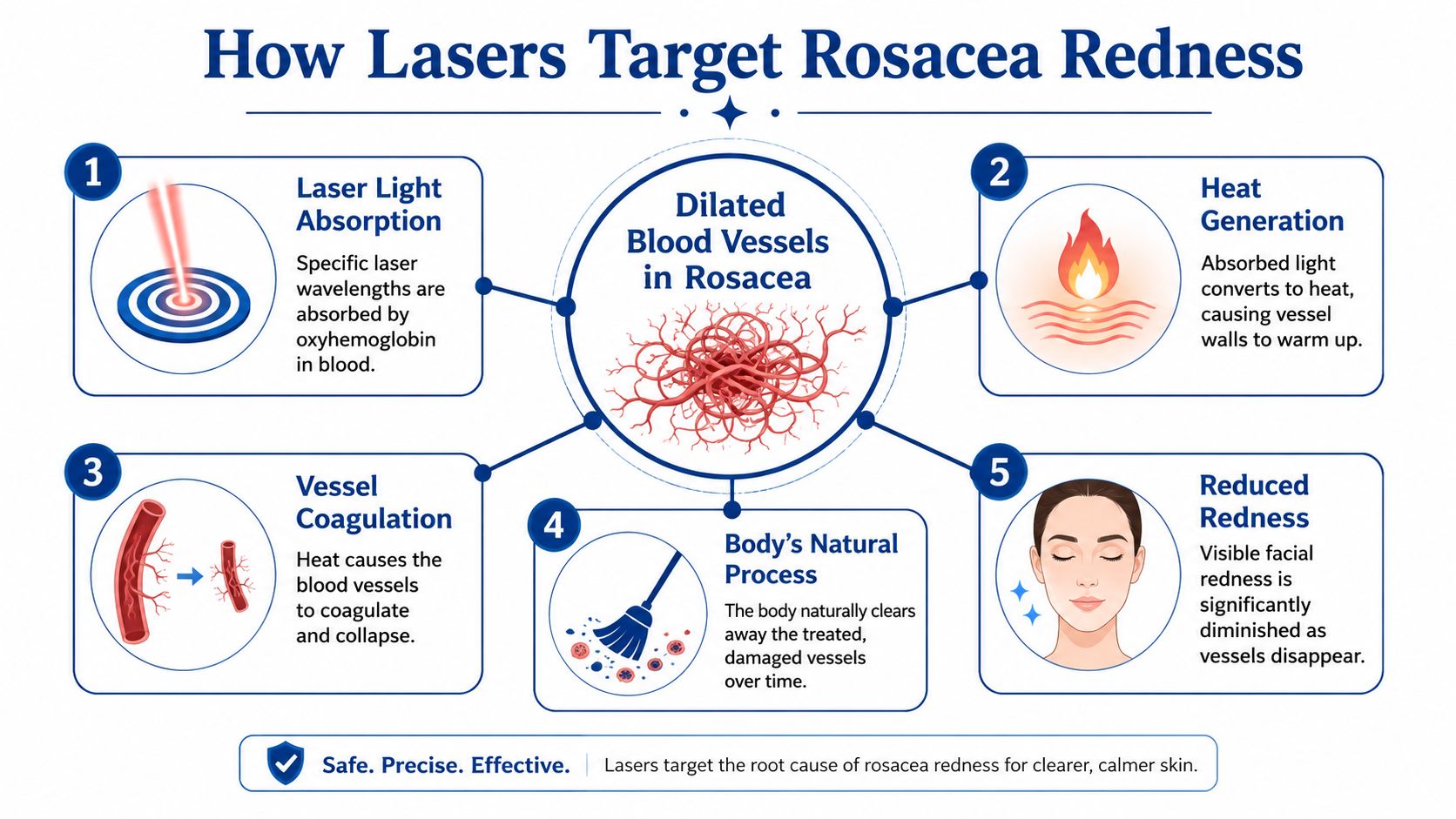
That's why this treatment can be so effective for facial redness that has a vascular cause. It's precise, and it's selective.
Why 595 nm PDL is used so often
The 595 nm pulsed-dye laser, often called PDL, is considered a gold standard because its light is selectively absorbed by hemoglobin in pathologic vasculature, causing the vessel to collapse and be resorbed by the body, while a dynamic cooling device protects the outer layer of skin, as described in this clinical review of 595 nm pulsed-dye laser treatment.
That mechanism matters in practical terms. It means the treatment is designed to hit what's red without broadly injuring the surrounding skin. Patients usually understand it better when they hear this in plain language: the laser is not “burning off” facial redness. It is targeting blood inside abnormal vessels.
Practical rule: The more your redness comes from visible vessels, the more a vessel-targeting laser tends to make sense.
Two things are worth keeping in mind. First, laser can reduce visible vascular redness, but it doesn't cure rosacea itself. Second, not every red face needs the same device. The pattern of redness matters. A patient with fine red lines around the nose is different from a patient whose cheeks stay diffusely pink all day with very few visible vessels.
That's why treatment planning should start with pattern recognition, not marketing language. A laser session is short. The decision behind it should be careful.
Choosing the Right Laser PDL vs IPL
A common consult in Bel Air goes like this. One patient points to fine red lines around the nose and cheeks. Another says, “I stay pink all the time, but I do not see many broken vessels.” Those two patients may both have rosacea, but they usually should not start with the same device.
When PDL usually makes more sense
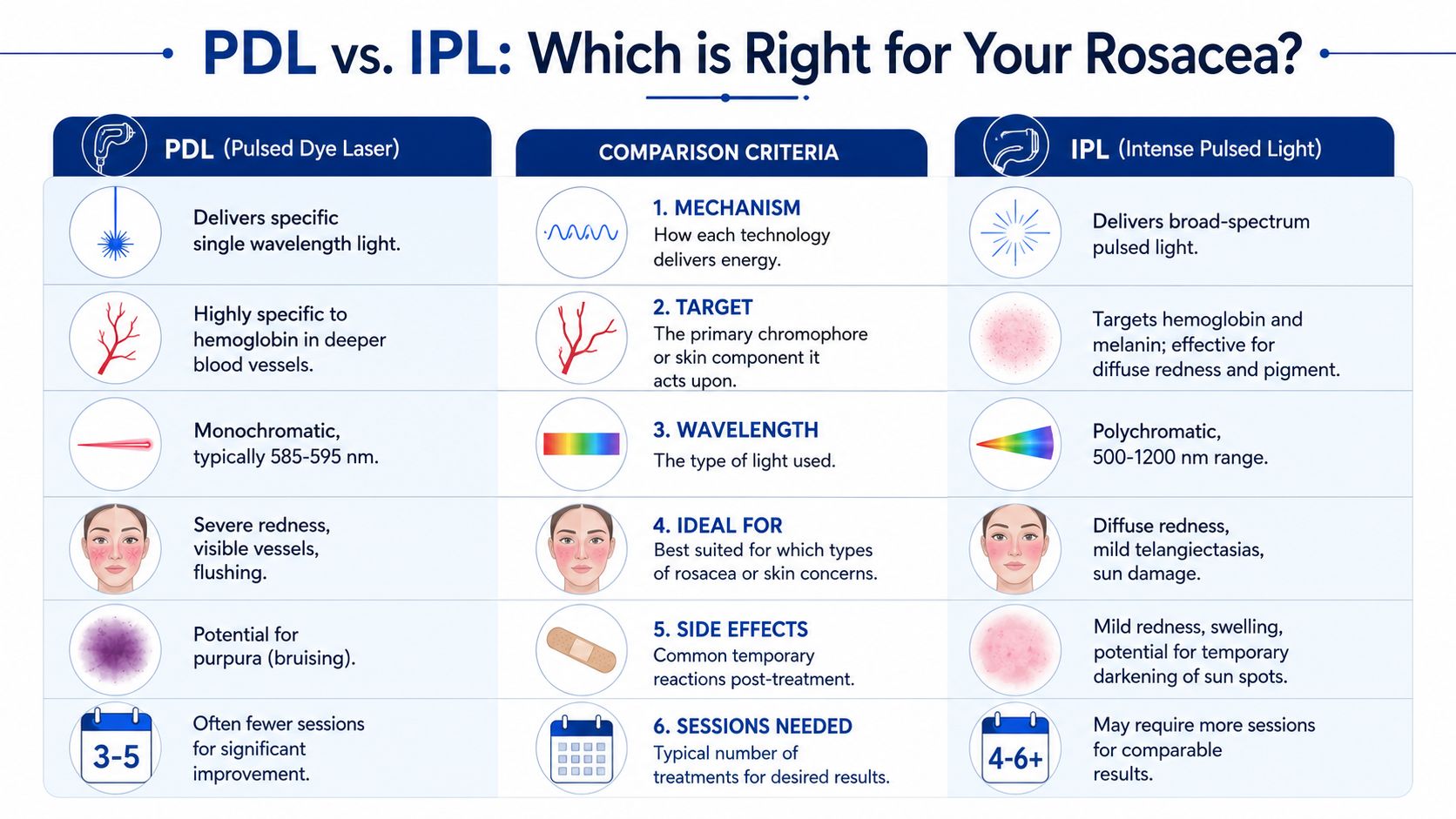
PDL is usually my first consideration when the main problem is visible vessels. If you can trace the redness as individual lines, especially around the nose or across the central cheeks, PDL often gives a more targeted approach. It is built for vascular selectivity, so it tends to make sense when the goal is to treat what can be clearly seen.
Comfort also matters. A 2024 meta-analysis comparing IPL and PDL reported higher rates of strong clearance with IPL, while PDL had lower pain scores. That is a real trade-off in practice. Some patients want the most aggressive improvement they can reasonably pursue. Others want a treatment plan they are more likely to tolerate well and repeat.
PDL can also be easier to justify for patients who want precision more than broad blending.
When IPL may be the better fit
IPL, or Intense Pulsed Light, is often a better fit for background redness that spreads across a wider area. If the cheeks look diffusely pink or flushed, and the redness is less about discrete vessels, IPL may treat that field more efficiently.
This can be a practical choice for patients who want overall improvement in tone, not just cleanup of a few obvious capillaries. In the treatment room, that often means less focus on one vessel at a time and more focus on reducing the general red cast that makes skin look reactive.
IPL is not automatically the better treatment. It is often the better match for a different pattern.
A practical decision guide
The choice usually comes down to three questions:
| What matters most? | Option that often fits best |
|---|---|
| Clear, visible surface vessels | PDL |
| Diffuse redness across broader areas | IPL |
| Lower tolerance for discomfort | PDL |
| Priority on stronger overall redness clearance | IPL |
| Combination of vessels and background redness | Sometimes a staged or customized plan |
A few details help narrow the decision:
- If you notice lines more than flush, PDL is often the better starting point.
- If you notice a constant pink or red cast, IPL may be more efficient.
- If pain tolerance is low, that should be part of the device choice, not an afterthought.
- If your rosacea includes papules, pustules, or major flushing triggers, laser may be only one part of the plan.
For patients comparing treatments beyond rosacea alone, our guide on how to choose the right laser and energy treatment for your skin can help you frame the larger decision.
The best choice is the device that matches your redness pattern, your tolerance, and your goals. Not the device with the most familiar name.
Are You a Good Candidate for Rosacea Laser Treatment
Not everyone with rosacea needs laser, and not everyone who wants laser should start there. Good candidacy depends less on frustration level and more on whether the skin findings match what vascular devices treat well.
Signs you may be a strong candidate
You may be a strong candidate if your rosacea is dominated by persistent redness, visible capillaries, or both. These are the findings most likely to improve when the treatment can selectively target superficial vessels.
Good candidates also tend to have realistic expectations. Laser can make a visible difference. It does not turn rosacea-prone skin into skin that never flushes again, never reacts, or never needs maintenance.
People usually do best when they can commit to the basics that protect results afterward, especially sun protection, gentle skincare, and trigger awareness. Treatment works better when the skin isn't being constantly pushed back into irritation.
When the plan may need to change
Some situations call for caution, delay, or a different treatment sequence:
- Predominant flushing without obvious vessels may not respond as dramatically as vessel-heavy rosacea.
- Papules and pustules can require a broader medical plan, because redness isn't the only problem.
- Active irritation or infection can make treatment less comfortable and less predictable.
- A history of abnormal scarring or pigment issues may affect how conservative the settings should be.
- Recent tanning or significant sun exposure can increase risk and usually changes timing.
A consultation is less about being “approved” for treatment and more about making sure the problem you want fixed is the one the laser is actually built to treat.
Another important point is subtype matching. If your main concern is background redness, one device may be favored. If your concern is sharply visible vessels, another may move to the front. If your skin is highly reactive, comfort and recovery become part of candidacy too.
That's why self-diagnosis only goes so far. Looking red in the mirror isn't the same as identifying which component of rosacea is driving that redness.
Your Laser Treatment Journey at ProMD Health Bel Air
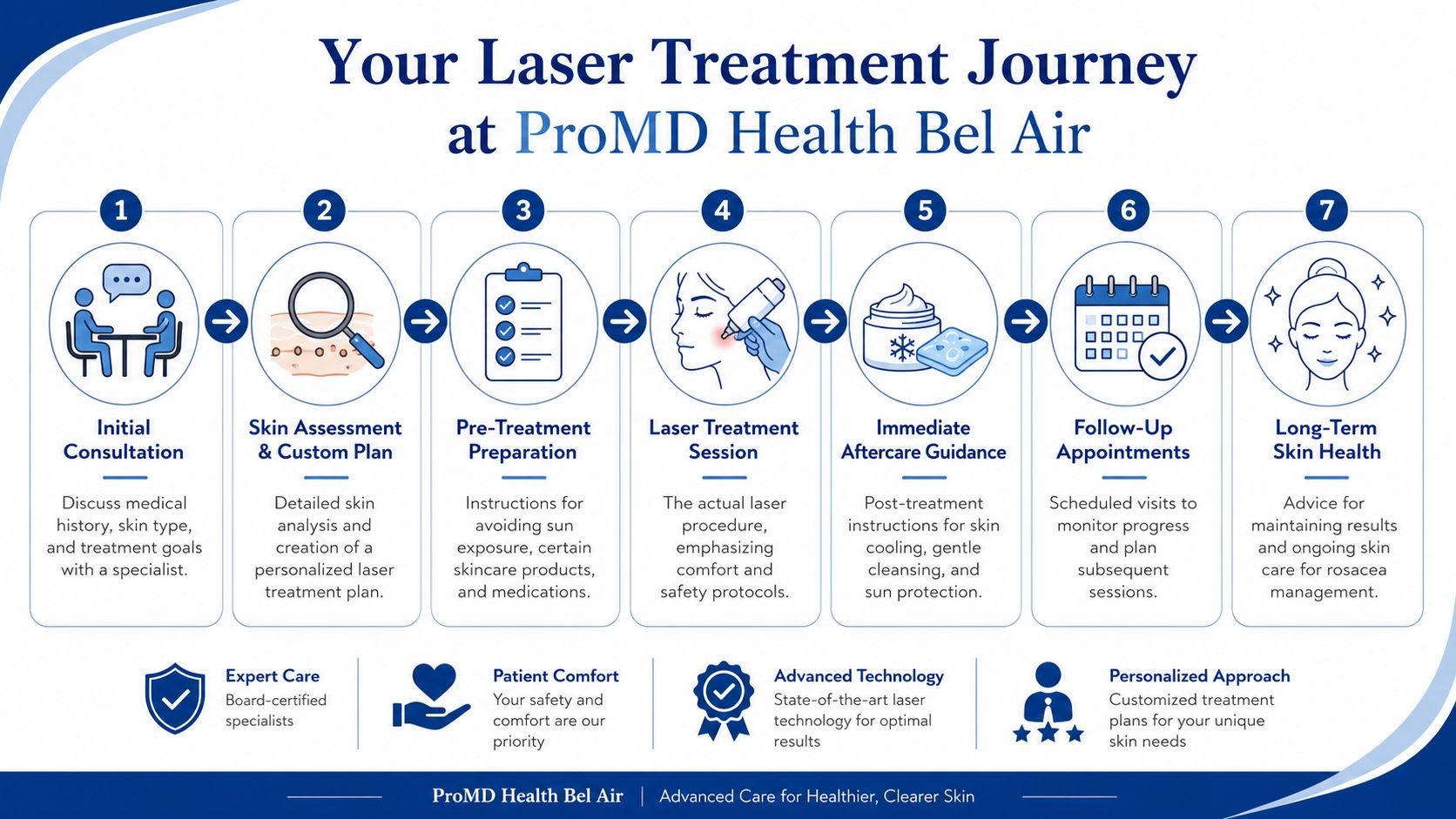
You book a consultation because your face stays red in photos, your cheeks flare after heat or exercise, and you are tired of guessing which treatment is meant for your type of rosacea. That first visit is where the plan becomes specific.
What the first visit is really like
A good consultation is practical. We look at whether your main problem is diffuse background redness, scattered visible vessels, frequent flushing, or a mix of these. That distinction matters because the treatment choice, comfort level, and recovery window are not identical for every pattern.
We also review triggers, past skin reactions, current skincare, and any history of pigment changes or strong sensitivity. Providers such as Amanda Pittillo, PA-C or Lauren Mason, PA-C, MSHS may help build the treatment plan based on your symptoms and how reactive your skin has been over time.
Some patients are ready to treat right away. Others do better if we calm the skin first. If the barrier is irritated or the rosacea is actively inflamed, waiting can give you a safer treatment and a more predictable result.
Patients who want a broader overview before their visit can review ProMD Health Bel Air's laser treatment services for redness and vascular concerns.
What treatment day feels like
Treatment day is usually straightforward. The skin is cleansed, protective eyewear is placed, and the treatment areas are marked based on where redness is most persistent and where vessels are easiest to target.
The sensation depends in part on the device and your own pain tolerance. Patients with diffuse redness often describe a series of warm snaps. Patients having more focused vessel treatment may feel sharper pulses in certain spots. Cooling helps, and the session is controlled from start to finish.
This is also where real-world trade-offs come up. If your priority is stronger vessel targeting, the treatment may feel more intense and the skin may look more reactive afterward. If your priority is a gentler session with less downtime, the improvement may come in smaller steps over multiple visits.
How progress is judged over time
Rosacea improvement is usually gradual. The first change is often that the skin looks less constantly irritated. Then makeup applies more evenly, flushing episodes feel less dramatic, or individual vessels become harder to see.
I tell patients not to judge success only by the mirror on day three. Judge it by patterns over several weeks. Are you less red by midday? Do photos look calmer? Are the areas around the nose and cheeks drawing less attention?
That is usually the more honest way to measure progress.
The best treatment journeys start with clear expectations. Laser treatment can reduce redness and visible vessels, but rosacea is still a chronic condition. Some Bel Air patients want the strongest correction they can get and accept a more noticeable recovery. Others want a lighter approach that fits work, social plans, or very reactive skin. Both are reasonable. The right plan is the one that matches your subtype, tolerance, schedule, and long-term maintenance goals.
Aftercare Risks and Long-Term Results
A common Bel Air scheduling mistake is booking treatment right before photos, a wedding, or a work event and expecting the skin to look camera-ready in a day or two. Laser for rosacea usually requires a short recovery period, and the skin can look more inflamed before it looks calmer.
What is normal right after treatment
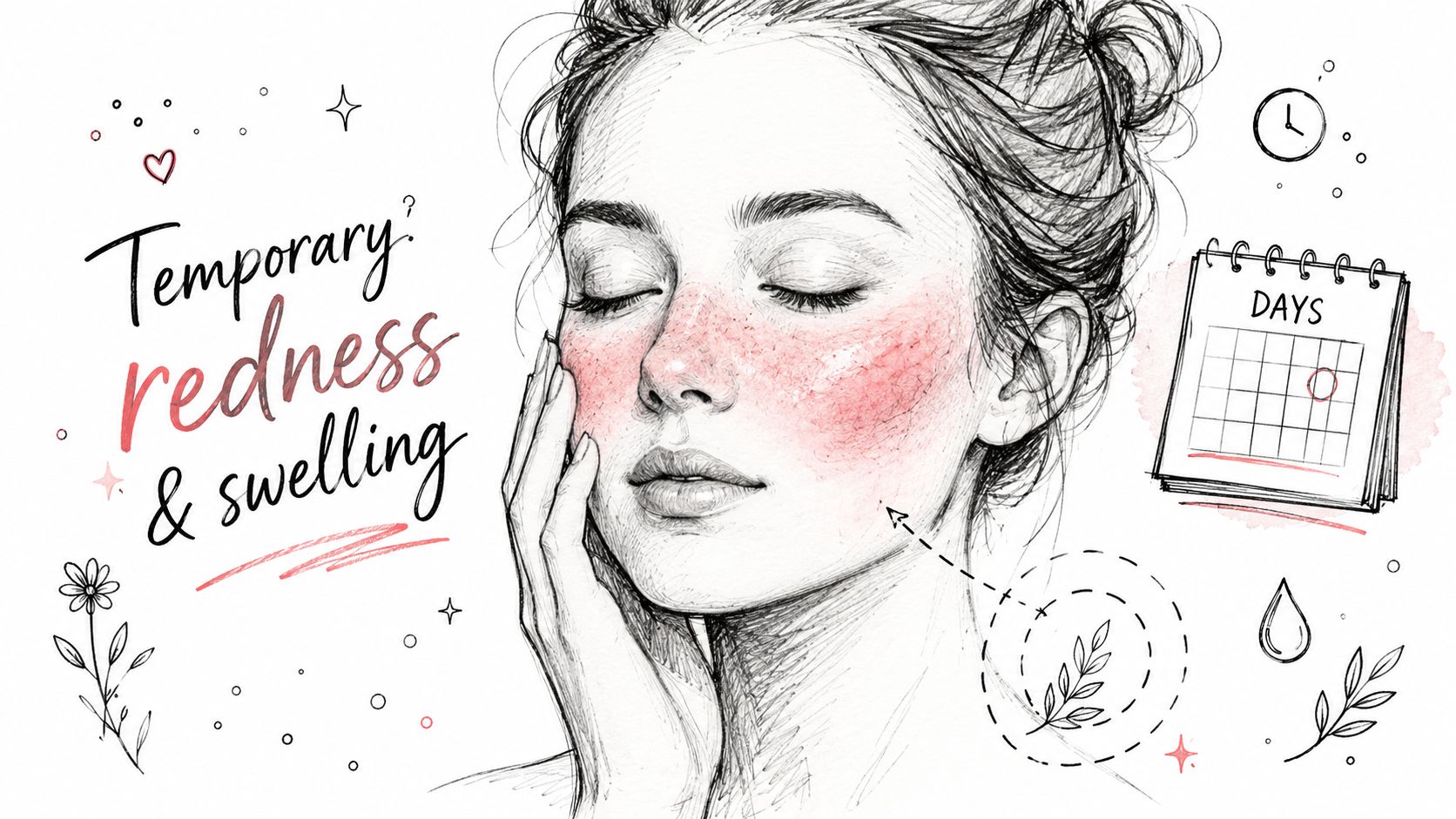
The exact recovery pattern depends on what was treated. Background redness often leaves the skin pink, warm, and mildly swollen for a few days. More targeted vessel work can leave temporary red or purple marks where those vessels were hit. Itching, dryness, and a tight feeling are also common.
Most of these effects settle within 1 to 2 weeks, and the cosmetic benefit can last 3 to 5 years before maintenance is needed, according to the American Academy of Dermatology's overview of lasers and lights for rosacea.
Scarring is uncommon when treatment is done appropriately, but no procedure is zero-risk. Skin that is very reactive, recently sun-exposed, or pushed too quickly with strong settings is more likely to stay irritated longer. That is one reason treatment choice matters. Patients treating diffuse redness often prefer a plan with less visible downtime, while patients focused on stubborn vessels may accept a rougher recovery for more direct targeting.
How to protect your results
Aftercare is straightforward, but it affects both comfort and outcome.
- Use a gentle cleanser and a plain moisturizer until the skin feels settled.
- Avoid exfoliating acids, retinoids, scrubs, and active products for the period your provider recommends.
- Limit heat exposure, vigorous exercise, hot showers, and anything else that predictably triggers flushing in the first few days.
- Use daily sun protection because UV and heat can reactivate redness.
- Do not rub, pick, or over-treat the skin while it is healing.
Patients who are unsure what counts as a safe post-procedure routine can review this guide to skincare products and how to choose them. If you need a simple option for moisture support, even a basic vegan facial moisturizer may be better tolerated than a heavily fragranced product.
Long-term results are usually good, but they are not permanent in the way many patients hope. Treated vessels can clear. Your rosacea still has its own tendencies. New vessels can form, flushing can return with heat or alcohol, and hormonal or lifestyle triggers still matter.
That is the practical expectation I want patients to have. Laser can reduce the amount of redness you live with and make flare-ups less visually obvious. It does not turn rosacea-prone skin into skin that no longer needs maintenance.
Frequently Asked Questions About Laser Rosacea Treatments
Does laser treatment for rosacea hurt
Most patients describe it as quick snaps of heat rather than prolonged pain. Comfort varies by device, settings, and your own sensitivity. In general, if discomfort is a major concern, that should be part of the treatment choice discussion because some vascular options are better tolerated than others.
What does laser treatment for rosacea cost
Cost depends on the treatment area, how much redness or vessel burden is present, and how many sessions are recommended. A small area with isolated vessels is different from treating diffuse redness across a larger portion of the face. The only accurate way to get pricing is through an in-person or virtual consultation where your skin can be assessed directly.
How many sessions will I need
That depends on the pattern and severity of your rosacea. Some patients improve in a short series, while others need a more gradual plan. The most predictable answer comes after your skin is examined and the provider decides whether the goal is vessel clearance, reduction of background redness, or both.
Will I need maintenance later
Usually, yes. Rosacea is chronic, and skin can form new vessels over time even when treated vessels are gone. Maintenance doesn't mean the original treatment failed. It means your skin condition continues to evolve.
What should I use on my skin afterward
Keep it simple. A gentle cleanser, bland moisturizer, and daily sun protection are usually the backbone of aftercare. If you're looking for a lightweight option, some patients prefer a vegan facial moisturizer that supports hydration without feeling heavy, but the best choice is always the one your skin tolerates well after treatment.
If you're considering laser for rosacea and want a plan built around your actual redness pattern, schedule a consultation with ProMD Health Bel Air. A personalized assessment can help you decide whether PDL, IPL, or another approach makes the most sense for your skin, comfort level, and long-term goals.