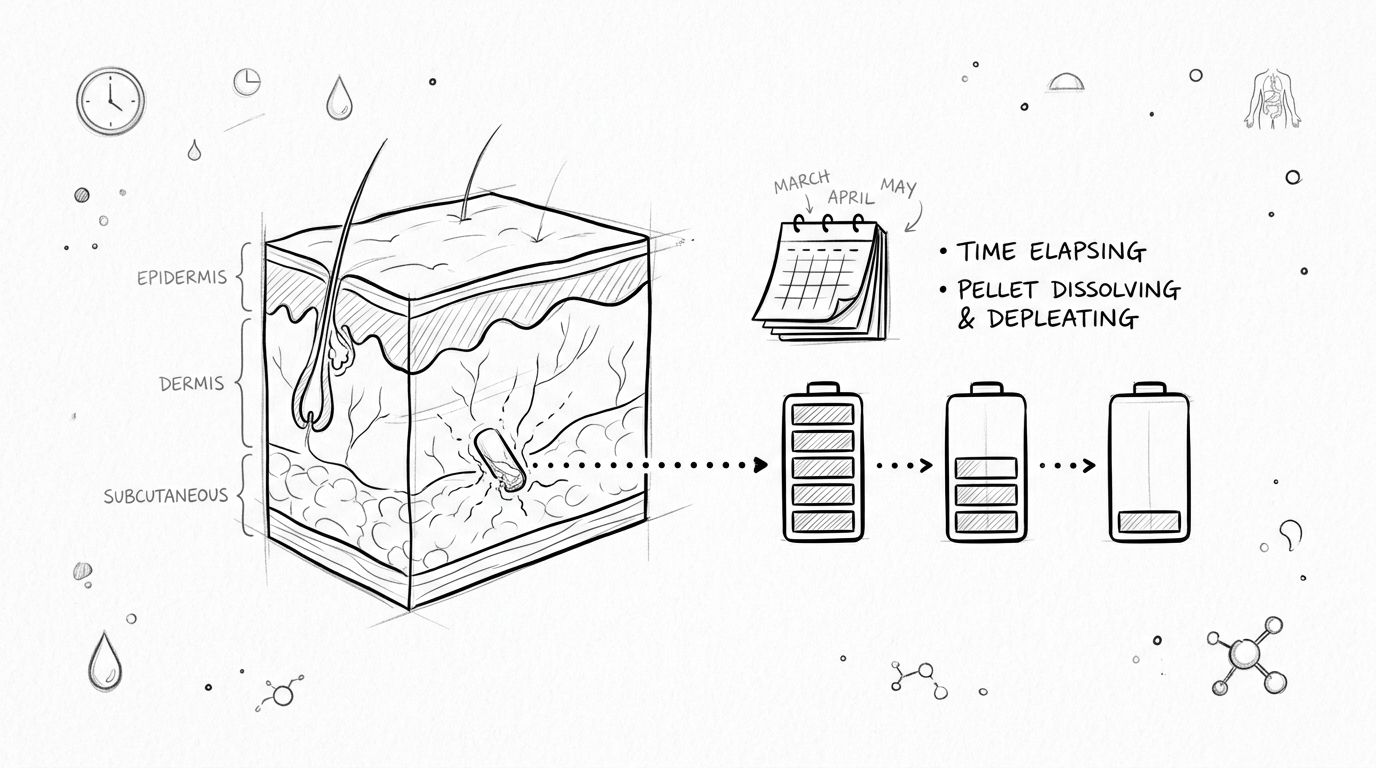
Hormone pellets usually last 3 to 6 months, but that range depends on your body and the hormone being used. In general, women tend to need replacement around 3 to 4 months, while men often stay in range for 4 to 6 months.
If you're reading this because you felt better after pellet insertion and now you're starting to wonder, “Why am I getting tired again?” or “Why do I feel a little off before my next visit?” you're not alone. This is one of the most common points of confusion with hormone replacement therapy. Many people hear a flat timeline and expect the pellets to work at the same level right up until the very last day.
That usually isn't how real life feels.
Hormone pellet therapy can be wonderfully convenient because it delivers hormones steadily under the skin, but there can still be an end-of-cycle phase where symptoms begin to creep back in. Fatigue may show up first. Sleep may get lighter. Mood may feel less stable. You might notice that your sense of well-being is not gone, but it's not as consistent as it was earlier in the cycle.
That wearing-off window matters. It doesn't automatically mean treatment failed. Often, it means your body is nearing the point where it needs the next insertion to maintain steadier hormone levels. Knowing what to expect can help you avoid that frustrating symptom gap and plan ahead with more confidence.
Table of Contents
- Your Guide to Hormone Pellet Longevity
- How Hormone Pellets Provide Steady Symptom Relief
- Key Factors That Influence How Long Your Pellets Last
- A Timeline of Your Hormone Pellet Journey
- Recognizing the Signs Your Pellets Are Wearing Off
- Your Pellet Therapy Plan at ProMD Health Bel Air
- Frequently Asked Questions About Hormone Pellets
Your Guide to Hormone Pellet Longevity
You feel better for months, then a familiar pattern starts to creep back in. Sleep gets lighter. Energy dips in the afternoon. Patience runs shorter than usual. For many new patients, that end-of-cycle shift is the part no one explains clearly enough.
When patients ask how long do hormone pellets last, they are usually trying to answer a practical question. "How long can I expect to feel steady before I need to plan my next insertion?" The short answer is that pellets often last for months, but your real experience is not measured by the calendar alone. It is measured by how consistently your symptoms stay controlled from one cycle to the next.
A helpful way to look at pellet longevity is to picture a long, gradual curve instead of a hard stop. Many patients do not feel perfectly fine one day and suddenly unwell the next. More often, there is a steady middle stretch, then a gentle taper near the end. That taper matters because it is where a symptom gap can happen if follow-up is scheduled too late.
This is one reason we encourage patients to learn their own pattern, not just memorize a general timeframe. If your body tends to signal early that hormone levels are easing down, planning ahead can help you avoid a stretch where old symptoms return and daily life starts to feel harder again. Our overview of how pellet therapy works over time explains the basics, but the bigger day-to-day question is often what the last few weeks of a cycle feel like for you.
That is also why realistic expectations help so much. Pellet therapy is designed to support steadier symptom relief, but it still follows a cycle. Your first goal is relief. Your second goal is timing. At ProMD Health Bel Air, we want patients to understand both, so they can track changes early and schedule proactively instead of waiting until symptoms fully return.
Some patients also explore supportive lifestyle habits alongside medical care, including reading about best herbs for women's wellness. Those habits can complement your routine, but they do not replace a well-timed pellet follow-up plan.
The key idea is simple. Pellet longevity is not just about how long the pellet remains active. It is about how to recognize the end of your cycle early enough to stay ahead of that drop-off in symptom control.
How Hormone Pellets Provide Steady Symptom Relief
A lot of patients notice the same pattern. After insertion, symptoms gradually settle. Sleep feels more predictable, mood may feel less jagged, and energy often becomes more dependable week to week. Then, near the end of a cycle, some of that steadiness starts to soften. That full arc matters, because pellet therapy is designed to give your body a slow, even release for most of the cycle, not a quick burst followed by a sharp drop.
Hormone pellets are tiny implants placed under the skin, usually in the upper buttock or hip area. They dissolve over time and release measured amounts of hormone day by day. A simple comparison is a slow-drip system rather than a faucet turning on and off. That gradual delivery is why many patients feel fewer ups and downs than they did with options that depend on daily dosing or more frequent fluctuations.
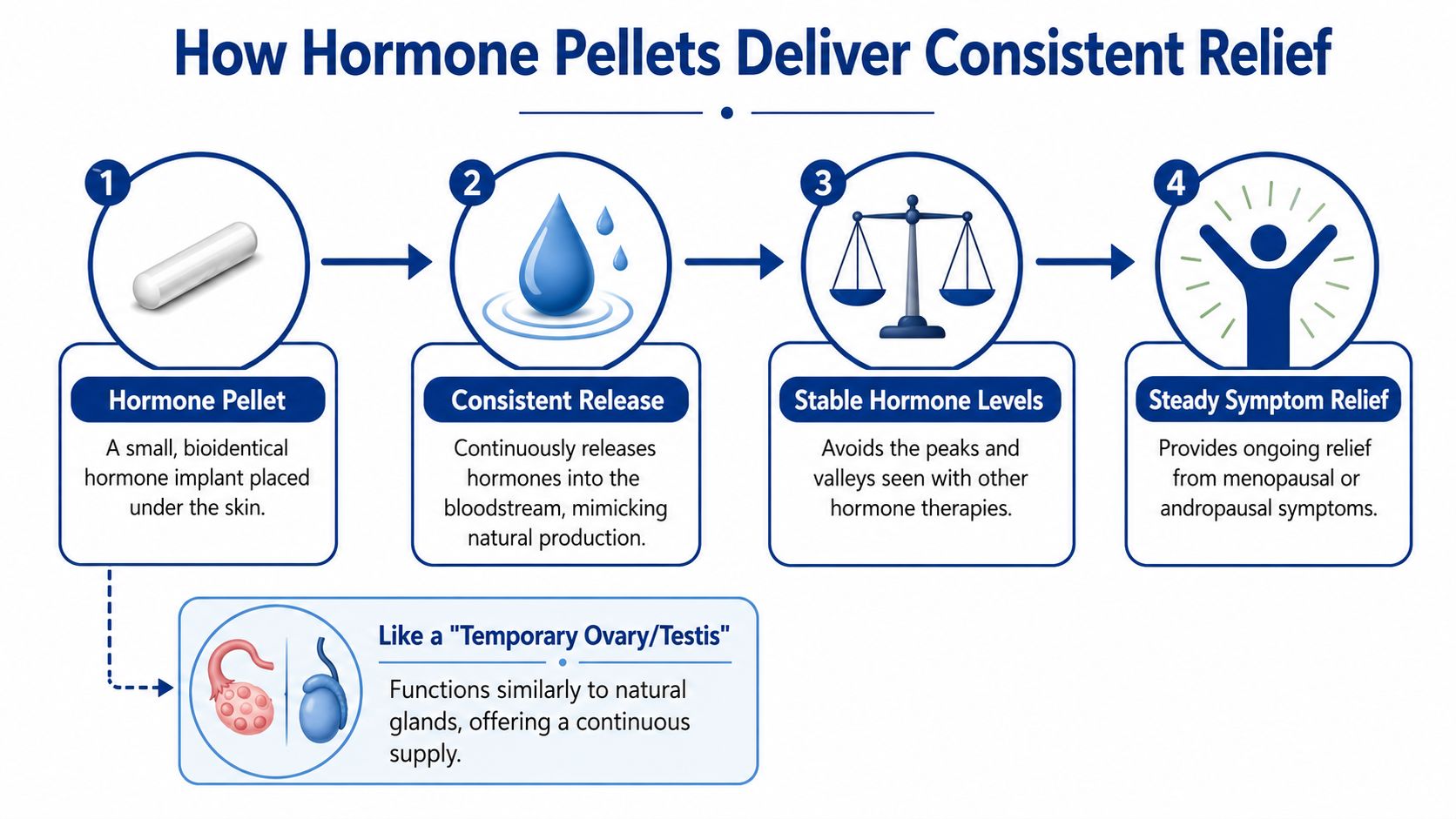
Why the release feels steadier
Your pellet sits in the fatty tissue under the skin and releases hormone in small amounts as it dissolves. The goal is a more even hormonal background, which can support steadier symptom control across the middle of the cycle.
That does not mean every week feels identical.
Early on, your body is adjusting. In the middle phase, many patients feel their most stable. Near the end, levels may begin to taper. The change is often subtle at first, which is why I encourage patients to pay attention to patterns instead of waiting for symptoms to become obvious again. If you want a closer look at the treatment itself, our overview of how pellet therapy works over time explains the basics in plain language.
Some patients also like to build supportive routines around treatment, including reading about best herbs for women's wellness as a general lifestyle resource. Those habits can support overall wellness, but they do not replace a timely pellet follow-up.
Why men's and women's timelines differ
Men and women often move through pellet cycles on different timelines. In general, women may need replacement sooner than men, while men often stay in range longer. The reason is practical. Different hormones release and clear differently, and each body uses them at its own pace.
That is why comparing your timeline to a friend's usually creates more confusion than clarity. Two patients can both be responding normally and still have different refill windows.
At ProMD Health Bel Air, we frame pellet therapy as a rhythm you learn over time. The benefit is not only steady relief in the middle of the cycle. It is also recognizing when that steady phase is starting to fade, so you can schedule proactively and avoid a symptom gap between insertions.
Key Factors That Influence How Long Your Pellets Last
Some people move through a pellet cycle faster than expected. Others stay comfortable closer to the outer end of the range. Usually, the answer isn't mystery. It's physiology plus lifestyle.
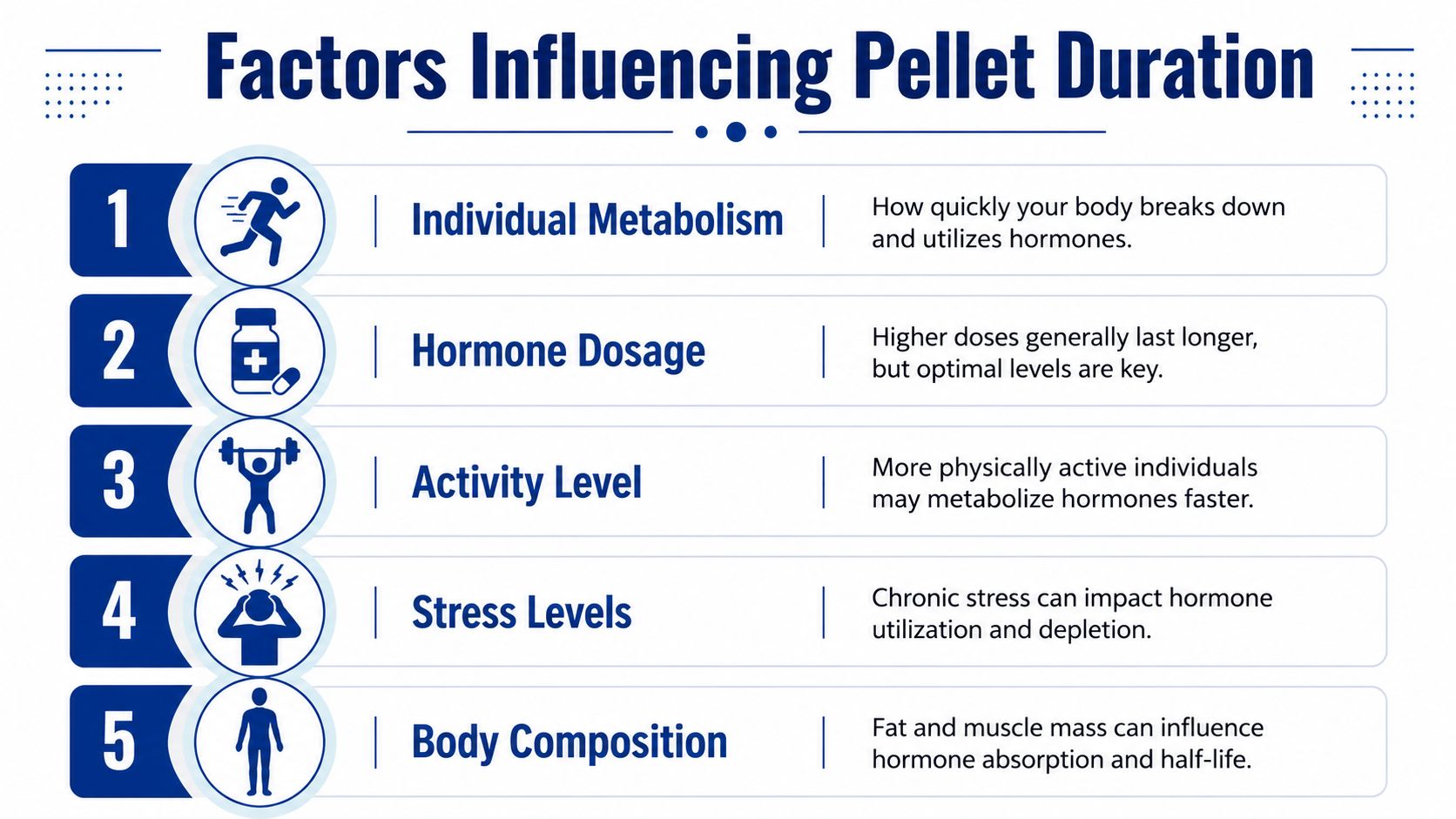
According to this review of factors that can speed pellet clearance, high stress, intense lower-body physical activity, certain medications, and sleep deprivation can accelerate pellet disintegration. Thinner patients or people with higher metabolic rates may also clear pellets faster.
Metabolism and Body Composition
Your metabolism affects how quickly your body uses and clears hormones. Some people naturally process things faster. That's not good or bad. It just means the pellet may not last as long in practice.
Body composition matters too. Pellets sit in the hip fat layer, and local blood flow influences release. A thinner patient, or someone whose body tends to run “fast,” may move through the cycle sooner than someone with slower clearance.
A simple example: two patients can receive appropriate treatment and still have different timelines. One feels stable well into the expected window. The other notices old symptoms creeping back earlier. Neither response is unusual.
Physical Activity
Exercise is healthy, but very intense lower-body activity can speed up pellet use. Running, cycling, and other high-output movement can increase circulation in the area and can change how quickly hormones are absorbed.
That doesn't mean you should avoid activity long term. It means your provider needs the full picture. If you're highly active, your timing may need to be watched more closely than the average schedule suggests.
Stress, Sleep, and Medications
Stress changes more than mood. High stress can affect how your body uses hormones. Sleep deprivation can do the same. Certain medications can also alter the pace of pellet disintegration.
Patients sometimes blame themselves when a pellet seems to wear off earlier than expected. Usually, it isn't about doing something wrong. It may reflect a demanding season of life. Poor sleep, heavy training, or a medication change can shift the cycle.
Clinical reality: The same pellet can last differently in different bodies, and even differently in the same person during different seasons of life.
Why Follow Up Matters
Pellets can't be adjusted after insertion. That means follow-up isn't just paperwork. It's how future cycles become more precise.
If you're considering BioTE hormone pellets in Bel Air, the most helpful mindset is this: your first cycle gives useful information, and your next cycle can be refined from there. Care works best when symptom changes, lifestyle patterns, and follow-up testing all get factored into the plan.
A Timeline of Your Hormone Pellet Journey
Knowing the average duration helps. Knowing what the months feel like is often more useful.
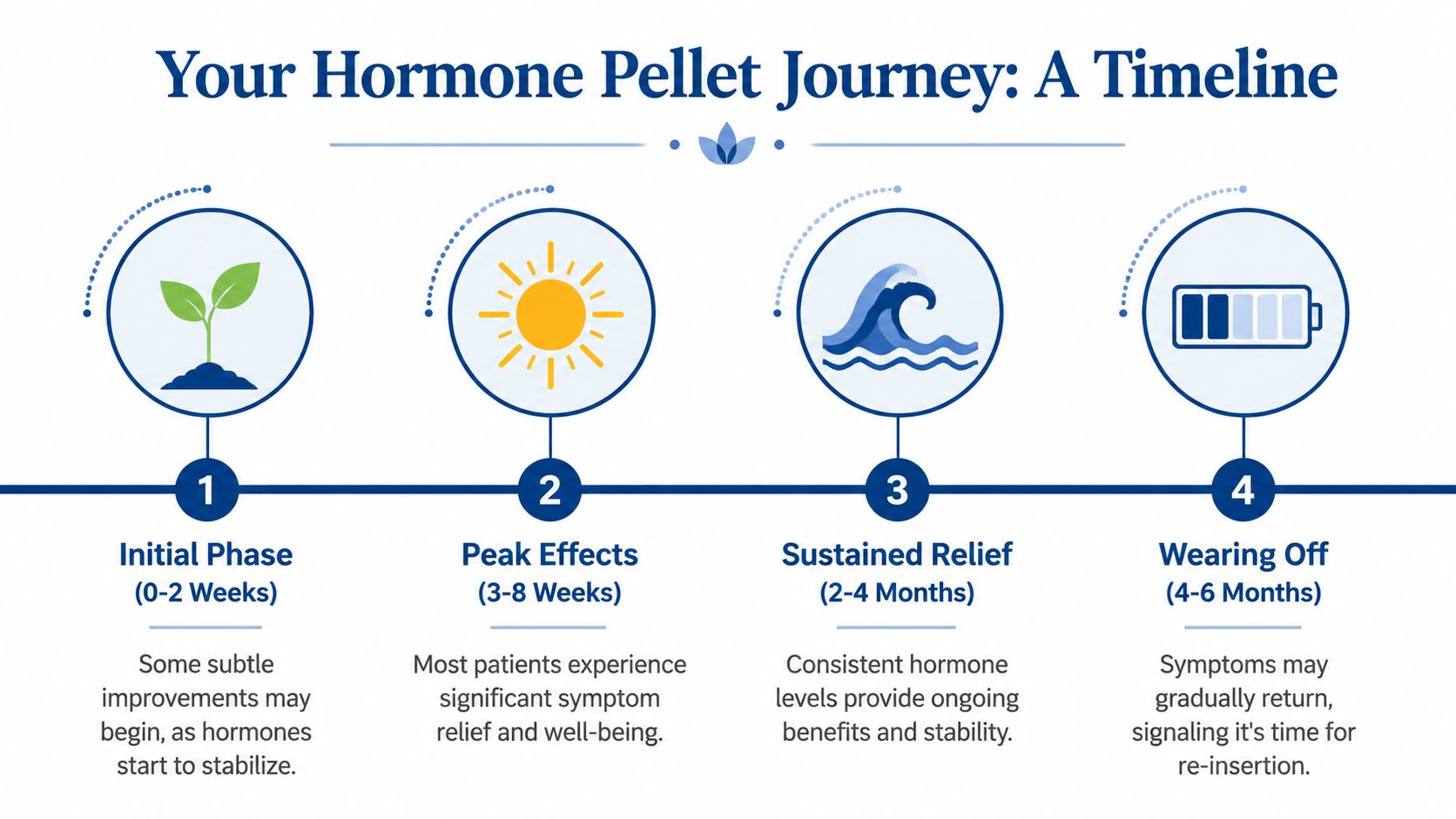
Clinical data comparing delivery methods notes that initial effects may begin within 1 to 3 days, full therapeutic results are typically achieved within 2 to 4 weeks, and follow-up blood testing is commonly performed 4 to 6 weeks after insertion to assess levels for future dose adjustment. That same study found women on pellet therapy had greater improvement in vasomotor symptoms such as hot flashes and night sweats, with a mean reduction of −2.08 vs −1.03, p<0.003, compared with transdermal methods in this clinical comparison of hormone delivery methods.
The First Few Days
Most patients don't walk out of the office feeling like an entirely different person that afternoon. That's a common misconception. Some subtle changes may begin early, sometimes within the first few days, but the body still needs time to respond.
You might notice a small lift in energy. Sleep may start to improve. Some people feel nothing dramatic at first, and that's okay too.
The First Month
This is when many patients start saying, “I feel more like myself.” Mood may feel steadier. Energy often becomes more reliable. Hot flashes or night sweats may calm down. Motivation for exercise may return.
Follow-up testing commonly happens in this window. That matters because the first cycle gives your provider a real-world look at how your body is responding, not just what your initial labs suggested.
The Mid-Cycle Stretch
This is often the most comfortable part of the pellet journey. Symptoms are more stable. Daily life feels less effortful. You're not thinking about hormone fluctuations every day because the therapy is doing its job in the background.
Here's where patients sometimes get caught off guard. They assume this balanced feeling will stay constant until the pellet is fully dissolved. In reality, the end of the cycle may soften gradually before symptoms become obvious.
| Phase | What patients often notice |
|---|---|
| Early response | Small, subtle changes rather than instant results |
| Therapeutic build | More noticeable symptom relief and improved stability |
| Steady phase | A more even sense of wellness across daily life |
| Late-cycle shift | Mild return of old symptoms that can signal timing for reinsertion |
Recognizing the Signs Your Pellets Are Wearing Off
Many people think pellets stop working all at once. More often, the end of the cycle shows up as a gradual symptom rebound.
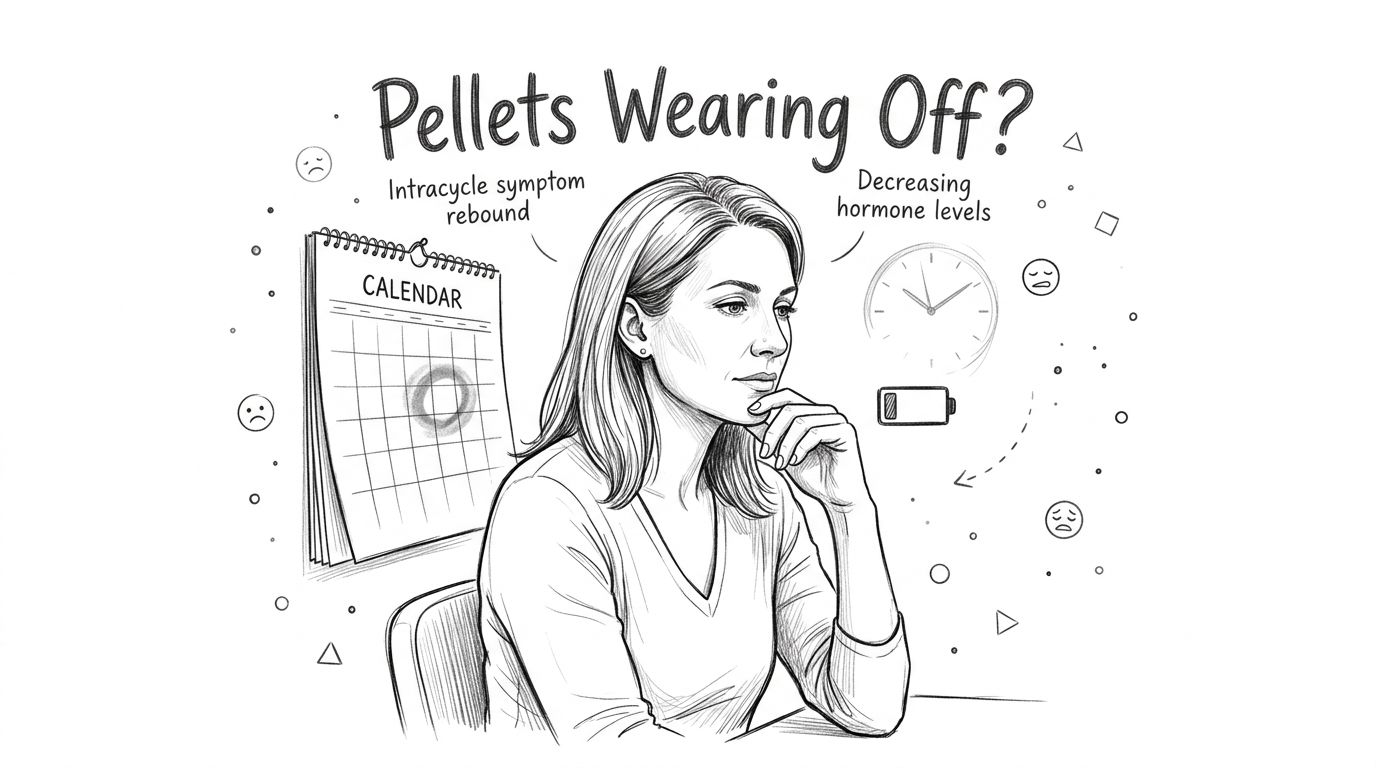
The name for this is intracycle symptom rebound. According to this pellet therapy FAQ discussing rebound timing, symptoms often return 1 to 2 weeks before the 6-month mark in men and 3 to 4 weeks before the 4-month mark in women.
What Intracycle Symptom Rebound Feels Like
This phase can be subtle at first. You may not wake up one day feeling terrible. Instead, you may notice your usual resilience isn't there. You need more caffeine. You feel less rested. Small stressors feel bigger than they did a few weeks ago.
That pattern can make people wonder if the therapy “stopped working” or if something else is wrong. Sometimes the simplest explanation is that the pellet is nearing the end of its active window.
A gradual return of symptoms near the end of the cycle often signals timing, not failure.
Signs to Watch For
Common clues include:
- Energy dipping again: You feel more tired, especially in the afternoon or evening.
- Mood feeling less even: Irritability, emotional sensitivity, or flat motivation starts to return.
- Sleep becoming less restorative: You fall asleep less easily or wake more often.
- Old hormone-related symptoms resurfacing: The specific symptoms that improved earlier begin creeping back.
The most useful step is to track the pattern. If symptoms are returning in a familiar way near the expected end of your cycle, that's valuable information to share with your provider. It may help prevent a gap between feeling well and waiting too long for the next insertion.
Your Pellet Therapy Plan at ProMD Health Bel Air
A good pellet plan doesn't stop at insertion day. It includes timing, symptom tracking, and enough follow-up to reduce the chance of an avoidable crash at the end of the cycle.
At ProMD Health Bel Air's hormone replacement therapy service, patients are evaluated through a medical process that looks at symptoms, lab work, and response over time. For hormone care in this office, that means the plan stays within the Hormone Replacement Therapy service rather than getting mixed with unrelated treatments.
Amanda Pittillo, PA-C, and Lauren Mason, PA-C, MSHS are part of the Bel Air team helping patients through this process. That kind of provider continuity matters because pellet therapy works best when someone notices not just your lab values, but also your pattern. Did your energy improve quickly? Did sleep lag behind? Did symptoms begin creeping back before the expected date?
A More Proactive Way to Schedule
The biggest mistake I see is waiting until symptoms are fully back before checking in. By then, you're not maintaining wellness. You're trying to recover it.
A more practical approach is to plan around the end-of-cycle window. If you're a woman who tends to feel changes before the expected replacement point, or a man who notices a predictable decline near the end of the cycle, that pattern deserves attention. Scheduling proactively can help reduce the “symptom gap” between insertions.
For patients in Bel Air, Fallston, Forest Hill, and nearby Maryland communities, the goal is simple. Stay ahead of the drop-off instead of reacting after it happens.
Frequently Asked Questions About Hormone Pellets
Does the pellet have to be removed
Usually, no. The pellets dissolve completely under the skin rather than needing removal, which is one reason many patients like this option.
How soon will I feel a difference
Some people notice early changes quickly, while others feel the benefits more gradually. If you'd like a patient-friendly outside read on the broader benefits of hormone pellet therapy, that can help frame expectations. In practice, most patients do best when they expect a build rather than an instant transformation.
What if my symptoms come back before my next visit
Tell your provider. A return of fatigue, mood changes, or sleep issues near the end of a cycle can be useful clinical information. It may mean your body tends to move through pellets faster and that your maintenance timing needs adjustment.
Is the insertion a major procedure
No. It's typically an in-office procedure. Patients often have mild soreness or bruising afterward, and they should follow their provider's aftercare instructions, especially around strenuous activity right after insertion.
How is my dose determined
It isn't guessed. Dose planning is based on your symptoms, lab work, and how you responded to prior treatment. That's one reason follow-up is so important. The first pellet cycle often helps fine-tune the next one.
If you're noticing that your energy, sleep, or mood starts slipping before your next pellet appointment, it may be time for a more proactive maintenance plan. ProMD Health Bel Air offers medically supervised Hormone Replacement Therapy for adults in Bel Air and surrounding communities, with care focused on realistic expectations, symptom tracking, and timely follow-up.