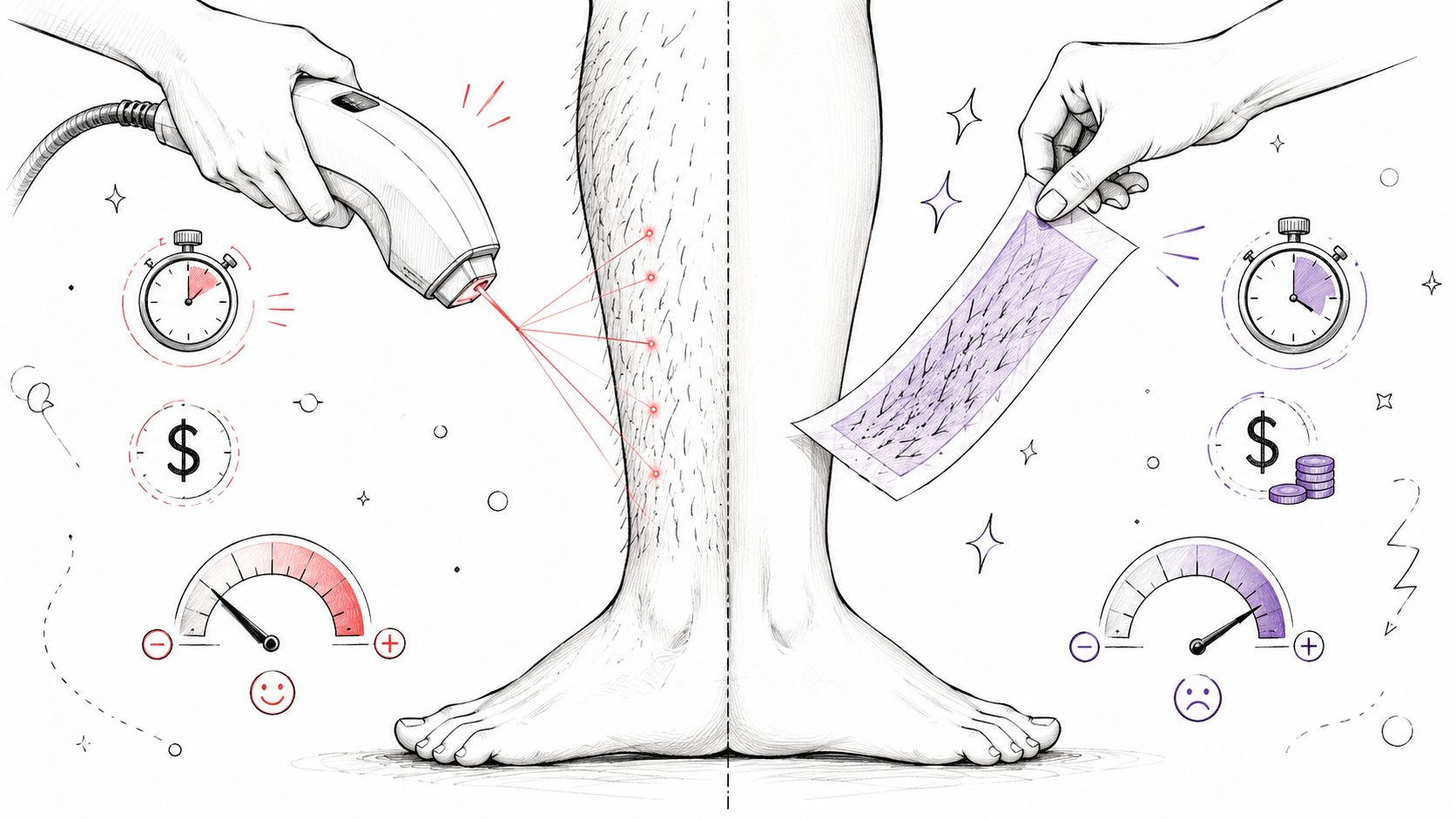
You're probably deciding between two kinds of frustration.
One is familiar. You shave, feel smooth for a day or two, then deal with stubble, razor burn, or ingrown hairs again. The other is the salon cycle. You wax, enjoy the result for a few weeks, then wait for enough regrowth to repeat the whole thing.
That's usually when patients start comparing laser hair removal vs waxing in a more serious way. They're no longer asking which one sounds better. They want to know which one best suits their skin, schedule, comfort, and budget over time.
In a clinic setting, this comparison looks different than it does in generic beauty content. The key question isn't just how hair comes off today. It's what happens to the follicle, how many repeat appointments you're signing up for, how the discomfort changes over time, and whether your hair and skin type make you a strong candidate for laser in the first place.
At a medically supervised practice in Bel Air, we see both sides of that decision. Some patients want a predictable temporary option and prefer waxing. Others are tired of the maintenance loop and want a path toward long-term reduction with laser. Both can be appropriate. They just solve different problems.
A quick side-by-side view helps frame the choice:
| Factor | Laser Hair Removal | Waxing |
|---|---|---|
| How it works | Uses focused light energy to target pigment in the follicle and damage it to delay regrowth | Removes hair from the root with wax but does not damage the follicle |
| Best fit | Patients seeking long-term reduction | Patients seeking temporary smoothness |
| Hair color limits | Not effective on blonde, white, or red hair | Works across hair colors |
| Ongoing upkeep | Series of treatments, then maintenance | Repeated appointments indefinitely |
| Decision lens | Long-term value | Short-term convenience |
Table of Contents
- Tired of the Temporary An Introduction
- How Hair Removal Works The Science Behind Each Method
- Results and Longevity Temporary Smoothness vs Long-Term Reduction
- Comparing Pain Comfort and Side Effects
- The True Cost A Lifetime Financial Comparison
- Ideal Candidates and Treatment Areas
- Start Your Hair-Free Journey in Bel Air
Tired of the Temporary An Introduction
People often don't start with laser. They start with whatever feels easiest.
That usually means shaving until the upkeep gets old, or waxing until the calendar starts feeling repetitive. You clear time for the appointment, let the hair grow out, deal with the discomfort, enjoy the smooth skin, then do it all again. For busy adults in Bel Air, Fallston, and Forest Hill, that cycle adds up fast.

Patients usually reach a turning point with one specific complaint. It might be underarm irritation, bikini area ingrowns, facial hair that keeps returning, or the simple annoyance of planning life around regrowth. At that point, professional waxing and laser hair removal stop being luxury add-ons and start becoming practical options.
Two professional paths with very different outcomes
Waxing and laser both improve on shaving, but they are not interchangeable.
Waxing is a maintenance service. It removes visible hair and leaves skin smooth for a while. Laser is a reduction strategy. It aims to change future growth by targeting the follicle itself. That difference is why the long-term experience feels so different.
Smooth skin for a few weeks and less hair over time are not the same goal.
In practice, the right choice depends on what bothers you most. If your main issue is temporary cleanup before an event or regular grooming, waxing may fit. If you're tired of constant repeat appointments and want fewer hairs returning, laser usually deserves a serious look.
What patients often overlook
Many online comparisons focus on one appointment at a time. That's not how real life works.
A better way to compare laser hair removal vs waxing is to look at the full timeline:
- Your routine: How often do you want to keep managing this area?
- Your tolerance: Do you want a recurring service or a defined treatment plan?
- Your goal: Are you trying to remove hair now, or reduce it long term?
Those are the questions that shape satisfaction with the result.
How Hair Removal Works The Science Behind Each Method
Laser and waxing remove hair in completely different ways. Once you understand that, the trade-offs make a lot more sense.
How laser targets the follicle
Laser hair removal uses concentrated light energy to target the pigment in the hair follicle. The light is absorbed by melanin, creates heat, and damages the follicle to interfere with future growth. Because the follicle has to be present for the laser to work, patients are told not to wax or pluck before treatment. Dermatologists recommend avoiding waxing or plucking in the treatment area for six weeks prior to laser, while shaving remains acceptable and often preferred, and laser is ineffective on blonde, white, or red hair according to this clinical summary on PubMed.
Here's how it works: the laser is looking for a dark target inside the skin. If the follicle is empty because the hair was pulled out, there's nothing meaningful to target.
For patients considering treatment details, the laser hair removal service page gives a general overview of how clinic-based treatment is approached.
How waxing removes visible hair
Waxing is mechanical, not follicle-altering.
Warm or soft wax adheres to the hair shaft, and the hair is pulled out from the root. That can leave the skin very smooth, but the follicle remains capable of producing a new hair. In other words, waxing removes what's there now. It does not reduce the follicle's long-term ability to grow more hair.
That one distinction explains most of the downstream differences between the two methods.
| Method | Primary target | What happens after treatment |
|---|---|---|
| Laser hair removal | Pigment in the follicle | Future growth is reduced over time |
| Waxing | Existing hair shaft and root | Hair returns as the follicle cycles again |
Why preparation matters
Preparation isn't just a formality with laser. It affects whether treatment can work well.
Practical rule: If you're planning laser, shave the area when instructed, but don't wax or tweeze it beforehand.
With waxing, prep is simpler. The hair needs enough length for the wax to grip. That makes waxing flexible for many people, but it also means living with visible regrowth between visits. For patients who dislike that grow-out phase, laser often feels more compatible with everyday life once the treatment plan is underway.
Results and Longevity Temporary Smoothness vs Long-Term Reduction
The two options separate most clearly on this point.
What long-term reduction actually means
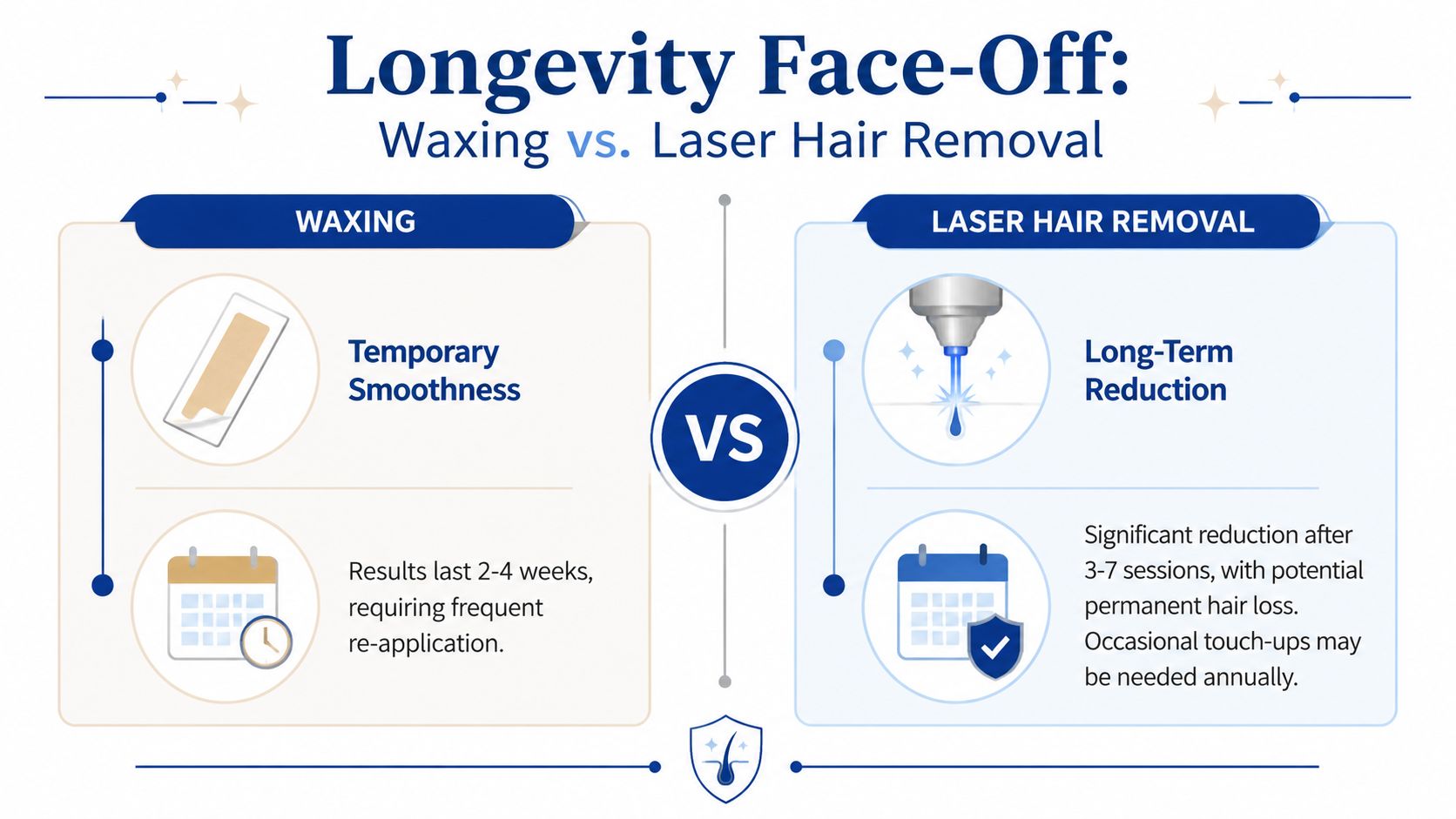
Laser hair removal can achieve approximately 80 to 90 percent long-term reduction in hair growth after a series of 6 to 8 treatment sessions, with results often lasting for years and only occasional touch-ups needed, while waxing provides temporary removal that lasts 3 to 6 weeks without damaging the follicle for permanent reduction, based on this laser versus waxing clinical comparison.
That's the key phrase patients should pay attention to: long-term reduction.
Laser doesn't mean every follicle vanishes forever with one appointment. It means the area usually becomes much less dense, much easier to manage, and much less dependent on constant maintenance after a treatment series.
Waxing gives a clean result, but not a changing one
Waxing can be very effective for the short term. Skin feels smooth, the result is visible right away, and many patients like the predictability of it.
But the outcome doesn't compound. The same follicle keeps producing new hair, so the routine stays in place. You remove hair, wait, regrow, and repeat. For someone who is fine with that cycle, waxing still has a place. For someone who wants the situation to improve over time, it usually falls short.
The biggest difference isn't speed. It's whether the next season looks different from this one.
A more useful timeline to compare
Instead of asking which treatment works better this month, ask what your calendar looks like after you commit.
- With waxing: smoothness is temporary, then the area returns to its usual pattern.
- With laser: progress builds across sessions as fewer hairs come back and remaining hairs often become easier to manage.
- With maintenance: laser may still require touch-ups, but the pattern is very different from recurring waxing.
That's why many patients who compare laser hair removal vs waxing end up deciding based on fatigue. They're not just tired of hair. They're tired of the repetition.
Clinical expectations matter
A medically supervised plan also keeps expectations realistic. Laser tends to work best when the target is appropriate, the sessions are spaced properly, and the patient follows prep instructions. Waxing remains useful when hair color makes laser a poor match or when someone prefers a temporary service.
Both options can be valid. Only one is designed to reduce future growth.
Comparing Pain Comfort and Side Effects
Pain gets oversimplified in this discussion.
A common question is which treatment hurts more during the appointment. That's understandable, but it misses the bigger issue. The better question is how discomfort behaves over time.
The cumulative pain timeline
One of the most useful ways to compare laser hair removal vs waxing is the cumulative pain timeline. According to this discussion of long-term pain exposure, waxing pain tends to stay consistent for decades of repeat appointments, while laser discomfort decreases significantly after the 4th to 6th session as hair thins, and total pain exposure over 10 years is 80 to 90 percent lower for laser.
That changes the whole conversation.
A person might find one waxing appointment tolerable and one laser session mildly uncomfortable. But if waxing continues indefinitely and laser discomfort drops as the treatment series progresses, the long view often favors laser from a comfort standpoint.
What the experience usually feels like
Laser is commonly described as a quick snap or burst of heat. Waxing is a pull. They're different sensations, and patient preference varies by area.
The more important practical distinction is that laser has an endpoint structure. Waxing usually does not. That means the discomfort from waxing may be familiar, but it keeps returning on schedule.
A finite treatment plan and an indefinite routine shouldn't be judged the same way.
Side effects patients actually care about
In a clinic setting, patients usually care about what happens after the appointment just as much as what happens during it.
With laser, the most common short-term issue is temporary redness or sensitivity in the treated area. With waxing, patients often mention irritation, tenderness, or ingrown hairs, especially in high-friction areas such as the bikini line or underarms.
A practical comparison looks like this:
- Laser concerns: Temporary warmth, redness, and sensitivity right after treatment.
- Waxing concerns: Repeated pulling, skin irritation, and a tendency toward ingrowns in some patients.
- Comfort over time: Laser discomfort often drops as hair becomes thinner. Waxing typically doesn't improve in the same way.
Why the setting matters
Technique matters with both services. Proper assessment, treatment spacing, and aftercare guidance can improve the overall experience.
That's where a clinic-based approach is helpful. Instead of guessing your candidacy or repeating a routine that isn't serving you well, you get a treatment plan shaped around your hair pattern, skin response, and the area being treated. That doesn't make every session painless. It does make the process more intentional and usually more efficient.
The True Cost A Lifetime Financial Comparison
The price tag that gets people's attention first is usually the per-visit price.
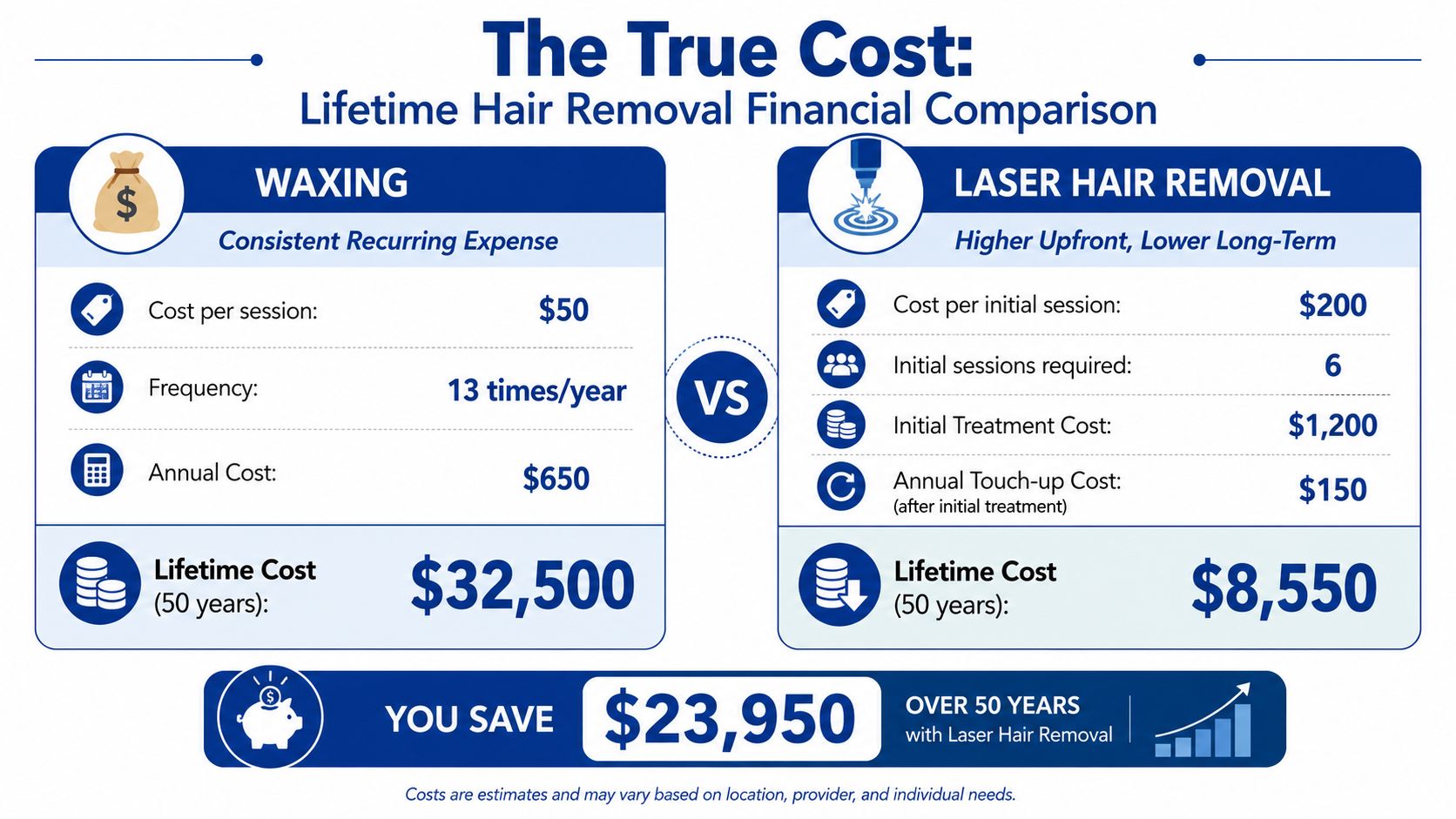
Waxing looks cheaper because it is cheaper each time you book it. Laser looks more expensive because the initial plan costs more upfront. If you stop the comparison there, waxing seems like the budget option. If you look at the full lifespan of the habit, the math changes.
What recurring waxing really adds up to
The average lifetime cost of waxing is estimated at approximately $23,000 because appointments continue every 3 to 6 weeks, while laser hair removal requires a higher initial investment and then only occasional touch-ups once or twice a year, according to this long-term cost breakdown.
That figure matters because waxing often feels inexpensive only when viewed one appointment at a time.
For patients who wax regularly, the expense isn't dramatic in any single month. It becomes expensive because there is no finish line. You keep paying for maintenance, and the maintenance never converts into less future growth.
For readers considering a temporary service for face or body areas, the waxing service page outlines the treatment category itself.
Upfront cost versus ownership cost
A cleaner way to think about this is to separate entry cost from ownership cost.
| Cost question | Laser hair removal | Waxing |
|---|---|---|
| What do I pay first? | More upfront | Less upfront |
| What am I paying for? | A treatment series aimed at reducing future growth | A temporary result |
| What happens later? | Maintenance only as needed | Ongoing repeat appointments |
That's why patients who initially resist laser on price often change their view after a real consultation. They realize they've been comparing a long-term strategy to a short-term visit.
Time is part of the cost too
Money isn't the only expense.
Waxing also requires repeated scheduling, repeated regrowth, repeated discomfort, and repeated mental bandwidth. Even patients who don't mind waxing often underestimate how much attention the routine keeps demanding year after year.
Laser asks more commitment early. Then the maintenance burden usually drops.
If a treatment saves appointments, regrowth management, and recurring discomfort, that has value even before you put a dollar amount on it.
When waxing still makes financial sense
Waxing can still be the right choice if you need flexibility, want a lower immediate spend, or have hair color that laser won't target well.
But if the goal is long-term value, laser generally wins because the spending is tied to a reduction process instead of an endless maintenance loop. That's the financial reality many patients only recognize after years of treating waxing as the cheaper option.
Ideal Candidates and Treatment Areas
The best method depends less on trends and more on your biology and your goals.
Who tends to do well with laser
Laser hair removal works by targeting pigment in the follicle, so the strongest candidates usually have enough contrast for the laser to identify that target clearly. Traditionally, that has meant lighter skin and darker hair, though newer clinical approaches have broadened suitability for darker skin tones as well. It still remains ineffective on blonde, white, or red hair, and if those are your dominant hair colors, waxing is usually the more practical path.
That's one reason consultation matters. A good plan starts by identifying whether laser is a good match, not by forcing it when the hair characteristics don't support it.
For patients curious about underarm treatment specifically, this guide to laser underarm treatments is a useful starting point.
Who may prefer waxing
Waxing is more universal in terms of hair color. It removes hair mechanically, so it doesn't depend on pigment the way laser does.
That makes waxing a reasonable option for:
- Lighter hair colors: If the hair is blonde, white, or red.
- Short-term goals: If you want temporary smoothness without committing to a treatment series.
- Shape-focused upkeep: Brows, lip, chin, and other areas where regular grooming may be the main objective.
Treatment area often shapes the decision
Some areas are especially persuasive for laser because they create frequent maintenance headaches. Underarms, bikini areas, legs, chest, and back often fall into that category. Patients who are prone to irritation or repeated ingrowns in these areas may find the long-term reduction more meaningful than a temporary clean-up.
Waxing still fits well in many facial and body areas, especially when the goal is periodic maintenance rather than reduction.
A practical way to decide is to ask:
- Is this area constantly bothering you?
- Is regrowth here uncomfortable or inconvenient?
- Do you want less hair over time, or just less hair right now?
The best candidate for laser isn't just someone with the right hair type. It's someone who wants out of the maintenance cycle.
Why individualized planning matters
In a medically supervised setting, treatment isn't chosen by trend. It's chosen by fit.
That means looking at skin tone, hair color, hair density, treatment area, sensitivity, and how much maintenance you're willing to keep doing. Those details matter more than generic beauty advice, especially when you're comparing a temporary service to one designed for long-term change.
Start Your Hair-Free Journey in Bel Air
Once you've looked at laser hair removal vs waxing through the lens of time, comfort, and outcome, the choice usually gets clearer.
Some patients want the flexibility of waxing and are comfortable with regular upkeep. Others are ready to stop managing the same area over and over and would rather commit to a treatment plan that aims for long-term reduction. Neither choice should be made casually. It should be matched to your skin, hair, and actual routine.

What a clinic consultation should do
A useful consultation doesn't just answer “How much is it?” It should clarify whether you're a strong laser candidate, whether waxing is more practical for your hair type, and what kind of maintenance each option would require in your case.
That process may include:
- Area review: Where the hair is bothering you most and how often you're currently managing it.
- Hair and skin assessment: Whether the follicle and pigment pattern support effective laser treatment.
- Lifestyle fit: Whether you want a temporary service or a long-term reduction strategy.
Local care matters
For adults in Bel Air and nearby communities, it helps to work with a clinic team that can assess the area directly and set realistic expectations from the start. If provider guidance is needed, patients may work with members of the Bel Air team such as Amanda Pittillo, PA-C, or Lauren Mason, PA-C, MSHS, depending on scheduling and service flow.
This is one of the places where ProMD Health Bel Air fits into the decision. The clinic offers both laser hair removal and waxing within a medically supervised setting, which makes it easier to compare the two based on candidacy and goals instead of marketing language.
Good hair removal planning is less about picking a popular option and more about choosing the right burden to remove from your life.
The next step
If you're exhausted by shaving, frustrated by ingrowns, or questioning whether repeated waxing is worth it, a consultation can narrow the decision quickly. You don't need to guess whether laser is appropriate for your skin and hair. You can get a direct answer, a treatment plan if you're a candidate, and a realistic alternative if you're not.
The right option is the one that fits your biology and your timeline, not the one that sounds easiest in a headline.
If you're weighing laser hair removal or waxing at ProMD Health Bel Air, schedule a consultation to talk through your goals, treatment areas, and candidacy with a local clinic team.